Go-To-Market Strategy Template: A Step-by-Step Framework for 2026
Build a go-to-market strategy that works. This step-by-step GTM template covers audience, positioning, channels, pricing, and launch execution with real examples.
95% of new products fail (G2). Not because the product is bad - but because the go-to-market strategy is missing, incomplete, or wrong.
A go-to-market strategy is your plan for launching a product into the market and driving adoption. It covers who you’re selling to, how you’ll reach them, what you’ll say, and how you’ll measure success.
This isn’t a 50-page document that nobody reads. It’s a practical template you can fill out in a few hours and actually use.
What Is a Go-To-Market Strategy?
A go-to-market (GTM) strategy is the tactical plan for bringing a product or service to market. It aligns product, marketing, sales, and customer success around a shared plan for reaching the right customers with the right message through the right channels.
A GTM strategy answers five questions:
- Who are we selling to?
- What problem are we solving for them?
- Where will we reach them?
- How will we convert them?
- When will we know if it’s working?
GTM Strategy vs. Marketing Strategy
| Go-to-Market Strategy | Marketing Strategy | |
|---|---|---|
| Scope | Specific product or launch | Entire brand over time |
| Timeline | Months (launch-focused) | Years (ongoing) |
| Goal | Gain initial traction and adoption | Sustained growth and awareness |
| Ownership | Product marketing (usually) | Marketing team broadly |
A GTM strategy is a subset of your overall marketing strategy, focused on a specific moment - launching something new.
The Go-To-Market Strategy Template
Here’s the complete framework. Each section includes what to fill in and why it matters.
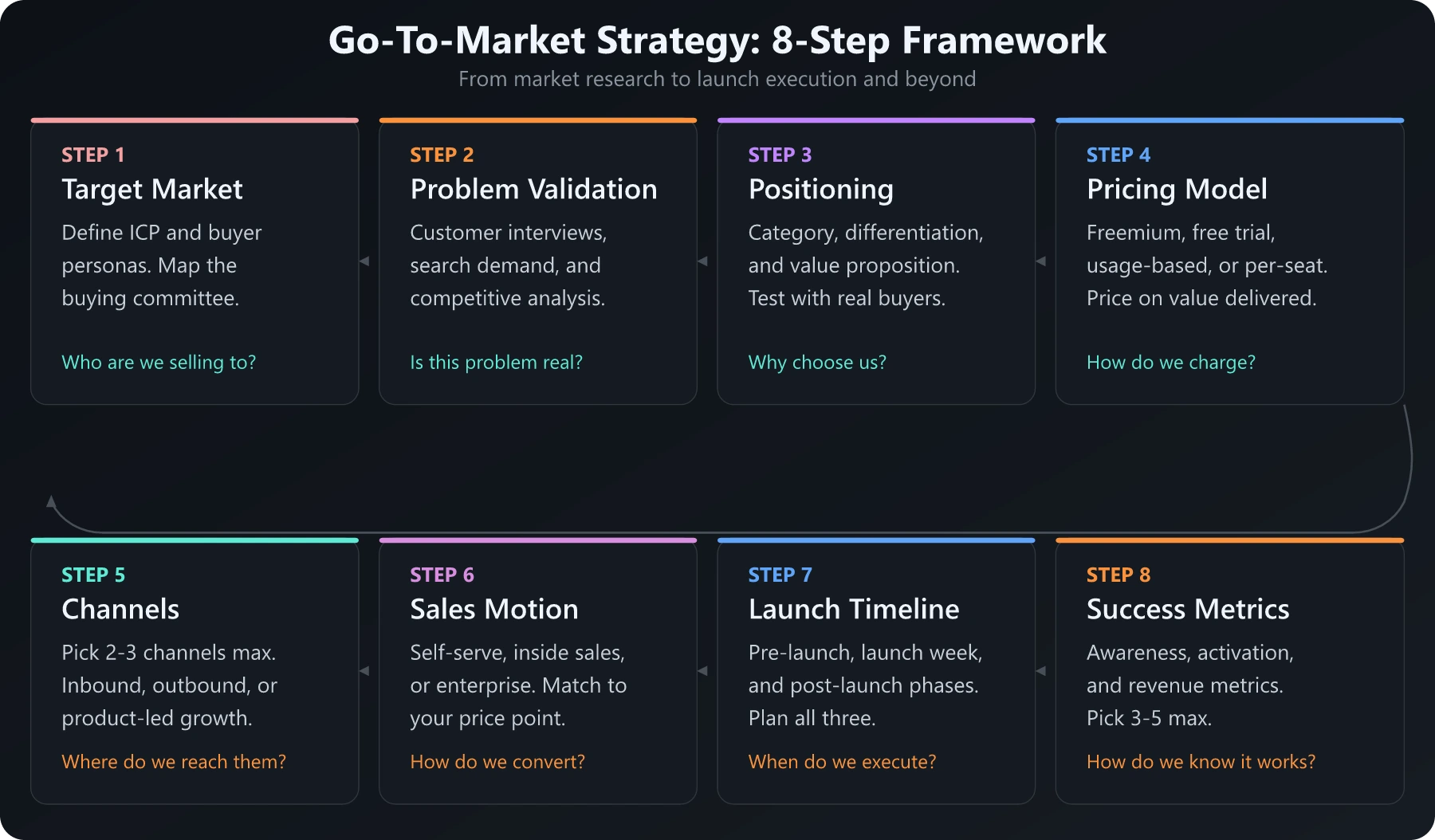
Step 1: Define Your Target Market
Start with who, not what. The most common GTM mistake is building a strategy around your product instead of around your customer.
Fill in:
- Ideal Customer Profile (ICP): Company size, industry, tech stack, budget range
- Buyer Personas: Job title, daily challenges, goals, objections
- Buying Committee: Who influences the decision? Who signs the check?
For a detailed framework on building both, see our guide on ICP vs buyer persona.
Example: “Mid-market B2B SaaS companies (100-1,000 employees) where the VP of Marketing is the champion but the CFO signs off on tools over $50K/year.”
Step 2: Validate the Problem
Don’t assume you know the problem. Validate it.
Methods:
- Customer discovery interviews (aim for 15-20)
- Competitive win/loss analysis
- Search demand data (use Ahrefs or Google Trends)
- Support ticket analysis from beta users
Key question: Would your target customer pay to solve this problem today? If they’re not already spending money or significant time on it, the problem might not be urgent enough.
Step 3: Craft Your Positioning
Your product positioning defines how your product fits in the market. A strong positioning statement for a GTM launch might look like:
“For mid-market marketing teams who waste 10+ hours a week on manual reporting, Acme Analytics is a marketing intelligence platform that surfaces actionable insights automatically. Unlike Tableau or manual spreadsheets, we connect to your entire stack in minutes with zero setup.”
Test it: Can your sales team say your positioning in a conversation without sounding scripted? Can a customer repeat it back? If not, simplify. See our positioning framework for the full template.
Step 4: Choose Your Pricing Model
Pricing is a GTM decision, not just a finance decision. Your pricing model shapes everything - from which customers you attract to how your sales team operates.
| Pricing Model | Best For | Risk |
|---|---|---|
| Freemium | High-volume, self-serve products | Conversion rate can be very low |
| Free trial | Products with fast time-to-value | Requires strong onboarding |
| Usage-based | API/infrastructure products | Revenue unpredictability |
| Per-seat | Team collaboration tools | Discourages adoption within orgs |
| Flat rate | Simple products with clear value | Leaves money on the table |
Key decision: Price based on value delivered, not cost to serve. If your product saves a customer $100K/year, charging $10K/year is fair - regardless of what it costs you to run.
Step 5: Select Your Channels
Where will you reach your target customers? Not every channel works for every product.
Inbound channels:
- SEO and content marketing (long-term, compounding)
- Social media (LinkedIn for B2B, Twitter/X for dev tools)
- Community and events
Outbound channels:
- Cold email and LinkedIn outreach
- Partnerships and co-marketing
- Paid advertising (Google Ads, LinkedIn Ads)
Product-led channels:
- Free tools and calculators
- Open-source or freemium tier
- Referral programs
- Marketplace listings
Pick 2-3 channels max for launch. Spreading across 10 channels means doing none of them well. Double down on what works after you have data.
Step 6: Build Your Sales Motion
Your sales motion depends on your price point and complexity:
| Deal Size | Sales Motion | Key Metric |
|---|---|---|
| < $5K ACV | Self-serve / product-led | Activation rate |
| $5K-$50K ACV | Inside sales + demos | Demo-to-close rate |
| $50K+ ACV | Enterprise sales + POCs | Pipeline velocity |
61% of B2B buyers now prefer a rep-free buying experience (Gartner). Even in enterprise sales, buyers complete most of their research before talking to your team. Your GTM needs to account for this - provide decision-enablement content, not just sales decks.
Step 7: Set Your Launch Timeline
A launch isn’t one day. It’s three phases:
Pre-launch (4-8 weeks before):
- Build a waitlist or beta program
- Create launch content (blog posts, case studies, videos)
- Brief your sales team and partners
- Seed product with early adopters for testimonials
Launch week:
- Product Hunt, social announcements, press outreach
- Email to waitlist and existing customers
- Sales team activates warm pipeline
- Monitor everything - bugs, feedback, conversion
Post-launch (4-12 weeks after):
- Analyze what worked and what didn’t
- Double down on winning channels
- Collect and publish customer stories
- Iterate on positioning based on market feedback
Step 8: Define Success Metrics
Pick 3-5 metrics that tell you if your GTM is working. Too many metrics means you’re not focused.
Awareness metrics:
- Website traffic from target audience
- Share of voice vs. competitors
Activation metrics:
- Sign-ups or demo requests
- Free trial starts
- Activation rate (users who complete key action)
Revenue metrics:
- Pipeline generated
- Win rate
- Customer acquisition cost (CAC)
- Time to first revenue
Set specific targets. “Increase sign-ups” is not a goal. “500 sign-ups in the first 30 days with a 15% activation rate” is.
GTM Strategy Examples
Slack (Product-Led)
Slack’s GTM was entirely product-led. They didn’t hire a sales team until they had over a million daily users. Their strategy: make the free product so good that teams adopt it organically, then sell to the enterprise when IT needs to consolidate.
Key tactic: They targeted teams, not companies. One team would adopt Slack, love it, and spread it internally. By the time the CIO got involved, much of the company was already using it. For more examples like this, see our product-led growth examples.
HubSpot (Content-Led)
HubSpot coined the term “inbound marketing” and built their entire GTM around it. Free tools (Website Grader, CRM), massive content library, certifications - all designed to attract, educate, and convert marketers.
Key tactic: They created the category, then positioned themselves as the obvious choice within it.
Figma (Community-Led)
Figma’s GTM targeted individual designers, not companies. Free for individuals, collaborative by default. They built a community of passionate users who pulled Figma into their organizations.
Key tactic: Browser-based = zero friction. No downloads, no IT approval needed. The product was the GTM strategy.
Common GTM Mistakes
1. Launching without clear positioning. If you can’t explain who it’s for and why it’s different in two sentences, you’re not ready to launch.
2. Targeting too broad an audience. “All businesses” is not a target market. Start narrow, dominate a niche, then expand.
3. Skipping the sales enablement step. Your sales team needs more than a product demo. They need competitive battlecards, objection handling guides, and customer stories.
4. Measuring vanity metrics. Press mentions and social impressions feel good but don’t pay the bills. Focus on pipeline and revenue.
5. Treating launch as a one-time event. The real work starts after launch. Most successful products iterate on their GTM for months after the initial release.
How AI Changes GTM Strategy in 2026
AI is reshaping every phase of the go-to-market strategy:
- Audience research: AI tools can analyze thousands of customer profiles to identify your true ICP patterns
- Competitive intel: Monitor competitor positioning, pricing changes, and feature launches automatically
- Content creation: Generate launch content 10x faster (but still needs human editing and strategy)
- Sales enablement: AI-generated battlecards, personalized outreach, and call coaching
- Analytics: Predict which channels and messages will drive the highest conversion
The companies winning at GTM in 2026 aren’t the ones with the biggest budgets. They’re the ones using AI to move faster and learn quicker - while keeping the strategic thinking human.
Your Next Steps
- Download or copy this template and fill in each section for your next launch
- Start with positioning - it drives every other decision (read the guide)
- Pick your top 2-3 channels and build a 90-day plan around them
- Set measurable goals for each phase (pre-launch, launch, post-launch)
- Review and iterate monthly - no GTM strategy survives first contact with the market unchanged
A great go-to-market strategy doesn’t guarantee success. But launching without one almost guarantees failure.
Related reading:
- Product Positioning - How to define where your product stands in the market
- What Is Product Marketing? - The role that owns GTM strategy
- AI SEO Strategy - Using AI for the SEO component of your GTM
- SaaS Growth Strategy - Scaling playbooks for after your GTM gains traction
- Go-to-Market Strategy for Startups - A startup-specific version of this framework