Marketing Strategy for New Product: The Complete Launch Playbook (2026)
A step-by-step marketing strategy for launching a new product. Covers market research, positioning, channel selection, launch tactics, and post-launch optimization with real data.
Only 40% of developed products ever reach the market. Of those, just 60% generate any revenue (G2). The gap between building something and successfully launching it is where most products die.
The problem isn’t the product. It’s the marketing strategy - or the lack of one.
A marketing strategy for a new product isn’t the same as your ongoing marketing plan. It’s a focused, time-bound effort to take something from unknown to adopted. This guide breaks down exactly how to do it.
Why New Product Marketing Is Different
Marketing an established product and marketing a new product are fundamentally different challenges.
| Established Product | New Product | |
|---|---|---|
| Awareness | People know you exist | Nobody knows you exist |
| Trust | Reviews, case studies, word of mouth | Zero social proof |
| Channels | You know what works | Everything is a guess |
| Messaging | Refined through iteration | Untested assumptions |
| Budget | Justified by past ROI | Spent on faith |
New product marketing requires more research, faster iteration, and higher tolerance for uncertainty. The playbook below is designed for that reality.
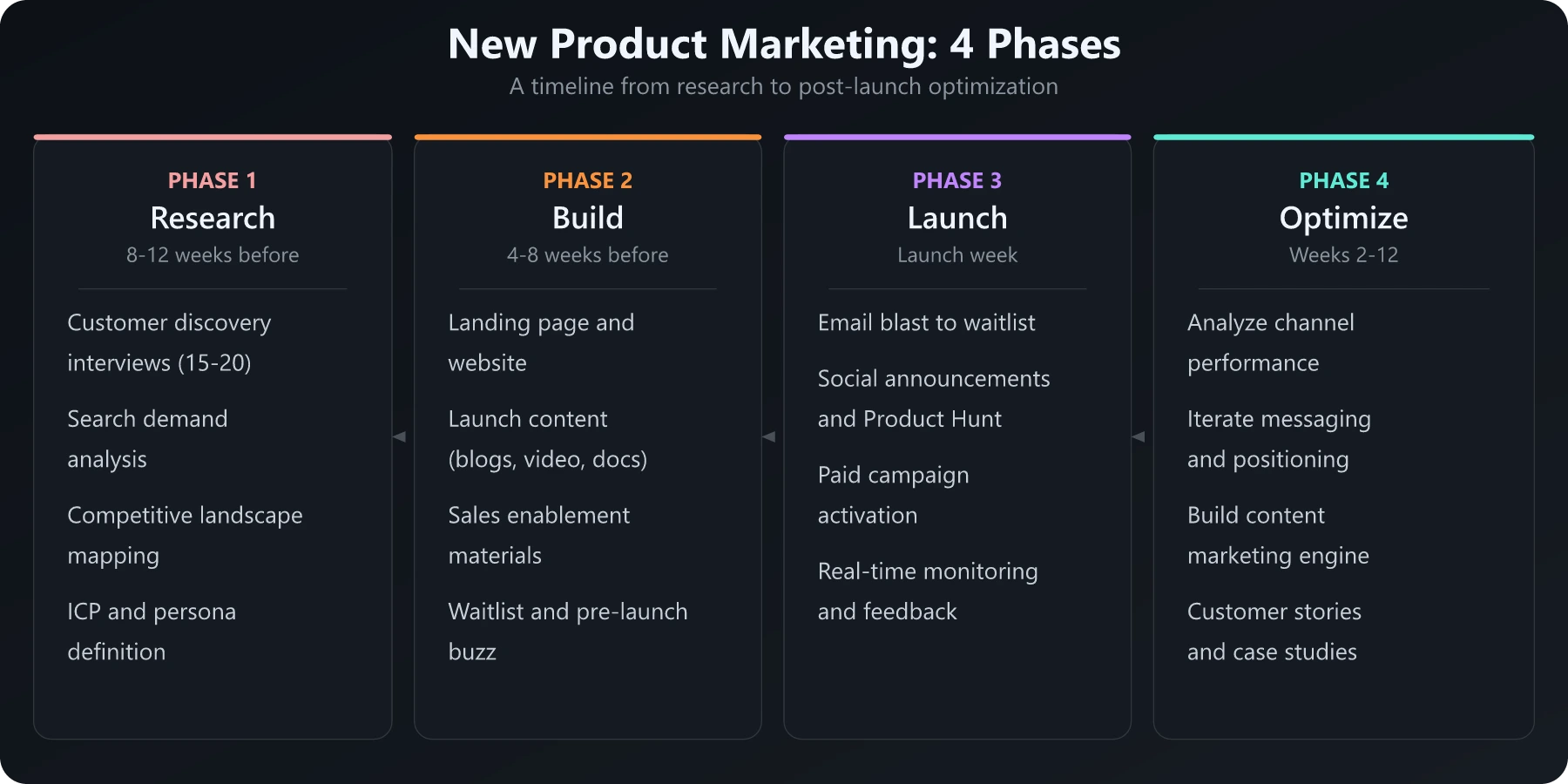
Phase 1: Pre-Launch Research (8-12 Weeks Before)
Market Validation
Before spending a dollar on marketing, confirm that the market actually wants what you’re building.
Customer Discovery Interviews:
- Talk to 15-20 potential customers
- Ask about their current workflow and pain points
- Never pitch your product during research interviews
- Focus on: What’s the most frustrating part of [process]? What have you tried? What would the ideal solution look like?
Search Demand Analysis:
- Use Ahrefs or Google Trends to measure search volume for your core problem
- If nobody is searching for the problem, that’s a red flag - people need to be aware of the problem before they’ll search for solutions
- Look for rising trends, not just current volume
Competitive Landscape:
- Map every alternative (including spreadsheets, agencies, and “doing nothing”) - our competitive analysis examples provide ready-to-use frameworks for this
- Identify gaps in their positioning and product
- Read their 1-2 star reviews - that’s where unmet needs live
Define Your Target Audience
“Everyone who needs X” is not a target audience. Get specific.
Ideal Customer Profile (ICP):
- Company size and industry
- Budget range and buying process
- Tech stack and existing tools
- Common triggers that create urgency
Buyer Persona:
- Job title and daily responsibilities
- Goals they’re measured on
- Frustrations with current solutions
- Where they consume information
Start narrow. It’s better to be the obvious choice for 1,000 companies than a maybe-option for 100,000. For a complete framework on building both your ICP and buyer personas, see our guide on ICP vs buyer persona.
Craft Your Product Positioning
Your product positioning defines how your product fits in the market. It should answer:
- Category: What type of product is this?
- Target: Who is this for?
- Problem: What pain does it solve?
- Differentiation: Why is your approach better?
- Proof: What evidence supports your claims?
Test your positioning with 5-10 people in your target audience. If they can’t immediately understand what you do and why it matters, iterate. Need a framework? Use the positioning statement template to structure your message.
Phase 2: Build Your Marketing Foundation (4-8 Weeks Before)
Create Your Core Content
Before launch day, you need these assets ready:
Website/Landing Page:
- Clear headline that states the benefit (not the feature)
- Social proof (even beta user quotes count)
- Demo or product tour
- Clear CTA (free trial, demo, waitlist)
Launch Content:
- 2-3 blog posts targeting your core keywords
- A product comparison page (you vs. alternatives)
- A customer story or case study (from beta if possible)
- A product demo video (under 3 minutes)
Sales Enablement (for B2B):
- One-pager with positioning and key benefits
- Competitive battlecard
- FAQ document for common objections
- Pricing page or proposal template
Choose Your Marketing Channels
You can’t be everywhere at launch. Pick 2-3 channels based on where your target audience already spends time.
| Channel | Best For | Time to Impact |
|---|---|---|
| SEO/Content | Long-term organic growth | 3-6 months |
| B2B products, thought leadership | 2-4 weeks | |
| Product Hunt | Dev tools, SaaS, consumer apps | Launch day spike |
| Email marketing | Existing audience, waitlist | Immediate |
| Paid search | High-intent, proven keywords | Days |
| Partnerships | Complementary products, co-marketing | 4-8 weeks |
| Communities | Niche products, technical audiences | 2-4 weeks |
The SEO play: Start creating content 3-6 months before launch. Target long-tail keywords around the problem you solve. By launch day, you’ll have organic traffic already flowing.
Build Pre-Launch Buzz
Waitlist strategy:
- Create a landing page with clear value proposition
- Offer early access or a launch discount for sign-ups
- Send 2-3 pre-launch emails with behind-the-scenes content
Social proof seeding:
- Get 5-10 beta users to share their experience publicly
- Collect testimonials and usage data
- Document and share your building journey (works especially well on Twitter/X and LinkedIn)
Phase 3: Launch Execution (Launch Week)
The Launch Day Checklist
- Product is stable and onboarding works
- Website is updated with final messaging
- Email blast to waitlist and existing contacts
- Social media announcements (personal + company accounts)
- Product Hunt launch (if relevant)
- Press outreach and blogger seeding
- Sales team briefed and ready
- Analytics and tracking in place
- Someone monitoring for bugs and customer feedback in real-time
First Week Priorities
Days 1-3: Amplify
- Respond to every comment, review, and social mention
- Share early user feedback publicly
- Run your highest-impact paid campaigns
- Push for coverage and backlinks
Days 4-7: Learn
- Analyze which channels drove the most sign-ups
- Read every piece of customer feedback
- Identify drop-off points in the funnel
- Note which messages resonated and which fell flat
Phase 4: Post-Launch Optimization (Weeks 2-12)
This is where most product launches fail. The initial buzz fades, the team moves on to the next thing, and the product stalls.
Analyze and Iterate
What to measure weekly:
- Sign-ups and activation rate
- Channel performance (which source drives the most activated users, not just sign-ups)
- Conversion rate at each funnel stage
- Customer feedback themes
What to adjust:
- Messaging that isn’t converting
- Channels that aren’t delivering ROI
- Pricing or packaging friction
- Onboarding steps where users drop off
Content Marketing Engine
After launch, shift from announcement content to education content:
- How-to guides targeting your product’s use cases
- Comparison posts (your product vs. alternatives)
- Customer stories with specific results
- SEO content targeting related keywords
This is where long-term organic growth lives. The top-ranking pages for “marketing strategy for new product” capture dozens of long-tail variations. Build a content cluster around your launch to capture that search demand.
Feedback Loop
Most companies need to make significant adjustments after launch - this is normal. The best product marketers build a feedback loop that continuously improves positioning, messaging, and marketing based on real market data.
Weekly:
- Review customer support tickets for messaging gaps
- Check competitor moves and market changes
Monthly:
- Update your positioning if needed
- Publish a new customer story
- Review and optimize your top-performing content
Quarterly:
- Full go-to-market strategy review
- Competitive landscape analysis
- Channel mix optimization
New Product Marketing Mistakes to Avoid
1. Building in silence. Companies that build in public - sharing progress, getting feedback, building a waitlist - launch stronger than those who disappear for 6 months and drop a product nobody asked for.
2. Leading with features. Customers don’t care about your tech stack. They care about outcomes. “Next-gen machine learning pipeline” means nothing. “Cut your reporting time from 3 hours to 10 minutes” means everything.
3. Skipping competitive research. If you don’t know how your competitors position themselves, you can’t differentiate. Read their websites, try their products, talk to their customers.
4. Launching without a follow-up plan. Launch day is 10% of the work. The other 90% is the 12 weeks after, when you need to sustain momentum, iterate on messaging, and build the content engine.
5. Ignoring early customer feedback. Your first 50 customers will tell you more about your positioning than any amount of market research. Listen to them, even when it’s uncomfortable.
AI-Powered New Product Marketing in 2026
AI tools are changing how product launches work:
- Market research: Analyze competitor reviews, social mentions, and search trends at scale
- Content creation: Draft launch content, ad copy, and email sequences faster
- Personalization: Customize messaging for different segments automatically
- Analytics: Predict which channels and messages will convert best
- Competitive monitoring: Track competitor launches and positioning changes in real-time
The best approach: use AI for speed and scale, but keep the strategic decisions - positioning, channel selection, pricing - human. AI can write your launch emails, but it can’t tell you who to send them to.
Summary
A marketing strategy for a new product follows four phases:
- Research - Validate the market, define your audience, craft positioning
- Build - Create content, choose channels, generate pre-launch buzz
- Launch - Execute a focused launch plan, then learn fast
- Optimize - Iterate on everything based on real data
The companies that launch successfully in 2026 aren’t the ones with the biggest budgets. They’re the ones with the clearest positioning, the fastest feedback loops, and the discipline to keep marketing long after launch day.
Related reading:
- Product Positioning - How to define where your product stands in the market
- Go-To-Market Strategy Template - The complete GTM framework
- What Is Product Marketing? - The role that drives new product launches
- Free AI Tools for Marketing - Tools to accelerate your launch
- SaaS Product Marketing Strategy - PMM playbook for SaaS launches specifically