Product-Led Growth Examples: 10 Companies That Nailed PLG in 2026
Explore real product-led growth examples from Slack, Notion, Figma, and more. Learn PLG strategies, metrics, and frameworks you can apply to your SaaS.
Figma IPO’d in mid-2025 and posted $1.056 billion in full-year revenue - up 41% year-over-year (Figma IR). Canva hit $4 billion in ARR with 265 million monthly active users (TechCrunch). HubSpot crossed $3.13 billion in annual revenue (HubSpot IR).
What do these companies share? They all used product-led growth to build massive user bases before layering on sales teams. Here are 10 product-led growth examples that show exactly how they did it.
What is Product-Led Growth?
Product-led growth (PLG) is a go-to-market strategy where the product itself drives user acquisition, activation, and expansion. Instead of requiring a demo call or sales conversation, users sign up, experience value, and convert on their own timeline.
The PLG model flips the traditional sales funnel. Users become advocates before they become customers. The product is the marketing, the sales pitch, and the onboarding experience all at once.
10 Product-Led Growth Examples
1. Slack - Viral Loops Through Team Invites
PLG mechanic: Every user who joins Slack invites their teammates. The product literally does not work alone.
Slack grew to an estimated 47 million daily active users by 2025 (DemandSage). The growth engine is simple - one person sets up a workspace, invites their team, and that team invites cross-functional collaborators. Each workspace becomes a distribution channel.
Key PLG lesson: Build a product where usage requires inviting others. The growth loop is baked into the core experience, not bolted on as a referral program.
2. Notion - Freemium Plus Template Marketplace
PLG mechanic: A generous free tier combined with a community-driven template ecosystem that turns users into distribution channels.
Notion crossed 100 million users and $500 million in ARR by September 2025 (CNBC). The template marketplace is brilliant - creators build and share Notion templates, driving new signups from people who discover them through search and social.
Key PLG lesson: Enable your power users to create shareable assets that bring new users to the product. User-generated content becomes your SEO strategy.
3. Figma - Collaboration as the Growth Engine
PLG mechanic: Real-time multiplayer design that makes Figma the default tool once one designer on a team adopts it.
Figma’s 2025 revenue hit $1.056 billion with 13 million monthly active users and a 136% net dollar retention rate (Figma IR). Nearly 95% of Fortune 500 companies use Figma (Figma S-1 Filing).
Key PLG lesson: Multi-player functionality creates natural network effects. When collaboration is the core feature, every new user pulls in stakeholders from design, product, and engineering.
4. Calendly - Product as Its Own Distribution
PLG mechanic: Every meeting link shared is an advertisement for the product.
Calendly reached over 20 million users and a $3 billion valuation (Contrary Research). The viral loop is elegant - you send someone a Calendly link, they book a time, they see how easy it is, they sign up for their own account.
Key PLG lesson: Make the product visible during every interaction. The scheduling link serves as both the core product experience and the acquisition channel simultaneously.
5. Zoom - Freemium with Natural Upgrade Triggers
PLG mechanic: A free tier with a 40-minute limit that creates predictable conversion moments.
Zoom generated $4.67 billion in revenue in fiscal year 2025 with over 300 million daily active users (DemandSage). The 40-minute cap on free group meetings is one of the most effective PLG friction points ever designed - it is annoying enough to drive upgrades but not so restrictive that people leave.
Key PLG lesson: Design your free tier limits around natural pain points that grow with usage. Time-based limits work because they hit at the exact moment users are getting value.
6. Canva - Freemium Design for Everyone
PLG mechanic: A free product so capable that millions use it daily, creating a massive top-of-funnel that converts through premium features and team plans.
Canva’s 265 million monthly active users generate $4 billion in ARR with 31 million paid users (TechCrunch). The free tier includes thousands of templates and design tools. Premium features like brand kit, background remover, and team collaboration drive upgrades.
Key PLG lesson: Give away a product good enough to build habitual usage. Once users rely on the tool daily, premium features sell themselves.
7. Dropbox - Referral-Driven PLG
PLG mechanic: Double-sided referral incentives that give both parties more storage.
Dropbox pioneered the modern referral program by offering 500MB of extra storage for every friend invited (and giving the friend 500MB too). This single mechanic grew Dropbox from 100,000 to 4 million users in 15 months. The company now generates approximately $2.5 billion in annual revenue (MacroTrends).
Key PLG lesson: Reward referrals with product value, not discounts. Storage space cost Dropbox almost nothing to give away but created enormous perceived value for users.
8. Loom - Async Video as Distribution
PLG mechanic: Every Loom video shared is a product demo viewed by the recipient.
Loom was acquired by Atlassian for $975 million in 2023 after reaching millions of users. The growth loop mirrors Calendly - when you send a Loom video, the viewer watches it on loom.com, sees the recording interface, and realizes they could use it too.
Key PLG lesson: Products that create shareable output turn every user into a distribution channel without any referral program.
9. Miro - Collaborative Whiteboarding
PLG mechanic: Shared boards that pull in cross-functional teams from product, design, and engineering.
Miro hit a $17.5 billion valuation in 2022 and grew to over 80 million users by 2024 before expanding into enterprise accounts. The free tier allows unlimited team members on up to 3 boards - enough to get hooked but not enough for a full team workflow.
Key PLG lesson: Limit by feature depth (number of boards) rather than by users. Let teams experience collaboration freely, then convert on capacity.
10. HubSpot - Free CRM as the PLG Wedge
PLG mechanic: A permanently free CRM that creates dependency, then upsells marketing, sales, and service hubs.
HubSpot crossed $3.13 billion in annual revenue in 2025 with 20% Q4 growth (HubSpot IR). The free CRM is the trojan horse - once your customer data lives in HubSpot, the switching cost to a competitor is enormous. Marketing Hub, Sales Hub, and Service Hub become natural extensions.
Key PLG lesson: Give away the sticky product (CRM) for free and monetize the workflows built around it. Data gravity is the ultimate moat.
PLG Frameworks and Metrics That Matter
Successful product-led growth companies track a specific set of metrics that differ from traditional sales-led models.
| Metric | What It Measures | Good Benchmark |
|---|---|---|
| Time to Value (TTV) | How fast users reach their “aha moment” | Under 5 minutes |
| Activation Rate | % of signups who complete key actions | 20-40% |
| Product-Qualified Leads (PQLs) | Users showing buying intent through usage | Varies by product |
| Free-to-Paid Conversion | % of free users who upgrade | 2-5% (freemium), 10-25% (free trial) |
| Net Dollar Retention (NDR) | Revenue expansion from existing customers | 110-140% |
| Viral Coefficient | New users generated per existing user | Above 1.0 = viral growth |
The most important metric varies by stage. Early-stage PLG companies should obsess over activation rate. Growth-stage companies should focus on PQLs and free-to-paid conversion. Scale-stage companies win on net dollar retention.
PLG vs Sales-Led Growth
| Factor | Product-Led Growth | Sales-Led Growth |
|---|---|---|
| Acquisition | Self-serve signup | Outbound + inbound demos |
| Qualification | Product usage signals (PQLs) | Sales conversations (SQLs) |
| Conversion | In-product upgrade prompts | Proposals and negotiations |
| Time to revenue | Days to weeks | Weeks to months |
| CAC | Low (product is the channel) | High (sales team overhead) |
| Best for | SMB + mid-market | Enterprise + complex deals |
| Scaling | Add features, not headcount | Add reps and managers |
Most successful SaaS companies in 2026 use a hybrid approach - PLG for initial adoption and self-serve revenue, with a sales-assisted motion for enterprise expansion. Figma’s 136% NDR comes from landing with individual designers (PLG) and expanding into organization-wide contracts (sales-assisted).
How to Apply Product-Led Growth to Your SaaS
Step 1: Find Your Natural Growth Loop
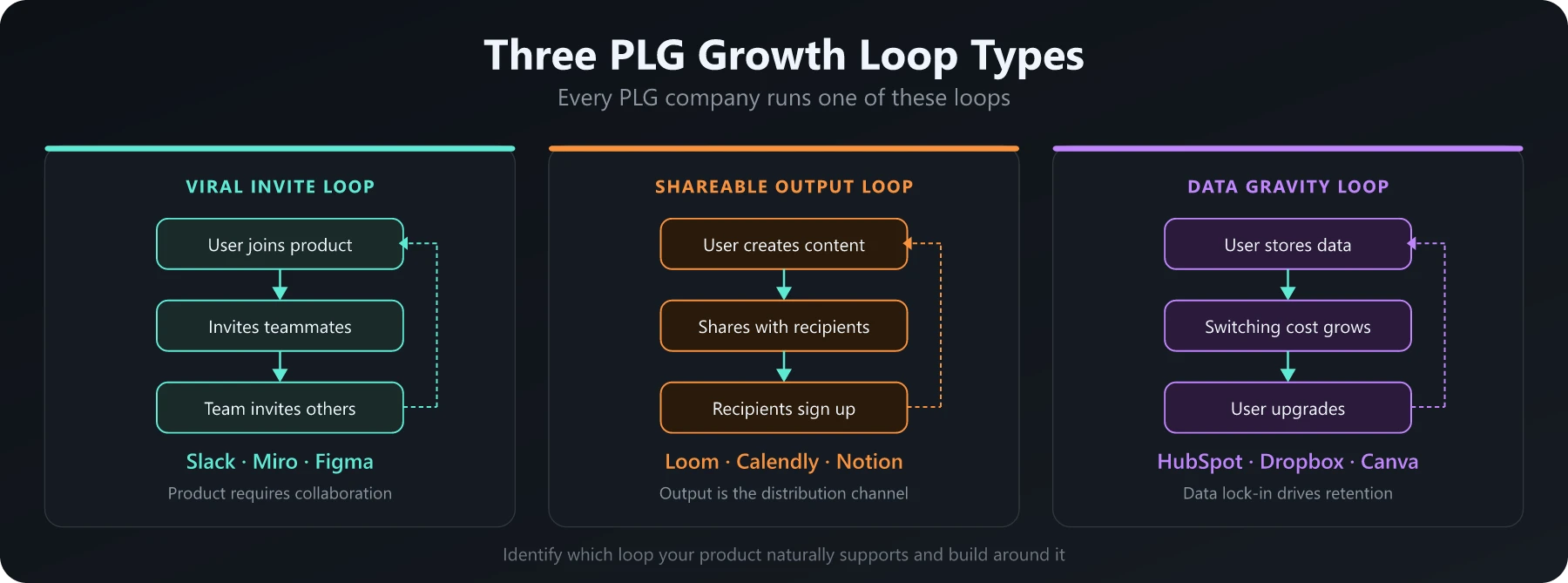
Look at how your product gets shared. Does usage require inviting others (Slack model)? Does the product create shareable output (Loom, Calendly model)? Does the free tier build data gravity (HubSpot model)?
Step 2: Design the Free Experience
Your free tier should be generous enough to create habitual usage but limited enough to drive upgrades at natural inflection points. Limit by capacity (Miro), by time (Zoom), or by features (Canva) - not by crippling the core experience.
Step 3: Instrument Your Activation Path
Identify the 3-5 actions that predict long-term retention and build your onboarding around driving users to complete them as fast as possible. Measure time to value in minutes, not days.
Step 4: Build PQL Scoring
Define product-qualified leads based on usage patterns that predict conversion - number of team members, feature adoption, frequency of use. Use these signals to trigger upgrade prompts and route high-intent users to sales. Understanding your ICP and buyer personas helps you identify which usage patterns actually predict conversion for your specific product.
Step 5: Layer Sales on Top
Once PLG generates consistent self-serve revenue, add sales-assisted motions for enterprise accounts. Your product positioning and product marketing strategy should support both self-serve and sales-assisted paths.
The Bottom Line
Product-led growth is not a tactic - it is a company-wide operating model. The product-led growth examples above share a common pattern: they give users genuine value for free, build viral distribution into the core experience, and monetize expansion rather than initial access.
The companies winning with PLG in 2026 are not choosing between product-led and sales-led. They are building product-led foundations with sales-assisted expansion. For a broader look at scaling tactics beyond PLG, see our SaaS growth strategy playbooks and the go-to-market strategy template for structuring your launch. Start with the product, prove value at scale, and let revenue follow usage.
Frequently Asked Questions
What is product-led growth?
Product-led growth (PLG) is a go-to-market strategy where the product itself drives acquisition, activation, and retention. Users experience value through free trials or freemium plans before converting to paid.
What companies use product-led growth?
Notable PLG companies include Slack, Notion, Figma, Calendly, Zoom, Canva, Dropbox, Loom, and Miro. These companies let users experience the product before requiring a purchase.
How is PLG different from sales-led growth?
In PLG, the product drives adoption through self-serve signups and in-product conversion. Sales-led growth relies on outbound sales teams to demo, negotiate, and close deals before users access the product.