Product Positioning: How to Define Where Your Product Stands in the Market
Learn what product positioning is, why it matters, and how to create a positioning statement that differentiates your product. With frameworks, examples, and a step-by-step process.
91% of product marketers say positioning and messaging is their core responsibility (PMA State of Product Marketing 2025). Yet most companies get product positioning wrong - or skip it entirely.
The result? Products that sound like everything else, sales teams that can’t articulate the difference, and marketing campaigns that fall flat.
Product positioning is the foundation that everything else - messaging, pricing, go-to-market strategy, sales enablement - sits on. Get it right, and everything downstream gets easier.
What Is Product Positioning?
Product positioning is how you define your product’s place in the market relative to alternatives. It answers a deceptively simple question: why should your target customer choose you over everything else?
“Everything else” doesn’t just mean direct competitors. It means the status quo, manual workarounds, spreadsheets, hiring an agency, or doing nothing at all.
Strong positioning does three things:
- Defines your competitive frame of reference - What category do you belong to?
- Highlights meaningful differentiation - What can you do that alternatives can’t?
- Connects to what customers actually care about - Not features, but outcomes.
Product Positioning vs. Brand Positioning
These terms get used interchangeably, but they’re different:
| Product Positioning | Brand Positioning | |
|---|---|---|
| Focus | Specific product or feature | Entire company identity |
| Scope | Functional benefits + differentiation | Emotional connection + values |
| Changes | Per product, per market segment | Rarely - it’s your north star |
| Example | ”Slack replaces email for team communication" | "Slack makes work life simpler” |
You need both, but product positioning comes first. You can’t build a brand promise without knowing what your products actually deliver.
The Positioning Framework
Every strong positioning statement addresses six elements:
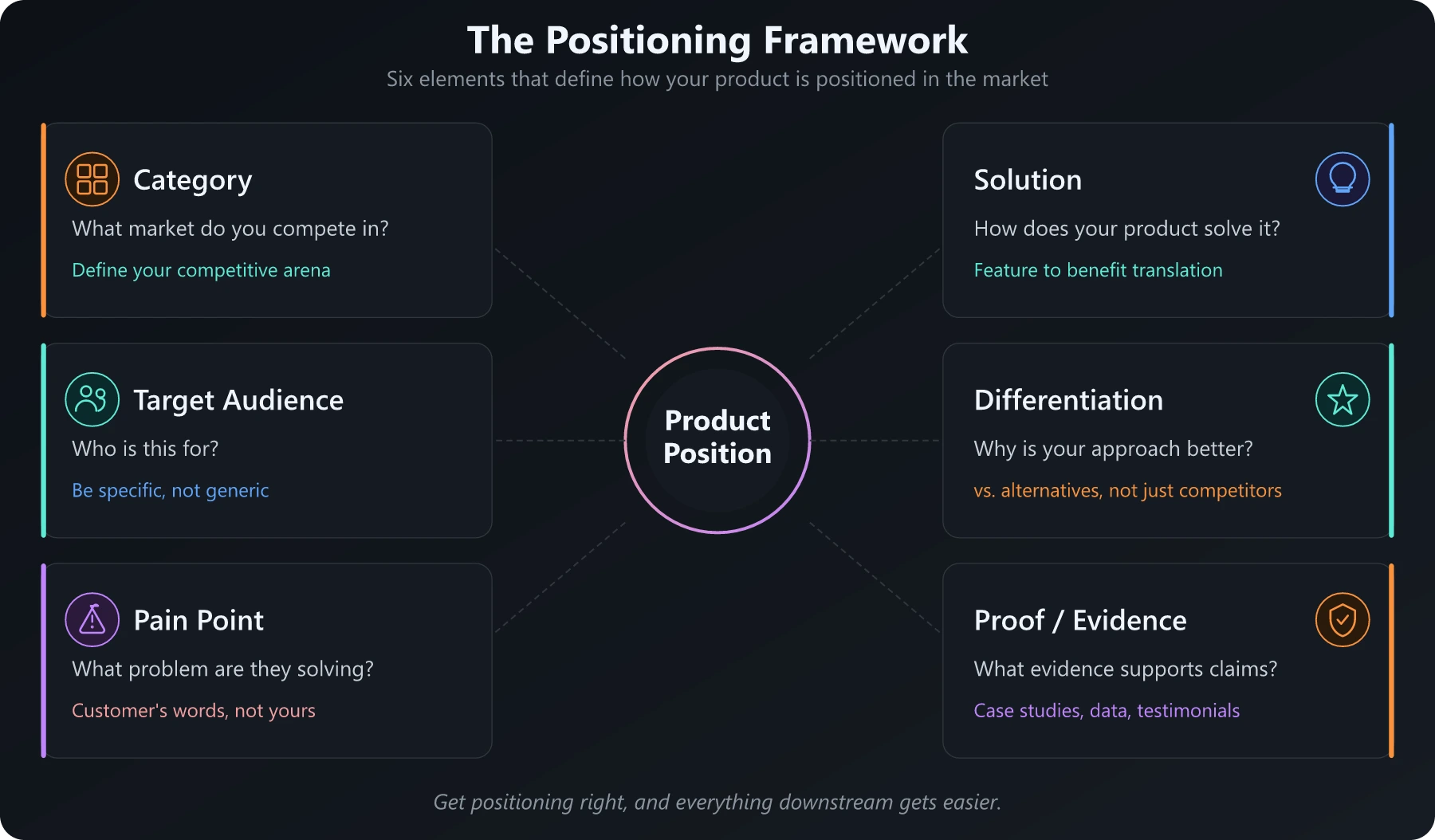
Let’s break each one down.
1. Category
What market do you compete in? This sets the buyer’s frame of reference.
Common mistake: Choosing a category that’s too broad (“We’re a SaaS platform”) or inventing a new one (“We’re an AI-powered revenue orchestration engine”).
Pick a category your buyers already understand. You can expand or redefine it later once you have traction.
2. Target Audience
Who is this for? Be specific - not “marketing teams” but “B2B marketing teams at companies with 50-500 employees who don’t have a dedicated ops person.”
The more specific your target, the stronger your positioning. You can’t position a product for everyone.
3. Pain Point
What problem are they solving? Use your customer’s words, not yours.
Talk to churned customers, read support tickets, listen to sales calls. The language your buyers use to describe their pain is the language your positioning should mirror.
4. Solution
How does your product solve it? This is where you translate features into benefits.
Nobody cares that you have “AI-powered analytics.” They care that they can “find revenue leaks in 5 minutes instead of 5 hours.”
5. Differentiation
Why is your approach better than alternatives? This is the hardest part.
True differentiation isn’t “better UI” or “more features.” It’s a structural advantage - something that’s hard to copy. Think: unique data, proprietary methodology, different business model, or a fundamentally different approach to the problem.
6. Proof
What evidence supports your claims? Without proof, positioning is just marketing spin.
Strong proof includes:
- Customer results - “Company X increased conversion by 34%”
- Third-party validation - Awards, analyst recognition, certifications
- Scale metrics - “Used by 10,000+ teams”
- Technical benchmarks - Speed tests, accuracy comparisons
How to Write a Product Positioning Statement
Here’s a simple template that works:
For [target audience] who [pain point/need], [product name] is a [category] that [key benefit/differentiation]. Unlike [primary alternative], we [unique proof point].
Example: Notion
For remote-first teams who struggle with scattered tools and documentation, Notion is a connected workspace that replaces wikis, docs, and project management tools in one place. Unlike Google Docs + Trello + Confluence, Notion keeps everything in one searchable, customizable system.
Example: Ahrefs
For SEO professionals and content marketers who need competitive intelligence and keyword data, Ahrefs is an SEO platform that provides the most accurate backlink and keyword data in the industry. Unlike SEMrush, Ahrefs crawls more pages per day than any other tool, giving you fresher and more complete data.
Product Positioning Examples
Apple (Premium Quality)
Apple positions every product around the intersection of technology and liberal arts. The iPhone isn’t positioned as “the most powerful phone” - it’s positioned as the phone that “just works.” Their positioning targets people who value simplicity, design, and ecosystem integration over specs.
Why it works: They chose a clear enemy (complexity) and a clear benefit (it just works).
HubSpot (All-in-One Platform)
HubSpot positioned against the fragmented marketing stack. Instead of competing feature-by-feature with Salesforce or Marketo, they positioned as the platform where marketing, sales, and service all work together natively.
Why it works: They repositioned the competition’s strength (depth) as a weakness (complexity and fragmentation).
Basecamp (Simplicity)
In a market full of complex project management tools with Gantt charts and resource allocation, Basecamp positioned as “the simple project management tool for people who have actual work to do.”
Why it works: They explicitly said “we’re not for everyone” - which made their target audience feel seen.
Five Types of Product Positioning Strategies
1. Quality-Based Positioning
Position on superior quality or craftsmanship. Works when your product genuinely delivers better results and you can prove it.
Example: Dyson positions its products as engineered to outperform conventional alternatives.
2. Price-Based Positioning
Position as the most affordable or best value option. Dangerous long-term but effective for market entry.
Example: Canva positioned as “design for everyone” at a fraction of the cost of Adobe Creative Suite.
3. Feature-Based Positioning
Position around a specific capability that competitors lack. Works well in technical markets.
Example: Figma positioned around real-time collaboration - something Sketch couldn’t match.
4. Use-Case Positioning
Position around a specific workflow or job-to-be-done. Narrows your market but deepens resonance.
Example: Calendly positioned around one use case - scheduling meetings - and owned it completely.
5. Category Creation
Define an entirely new category. Highest risk, highest reward.
Example: Drift created the “conversational marketing” category to differentiate from traditional form-based lead capture.
Common Product Positioning Mistakes
1. Positioning on features, not outcomes. “We have AI-powered analytics” means nothing. “Find your best customers 10x faster” means everything.
2. Trying to appeal to everyone. If your positioning doesn’t exclude anyone, it doesn’t attract anyone either. The best positioning is polarizing.
3. Ignoring the competitive context. Positioning doesn’t exist in a vacuum. If you don’t explicitly address what you’re better than, customers will fill in the blanks themselves - and they’ll usually get it wrong.
4. Writing positioning in a conference room. Positioning that comes from internal brainstorming sessions instead of customer conversations is almost always wrong. Start with customer research, not a whiteboard.
5. Setting it and forgetting it. Markets change. Competitors launch new features. Customer needs evolve. Review your positioning quarterly.
How AI Is Changing Product Positioning in 2026
AI is making positioning both easier and harder.
Easier because:
- Tools like ChatGPT and Claude can analyze thousands of customer reviews to extract positioning themes in minutes
- Competitive intelligence tools surface positioning gaps automatically
- A/B testing messaging at scale is now trivial
Harder because:
- Every competitor is using the same AI tools, making differentiation harder
- “AI-powered” has become meaningless as a differentiator - everyone claims it
- Customers are more sophisticated and can see through generic positioning faster
The winning strategy in 2026: Use AI for research and iteration, but ground your positioning in genuine customer insights and real product advantages. AI can help you say it better, but it can’t create differentiation that doesn’t exist.
Getting Started
Here’s a practical process to nail your positioning:
- Interview 10-15 customers - Ask why they chose you, what alternatives they considered, and how they’d describe your product to a colleague
- Map the competitive landscape - List every alternative (including “do nothing”) and identify their positioning
- Identify your unique strengths - What do customers consistently praise that competitors can’t match?
- Draft your positioning statement - Use the template above
- Test with your sales team - If they can’t use it in a conversation, it’s too abstract
- Validate with prospects - Does it resonate with people who haven’t bought yet?
Use your ICP and buyer persona definitions to select the right customers for step 1, and our competitive analysis examples provide ready-to-use frameworks for step 2.
Product positioning isn’t a one-time exercise. It’s an ongoing process of understanding your market, your customers, and your competitive advantage - then articulating it so clearly that your buyers can repeat it back to you.
Related reading:
- What Is Product Marketing? - The complete guide to the role that owns positioning
- AI SEO Strategy - How to position your content for search and AI overviews
- Go-To-Market Strategy Template - Where positioning fits in your GTM plan
- Marketing Strategy for New Product - Applying positioning to a product launch