SaaS Growth Strategy: 7 Proven Playbooks for Scaling in 2026
Build a SaaS growth strategy that works. Learn 7 data-backed playbooks for acquisition, retention, and expansion that high-growth SaaS companies use in 2026.

The global SaaS market hit $315.68 billion in 2025 and is projected to reach $1.48 trillion by 2034, growing at a CAGR of 18.7% (Fortune Business Insights). Yet median SaaS company growth rates have compressed - bootstrapped companies grow at 23% annually and VC-backed at 25% (SaaS Capital). The companies that break away from the median share one thing: a clear SaaS growth strategy tied to their stage and market.
A SaaS growth strategy is not a single tactic. It is a system of playbooks that work together across acquisition, activation, retention, and expansion. Here are seven that the fastest-growing companies run in 2026.
What Makes a SaaS Growth Strategy Different
SaaS growth compounds in ways physical products cannot. A customer retained is not just recurring revenue - it is expansion revenue, referral potential, and reduced acquisition cost amortized over a longer lifetime.
The math is simple: if your net revenue retention (NRR) exceeds 100%, your existing customer base grows even without acquiring a single new account. Top-performing SaaS companies achieve NRR above 120% while the median sits at 106% (Wudpecker).
This means your SaaS growth strategy must balance two engines simultaneously: new customer acquisition and existing customer expansion.
The 7 SaaS Growth Strategy Playbooks
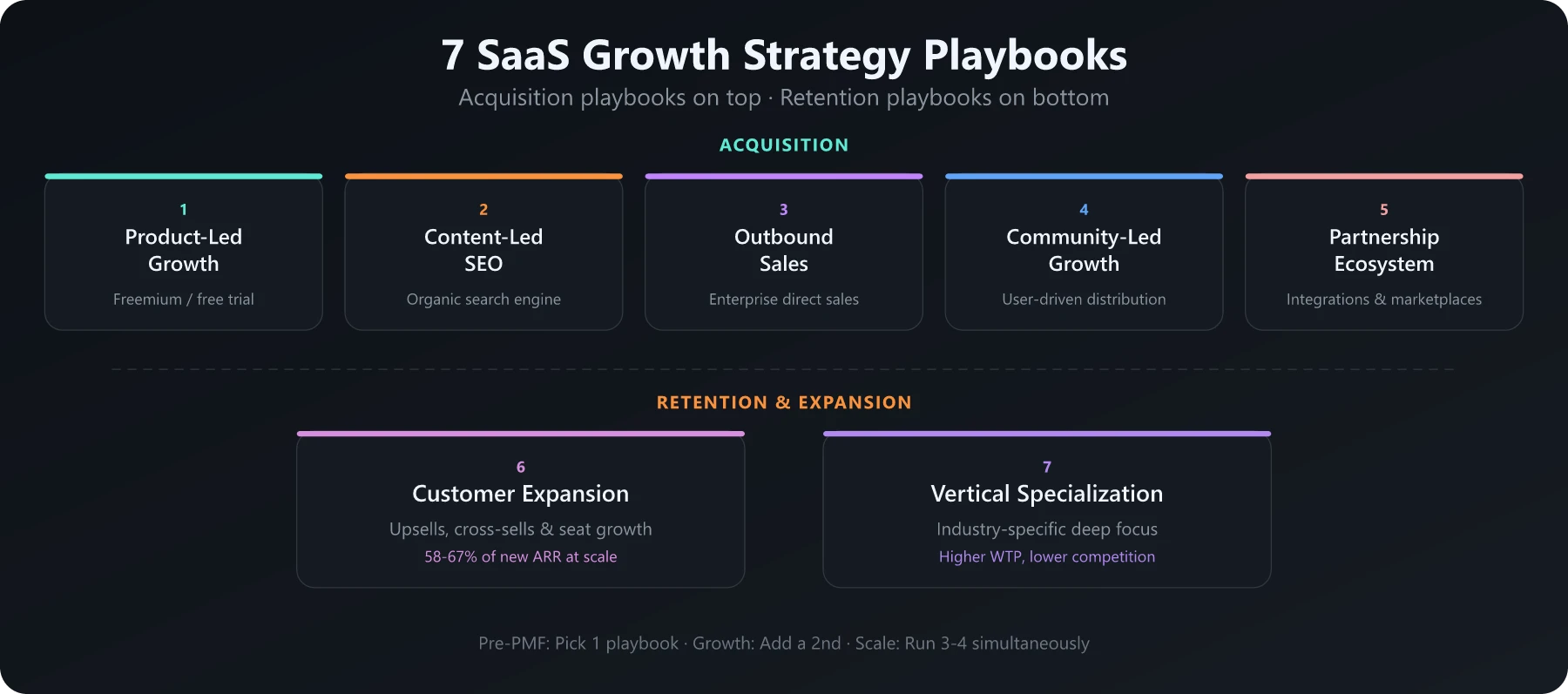
Playbook 1: Product-Led Growth
Let users experience your product before paying. Offer a freemium tier or free trial that delivers real value and builds habitual usage.
Companies like Figma ($1.056B revenue, 136% NRR) and Canva ($4B ARR, 265M users) prove that giving away a genuinely useful product creates massive top-of-funnel that converts through natural upgrade triggers. See our full breakdown of product-led growth examples for detailed case studies.
When to use: SMB and mid-market products where the product can demonstrate value without a sales conversation. Works best when usage naturally expands to teams.
Key metrics: Activation rate, free-to-paid conversion, time to value.
Playbook 2: Content-Led SEO
Build a content engine that captures search demand across your buyer’s journey. Target keywords at every stage - awareness (“what is X”), consideration (“X vs Y”), and decision (“best X for Y”).
Content-led growth compounds over time. A blog post written today generates traffic for years. Combined with lead magnets and email nurture through marketing automation workflows, content becomes a scalable acquisition channel with decreasing marginal cost.
When to use: Categories where buyers research extensively before purchasing. Particularly effective for B2B SaaS with long sales cycles.
Key metrics: Organic traffic growth, keyword rankings, content-attributed pipeline.
Playbook 3: Outbound Sales Motion
Build a sales team that targets high-value accounts through cold outreach, demos, and relationship selling. This is the traditional B2B playbook - it is expensive but works when deal sizes justify the cost.
When to use: Enterprise deals above $25,000 ACV where buyers expect a consultative sales process. Also effective when entering new markets or verticals.
Key metrics: Pipeline generated, win rate, average deal size, sales cycle length.
Playbook 4: Community-Led Growth
Build a community of users, practitioners, and advocates who drive product adoption, support each other, and create content.
Notion’s template marketplace, Figma’s community files, and HubSpot’s Academy all demonstrate how community creates distribution that the company does not have to pay for.
When to use: Products with power users who create shareable output or have strong professional identities around the tool category.
Key metrics: Community members, user-generated content volume, community-attributed signups.
Playbook 5: Partnership and Integration Ecosystem
Build integrations with tools your customers already use. Get listed in partner marketplaces. Create co-marketing programs with complementary products.
Being available in app marketplaces like Salesforce AppExchange, Shopify App Store, or HubSpot Marketplace puts your product in front of buyers who are already looking for solutions.
When to use: Products that work as part of a larger stack. Particularly effective when one integration can unlock an entire customer segment.
Key metrics: Integration-attributed signups, partner-sourced pipeline, marketplace impressions.
Playbook 6: Customer Expansion
Grow revenue within existing accounts through upsells, cross-sells, and seat expansion. Companies with $50M+ ARR now generate 58-67% of new ARR from expansion rather than new logos (Benchmarkit).
Build expansion into your product: usage-based pricing tiers, feature gates that unlock at higher plans, and team plans that grow with headcount. Pair this with a customer success team that proactively identifies expansion opportunities.
When to use: Always. Expansion is the most capital-efficient growth lever at every stage.
Key metrics: NRR, expansion MRR, upsell conversion rate.
Playbook 7: Vertical SaaS Specialization
Instead of building a horizontal product for everyone, specialize in a specific industry. Vertical SaaS companies win by deeply understanding one market’s workflows, regulations, and pain points.
Examples: Veeva (life sciences), Procore (construction), ServiceTitan (home services). Vertical focus reduces competition, increases willingness to pay, and creates switching costs through industry-specific features.
When to use: When you have deep domain expertise in a specific industry or when horizontal competitors are too entrenched to beat head-on.
Key metrics: Market penetration within vertical, competitive win rate, industry-specific NPS.
SaaS Growth Metrics That Matter
Track these metrics at every board meeting and strategy review. The benchmarks shift by company stage.
| Metric | What It Measures | Pre-PMF | Growth | Scale |
|---|---|---|---|---|
| ARR Growth Rate | Revenue momentum | 100%+ | 40-80% | 20-40% |
| Net Revenue Retention | Expansion vs churn | 90-100% | 105-115% | 115-130% |
| Gross Margin | Unit economics | 60-70% | 70-80% | 75-85% |
| CAC Payback | Acquisition efficiency | 18-24 months | 12-18 months | Under 12 months |
| LTV:CAC Ratio | Long-term unit economics | 2:1 | 3:1 | 4:1+ |
| Monthly Churn | Customer retention | Under 5% | Under 3% | Under 1.5% |
| Activation Rate | Onboarding effectiveness | 15-25% | 25-40% | 35-50% |
Benchmark sources: Benchmarkit, SaaS Capital, High Alpha
SaaS Growth Strategy by Stage
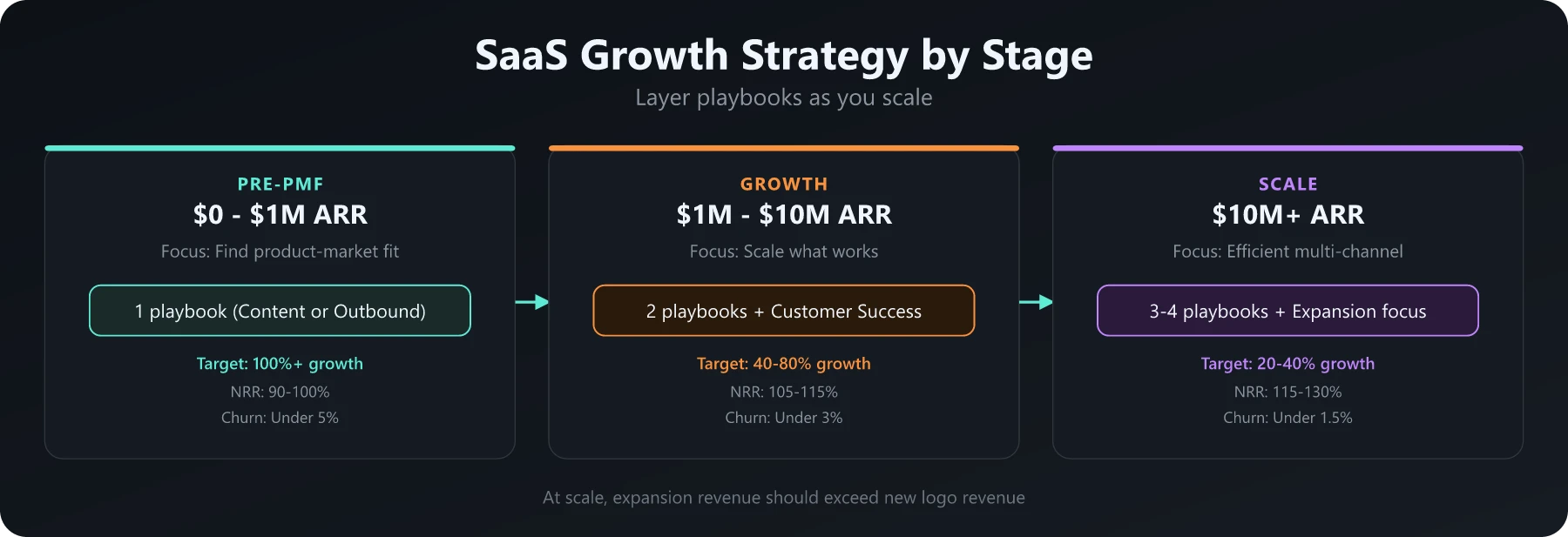
Pre-PMF ($0-1M ARR)
Primary focus: Find product-market fit and a repeatable acquisition channel.
At this stage, your SaaS growth strategy should be narrow. Pick one playbook and execute it deeply. Most pre-PMF companies benefit from either content-led SEO (low cost, compounds) or direct outbound to your ideal customer profile.
Do not invest in multiple playbooks simultaneously. You do not have the resources, and spreading thin delays learning what works.
Critical question: Do at least 10 customers use the product weekly without you asking them to?
Growth ($1-10M ARR)
Primary focus: Scale what works and add a second acquisition channel.
You have found PMF and have a working acquisition channel. Now layer on a second playbook. If content-led SEO got you to $1M, add a sales motion for larger deals. If outbound sales got you here, invest in PLG or content to reduce CAC.
Start building the customer success function to protect retention and identify expansion opportunities. Every point of NRR improvement compounds over time.
Critical question: Can you predictably generate pipeline and close deals month over month?
Scale ($10M+ ARR)
Primary focus: Efficient growth across multiple channels with strong retention economics.
At scale, the winning SaaS growth strategy combines 3-4 playbooks simultaneously. You need a go-to-market team running product-led, sales-led, and partner-led motions in parallel.
Expansion revenue should be your largest growth driver. The best companies at this stage generate more ARR from existing customers than from new logos.
Critical question: Is your NRR above 115% and are you growing efficiently (Rule of 40)?
Common SaaS Growth Strategy Mistakes
Scaling acquisition before fixing retention. If monthly churn exceeds 3%, every new customer you acquire is filling a leaky bucket. Fix retention first - it is the highest-leverage growth activity. Building a competitive intelligence analysis system also helps you understand why customers might be switching to alternatives.
Chasing too many channels too early. Pre-PMF and early growth companies should master 1-2 channels before adding more. Spreading thin means no channel gets enough investment to succeed.
Ignoring expansion revenue. Most SaaS companies over-invest in new logos and under-invest in growing existing accounts. Expansion is 3-5x more capital efficient than acquisition.
Pricing too low. SaaS companies consistently under-price, especially when selling to enterprise. If you have never lost a deal on price, you are almost certainly leaving money on the table.
No product marketing investment. Product marketing connects your product to your market through positioning, messaging, and competitive intelligence. Without it, sales teams struggle to articulate differentiation and marketing campaigns miss the mark.
Build Your SaaS Growth Strategy This Quarter
Start with an honest assessment of your stage and metrics. Use the go-to-market strategy template to structure your plan. Pick the playbooks that match your stage, set measurable targets for each, and review progress monthly.
The companies that scale fastest are not the ones running the most playbooks. They are the ones that execute 1-2 playbooks exceptionally well at each stage and know when to add the next one. Your SaaS growth strategy should be a living document that evolves as your metrics and market change.
Frequently Asked Questions
What is a SaaS growth strategy?
A SaaS growth strategy is a structured plan for scaling a software business across acquisition, activation, retention, and expansion. It combines product, marketing, and sales tactics aligned to specific growth metrics.
What are the most important SaaS growth metrics?
Key SaaS growth metrics include MRR/ARR growth rate, net revenue retention (NRR), customer acquisition cost (CAC), LTV:CAC ratio, churn rate, and activation rate.
How do SaaS companies grow fast?
Fast-growing SaaS companies typically combine product-led growth with efficient paid acquisition, strong retention through customer success, and expansion revenue from upsells and cross-sells.