AI and the Future of SEO: What Changes (and What Doesn't) in 2026
How AI is reshaping SEO in 2026. From AI Overviews to generative engine optimization, learn what's changing and how to adapt your SEO strategy.
Nearly 60% of all Google searches now end without a single click (Click Vision). AI Overviews peaked at nearly 25% of Google searches in mid-2025 - up from 13% just months earlier (Semrush). And AI-referred website sessions jumped 527% in early 2025 (Search Engine Land).
AI and the future of SEO are no longer a hypothetical conversation. The shift is happening now, and it is changing how people find, consume, and act on information online.
How AI is Changing SEO in 2026
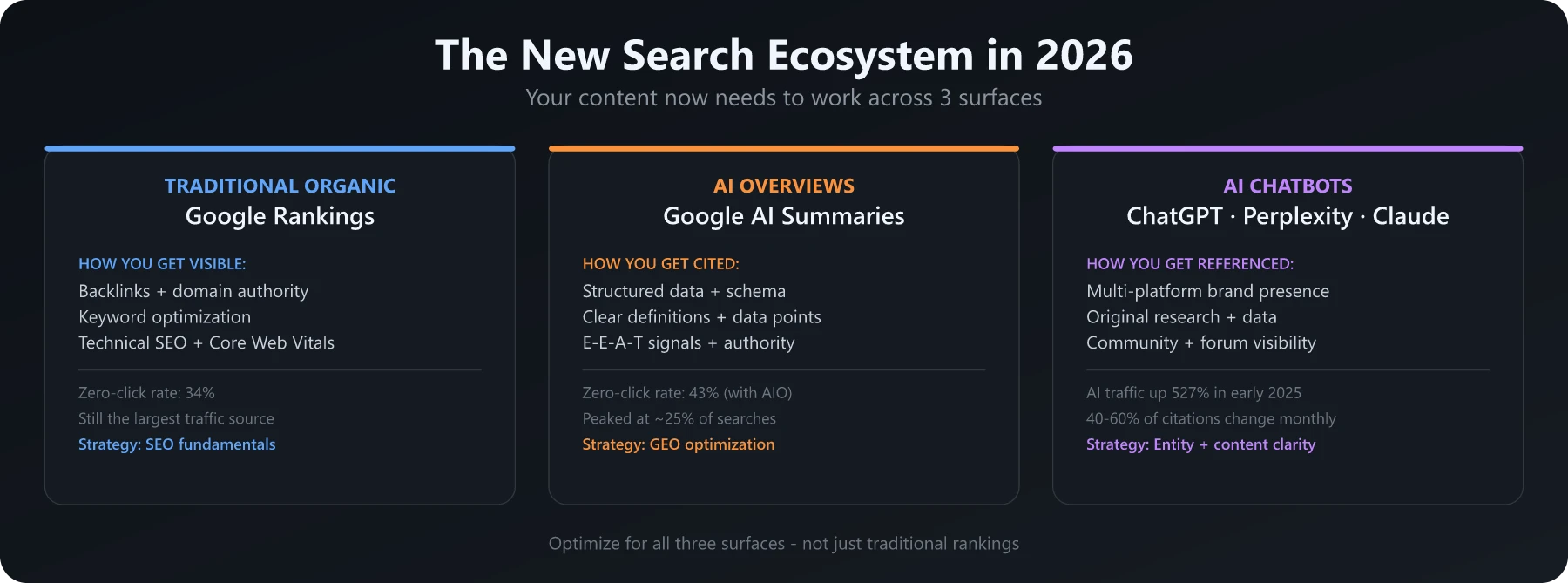
AI Overviews and Zero-Click Search
Google’s AI Overviews synthesize answers directly in search results, pulling information from multiple sources. The impact is measurable: searches with AI Overviews show a 47% lower click-through rate compared to searches without them (Digital Bloom).
The zero-click rate varies dramatically by context:
- 34% for standard Google searches without AI Overview
- 43% for Google searches with an AI Overview
- 93% for Google’s AI Mode
This does not mean SEO is dead. It means the value of a click just went up. Users who do click through AI Overviews tend to have higher intent and engage more deeply with content.
ChatGPT and Perplexity as Search Alternatives
AI chatbots are becoming a parallel search channel. Users ask ChatGPT, Perplexity, and Claude questions they previously typed into Google. These AI engines pull information from web content and cite their sources - creating a new category of organic visibility.
Between 40-60% of cited sources in AI search change month to month (Profound), making AI visibility volatile but winnable. Platforms like Perplexity lean heavily on Reddit and community sources, while Google AI Overviews favor authoritative publications. This means multi-platform presence - not just your website - affects AI visibility.
AI Content Detection and E-E-A-T
Google’s emphasis on Experience, Expertise, Authoritativeness, and Trustworthiness (E-E-A-T) has strengthened specifically because AI can generate generic content at scale. The signal that differentiates human-valuable content is now the “Experience” dimension - first-hand knowledge that AI cannot fabricate.
Content that demonstrates real experience - original data, personal case studies, expert interviews, proprietary research - outperforms AI-generated commodity content in both traditional and AI-powered search.
What is Generative Engine Optimization (GEO)?
Generative engine optimization is the practice of optimizing your content to be cited, referenced, and recommended by AI-powered search engines. It extends traditional SEO to cover how AI models discover, evaluate, and present information.
Research from Princeton shows that the most effective GEO tactics improve AI visibility by 30-40%. The top-performing methods: citing sources, adding quotations, and including statistics (arXiv).
How AI models select sources to cite:
- Entity clarity - Is your brand or author clearly identified with structured data and consistent mentions across the web?
- Content extractability - Can the AI easily identify and extract key claims, definitions, and data points from your content?
- Multi-platform presence - Does your brand appear consistently across forums, publications, social platforms, and your own site?
- Source authority - Do other authoritative sources link to and reference your content?
AI citations are volatile, but brands that show up consistently share structural characteristics - entity clarity, content extractability, and multi-platform presence - that make them easier for AI to trust and reference.
The Future of SEO: What is Changing
Content Strategy Shifts
From keyword targeting to answer engineering. AI engines want clear, structured answers they can extract and cite. Format content with explicit definitions, numbered steps, and data-backed claims.
From volume to depth. Publishing 20 thin articles per month loses to 4 comprehensive pieces backed by original research. The AI SEO strategy that works in 2026 prioritizes depth, originality, and structured data over output volume.
From single-page to topical authority. AI models evaluate your expertise across your entire site, not page by page. Building interconnected content clusters around core topics signals authority more effectively than isolated posts.
Technical SEO Becomes More Important
Structured data helps AI engines understand your content’s meaning and context. Key technical priorities:
- Schema markup - FAQ, HowTo, Article, and Organization schema help AI extract structured information
- Clear headings and structure - AI models parse H2/H3 hierarchies to understand content relationships
- Entity markup - Help search engines connect your content to known entities (people, companies, concepts)
- Site performance - Fast, accessible sites still rank better in traditional search and are crawled more efficiently
For a deep technical foundation, see our technical SEO audit guide.
Link Building Evolves
Links still matter for traditional rankings, but AI search adds a new dimension. Being cited on platforms where AI models pull citations - Reddit, Quora, industry forums, and authoritative publications - creates AI visibility that traditional backlinks alone do not provide.
Intent Becomes Everything
AI handles simple informational queries directly. The searches that still drive clicks are:
- Commercial investigation - “Best X for Y” comparisons
- Transactional - Searches with buying intent
- Complex informational - Topics requiring nuance, multiple perspectives, or current data
- Navigational - Users looking for a specific brand or product
Optimize for queries where the answer cannot fit in a two-sentence AI summary.
The Future of SEO: What is NOT Changing
Quality Content Still Wins
AI has not changed the fundamental truth: content that genuinely helps users outperforms content that games algorithms. The format of discovery has shifted, but the requirement for useful, accurate, and well-structured information has not.
User Experience Still Matters
Core Web Vitals, mobile responsiveness, page speed, and intuitive navigation remain ranking factors. AI search does not change the fact that users who land on your site need a good experience to convert.
E-E-A-T Principles Strengthen
If anything, AI amplifies the importance of E-E-A-T. When AI can generate surface-level content on any topic, the differentiator becomes demonstrable expertise and real-world experience. Author bios, credentials, original research, and expert sources matter more than ever.
Long-Term Thinking Pays Off
SEO has always been a long game. AI and the future of SEO do not change this. Building topical authority, earning quality backlinks, and creating genuinely useful content compounds over time - regardless of how search results are displayed.
AI SEO Strategy: How to Adapt
1. Optimize for AI Citations
Structure your content so AI can easily extract and cite it:
- Lead sections with clear definitions and key claims
- Include specific data points with source citations
- Use tables and lists for comparative information
- Add FAQ sections that directly answer common questions - ChatGPT prompts for marketing can help you generate and refine these at scale
- Maintain consistent entity information across your site
2. Create Content AI Cannot Replicate
Focus on content types that require human experience:
| Content Type | Why AI Cannot Replicate | SEO Impact |
|---|---|---|
| Original research/data | Requires data collection and analysis | High citation potential |
| Expert interviews | Requires relationships and access | E-E-A-T signal |
| Case studies | Requires real customer outcomes | Commercial intent traffic |
| Personal experience | Requires lived experience | ”Experience” in E-E-A-T |
| Industry predictions | Requires expertise and reputation | Thought leadership links |
3. Build Topical Authority
AI models evaluate expertise at the site level. A single great article on a topic you never cover again is less valuable than a cluster of interconnected content that demonstrates deep expertise.
Build content clusters: pillar pages supported by detailed subtopic articles, all internally linked. This is the same strategy that works for traditional SEO but is even more important for AI visibility.
4. Use AI Tools to Scale (Not Replace) Content
AI tools for marketing can help with research, outlines, drafting, and optimization. But the final content needs human expertise, original insights, and fact-checking to stand out. The question will marketing be replaced by AI misses the point - AI augments the process while humans provide the value.
5. Diversify Your Traffic Sources
Do not depend entirely on Google organic search. Build presence across:
- AI chatbots (optimize for citations)
- Community platforms (Reddit, industry forums)
- Email lists (owned audience)
- Social media (particularly LinkedIn for B2B)
- YouTube (video search growing)
AI SEO Tools Comparison
| Tool | Primary Use | AI Features | Starting Price |
|---|---|---|---|
| Surfer SEO | Content optimization | AI writing + NLP analysis | $99/mo |
| Frase | Content research + briefs | AI-generated outlines + answers | $49/mo |
| Clearscope | Content scoring | NLP-driven topic modeling | $129/mo |
| MarketMuse | Topic authority planning | AI content inventory + gaps | $99/mo |
| Ahrefs | Keyword + competitor research | AI content grader | $129/mo |
| SEMrush | All-in-one SEO suite | AI writing assistant | $139.95/mo |
Adapt Now, Not Later
AI and the future of SEO are not a crisis - they are an evolution. The fundamentals still apply: create valuable content, build authority, optimize technically, and serve user intent. What has changed is the surface area of search. Your content now needs to work in traditional results, AI Overviews, chatbot citations, and community platforms simultaneously.
Understanding where you sit on the AI maturity curve will help you prioritize which of these changes to tackle first. Start by auditing your highest-traffic pages for AI citation readiness. Add structured data, sharpen your definitions, include verifiable data points, and build out the topical clusters around your core expertise. The companies that adapt their SEO strategy to AI search now will compound that advantage for years.
Frequently Asked Questions
Will AI replace SEO?
AI will not replace SEO but is fundamentally changing it. Search still drives billions of queries daily. What's changing is how results are displayed (AI Overviews, zero-click answers) and how content needs to be optimized for both traditional and AI-powered search.
What is generative engine optimization (GEO)?
Generative engine optimization (GEO) is the practice of optimizing content to be cited and referenced by AI-powered search engines like Google AI Overviews, ChatGPT, and Perplexity, in addition to traditional organic rankings.
How do AI Overviews affect organic traffic?
AI Overviews can reduce click-through rates for informational queries by providing answers directly in search results. However, being cited in AI Overviews can drive brand visibility and targeted traffic for complex topics.