The Marketer's AI Maturity Curve: Where Are You on It?
Find your stage on the AI maturity curve, from AI-curious to AI-native, with the data on where marketers stall and the SPAR framework for moving up a level.

Here’s a number that should make you uncomfortable: 91% of marketers now say they actively use AI in their work (Jasper State of AI in Marketing 2026). That’s up from 63% just a year ago.
But “using AI” can mean anything. It can mean asking ChatGPT to fix a subject line. It can also mean running an entire content operation with AI agents that draft, optimize, publish, and report - with a human reviewing the final output.
These are not the same thing. And the gap between them? That’s the AI maturity curve.
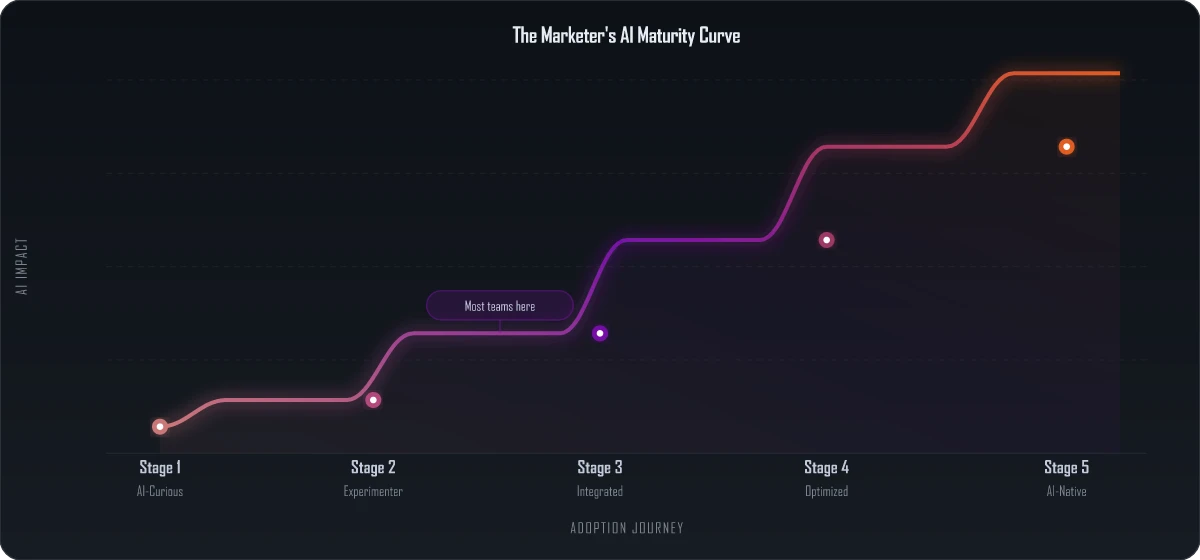
I’ve spent the last year building AI agents, automating marketing workflows, and watching how teams across industries adopt (or resist) AI. What I’ve noticed is that most marketers fall into one of five stages - and very few know which one they’re actually on.
Let me walk you through each stage, where the data says most teams are stuck, and what it actually takes to move up.
The 5 Stages of AI Maturity for Marketers
I’ve adapted this framework from Gartner’s AI Maturity Model and MIT Sloan’s research on AI maturity levels, tailored specifically for marketing teams.
Stage 1: AI-Curious (Awareness)
Where you are: You’ve heard about AI. You’ve maybe tried ChatGPT or Gemini for a blog draft or email subject line. But there’s no system, no process, no regular usage.
What it looks like:
- You manually write every piece of content from scratch
- You Google “best AI tools for marketers” once a month
- AI feels like a shiny toy, not a business tool
- Your team has no AI guidelines or policies
The data: According to McKinsey’s 2025 State of AI report, about 22% of organizations are still in this early exploration phase - aware of AI’s potential but with no formal adoption (McKinsey).
How to level up:
- Pick ONE repetitive task (e.g., writing meta descriptions, summarizing meeting notes, generating social captions)
- Use a free AI tool like ChatGPT, Claude, or Gemini for that one task for 2 weeks straight
- Track time saved - even 30 minutes a day adds up to 10+ hours per month
Stage 2: AI-Experimenter (Tactical Use)
Where you are: You’re using AI tools regularly, but it’s ad hoc. Different team members use different tools for different things. There’s no shared workflow or best practice.
What it looks like:
- You use ChatGPT for blog outlines, Canva AI for images, Grammarly for editing
- AI tools are siloed - no one tool connects to another
- Results are inconsistent because prompts and processes vary
- You spend more time figuring out the tools than getting output
The data: This is where the bulk of marketers sit today. HubSpot’s 2025 AI Trends Report places marketer-specific AI adoption at 66% globally, but most of this is experimental - not systematic. Only 31% of prioritized AI use cases have reached full production (Gartner).
How to level up:
- Create a shared AI playbook for your team - document which tools you use, what prompts work, and what the review process looks like
- Standardize on 2-3 tools instead of experimenting with 15
- Assign one person as the “AI champion” who tests, evaluates, and shares learnings
Stage 3: AI-Integrated (Systematic Adoption)
Where you are: AI is baked into your workflows. It’s not something you “use sometimes” - it’s part of how your team operates. You have defined processes, templates, and guardrails. In Claude, turning a defined process into a Claude skill lets Claude load those instructions when a request matches.
What it looks like:
- AI drafts the first version of most content (blogs, emails, social posts)
- Humans review, edit, and add brand voice and strategic context
- AI tools are connected - your CRM feeds data to your content tool, which feeds your analytics
- You have prompt libraries, brand voice guidelines for AI, and a review process
- You measure time saved and quality improvements
The data: Marketing teams at this stage report 44% higher productivity and save an average of 11 hours per week (All About AI). Content production timelines drop by up to 80% (Sopro). And 93% of marketers at this level use AI to generate content faster.
How to level up:
- Build AI into your SOPs (Standard Operating Procedures), not just your toolstack
- Create feedback loops - track which AI outputs need the most human editing and refine your prompts/processes
- Start measuring AI ROI formally: time saved, cost per piece, output quality scores. If your team runs on Claude, you can estimate the cost per piece on each Claude model from Anthropic’s list prices before you run a job.
Stage 4: AI-Optimized (Strategic AI)
Where you are: AI isn’t just in your workflows - it’s informing your strategy. You’re using AI for audience insights, predictive analytics, personalization at scale, and real-time optimization.
What it looks like:
- AI analyzes customer data to identify segments you didn’t know existed
- You use predictive models to forecast campaign performance before launch
- Personalization is dynamic - emails, landing pages, and ads adapt based on user behavior
- AI handles A/B testing at scale, running 50+ variants instead of 2
- Your team has dedicated AI roles - an AI ops person, an AI strategist, or both
The data: 65% of marketing teams now have designated AI roles (Jasper), and businesses using AI-driven marketing report 20-30% higher ROI compared to traditional approaches (Loopex Digital). Teams at this stage report an average 300% ROI from AI, accounting for both revenue increases and cost savings.
How to level up:
- Invest in AI training for your entire team - not just the “tech person”
- Build custom AI agents tailored to your specific marketing workflows (not just using off-the-shelf tools)
- Start connecting AI outputs to business outcomes (revenue, pipeline, retention), not just marketing metrics (clicks, opens, impressions)
Stage 5: AI-Native (Transformational)
Where you are: AI is the backbone of your marketing operation. Your team thinks AI-first for every project. Humans focus on strategy, creativity, and relationship-building - AI handles execution, optimization, and analysis.
What it looks like:
- Content operations run on AI agents with human oversight, not the other way around
- Campaign planning starts with AI-generated insights and forecasts
- Your martech stack is interconnected - data flows seamlessly between tools
- AI handles repetitive decisions (bid optimization, send-time optimization, audience selection) autonomously
- Your competitive advantage IS your AI infrastructure
The data: This is where very few teams have arrived. Gartner’s research shows that only 45% of organizations with high AI maturity manage to keep AI projects operational for 3+ years - meaning even the most advanced teams struggle with sustained AI transformation (Gartner). And 50% of organizations still lack the technical and data stack readiness required for AI agent deployment.
The reality check: Getting to Stage 5 isn’t about buying more tools. It’s about building an AI-ready culture - where every marketer is comfortable working alongside AI, data infrastructure is solid, and there are clear governance frameworks for AI-generated content.
Where Most Marketers Are Stuck (And Why)
Let’s be honest: most marketing teams are somewhere between Stage 2 and Stage 3. They’re using AI, but it’s messy. Inconsistent. Untracked.
Here’s why teams get stuck:
The Tool Trap
Teams buy 10 AI tools and use none of them well. 81% of martech leaders are either piloting or implementing AI agent solutions (Gartner), but 45% say these tools fail to meet their expectations. More tools ≠ more maturity.
The Talent Gap
Half of organizations cite a shortage of technical talent as a barrier to AI deployment. But here’s what most people miss: you don’t need data scientists. You need marketers who understand how to work with AI - how to prompt, how to review, how to build workflows. That hybrid already has a name and a hiring market: revenue teams are staffing it as a dedicated role, and the people who land it usually come from SDR, RevOps, or growth-ops seats rather than a data-science track.
The Measurement Problem
If you’re not measuring AI’s impact, you can’t justify scaling it. Only 31% of AI initiatives reach full production because teams can’t prove ROI early enough to get continued investment.
The Fear Factor
65% of CMOs say AI will dramatically change their role in the next two years (Gartner). Change is scary. Some teams slow-walk AI adoption because they’re afraid of getting it wrong, replacing jobs, or losing the “human touch.”
A Practical Framework to Move Up the Curve
Here’s my simple framework for advancing one stage at a time. I call it SPAR:
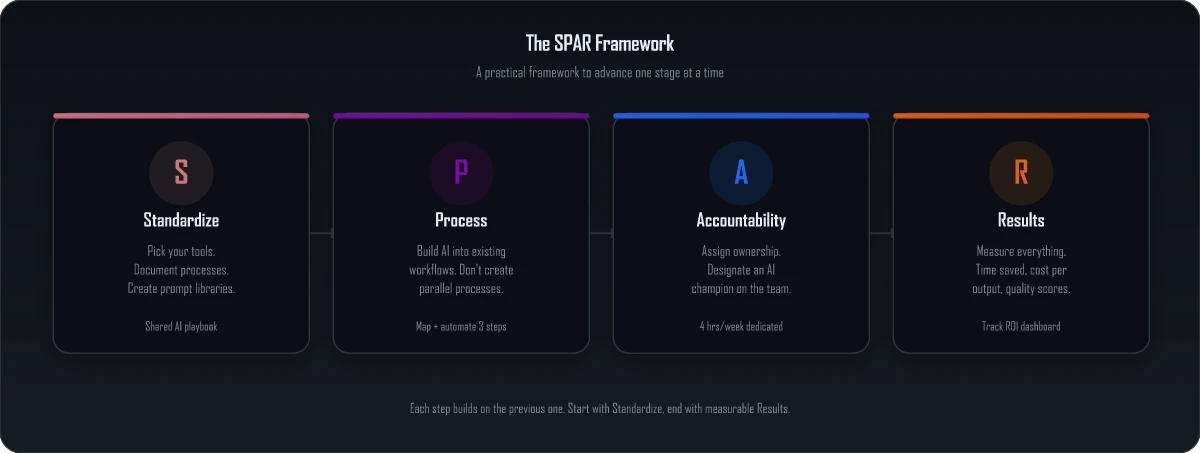
S - Standardize
Pick your tools. Document your processes. Create prompt libraries. Make AI usage consistent across the team. Choose them by the step that actually jams rather than by category, since a team stuck on first drafts needs a different shortlist than one stuck on keyword clustering, and this bottleneck-first way of assembling an AI stack runs that decision through content, SEO, analytics and email one layer at a time.
Action item: Create a shared Google Doc or Notion page with your team’s top 10 AI prompts, organized by use case (email, blog, social, ad copy). Our ChatGPT prompts for marketing library is a great starting point.
P - Process
Build AI into your existing workflows - don’t create parallel workflows. AI should fit INTO how you already work, not add another step.
Action item: Map your current content creation workflow. Identify 3 steps where AI could do the first draft or initial analysis. Implement for 30 days and measure.
A - Accountability
Assign ownership. Someone on your team should be responsible for AI adoption, training, and measurement. This doesn’t have to be a full-time role - it can be 20% of someone’s time.
Action item: Designate an AI champion. Give them 4 hours/week to test new tools, create training materials, and track team AI usage.
R - Results
Measure everything. Time saved. Cost per output. Quality scores. Revenue attribution. If you can’t show AI’s impact, you’ll never get the budget or buy-in to scale.
Action item: Set up a simple dashboard tracking: hours saved/week, pieces of content produced, cost per piece before vs. after AI, and quality ratings from your review process.
The Numbers That Should Motivate You
If you’re still on the fence about climbing the maturity curve, here are the numbers that convinced me:
| Metric | Without AI | With AI (Stage 3+) | Source |
|---|---|---|---|
| Content production time | Baseline | 80% faster | Sopro |
| Marketing productivity | Baseline | 44% higher | All About AI |
| Time saved per week | 0 | 11 hours | All About AI |
| Campaign ROI | Baseline | 20-30% higher | Loopex Digital |
| First-year ROI from AI tools | - | 86% positive | Sopro |
The AI marketing market has grown from $6.46B in 2018 to $57.99B in 2026 - a CAGR of 37.2% (All About AI). This isn’t a trend. It’s a structural shift.
My Honest Take
I’ve been building AI agents and automating marketing workflows for over a year now. Here’s what I’ve learned:
-
Stage 3 is the sweet spot for most teams. You don’t need to be AI-native to see massive gains. Just being systematic about AI adoption puts you ahead of 70% of marketing teams.
-
The biggest ROI comes from boring use cases. It’s not the flashy AI-generated video. It’s automating your weekly reporting, auto-generating meta descriptions, or having AI pre-score your leads. The boring stuff saves the most time. An AI SEO strategy is a perfect example - using AI for keyword clustering and content optimization delivers measurable results without requiring cutting-edge AI infrastructure.
-
AI doesn’t replace marketers - it replaces the parts of marketing that marketers hate. Data entry. Report formatting. First drafts of repetitive content. The tedious, repetitive work that no one signed up for. For a deeper exploration of this topic, see our analysis on whether marketing will be replaced by AI.
-
The gap between Stage 2 and Stage 3 is where careers are made. If you’re the person on your team who builds the AI playbook, creates the prompt libraries, and shows the ROI - you become indispensable.
Where Do You Stand?
Be honest with yourself. Where are you right now?
- Stage 1: You know AI exists but haven’t really started
- Stage 2: You use AI tools, but it’s scattered and inconsistent
- Stage 3: AI is built into your workflows with clear processes
- Stage 4: AI drives your strategy, not just your execution
- Stage 5: Your entire operation is AI-first
Most marketers reading this are at Stage 2, trying to get to Stage 3. And that’s okay. The maturity curve isn’t a race - it’s a progression. But the marketers who will thrive in 2026 and beyond are the ones who are intentional about moving up.
Start with one workflow. Standardize it. Measure it. Then scale it.
That’s the entire playbook.
What stage are you at? I’d love to hear - reach out to me on LinkedIn or Twitter.