AI SEO Strategy: How to Use AI to Rank Higher in 2026
A practical, no-fluff guide to using AI for SEO - from keyword research to content optimization to technical audits. With real data on what actually moves rankings.

Here’s what changed: 58-60% of Google searches now end without a click to any website (SparkToro Zero-Click Study, 2024). AI Overviews now appear in a growing share of Google searches and reach over 2 billion monthly users across 200+ countries. When AI Overviews show up, organic CTR drops by 61% (Search Engine Land / Seer Interactive, 2025).
If your SEO strategy is still “write a blog post, add keywords, build some links” -you’re optimizing for a search engine that doesn’t exist anymore. The landscape has shifted fundamentally - for a broader look at these changes, see our guide on AI and the future of SEO.
Meanwhile, the majority of SEO professionals have already integrated AI into their workflows. The marketers who understand this shift are the ones capturing traffic that everyone else is losing.
Here’s exactly how to build an AI SEO strategy that works in 2026 -with real tools, real workflows, and real data.
What’s Actually Changed in SEO
Before we get tactical, let’s understand the landscape:
Zero-click searches on queries with AI Overviews hit an average of 83% -users get their answer without ever visiting a website (Click Vision, 2026). Gartner forecasts a 25% decrease in traditional search traffic by 2026.
Content velocity has exploded. AI has made content creation dramatically faster, which means the bar for ranking has gone up, not down. More content is competing for the same search results.
But there’s a silver lining: Brands cited in AI Overviews see 35% more organic clicks than those not cited (Seer Interactive, 2025). Getting your content referenced by AI systems is becoming a powerful traffic driver.
This means your AI SEO strategy can’t just be “use AI to write more content faster.” That’s a race to the bottom. The strategy needs to be smarter than that.
The 6-Part AI SEO Strategy
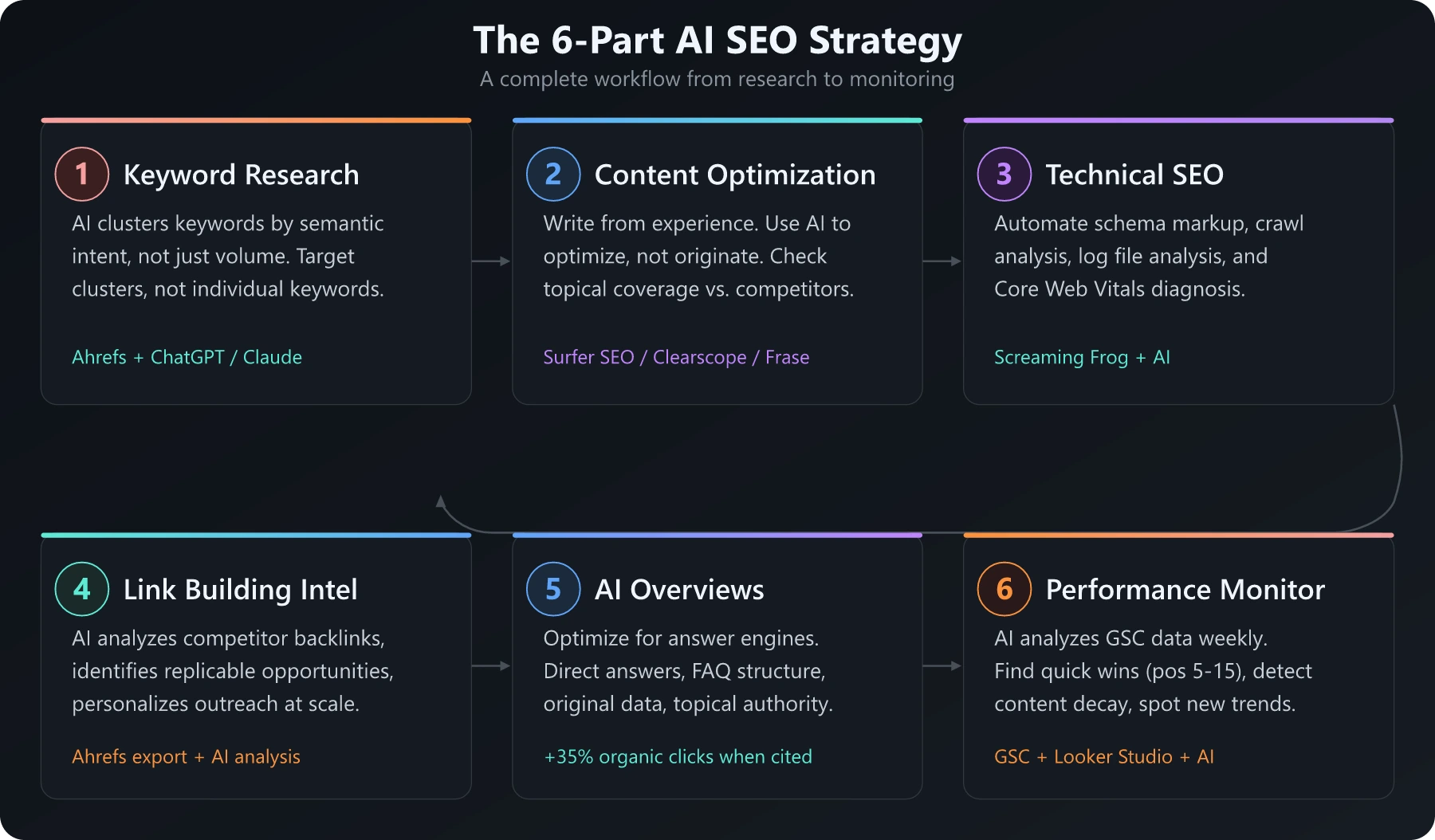
1. AI-Powered Keyword Research & Clustering
The old way: Manually combing through keyword tools, building spreadsheets, guessing at intent.
The AI way: Use AI to cluster keywords by semantic intent, identify content gaps at scale, and prioritize based on traffic potential -not just volume.
How to do it:
- Start with seed keywords in a tool like Ahrefs or Semrush
- Export keyword data (keyword, volume, KD, intent)
- Feed the data to ChatGPT or Claude with this prompt:
Group these keywords into topical clusters based on search intent.
For each cluster, identify:
- The primary keyword (highest volume)
- Supporting keywords
- The content type that would rank (guide, listicle, comparison, tool page)
- Any content gaps competitors might be missing

[Paste your keyword data]- Build a content map from the clusters
Why this works: Manually clustering 500 keywords takes hours. AI does it in seconds, and it catches semantic relationships humans miss. For example, “ai seo strategy” and “how to use artificial intelligence for search optimization” are the same intent -AI groups them instantly.
Real impact: Targeting keyword clusters instead of individual keywords lets you cover significantly more search queries with the same number of articles. One well-clustered piece can rank for dozens of related terms.
2. Content Optimization (Not Content Generation)
Here’s the critical distinction: AI is better at optimizing content than generating it.
Google’s guidelines are clear -they evaluate content based on quality, regardless of how it was produced. But they also detect and penalize thin, unhelpful content at scale (Google Search Central).
The strategy:
- Write from experience. Use your expertise, original data, and real opinions. This is what Google’s E-E-A-T framework rewards -Experience, Expertise, Authoritativeness, Trustworthiness.
- Use AI to optimize, not originate. After writing, use AI to:
- Identify missing subtopics competitors cover
- Suggest internal linking opportunities
- Improve readability and structure
- Generate meta descriptions and title tag variations
- Check keyword coverage without keyword stuffing
Tools for this:
| Tool | What It Does | Free? |
|---|---|---|
| Surfer SEO | NLP-based content scoring against top SERP results | Paid ($99/mo) |
| Clearscope | Content optimization with readability + relevance grades | Paid ($129/mo) |
| Frase | AI content briefs + SERP analysis | Paid ($49/mo) |
| ChatGPT/Claude | Manual optimization via prompting | Free tier available |
| Google’s NLP API | Entity analysis for semantic SEO | Free tier (5K requests/mo) |
Practical prompt for content optimization:
You are an SEO content editor. Analyze this blog post against
the following top-ranking URLs for the keyword "[your keyword]":

[Paste top 3-5 competitor URLs]

Identify:
1. Subtopics I'm missing that competitors cover
2. Questions I should answer that I haven't
3. Entities and related terms I should naturally include
4. Structural improvements (headings, sections, flow)

Do NOT suggest keyword stuffing. Focus on topical completeness.
3. Technical SEO Automation
AI shines brightest in technical SEO -it’s pattern recognition at scale, which is exactly what machines do well.
What to automate with AI:
- Crawl analysis: Tools like Screaming Frog + AI can process thousands of URLs and prioritize issues by impact
- Schema markup generation: Feed AI your page content and it generates structured data (FAQ, HowTo, Article schema)
- Log file analysis: AI can process server logs to understand how Googlebot crawls your site and identify crawl budget waste
- Redirect mapping: During migrations, AI can match old URLs to new ones based on content similarity
- Core Web Vitals diagnosis: AI can analyze PageSpeed Insights data and prioritize fixes by impact
Quick win - Schema markup with AI:
Generate Article schema markup (JSON-LD) for this blog post:

Title: [Your title]
Author: [Your name]
Date published: [Date]
Description: [Meta description]
URL: [Page URL]

Include all required and recommended properties per
Google's structured data guidelines.
This alone can improve your chances of appearing in rich results. Pages with structured data can see significantly higher click-through rates in search results, with some case studies reporting up to 30% CTR improvement for rich snippets.
4. AI for Link Building Intelligence
Link building is still critical -backlinks remain a key Google ranking signal (Backlinko ranking factors study). But AI changes how you approach it.
AI-powered link building workflow:
- Competitor backlink analysis: Export competitor backlinks from Ahrefs. Feed the data to AI:
Analyze these backlinks to my competitor [domain].
Categorize them by:
- Type (guest post, resource page, editorial mention, directory)
- Quality (DR of linking domain)
- Replicability (can I get a similar link?)

Prioritize the top 20 most replicable, high-quality opportunities.-
Outreach personalization at scale: AI can analyze a prospect’s recent content and generate personalized outreach angles. This isn’t about blasting template emails -it’s about making genuine personalization efficient.
-
Content gap → link magnet identification: AI can analyze what content types earn the most links in your niche (original research, tools, data visualizations, frameworks).
What NOT to do: Don’t use AI to mass-generate spammy outreach. Google’s SpamBrain algorithm and email providers are both getting better at detecting this. Quality over quantity, always.
5. Optimizing for AI Overviews & Answer Engines
This is the new frontier of SEO. With ChatGPT search, Perplexity, Google AI Overviews, and other AI answer engines, you need to optimize for machines that read and cite your content.
Key principles:
- Structure content with clear, direct answers. AI Overviews pull from content that directly answers the query in 2-3 sentences, then provides depth.
- Use FAQ format strategically. AI engines love structured Q&A content.
- Include original data and citations. AI systems prefer citing sources with unique data points over generic content.
- Build topical authority. AI Overviews preferentially cite sites with multiple pieces of content on related topics.
The data: Domain authority matters for AI citations. Sites with strong backlink profiles are significantly more likely to be cited by AI answer engines like ChatGPT and Perplexity. And brands cited in AI Overviews earn 35% more organic clicks than those not cited (Seer Interactive, 2025).
Practical framework for AI Overview optimization:
- Identify questions your target audience asks (use AnswerThePublic, AlsoAsked)
- Answer each question directly in the first 2-3 sentences of the relevant section
- Follow with depth, data, and your unique perspective
- Include structured data (FAQ schema) on the page
- Build supporting content that creates a topical cluster
6. AI-Powered Performance Monitoring
Set up AI to monitor your SEO performance and alert you to opportunities:
-
Google Search Console + Looker Studio + ChatGPT: Export GSC data monthly, feed it to AI to identify:
- Keywords where you’re position 5-15 (striking distance)
- Pages losing traffic (content decay)
- New keywords you’re ranking for unintentionally (expansion opportunities)
-
Automated content decay detection: Use AI to flag pages where traffic dropped >20% month-over-month. These are your update priorities.
Prompt for performance analysis:
Here is my Google Search Console data for the last 3 months
(keyword, clicks, impressions, CTR, position):

[Paste data]

Identify:
1. Keywords in positions 5-15 with high impressions (quick wins)
2. Keywords where position improved but CTR is below average
   (title tag optimization needed)
3. Pages losing clicks month-over-month (content refresh needed)
4. New keyword opportunities I might not be aware of
What Google Actually Says About AI Content
Let’s clear this up: Google does not penalize content for being AI-generated. Their guidelines focus on quality, not origin.
From Google’s guidance on AI-generated content:
“Appropriate use of AI or automation is not against our guidelines. This means that it is not used to generate content primarily to manipulate search rankings, which is against our spam policies.”
What Google DOES penalize:
- Content created primarily to manipulate search rankings
- Content that doesn’t demonstrate E-E-A-T
- Scaled content that adds no original value
- Content that’s factually wrong or misleading
The takeaway: Use AI as a tool in your SEO workflow, but bring original expertise, data, and perspective. That’s what ranks.
The Workflow I Use
Here’s my actual AI SEO workflow, start to finish:
- Research (30 min): Ahrefs for keyword data → AI for clustering and prioritization
- Brief creation (15 min): AI generates a content brief based on SERP analysis
- Writing (2-3 hours): I write from my own experience and expertise
- Optimization (30 min): AI checks topical coverage, suggests improvements
- Technical (10 min): AI generates schema markup, meta tags, internal linking suggestions
- Publishing (15 min): Publish with proper technical setup
- Monitoring (weekly): AI-assisted GSC analysis
Total time: ~4 hours per high-quality, optimized blog post. Without AI, the same workflow used to take 8-10 hours.
That’s a 50% time reduction without sacrificing quality. That’s the real promise of AI SEO -not replacing the work, but making the work faster and more informed.
Start Here
If you’re new to AI SEO, don’t try to implement everything at once. Here’s your starting sequence:
- Week 1: Set up Google Search Console if you haven’t. Export your data.
- Week 2: Use AI to analyze your GSC data and identify quick wins (positions 5-15).
- Week 3: Optimize your top 3 underperforming pages using AI content analysis.
- Week 4: Build your keyword clustering workflow and plan your next 10 pieces of content.
That’s four weeks to a functioning AI SEO strategy. No expensive tools required. No PhD in data science needed.
Just a willingness to let AI handle the analysis while you bring the expertise. For more tools to add to your workflow, check out our guide to free AI tools for marketing and our collection of ChatGPT prompts for marketing that includes SEO-specific templates.