B2B Marketing Automation: The Complete Guide for 2026
Master B2B marketing automation with proven strategies for lead nurturing, scoring, and multi-channel campaigns that drive pipeline and revenue.
The global marketing automation market hit $7.23 billion in 2025 and is projected to reach $20.12 billion by 2034 (Fortune Business Insights). Yet most B2B teams barely scratch the surface of what their tools can do. 76% of businesses use marketing automation, but only about half use it extensively across their operations (Flowlyn).
B2B marketing automation is not about blasting emails. It is about building systems that nurture prospects through long sales cycles, score leads based on real buying signals, and hand off qualified opportunities to sales at the right moment.
How B2B Marketing Automation Differs from B2C
If you have worked with B2C marketing automation, B2B requires a fundamentally different approach. The differences affect every workflow you build.
| Factor | B2B Automation | B2C Automation |
|---|---|---|
| Sales cycle | 3-12 months | Minutes to days |
| Decision makers | 3-10 per deal | Usually 1 |
| Primary goal | Lead qualification + pipeline | Direct conversion + retention |
| Key trigger | Content engagement + intent signals | Purchase behavior + browse activity |
| CRM integration | Critical (Salesforce, HubSpot) | Optional |
| Lead scoring | Central to strategy | Rarely used |
| Average deal size | $5,000-$100,000+ | $10-$500 |
B2B automation succeeds when it aligns marketing and sales around a shared definition of a qualified lead. Without that alignment, automation just accelerates bad leads into your pipeline.
Core B2B Marketing Automation Strategies
Lead Scoring and Qualification
Lead scoring assigns points to prospects based on demographics (job title, company size, industry) and behavior (pages visited, content downloaded, emails opened). This should be one of the first components in your marketing automation strategy. Companies using AI-powered lead scoring report 75% higher conversion rates compared to traditional scoring methods (Landbase).
A basic B2B lead scoring model:
| Action | Points |
|---|---|
| Visits pricing page | +20 |
| Downloads case study | +15 |
| Attends webinar | +15 |
| Opens email | +3 |
| Clicks email link | +5 |
| Job title matches ICP | +25 |
| Company size matches ICP | +20 |
| Unsubscribes from list | -50 |
Set a threshold (e.g., 60 points) where leads automatically route to sales. Review and adjust the threshold quarterly based on actual conversion data.
Multi-Touch Email Nurture Sequences
Nurtured leads produce a 20% increase in sales opportunities compared to non-nurtured leads (Demand Gen Report). Automated nurturing emails also generate 320% more revenue than non-automated emails (Campaign Monitor).
A typical B2B nurture sequence runs 5-7 emails over 3-6 weeks:
- Welcome + value prop (immediate) - Set expectations, deliver the lead magnet
- Educational content (Day 3) - Industry insight or how-to guide
- Case study (Day 7) - Social proof from a similar company
- Problem agitation (Day 14) - Address the specific pain point
- Product/solution (Day 21) - Show how you solve the problem
- Objection handling (Day 28) - FAQ, ROI calculator, or comparison
- CTA + urgency (Day 35) - Demo request or trial offer
Branch the sequence based on engagement. If someone clicks the case study link, skip ahead to the solution email. If someone goes quiet after email 3, send a re-engagement trigger instead. For more ready-to-use sequences like this, see our marketing automation workflow templates.
Account-Based Marketing Automation
ABM automation targets specific high-value accounts rather than individual leads. This works best for companies with deal sizes above $25,000 where the buying committee includes multiple stakeholders.
Key ABM automation workflows:
- Account identification - Use intent data tools (Bombora, 6sense) to flag accounts showing buying signals
- Multi-threading - Automatically enroll multiple contacts from the same account into coordinated sequences
- Personalized content - Dynamically swap case studies, stats, and CTAs based on the account’s industry
- Sales alerts - Notify the assigned rep when an account hits engagement thresholds
Build your ICP and buyer personas before setting up ABM workflows. Automating outreach to the wrong accounts wastes budget faster than manual prospecting.
Sales and Marketing Alignment
Automation breaks down when marketing and sales disagree on what qualifies as a lead. Establish these definitions before building workflows:
- MQL (Marketing Qualified Lead) - Meets demographic criteria and reaches a behavioral score threshold
- SQL (Sales Qualified Lead) - MQL that sales has accepted after initial review
- SAL (Sales Accepted Lead) - SQL that sales is actively working
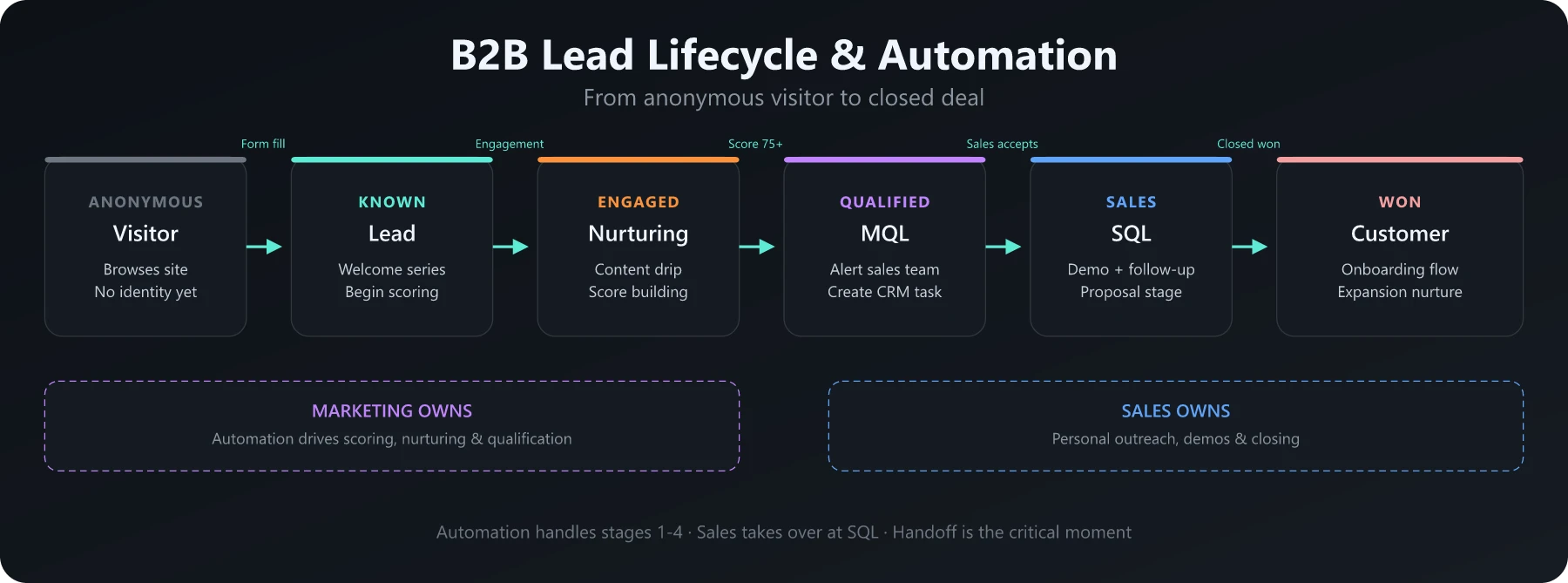
Automate the handoff: when a lead hits MQL status, create a task in your CRM, notify the assigned rep, and include the lead’s full activity history. 14.5% increase in sales productivity is the reported gain from proper automation handoffs (Flowlyn).
B2B Marketing Automation Platform Comparison
Choosing the right platform depends on your budget, team size, and tech stack. Here is how the major players compare in 2026.
| Platform | Starting Price | Best For | Key Strength |
|---|---|---|---|
| HubSpot Marketing Hub | $890/mo (Professional, 2,000 contacts) | Mid-market B2B teams | All-in-one CRM + marketing + sales |
| Salesforce MCAE (Pardot) | $1,250/mo (Growth) | Enterprise Salesforce shops | Deep Salesforce CRM integration |
| ActiveCampaign | $15/mo annual (Starter, 1,000 contacts) | SMBs and startups | Best automation builder for the price |
| Brevo | $9/mo (Starter, 5,000 emails) | Budget-conscious teams | Volume-based pricing, unlimited contacts |
| Marketo (Adobe) | Custom pricing (~$40K+/year) | Enterprise with complex needs | Advanced multi-channel orchestration |
Pricing sources: HubSpot, Salesforce, ActiveCampaign, Brevo
Important note: HubSpot Professional requires a $3,000 one-time onboarding fee and annual commitment. Salesforce MCAE pricing does not include implementation costs, which vary widely depending on complexity and partner.
For most B2B teams under 10,000 contacts, ActiveCampaign offers the best balance of automation power and cost. AI tools can also accelerate how you create email copy, subject lines, and nurture sequences within these platforms. Once you outgrow it or need deep Salesforce integration, HubSpot or Pardot make sense.
B2B Marketing Automation Workflows That Work
Workflow 1: Inbound Lead Nurture
Trigger: New lead downloads gated content
Sequence:
- Immediately: Deliver the content + welcome email
- Day 2: Related blog post or guide
- Day 5: Case study from their industry (dynamic content)
- Day 10: Invite to webinar or demo
- Day 15: Check lead score - if above threshold, route to sales. If below, continue nurture.
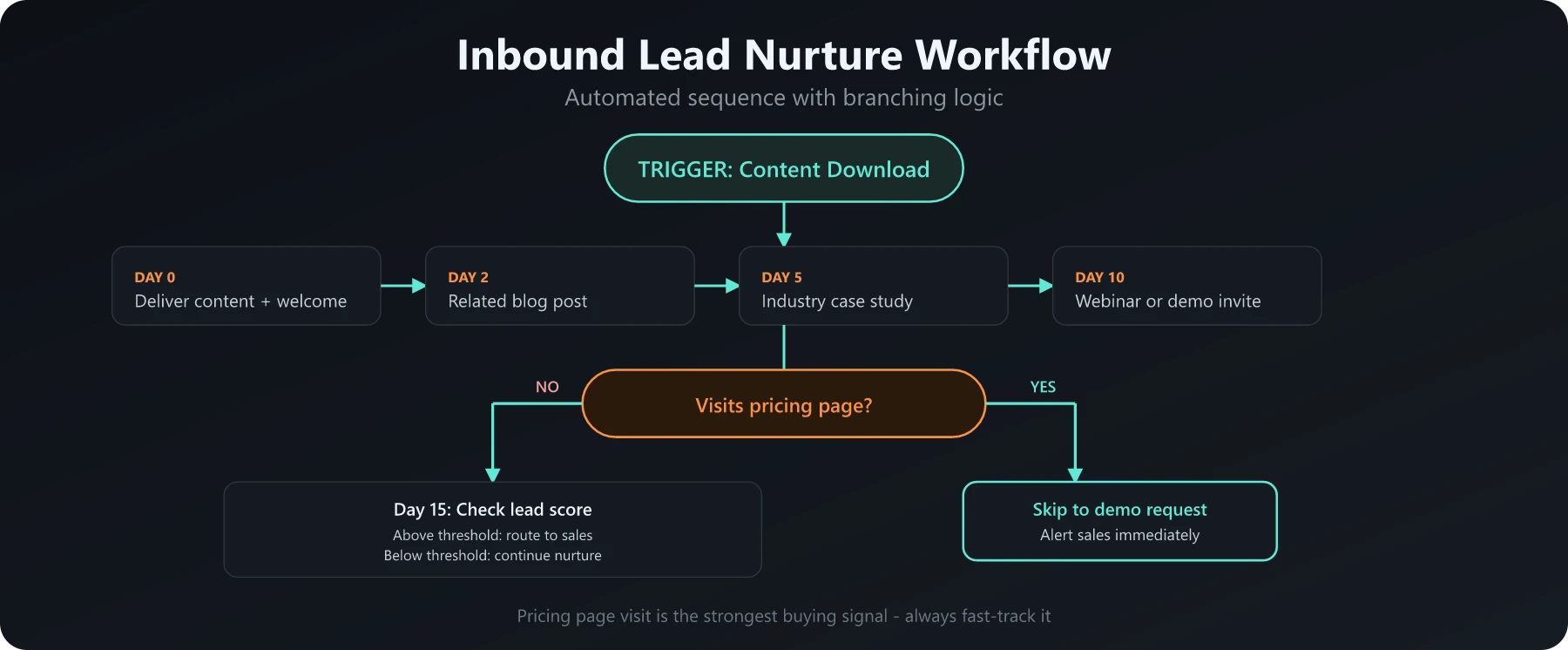
Branch logic: If the lead visits the pricing page at any point, skip to demo request and alert sales immediately.
Workflow 2: Cold Lead Re-engagement
Trigger: No email opens or website visits in 60 days
Sequence:
- Day 0: “We noticed you have been quiet” email with a new piece of high-value content
- Day 7: Industry report or benchmark data
- Day 14: Final email - “Should we stop sending?” with a clear opt-out
Goal: If no engagement after the 3-email sequence, move to a suppression list. Keeping cold leads in active campaigns hurts deliverability.
Workflow 3: Post-Demo Follow-Up
Trigger: Sales marks a contact as “demo completed” in CRM
Sequence:
- Immediately: Thank you email + demo recording link
- Day 2: Case study matching their use case
- Day 5: ROI calculator or comparison guide
- Day 10: Check-in from the assigned rep (personalized, not automated)
Branch logic: If the deal moves to “proposal sent” in CRM, pause the automation and let sales handle communication directly.
Measuring B2B Marketing Automation ROI
Track these metrics monthly to justify your automation investment:
| Metric | What It Measures | Target Benchmark |
|---|---|---|
| MQL to SQL rate | Lead quality from automation | 25-35% |
| Lead velocity | Speed of pipeline growth | Increasing month over month |
| Email engagement | Nurture effectiveness | 35%+ open rate, 5%+ CTR |
| Pipeline influenced | Revenue touched by automation | 40-60% of total pipeline |
| CAC payback | Time to recover acquisition cost | Under 12 months |
| Automation ROI | Revenue attributed / automation cost | 5:1 or higher |
Automated emails account for 37% of all email-generated sales despite making up just 2% of total email volume (Sender). That efficiency gap is the core argument for B2B marketing automation investment.
Build Your B2B Marketing Automation Stack
Start small. The biggest mistake in B2B marketing automation is trying to automate everything at once. Pick one workflow - usually inbound lead nurture - and perfect it before adding complexity.
Here is a realistic implementation timeline:
- Month 1: Choose a platform, integrate with your CRM, clean your contact database
- Month 2: Build your lead scoring model and first nurture sequence
- Month 3: Launch, monitor, and adjust scoring thresholds based on sales feedback
- Month 4+: Add ABM workflows, re-engagement sequences, and reporting dashboards
Your SaaS product marketing strategy should inform what content goes into your nurture sequences. The messaging, positioning, and competitive differentiation you build for product marketing feeds directly into the emails and content your automation delivers.
B2B marketing automation is not a set-it-and-forget-it system. The companies that win treat it as a living process - reviewing lead scores quarterly, refreshing nurture content, and tightening the feedback loop between marketing and sales every sprint.
Frequently Asked Questions
What is B2B marketing automation?
B2B marketing automation uses software to automate repetitive marketing tasks like email nurturing, lead scoring, and campaign management, allowing teams to scale personalized outreach across longer B2B sales cycles.
What are the best B2B marketing automation platforms?
Top B2B marketing automation platforms include HubSpot, Marketo, ActiveCampaign, and Pardot. The best choice depends on your team size, budget, and integration needs.
How is B2B marketing automation different from B2C?
B2B marketing automation focuses on longer sales cycles, multiple decision-makers, lead scoring, and CRM integration, while B2C automation prioritizes high-volume triggers, cart abandonment, and rapid purchase cycles.