Competitive Analysis Examples: 5 Real Frameworks You Can Copy
See real competitive analysis examples from SaaS, ecommerce, and B2B. Includes templates, scoring frameworks, and step-by-step breakdowns you can apply today.

94% of companies report their markets have become more competitive (Crayon). Yet 58% of CI professionals struggle to keep battlecards and content updated (Crayon). The gap between knowing you should analyze competitors and actually doing it well is enormous.
Most competitive analysis efforts fail because they produce generic SWOT charts that nobody acts on. What works is structured, specific analysis tied to decisions your team needs to make. Here are five competitive analysis examples you can copy and adapt.
What Makes a Good Competitive Analysis
Before the examples, here are the criteria that separate useful competitive analysis from busywork:
- Actionable - Every insight leads to a specific decision or action
- Focused - Answers a specific question, not “tell me everything about competitors”
- Comparative - Uses consistent scoring or criteria across competitors
- Current - Based on recent data, refreshed at least quarterly
- Distributed - Shared with the people who make decisions (sales, product, marketing)
Your competitive product analysis should serve strategy, not just fill a slide deck.
Competitive Analysis Example 1: SaaS Feature Comparison Matrix
Use this when: Evaluating product gaps, planning your roadmap, or creating sales battlecards.
This example compares three project management tools across key feature categories. Each feature scores on a 0-3 scale:
- 0 = Not available
- 1 = Basic implementation
- 2 = Competitive with alternatives
- 3 = Best-in-class
| Feature | Asana | Monday.com | ClickUp |
|---|---|---|---|
| Task management | 3 | 3 | 3 |
| Custom workflows | 2 | 3 | 3 |
| Time tracking | 1 | 2 | 3 |
| Resource management | 2 | 2 | 1 |
| Reporting/dashboards | 2 | 3 | 2 |
| Integrations | 3 | 2 | 2 |
| Mobile app | 3 | 2 | 2 |
| AI features | 2 | 2 | 3 |
| Free tier | 2 | 1 | 3 |
| Enterprise security | 3 | 2 | 2 |
| Total | 23 | 22 | 24 |
How to use this: The total score is less important than the individual category gaps. If you are Asana looking at this matrix, the clear action is to invest in time tracking (score: 1) and AI features (score: 2). If you are Monday.com, your mobile app and free tier need work.
Pro tip: Weight the categories by customer importance. If your buyer personas care most about integrations and enterprise security, those scores matter more than time tracking.
Competitive Analysis Example 2: Pricing Strategy Analysis
Use this when: Setting or adjusting your pricing, preparing for a competitor’s price change, or arming sales against pricing objections.
This example maps competitor pricing for email marketing platforms:
| Platform | Free Tier | Entry Paid | Mid-Tier | Enterprise | Pricing Model |
|---|---|---|---|---|---|
| Mailchimp | 250 contacts, 500 emails/mo | $13/mo (500 contacts) | $20/mo (500 contacts) | $350/mo Premium (10,000 contacts) | Contact-based |
| ActiveCampaign | 14-day trial only | $15/mo (1,000 contacts) | $49/mo (1,000 contacts) | $145/mo (1,000 contacts) | Contact-based |
| Brevo | 300 emails/day, unlimited contacts | $9/mo (5,000 emails) | $18/mo (5,000 emails) | Custom | Volume-based |
| Klaviyo | 250 contacts, 500 emails/mo | $20/mo (251-500 contacts) | $100/mo (2,500 contacts) | Custom | Contact-based |
Analysis patterns to look for:
- Pricing model differences - Brevo charges per email sent while others charge per contact. This matters because it changes the cost calculation for companies with large but infrequently contacted databases.
- Free tier strategy - Mailchimp and Brevo offer generous free tiers (PLG approach), while ActiveCampaign uses a trial-only model (sales-assisted). This signals different go-to-market strategies.
- Enterprise jump - The gap between mid-tier and enterprise pricing reveals each company’s target market. Large jumps indicate the vendor prioritizes enterprise revenue.
How to use this: Map your pricing against the matrix. If you are positioned between two competitors with no clear differentiation, you are in the “squeeze zone” - either differentiate on features or adjust pricing to own a clear price point.
Competitive Analysis Example 3: Positioning and Messaging Audit
Use this when: Developing product positioning, refreshing website copy, or identifying messaging gaps.
Analyze competitor homepage headlines and value propositions:
| Company | Primary Headline | Key Value Prop | Target Audience Signal | Emotional Angle |
|---|---|---|---|---|
| Asana | ”Manage your team’s work, projects, & tasks online” | Organization + clarity | Teams with complex projects | Control over chaos |
| Monday.com | ”Outpace everyone with the best AI work platform” | AI-powered speed | Broad market | Competitive advantage |
| ClickUp | ”Every app. Every team. Unlimited AI Agents.” | AI consolidation | Tool-fatigued teams | Automation of everything |
| Notion | ”One workspace. Zero busywork.” | Unified simplicity | Knowledge workers | Relief from overhead |
Analysis patterns to look for:
- Category positioning - Asana positions as team work management, Monday as an “AI work platform,” ClickUp as an AI-powered all-in-one. Each creates a different competitive frame.
- Differentiation gaps - If all competitors emphasize “AI-powered” but none talk about security or compliance, there is an open positioning lane.
- Audience signals - The language reveals who they are targeting. “Enterprise” words (governance, compliance, SSO) vs “startup” words (fast, free, no credit card) tell you their ICP.
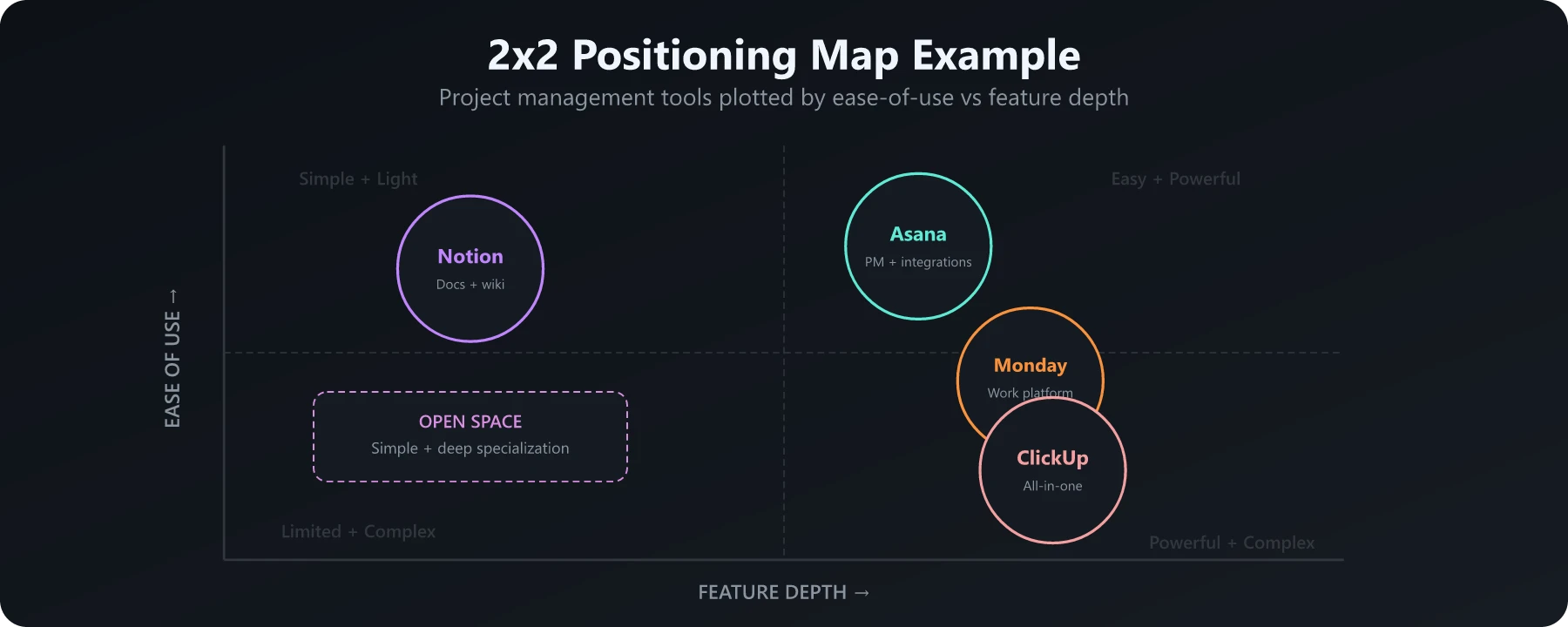
How to use this: Create a 2x2 positioning map with your two most important differentiation axes (e.g., ease-of-use vs power, broad vs specialized). Plot competitors and identify open space.
Competitive Analysis Example 4: SEO and Content Gap Analysis
Use this when: Planning content strategy, finding keyword opportunities, or understanding how competitors attract organic traffic.
An AI SEO strategy can accelerate this analysis significantly. Use Ahrefs, SEMrush, or Similarweb to compare organic search performance:
| Metric | Your Site | Competitor A | Competitor B | Competitor C |
|---|---|---|---|---|
| Organic traffic (monthly) | 15,000 | 85,000 | 42,000 | 120,000 |
| Ranking keywords | 1,200 | 8,500 | 4,300 | 12,000 |
| Domain Rating | 42 | 71 | 58 | 78 |
| Top content type | How-to guides | Comparison pages | Templates | Data reports |
| Content velocity | 4/month | 12/month | 6/month | 20/month |
Content gap analysis:
| Keyword | Your Rank | Competitor A | Competitor B | Opportunity |
|---|---|---|---|---|
| ”project management software” | Not ranking | #3 | #8 | High (commercial intent) |
| “free project management tools” | #45 | #1 | #12 | Medium (improve existing) |
| “project management templates” | Not ranking | Not ranking | #2 | High (competitor blind spot) |
| “agile project management” | #22 | #5 | #15 | Medium (optimize + build) |
How to use this: Prioritize keywords where competitors rank and you do not (content gaps), then keywords where you rank lower than competitors (optimization opportunities). Templates and comparison pages often have high commercial intent and lower competition than head terms.
Competitive Analysis Example 5: Win/Loss Analysis
Use this when: Understanding why deals close or fall through, improving sales enablement, or building competitive battlecards.
Structured win/loss interviews with recent customers and lost prospects reveal patterns that no other analysis method captures.
Sample win/loss findings (B2B SaaS, 50 interviews):
| Factor | Wins (n=30) | Losses (n=20) | Insight |
|---|---|---|---|
| Primary decision factor | Integration depth (40%) | Pricing (35%) | We win on capability but lose on price |
| Average eval duration | 3.2 weeks | 6.1 weeks | Longer evaluations favor competitors |
| Competitors in final round | 2.1 average | 2.8 average | More competitors = lower win rate |
| Champion title | Director+ (67%) | Manager (55%) | Seniority of champion predicts outcome |
| Demo to decision | 8 days average | 22 days average | Speed after demo is critical |
Actions from this analysis:
- Price perception problem - Losses cite pricing 35% of the time. This does not necessarily mean “lower the price” - it may mean the value is not communicated effectively before the price conversation.
- Speed wins - Deals that close within 8 days of demo have much higher win rates. Build urgency and reduce friction after the demo (immediate follow-up, trial access, ROI calculator).
- Stakeholder mapping - Director-level champions close at a higher rate. Adjust prospecting to target senior stakeholders and arm them with executive-facing content.
How to Keep Your Competitive Analysis Updated
Static competitive analysis loses value fast. Build a system that keeps insights current.
Weekly: Monitor competitor website changes, new content, social posts, and product updates using tools like Crayon or Klue. Teams using conversational intelligence tools to track competitor mentions in calls report an 82% lift in win rates (Crayon).
Monthly: Review win/loss data, update pricing comparisons, and check for new competitor features or messaging changes. AI tools for marketing can automate much of this monitoring work.
Quarterly: Refresh the full competitive analysis. Re-score feature matrices. Update positioning maps. Share findings with product, marketing, and sales.
For a deeper dive into building a continuous competitive intelligence program, see our guide on competitive intelligence analysis. And for turning analysis into sales-ready materials, check out the competitive battlecard template.
Start With One Framework
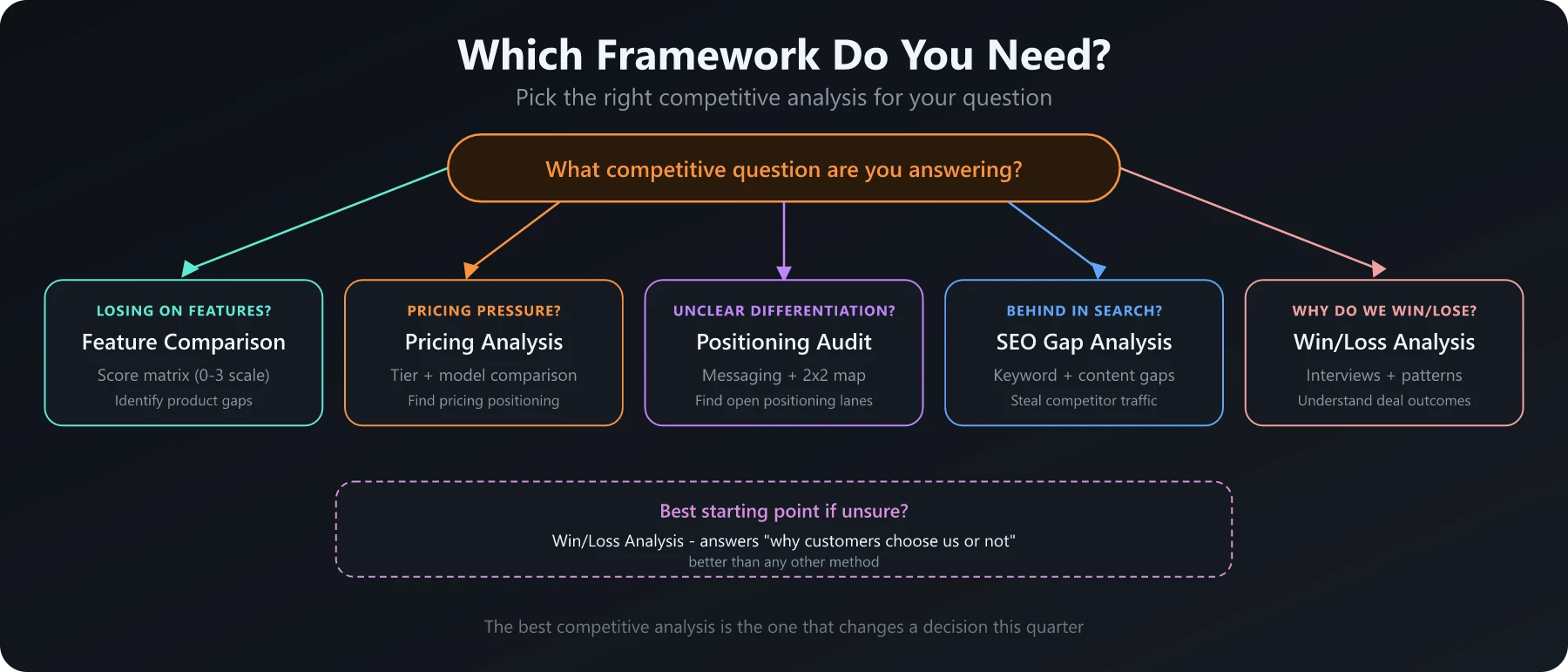
You do not need all five competitive analysis examples running simultaneously. Pick the one that addresses your most pressing competitive question:
- Losing on features? Start with the feature comparison matrix.
- Pricing pressure from competitors? Run the pricing analysis.
- Unclear differentiation? Do the positioning audit.
- Falling behind in organic search? Execute the SEO gap analysis.
- Want to understand what product marketing teams really need? Begin with win/loss analysis - it answers the question “why do customers choose us or not” better than any other method.
The best competitive analysis is the one that changes a decision this quarter. Start there.
Frequently Asked Questions
What is a competitive analysis example?
A competitive analysis example is a real-world demonstration of how a company systematically evaluates its competitors across dimensions like pricing, features, positioning, and market share to inform strategic decisions.
What should a competitive analysis include?
A thorough competitive analysis includes competitor identification, feature comparison, pricing analysis, positioning and messaging review, SWOT assessment, and market share estimation.
How often should you update a competitive analysis?
Update competitive analysis quarterly at minimum, or whenever a competitor launches a major feature, changes pricing, or enters a new market segment.