Competitive Battlecard Template: Examples That Win Deals
A competitive battlecard template sales reps actually pull up mid-call: 10 sections, two proven frameworks, and real examples from teams that win.
71% of businesses using battlecards report improved win rates. Among those, 93% say the improvement exceeds 20% (Crayon Sales Enablement Statistics). Yet only 35% of competitive intelligence professionals actually create them (Crayon).
That’s a massive gap between what works and what teams actually do.
A competitive battlecard is a concise, one-page reference document that gives your sales team everything they need to win against a specific competitor, in a form they can pull up mid-call rather than a 20-page analysis or a feature comparison spreadsheet. It is also where a claim goes when it stops being a differentiator: a feature a competitor has matched can still win an objection even after it stops leading the pitch.
This guide covers exactly how to build one - with a template, real frameworks, and the data to back it up.
Skip the blank page. Use the free Sales Battlecard Generator to build a polished, sales-ready battlecard in 2 minutes. Live preview, PNG download, no signup.
Why Competitive Battlecards Matter
The numbers paint a clear picture. 68% of B2B sales deals now involve at least one direct competitor, yet the average sales team rates itself just 3.8 out of 10 for competitive preparedness (Crayon State of CI 2025).
Your reps are fighting competitive deals every day - and most of them are unprepared.
Here’s what the data shows about teams that invest in battlecards:
| Metric | Strong Battlecard Adoption | Weak Adoption |
|---|---|---|
| Revenue impact from CI | 81% report direct impact | 39% report direct impact |
| Sales enablement content used | High adoption | 65% goes unused |
The problem isn’t that sales teams don’t want competitive intel. It’s that an estimated 65% of content marketing assets go unused because they’re irrelevant to the audience or sales context (Forrester). Battlecards fix this by distilling competitive intelligence into a format reps can actually use in real-time.
The Competitive Battlecard Template
Every effective battlecard covers these 10 sections. Not all sections need equal depth - prioritize what your sales team needs most.
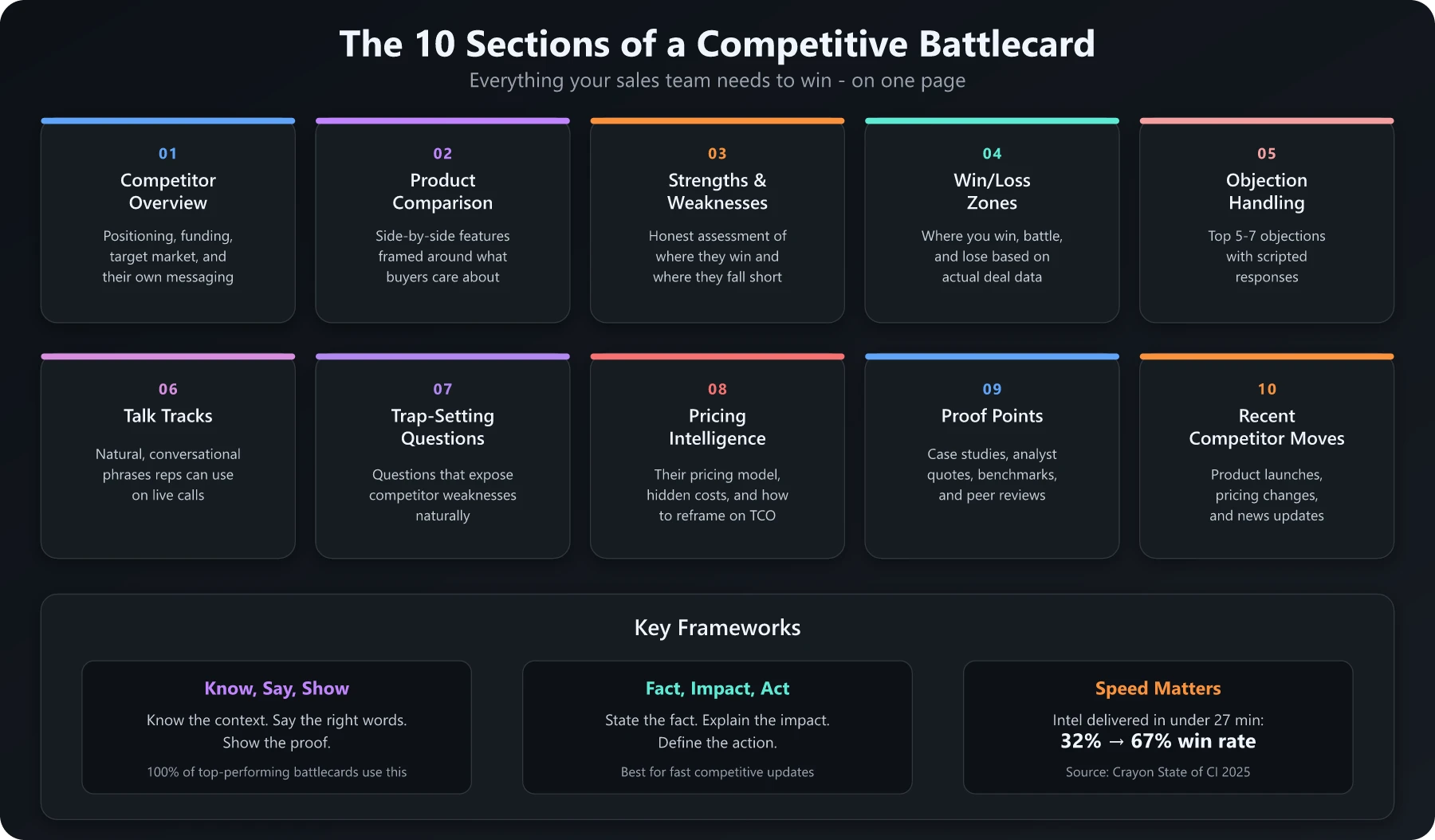
1. Competitor Overview
Start with the basics. Who is this competitor and how do they position themselves?
Include:
- Company name, logo, one-line positioning statement
- Founded year, funding/revenue (if known), employee count
- Target market and ideal customer
- Their own messaging (pulled directly from their website)
Keep this section short. Its purpose is context, not analysis.
2. Product Comparison
A side-by-side feature comparison table, framed around what your target buyers care about most rather than a flat feature list.
| Capability | Us | Competitor |
|---|---|---|
| Real-time collaboration | Native, unlimited users | Add-on, 5 user limit |
| API integrations | 200+ native | 50 native, rest via Zapier |
| Onboarding time | 2 hours average | 2-3 weeks with consultant |
| Pricing (mid-tier) | $49/user/mo | $79/user/mo + setup fee |
Pick 5-8 capabilities that matter to your buyers. Don’t list 40 features - nobody reads that mid-call.
3. Strengths and Weaknesses
Be honest about where the competitor is strong. Your reps will lose credibility instantly if they dismiss a competitor’s genuine advantages.
Their Strengths:
- Larger brand recognition in enterprise
- Deeper analytics capabilities
- Stronger partner ecosystem
Their Weaknesses:
- Slow implementation timelines (3-6 months avg)
- Limited customization without professional services
- High customer churn in mid-market segment
4. Win/Loss Zones
This is the most valuable section. Map out three zones based on your actual win/loss data, which a win-loss analysis dashboard makes far easier to see:
- Winning zones - Scenarios where you consistently beat this competitor
- Battling zones - Areas where you’re evenly matched
- Losing zones - Situations where this competitor has the advantage
Be specific. “We win when the buyer has a technical team that values API-first architecture” is useful. “We have better product” is not.
5. Objection Handling
List the top 5-7 objections prospects raise when comparing you to this competitor, with scripted responses.
Objection: “Competitor X has been in the market longer and has more customers.”
Response: “They’ve been around longer, which means their architecture is older too. Our platform was built cloud-native from day one, which is why our customers see 40% faster implementation times. [Customer Name] switched from Competitor X specifically because of this - want me to share their story?“
6. Talk Tracks
Give reps exact phrases they can use in conversations. Not corporate messaging - natural, conversational language.
When a prospect mentions the competitor:
“I hear that a lot. The way I think about it is [your key differentiator]. What matters most to your team - [advantage A] or [advantage B]?”
When positioning against them proactively:
“Companies like [reference customer] looked at [Competitor] too. What made them choose us was [specific advantage]. Their team saw [specific result] within the first 90 days.”
7. Trap-Setting Questions
Questions that expose competitor weaknesses without directly attacking them.
- “How important is [capability they lack] to your workflow?”
- “What’s your timeline for getting this live? Have you budgeted for implementation consulting?”
- “How many integrations does your current tech stack require? Do you need those working on day one?”
These work because they let the prospect discover the competitor’s limitations on their own.
8. Pricing Intelligence
What you know about their pricing structure and how to position against it.
- Their pricing model (per-seat, usage-based, flat-rate)
- Typical deal sizes and discount patterns
- Hidden costs (implementation fees, support tiers, overage charges)
- How to reframe the conversation from price to total cost of ownership
9. Proof Points
Evidence that backs up your claims. An audit of 150+ battlecards found that 100% of the highest-retention cards included proof points, while only 19% of battlecards overall include them (Klue). That gap is a production problem, not an evidence problem: the wins exist and nobody writes them up, so pair every closed competitive deal with a one-page customer proof sheet while the numbers are still fresh.
Strong proof includes:
- Named customer case studies with specific metrics
- Third-party analyst quotes or recognition
- Head-to-head benchmark results
- G2 and Gartner Peer Insights comparisons
10. Recent Competitor Moves
The latest news about this competitor - product launches, pricing changes, executive hires, funding rounds, negative press. Update this section at least monthly.
Why it matters: 83% of B2B buyers alter their initial vendor lineup during the buying process (Gartner). Your reps need to address what prospects are seeing right now, not what was true six months ago.
Two Battlecard Frameworks That Work
Framework 1: Know, Say, Show
Developed after auditing hundreds of battlecards, this framework ensures every section answers three questions:
- Know - Background context the rep needs to understand
- Say - Exact language they can use in conversations
- Show - Evidence that supports the claim (case studies, data, screenshots)
Example applied to a pricing objection:
| Know | Say | Show |
|---|---|---|
| Competitor charges per-seat plus $15K implementation fee. Average deal is $40K more expensive over 3 years. | ”When you factor in the implementation fee and per-seat costs over 3 years, most teams find we’re 30-40% less expensive total. Let me walk you through the math.” | TCO comparison spreadsheet. Case study showing Customer X saved $120K over 3 years after switching. |
Source: Klue Battlecard Best Practices
Framework 2: Fact, Impact, Act (FIA)
For teams that prefer a simpler structure:
- Fact - The competitive insight and its context
- Impact - Why this matters and when sellers encounter it
- Act - What to do (talk tracks, questions, follow-ups)
Example:
- Fact: Competitor released a free tier last month targeting startups
- Impact: Prospects in the startup segment will ask why we don’t offer a free plan
- Act: Acknowledge the free tier, then ask: “How many users do you expect to need in 6 months? Their free tier caps at 3 users, and scaling past that gets expensive fast. Let me show you what our startup plan looks like at that scale.”
Source: Klue FIA Framework
Real Results: Companies That Got Battlecards Right
Alteryx
Alteryx overhauled their competitive enablement program and saw a 40% increase in battlecard adoption within just 60 days (Crayon).
Oracle
Tim Rhodes, head of marketing strategy and CI at Oracle, reported an almost 20% increase in win rates within 6 months after rebuilding their competitive intelligence program (Klue).
The Speed Factor
Crayon’s data shows that teams enabling sales with competitive intel on a daily basis see an 84% increase in effectiveness, while having a sales executive sponsor boosts results by 76% (Crayon). Yet less than a third of compete teams engage with sales daily or weekly, and 44% lack visibility into which competitors are in which deals.
Speed and accessibility matter as much as the quality of the content.
Common Battlecard Mistakes
1. Information overload. A battlecard is not a white paper. If it takes more than 2 minutes to scan, it’s too long. Reps need answers mid-conversation, not during a study session.
2. Feature-first thinking. Listing features instead of positioning and value differentiation. Buyers don’t care that you have “AI-powered analytics.” They care that you can “cut reporting time from 3 hours to 10 minutes.”
3. Stale content. Nothing destroys sales credibility faster than citing competitor information that’s months old. 58% of CI professionals struggle to keep battlecards and competitive content updated (Crayon). Set a regular update cadence - biweekly at minimum for top competitors.
4. Poor accessibility. If battlecards live in a shared drive folder nobody checks, they won’t get used. Integrate them into your CRM, Slack, or wherever your reps already work. Access is only half the problem: a card the rep has never said out loud stays unused under pressure, which is why the competitive drill block at the annual kickoff should run 75 minutes of live trap objections rather than a walkthrough of the deck.
5. No measurement. Track battlecard usage, win rates against each competitor, and rep feedback. If a battlecard isn’t improving outcomes, fix it or kill it.
6. Ignoring indirect competitors. Don’t just monitor direct competitors. The status quo - spreadsheets, manual processes, “doing nothing” - is often your biggest competitor. Build a battlecard for that too.
How AI Is Changing Competitive Battlecards in 2026
AI is transforming how teams build and maintain battlecards:
What’s working now:
- Automated monitoring - AI tools track 100+ sources per competitor, flagging pricing changes, product launches, and positioning shifts automatically (AriseGTM)
- Real-time updates - Battlecard obsolescence dropped from 30-day update cycles to continuous accuracy
- Call intelligence - Teams using conversational intelligence tools (e.g. Gong, Chorus) for competitive tracking report an 82% lift in sales effectiveness (Crayon)
- Deal coaching - AI-driven deal coaching shows a 21% improvement in win rates compared to static battlecards (HireSteve.ai)
The cost savings are significant. B2B SaaS reps spend 8-12 hours per month researching competitors manually (AriseGTM). For a 50-person sales org, that’s $195,000-$293,000 annually in direct labor costs. AI eliminates most of this.
But AI doesn’t replace the strategic thinking. It handles monitoring and formatting. You still need product marketers to interpret the data, craft the positioning, and write talk tracks that sound human.
Getting Started: Your First Battlecard in 5 Steps
- Pick your #1 competitor - The one your sales team loses to most often
- Pull your win/loss data - Interview 5-10 reps about recent competitive deals
- Map their positioning - Read their website, G2 reviews, and recent press
- Fill the template - Use the 10 sections above, starting with objection handling and talk tracks (highest immediate value)
- Test with 3 reps - Have them use it for one week, then iterate based on their feedback
Don’t try to build battlecards for every competitor at once. Start with one, get it right, then expand. For the full research methodology behind step 2, see our competitive product analysis framework.
If you are building a battlecard for a job application rather than a sales team, set it on a fictional pair or two public products and link and date every claim, as I explain in my guide to NDA-safe portfolio samples for product marketers.
Build your first battlecard right now. The free Battlecard Generator walks you through every section, shows a live preview as you type, and exports a PNG you can drop into Google Slides, Notion, or your sales enablement platform.
Related reading:
- Product Positioning - The foundation that battlecards build on
- Go-To-Market Strategy Template - Where battlecards fit in the GTM plan
- What Is Product Marketing? - The role that owns competitive intelligence
- Competitive Analysis Examples - 5 frameworks to inform your battlecard content
- Competitive Analysis Template - A fill-in-the-blank framework to structure your research
- Competitive Intelligence Analysis - Build the system that keeps battlecards current
Frequently Asked Questions
What is a competitive battlecard template?
It is a reusable one-page structure a rep fills in for one named competitor. The frame holds the competitor overview, a feature comparison, win and loss zones, objection responses, talk tracks, trap-setting questions, pricing intelligence, proof points, and recent moves. You keep one filled-in copy per competitor you actually meet in deals.
What should a competitive battlecard include?
Ten sections: competitor overview, product comparison, strengths and weaknesses, win/loss zones, objection handling, talk tracks, trap-setting questions, pricing intelligence, proof points, and recent competitor moves. Build objection handling and talk tracks first. Those are the two sections a rep opens with a prospect on the line; the rest can fill in over following weeks.
How long should a competitive battlecard be?
One page, scannable in under two minutes. Two to three sentences per section is the working limit, because the rep is reading it during a live call rather than before one. When a section needs more room, link out to the full competitive analysis and keep the card itself short.
What is the difference between a competitive battlecard and a product battlecard?
A competitive battlecard is built around one named rival and answers how to win a contested deal against them. A product battlecard is built around one of your own products and covers buyer pain points, use cases, pricing tiers, and cross-sell paths. Teams selling a multi-product line usually keep both under the same owner.
Why do sales reps ignore battlecards?
Three failure modes account for most of it: the card runs too long to read with a prospect on the line, it sits in a drive folder instead of the CRM or Slack where the rep already works, and its competitor intel has aged past the point anyone trusts it. Fix access and freshness before length.