Competitive Intelligence Analysis: How to Track and Outmaneuver Competitors
Learn how to build a competitive intelligence analysis system that tracks competitor moves in real time. Includes tools, frameworks, and a CI reporting template.

94% of companies report their markets have become more competitive, yet 58% of CI professionals struggle to keep battlecards and content updated (Crayon, Crayon State of CI 2024). That gap between knowing competitors matter and actually tracking them is where competitive intelligence analysis comes in.
A competitive intelligence analysis is not a one-time research project. It is a system - a repeatable process for gathering, analyzing, and distributing competitor insights to the people who make decisions.
What is Competitive Intelligence Analysis
Competitive intelligence analysis is the systematic process of collecting, organizing, and acting on information about competitors, market trends, and industry shifts. It turns scattered observations into structured insights that inform product, marketing, sales, and strategy decisions.
CI vs competitive analysis: A competitive analysis is a snapshot - a document that compares you to competitors at a point in time. Competitive intelligence is the ongoing system that keeps that snapshot current. One is a deliverable, the other is a capability.
For a deep dive into building the snapshot itself, see our guide on competitive product analysis. This guide focuses on building the system that keeps intelligence flowing.
The Competitive Intelligence Analysis Framework
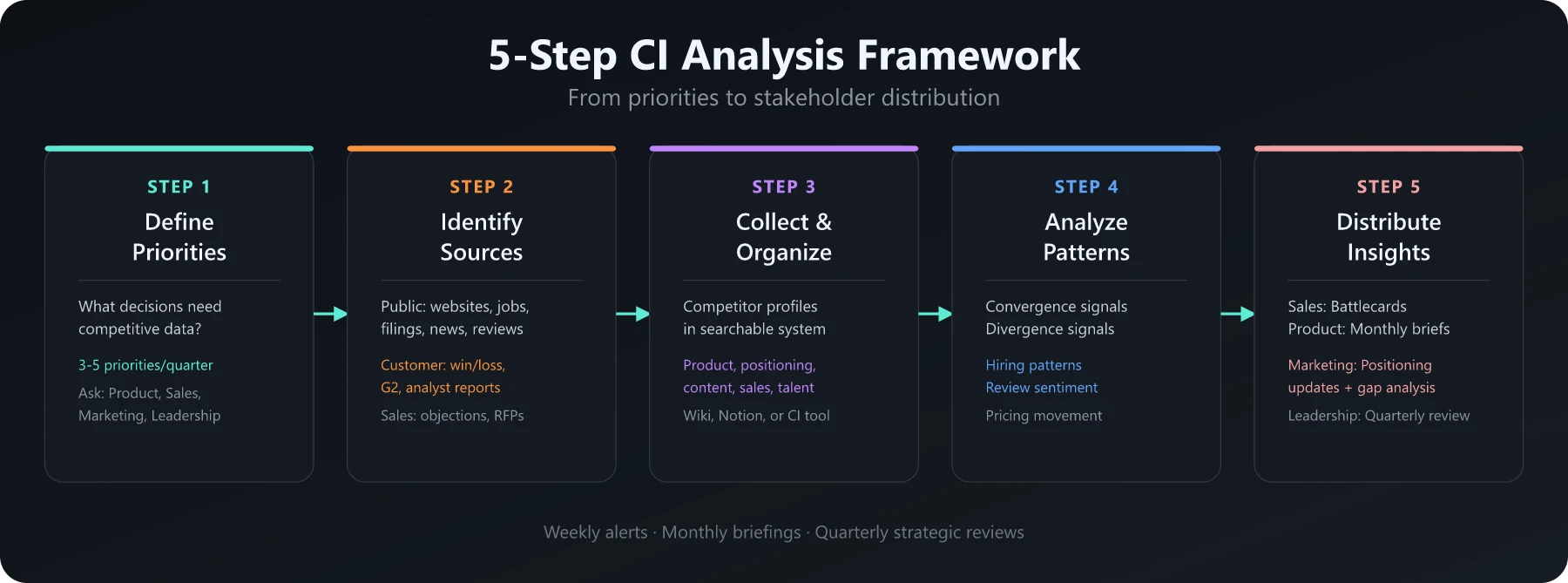
Step 1: Define Intelligence Priorities
Not all competitor information is equally valuable. Start by asking stakeholders what decisions they need competitive intelligence to inform.
| Stakeholder | Key Questions | Intelligence Priority |
|---|---|---|
| Product team | What are competitors building? Where are they investing? | Feature roadmap, job postings, patent filings |
| Sales team | How do we win against competitor X? What objections come up? | Pricing, positioning, win/loss data |
| Marketing team | What messaging resonates? Where are they investing? | Content strategy, ad spend, positioning changes |
| Leadership | How is the competitive landscape shifting? | Market share, funding, strategic moves |
Focus on 3-5 intelligence priorities per quarter. Trying to track everything about every competitor leads to information overload with no action.
Step 2: Identify Information Sources
Good competitive intelligence comes from combining multiple source types:
Public sources (always monitor):
- Competitor websites (pricing pages, product pages, blog)
- Press releases and news coverage
- Social media accounts and employee posts
- Job postings (reveal strategic priorities)
- Patent and trademark filings
- SEC filings and financial reports (for public companies)
- App store updates and changelogs
Customer and market sources:
- Win/loss interviews with recent deals
- G2, Capterra, and TrustRadius reviews
- Industry analyst reports
- Conference presentations and webinar recordings
- Community forums and Reddit discussions
Sales team sources:
- Prospect objections mentioning competitors
- RFP responses and competitive bake-offs
- Information shared by prospects during demos
AI adoption among CI teams surged 76% year-over-year in 2025, with 60% of teams now using AI daily for tasks like summarizing content and analyzing competitor data (Crayon). AI tools can now monitor sources at scale that would take a human team weeks.
Step 3: Collect and Organize Data
Raw information is not intelligence. Organize collected data into a structured system:
Create a competitor profile for each tracked competitor:
| Section | What to Track | Update Frequency |
|---|---|---|
| Company overview | Size, funding, revenue, headcount | Quarterly |
| Product | Features, pricing, integrations, roadmap signals | Monthly |
| Positioning | Tagline, value props, target audience, differentiators | Monthly |
| Content/SEO | Blog topics, keyword rankings, content velocity | Monthly |
| Sales motion | Pricing model, sales process, common objections | Quarterly |
| Talent signals | Key hires, departures, open roles | Monthly |
| Customer sentiment | Review trends, NPS signals, churn indicators | Monthly |
Store profiles in a shared, searchable location - a wiki, Notion database, or dedicated CI tool. If the sales team cannot find it in under 30 seconds, it will not get used.
Step 4: Analyze Patterns and Signals
Individual data points are noise. Patterns are intelligence. Look for:
Convergence signals - Multiple competitors making similar moves (entering a new market, adding similar features) indicates an industry shift you need to respond to.
Divergence signals - A competitor making a unique move (new pricing model, unexpected acquisition, pivot to a new segment) may signal an opportunity or threat.
Hiring patterns - A competitor hiring 10 machine learning engineers signals AI investment. A surge in enterprise sales hires signals an upmarket push. Job postings are one of the most reliable leading indicators of strategy.
Review sentiment trends - Increasing negative reviews about a competitor’s product quality or support create an opening for your sales and marketing messaging.
Pricing movement - Competitor price increases often signal confidence and market validation. Price decreases may indicate desperation or a shift to volume strategy.
Step 5: Distribute Insights to Stakeholders
Intelligence that sits in a database is worthless. Build distribution channels that match how each team consumes information:
For sales: Competitive battlecards - one-page reference docs for each competitor covering positioning, pricing, strengths, weaknesses, and talk tracks. Keep them in your CRM or sales enablement tool where reps access them during deals.
For product: Monthly competitive briefings highlighting feature launches, roadmap signals from job postings, and customer request patterns from reviews.
For marketing: Positioning and messaging comparison updates, content gap analysis, and SEO competitive intelligence. Your AI SEO strategy should incorporate competitive keyword data from these reports.
For leadership: Quarterly strategic reviews covering market landscape shifts, competitive threat assessment, and recommended responses.
Types of Competitive Intelligence
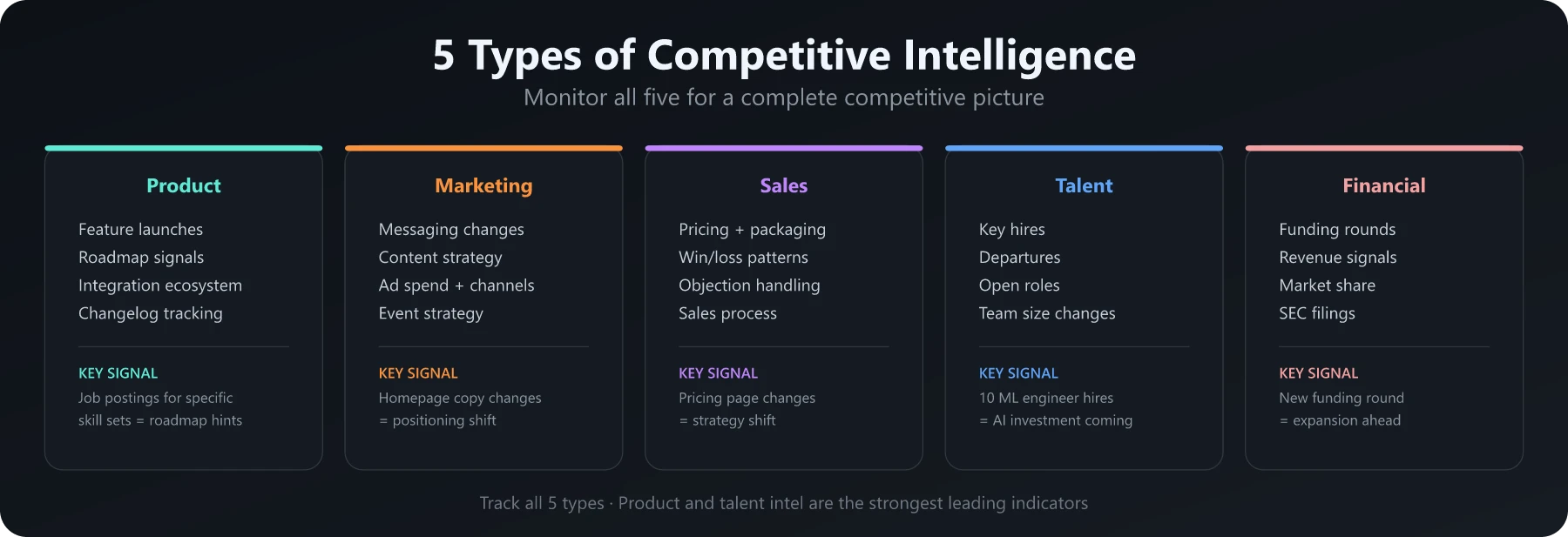
Product Intelligence
Track what competitors are building and where they are investing:
- Feature monitoring - Changelog tracking, product update announcements, beta program signals
- Roadmap signals - Job postings for specific skill sets, patent filings, conference talks about upcoming capabilities
- Integration ecosystem - New partnership announcements, marketplace listings, API documentation changes
Marketing Intelligence
Understand how competitors position themselves and where they invest marketing dollars:
- Messaging and positioning - Homepage copy changes, ad creative, email campaigns
- Content strategy - Blog topics, keyword rankings, content volume and velocity
- Ad spend and channels - Paid search and social advertising tracked through SEMrush or Similarweb
- Event strategy - Conference sponsorships, webinar topics, community engagement
Sales Intelligence
Arm your sales team with intelligence that wins deals:
- Pricing and packaging - Current plans, pricing changes, discount patterns
- Win/loss patterns - Why deals are won or lost against specific competitors
- Objection handling - Common competitor claims and effective counter-messaging
- Sales process - How competitors sell, demo cadence, trial structure
Talent Intelligence
People moves reveal strategic direction faster than press releases:
- Key hires - New C-suite or VP-level hires often signal strategic pivots
- Departures - Senior leadership exits may indicate internal problems
- Open roles - Hiring patterns by function and geography show where investment is going
- Team size changes - Layoffs or rapid scaling reveal financial and strategic health
Financial Intelligence
For public competitors, financial data is freely available. For private competitors, look for proxy signals:
- Funding rounds - Amount raised, investors, valuation changes
- Revenue signals - Customer counts, pricing changes, office expansions
- Market share indicators - G2 grid positions, review volume trends, Similarweb traffic
Competitive Intelligence Tools Comparison
The CI tools market is projected to reach $1.46 billion by 2030 at a 20% CAGR (Mordor Intelligence). Here are the leading platforms:
| Tool | Primary Use | Best For | Estimated Pricing |
|---|---|---|---|
| Crayon | Automated competitor tracking | Enterprise CI programs | Starting ~$15,000/year (custom) |
| Klue | Battlecards + CI platform | Sales enablement + CI | ~$20,000-$40,000/year |
| Kompyte | Competitor monitoring | Mid-market teams | Custom pricing |
| Ahrefs | SEO competitive intelligence | Content + SEO teams | $129/mo |
| SEMrush | All-in-one marketing intelligence | Marketing teams | $139.95/mo |
| Similarweb | Traffic and market analysis | Strategy teams | Custom pricing |
| G2 | Review monitoring | Product marketing | Free (basic alerts) |
| Talent intelligence | HR + strategy | Free-$60/mo |
Pricing source: Vendr, Autobound
For teams without budget for dedicated CI tools, you can build a solid program using Ahrefs (SEO), Google Alerts (news), LinkedIn (talent), and G2 (reviews). The framework matters more than the tools.
Building a CI Reporting Cadence
Weekly: Competitor Alerts
Set up automated monitoring for:
- Competitor website changes (especially pricing and product pages)
- New blog posts and content published
- Social media mentions and announcements
- Job posting changes
- Review site activity
Tools like Crayon automate this. Without a tool, use Google Alerts, LinkedIn notifications, and RSS feeds for competitor blogs.
Monthly: Competitive Briefing
A 15-30 minute briefing covering:
- Top competitor moves from the past month
- New features or product changes observed
- Messaging or positioning shifts
- Win/loss data summary
- Recommended actions for product, marketing, and sales
Share as a written brief and discuss in a cross-functional meeting. Record it for team members who cannot attend.
Quarterly: Strategic Review
A deeper analysis for leadership:
- Competitive landscape map update
- Market share estimation changes
- Threat assessment (new entrants, adjacent competitors expanding)
- Opportunity identification (competitor weaknesses, market gaps)
- Recommended strategic responses
Competitive Intelligence Analysis Template
Use this template to structure your quarterly competitive analysis for each tracked competitor:
1. Company Snapshot
- Company name, founded, HQ, employee count, funding/revenue
- Key products and target market
2. Product Analysis
- Core features and recent additions
- Pricing and packaging
- Key integrations
- Product strengths and weaknesses
3. Go-to-Market
- Positioning statement and key messaging
- Primary acquisition channels
- Sales motion (PLG, sales-led, hybrid) - see product-led growth examples for how top companies approach this
- Content strategy and SEO performance
4. Customer Intelligence
- Review sentiment trends (G2, Capterra)
- Common praise and complaints
- Target customer profile
- Notable customer wins/losses
5. Strategic Signals
- Recent hires and departures
- Funding or financial changes
- Partnership announcements
- Market expansion signals
6. Implications for Us
- Threats: What competitive moves require a response?
- Opportunities: Where are competitor weaknesses we can exploit?
- Recommended actions: Specific next steps for product, marketing, and sales
Build Your CI System This Month
You do not need Crayon or Klue to start a competitive intelligence analysis program. You need a framework, a cadence, and commitment from stakeholders to act on what you find.
Week 1: Identify your top 3-5 competitors and set up basic monitoring (Google Alerts, LinkedIn follows, G2 review subscriptions).
Week 2: Create competitor profiles using the template above. Fill in what you already know and flag gaps.
Week 3: Conduct your first round of research to fill gaps. Check pricing pages, read recent reviews, scan job postings.
Week 4: Distribute your first competitive brief to sales, product, and marketing. Get feedback on what is useful and what is missing.
Then build from there. For turning your intelligence into sales-ready materials, see our competitive battlecard template. For practical frameworks on analyzing specific competitors, check our competitive analysis examples. And for connecting CI to your broader strategy, see our guide on product marketing.
The companies that systematically track and act on competitive intelligence do not just react to competitors. They anticipate moves, exploit gaps, and win more deals. Start the system, and the compounding returns will follow.
Frequently Asked Questions
What is competitive intelligence analysis?
Competitive intelligence analysis is the systematic process of gathering, analyzing, and acting on information about competitors, market trends, and industry shifts to make better strategic decisions.
Is competitive intelligence legal?
Yes. Competitive intelligence uses publicly available information like websites, job postings, patent filings, press releases, and industry reports. It is distinct from corporate espionage, which involves illegal methods.
What tools are used for competitive intelligence?
Common CI tools include Crayon and Klue for automated tracking, Ahrefs and SEMrush for SEO intelligence, LinkedIn and Glassdoor for talent signals, and G2 and TrustRadius for review monitoring.