How to Do Content Marketing Competitor Analysis: A Step-by-Step Framework
Learn how to do content marketing competitor analysis with a proven framework. Find content gaps, reverse-engineer top performers, and build a winning strategy.

Most companies publish content without ever looking at what is already working in their market. They guess at topics, guess at formats, and wonder why traffic stays flat. The result? According to an Ahrefs study of 14 billion pages, 96.55% of all content gets zero traffic from Google. Meanwhile, their competitors have already answered the questions their audience is asking.
Learning how to do content marketing competitor analysis turns that guesswork into a system. Instead of hoping your next blog post performs, you can reverse-engineer what is already winning - then build something better, faster, and more targeted.
This framework breaks the process into six repeatable steps. No fluff. Just the process that finds gaps, reveals opportunities, and gives you an unfair advantage in organic search.
Why Content Marketing Competitor Analysis Matters
Content marketing does not happen in a vacuum. Global content marketing revenue is projected to reach $107 billion by 2026, and every keyword you target, every topic you cover, and every format you choose exists in a competitive landscape where someone else is already publishing. Yet a Gartner survey found that 67% of B2B buyers now prefer a rep-free buying experience - meaning your content is often the only touchpoint before a purchase decision.
A content competitor analysis tells you three critical things:
- What is already working in your niche - so you don’t waste time reinventing the wheel
- Where the gaps are - topics your audience cares about that nobody is covering well
- How to differentiate - what angle, depth, or format will make your content the obvious choice
Without this analysis, you are competing blind. Most content fails because it is published without a competitive strategy. With a proper analysis, every piece of content you produce has a strategic rationale behind it.
If you have already run a broader competitive intelligence analysis, content competitor analysis narrows that lens specifically to content strategy - what competitors publish, where it ranks, and why it performs.
How to Do Content Marketing Competitor Analysis: The 6-Step Framework
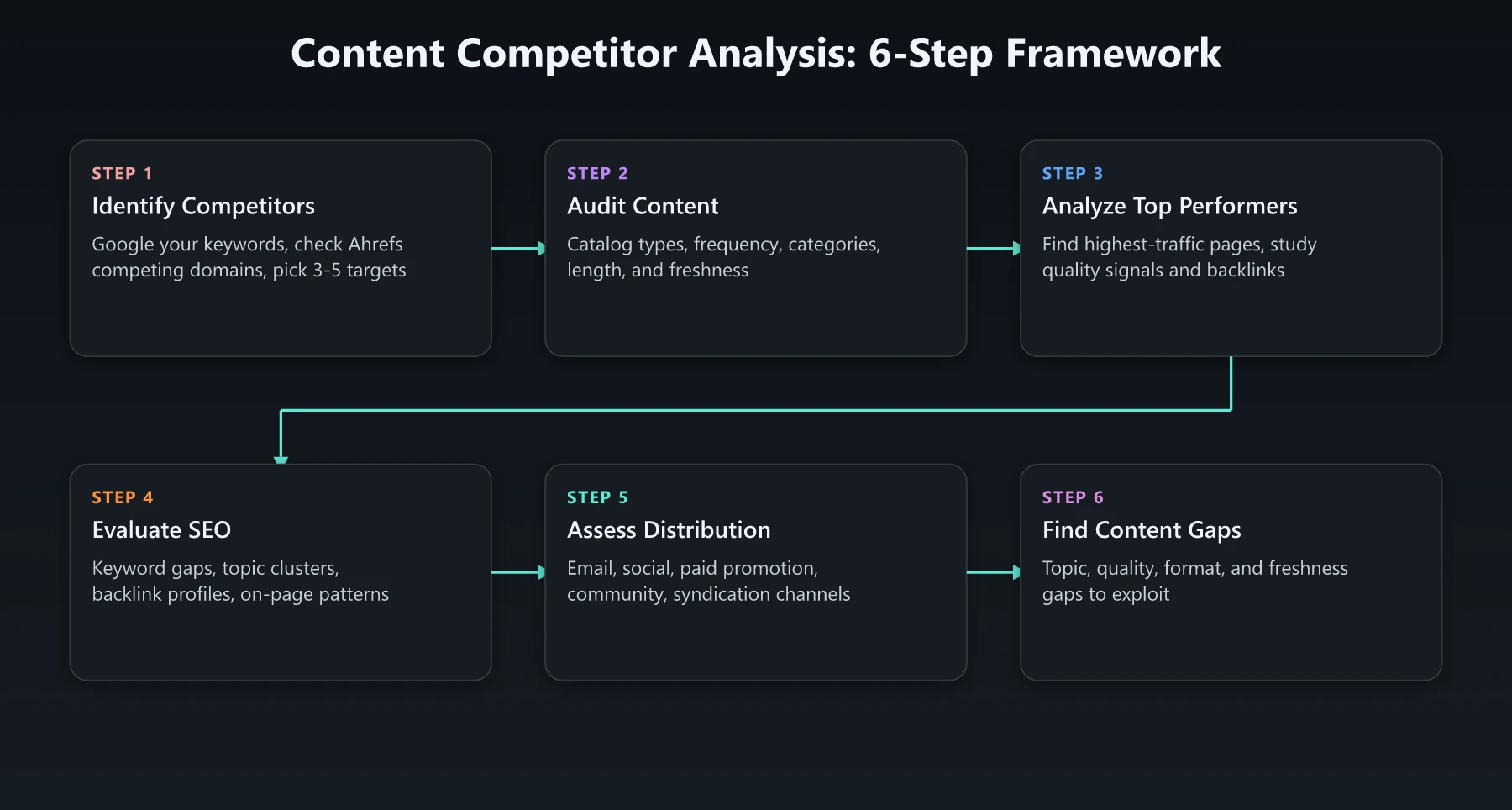
Step 1: Identify Your Real Content Competitors
Your content competitors are not always your business competitors. A SaaS company selling project management software might compete for deals against Asana and Monday.com - but in search results, they might be competing against HubSpot, Zapier, and niche bloggers who rank for the same keywords.
Find your content competitors using these methods:
- Google the keywords you want to rank for. The sites that appear on page one are your content competitors for those terms. Do this for 10-15 of your highest-priority keywords.
- Check Ahrefs or Semrush “Competing Domains” to see which sites share the most organic keyword overlap with yours.
- Look at SimilarWeb’s “Competitors” tab for sites with similar audience profiles and traffic sources.
Pick 3-5 content competitors for deep analysis. Going wider than that creates data overload without actionable insight.
Step 2: Audit Their Content Inventory
Once you know who to study, catalog what they publish. This is the foundation of everything that follows.
For each competitor, document:
| Dimension | What to Record | Why It Matters |
|---|---|---|
| Content types | Blog posts, guides, videos, podcasts, tools, templates | Reveals format preferences and investment areas |
| Publishing frequency | Posts per week/month over the last 6 months | Shows content velocity and resource commitment |
| Content categories | Main topic clusters and subtopics | Maps their content strategy and audience focus |
| Content length | Average word count for top-performing pieces | Indicates depth expectations in your niche |
| Content freshness | How often they update older posts | Signals whether they invest in content maintenance |
You can pull blog URLs at scale using Ahrefs Site Explorer or Screaming Frog. For a quick manual audit, browse their blog archive and sitemap.
Pay attention to what they do not cover. Gaps in a competitor’s content library are just as valuable as their strengths.
Step 3: Analyze Their Top-Performing Content
Not all competitor content is worth studying. Focus your analysis on the pieces that actually perform.
Identify top performers using:
- Ahrefs Top Pages report - Shows which pages drive the most organic traffic
- BuzzSumo - Reveals most-shared content by social engagement
- Semrush Organic Research - Lists pages ranked for the most keywords
For each top-performing piece, analyze:
Content quality signals:
- Depth and comprehensiveness - do they cover the topic fully or just skim the surface?
- Original research, data, or unique angles
- Visual assets - custom graphics, diagrams, videos, interactive tools
- Readability - short paragraphs, clear headers, scannable format
Performance signals:
- Estimated organic traffic (from Ahrefs or Semrush)
- Number of ranking keywords
- Number of referring domains (backlinks)
- Social shares and engagement
This analysis reveals the quality bar you need to clear. If every top-ranking piece for your target keyword is a 3,000-word guide with custom visuals, a 500-word post will not compete. Remember, only 3.45% of all published content earns any Google traffic at all - the pieces that clear the quality bar are the ones that win.
Step 4: Evaluate Their SEO Strategy
Content performance is inseparable from SEO execution. Understanding how competitors approach search optimization reveals both their strengths and vulnerabilities.
Keyword strategy analysis:
- Which keywords do they rank for? Export their keyword list from Ahrefs or Semrush. Sort by traffic value to see where they generate the most ROI from search.
- What keyword gaps exist? Use the “Content Gap” tool in Ahrefs or “Keyword Gap” in Semrush. These show keywords your competitors rank for that you do not. This is where your biggest content opportunities hide.
- How do they structure topic clusters? Look for patterns in their URL structure and internal linking. Strong competitors build pillar pages linked to related subtopics.
Backlink profile analysis:
- Which pages attract the most backlinks? These are the content types and topics that earn links in your niche.
- What types of sites link to them? Industry publications, resource pages, and roundup posts each suggest different link-building tactics.
- Which pages have strong backlinks but weak content? These represent opportunities where better content could capture those links.
On-page SEO patterns:
- Title tag formats and length
- Header structure (H2/H3 usage)
- Internal linking density and patterns
- Schema markup usage
For a more detailed SEO auditing methodology, see our guide on how to conduct a technical SEO site audit.
Step 5: Assess Their Content Distribution
Creating content is only half the equation. How competitors distribute and promote their content determines its reach and impact.
Channels to evaluate:
- Email marketing - Subscribe to their newsletter. Note frequency, content format, and how they drive traffic back to blog posts.
- Social media - Which platforms do they prioritize? What content gets the most engagement? What posting cadence do they maintain?
- Paid promotion - Check Facebook Ad Library and Google Ads Transparency Center for promoted content. If competitors pay to boost specific posts, those topics are clearly high-value.
- Community presence - Are they active on Reddit, Quora, industry forums, or Slack communities? Community distribution is hard to scale but builds authority.
- Syndication and guest posting - Do they republish content on Medium, LinkedIn articles, or industry publications?
Map out each competitor’s distribution strategy. You will often find that competitors excel in content creation but underinvest in distribution - or vice versa. Both represent opportunities.
Step 6: Find Content Gaps and Opportunities
This is where the analysis pays off. Combine everything you have gathered to identify specific opportunities.
Four types of content gaps to look for:
1. Topic gaps - Keywords and topics your audience searches for that no competitor covers well. Use the keyword gap analysis from Step 4, filtered by search intent relevance.
2. Quality gaps - Topics where existing content is thin, outdated, or poorly executed. If page-one results for a high-volume keyword are all surface-level listicles, a comprehensive guide will outperform them.
3. Format gaps - Topics where competitors only offer blog posts, but the audience would benefit from templates, calculators, video tutorials, or interactive tools.
4. Freshness gaps - High-ranking pages that have not been updated in years. Google increasingly favors fresh, current content - especially in fast-moving industries.
Prioritize opportunities using this scoring approach:
| Factor | Weight | How to Assess |
|---|---|---|
| Search volume | High | Keyword research tools |
| Competition difficulty | High | Keyword difficulty score + manual SERP review |
| Business relevance | High | Does this topic attract your ICP? |
| Content gap severity | Medium | How weak is existing coverage? |
| Link potential | Medium | Do similar topics attract backlinks? |
Score each opportunity, rank them, and you have a prioritized content roadmap built on competitive intelligence rather than intuition. For real-world examples of how competitive analysis frameworks translate into actionable strategy, check out our competitive analysis examples.
Content Competitor Analysis Tools: Free vs Paid
You do not need expensive tools to get started. Here is what is available at each price point:
| Tool | Type | Best For | Price |
|---|---|---|---|
| Google Search | Free | Manual SERP analysis, identifying content competitors | Free |
| Google Search Console | Free | Your own keyword and page performance data | Free |
| SimilarWeb (free tier) | Free | Traffic estimates, competitor identification | Free |
| Wayback Machine | Free | Tracking competitor content changes over time | Free |
| BuiltWith | Free/Paid | Identifying competitor tech stack and tools | Free tier available |
| Ahrefs | Paid | Keyword gap analysis, top pages, backlink analysis | From $29/mo (Trial), $129/mo (Lite) |
| Semrush | Paid | Organic research, content gap, position tracking | From $139/mo (Pro) |
| BuzzSumo | Paid | Social engagement analysis, content discovery | From $199/mo |
| Surfer SEO | Paid | On-page optimization, content scoring vs competitors | From $99/mo (annual) |
| SparkToro | Paid | Audience intelligence, identifying where audiences engage | From $50/mo |
The recommended stack for most teams:
- Starting out: Google Search + Google Search Console + SimilarWeb free tier. Manual but effective for identifying gaps and tracking competitors.
- Growing teams: Add Ahrefs or Semrush (pick one - not both). Either tool covers keyword research, competitor analysis, backlink tracking, and content gap identification.
- Mature content operations: Add BuzzSumo for social performance data and SparkToro for audience research. Layer in Surfer SEO if content optimization at scale is a priority. With 95% of B2B marketers now using AI-powered tools according to CMI’s 2026 research (up from 81% the year before), consider how AI-assisted workflows can accelerate your competitor analysis process.
Building Your Action Plan From the Analysis
A content competitor analysis is only valuable if it changes what you publish. The investment pays off - 58% of B2B marketers reported that content marketing directly increased their sales and revenue in 2023, according to the Content Marketing Institute. Here is how to turn findings into a content plan.
Immediate wins (execute this month):
- Update your existing pages that compete directly with top-performing competitor content. Add depth, fresher data, better visuals, or a more useful structure.
- Publish content targeting topic gaps where demand is high and competition is weak.
- Fix any technical SEO issues your competitor audit revealed (broken links, missing schema, slow pages).
Short-term strategy (next quarter):
- Build topic clusters around your highest-opportunity themes from the gap analysis.
- Test content formats your competitors are not using. If everyone publishes text guides, create a video walkthrough or interactive tool.
- Launch a distribution channel your competitors neglect. If no one in your space has a newsletter, start one.
Ongoing cadence:
- Monthly: Track competitor publishing frequency and monitor new top-performing content. Check if competitors have updated pages that compete with yours.
- Quarterly: Rerun the full content competitor analysis. Markets shift, new competitors emerge, and keyword landscapes evolve.
- Per-piece: Before creating any new content, check what already ranks for the target keyword. Every brief should include a competitor content review.
Common Mistakes in Content Marketing Competitor Analysis
Even teams that run content competitor analysis regularly make mistakes that undermine their results.
Copying instead of differentiating. The goal is not to replicate what competitors do. It is to understand the landscape so you can find angles they missed. If your content reads like a paraphrase of the top-ranking result, Google has no reason to rank it.
Analyzing too many competitors. Trying to track 10+ competitors creates analysis paralysis. Focus on 3-5 that genuinely compete for your audience’s attention in search results.
Ignoring search intent. A competitor might rank well for a keyword with a product comparison page. If you create a how-to guide for the same keyword, you are targeting a different intent. Always match the dominant intent on the SERP before creating content.
Treating it as a one-time project. Content markets are dynamic. A gap you identified three months ago may already be filled. The competitors who won last quarter may have gone stale. Build the analysis into your regular workflow, not a once-a-year exercise.
Focusing only on organic search. Content performance happens across channels. A competitor might get minimal organic traffic but dominate LinkedIn or YouTube. Analyzing only SEO data gives you an incomplete picture.
Start Your Content Marketing Competitor Analysis Today
Knowing how to do content marketing competitor analysis gives you a structural advantage over teams that publish based on intuition. The framework is straightforward: identify content competitors, audit what they publish, analyze what performs, evaluate their SEO approach, map their distribution, and find gaps.
The teams that win in content marketing are not the ones that publish the most. They are the ones that publish the right content - in the right format, targeting the right gaps, with a clear understanding of what they are competing against. In an industry heading toward $107 billion in global revenue, the gap between strategic and unfocused content teams will only widen.
Start with Step 1. Google your five highest-priority keywords. Write down who ranks on page one. That is your competitor list - and the beginning of a content strategy grounded in competitive reality rather than guesswork.
For a broader view of competitive analysis beyond content, explore our guide on competitive product analysis.
Frequently Asked Questions
How to do content marketing competitor analysis?
Start by identifying 3-5 direct competitors, audit their content across all channels, analyze their top-performing pages using tools like Ahrefs or Semrush, identify content gaps, and build a strategy to fill those gaps with better content.
What tools do I need for content competitor analysis?
Free tools like Google Search Console and SimilarWeb's free tier can get you started. For deeper analysis, Ahrefs, Semrush, and BuzzSumo help you analyze competitor keywords, backlinks, and top-performing content.
How often should you do a content competitor analysis?
Run a comprehensive content competitor analysis quarterly. Do lighter monthly check-ins on competitor publishing frequency and top-performing new content to stay responsive to market shifts.