ICP vs Buyer Persona: What's the Difference and Why You Need Both (2026)
ICP and buyer persona are not the same thing. Learn the difference, when to use each, and how to build both with frameworks, templates, and real data.
71% of companies that regularly exceed their revenue and lead goals use ideal customer profiles as a key part of their sales and marketing process (OneUpWeb via SuperOffice). Meanwhile, 81% of B2B buyers select a preferred vendor before they ever speak to sales (6sense 2024 Buyer Experience Report).
Both data points tell the same story: the companies that win are the ones who know exactly who they’re targeting and how to reach them. But ICP and buyer persona solve completely different problems - and confusing them is one of the most common mistakes in B2B marketing.
An ICP tells you which companies to target. A buyer persona tells you how to talk to the people inside those companies. Skip either one, and you’re either selling to the wrong organizations or saying the wrong things to the right ones.
ICP vs Buyer Persona: The Core Difference
Here’s the simplest way to think about it:
| Ideal Customer Profile (ICP) | Buyer Persona | |
|---|---|---|
| Defines | The right company | The right person |
| Level | Organization | Individual |
| Purpose | Pre-qualification filter | Personalization guide |
| Data type | Firmographic + technographic | Psychographic + behavioral |
| Answers | ”Should we pursue this account?" | "How do we convince this stakeholder?” |
| Example | ”B2B SaaS, 100-500 employees, $10M+ revenue, uses Salesforce" | "VP of Marketing, measured on pipeline, frustrated by manual reporting, reads industry podcasts” |
| Changes | Per market segment or product | Per role in the buying committee |
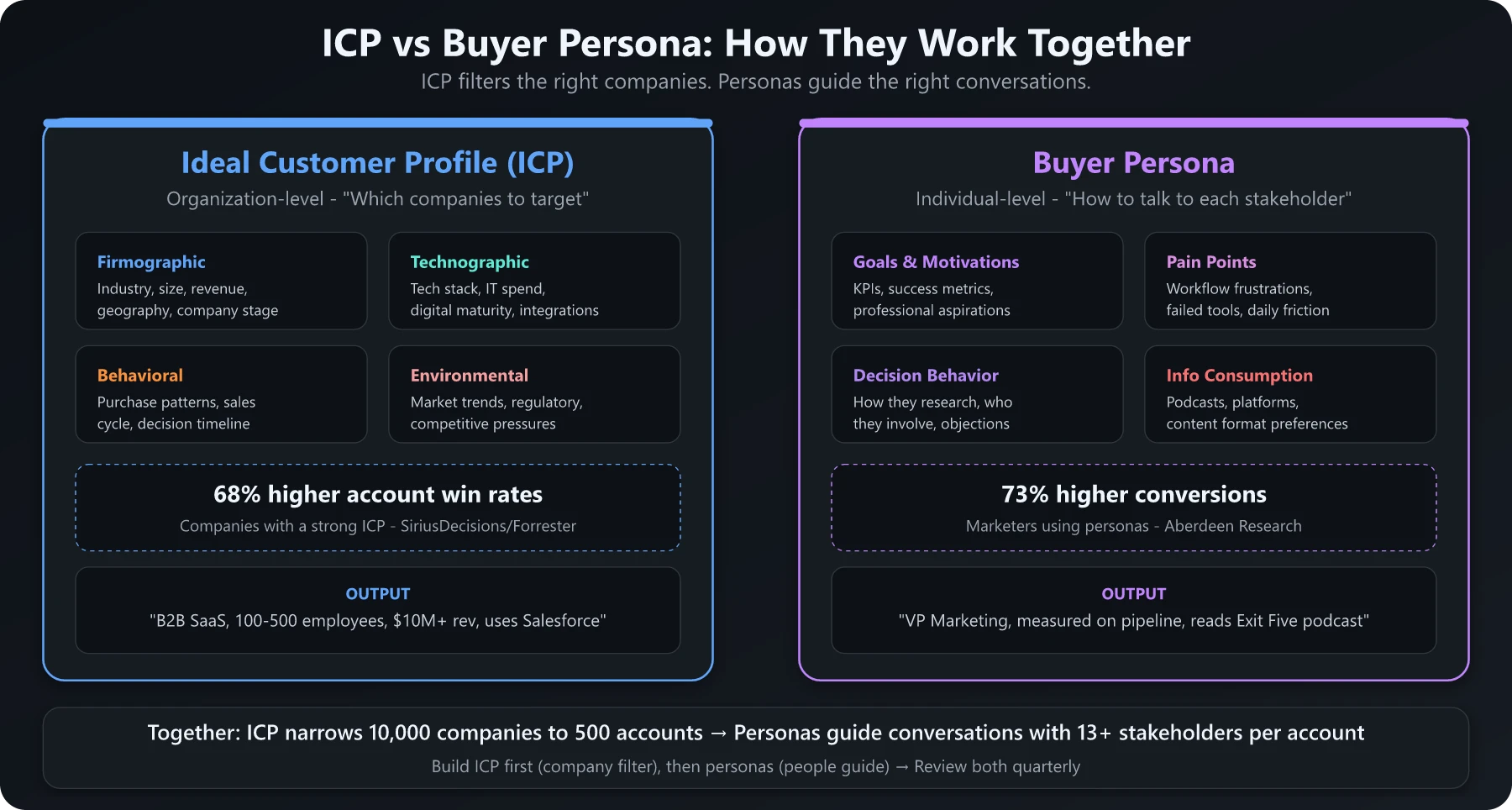
Why You Need Both
Think of it as a two-step filter:
- ICP filters companies - Out of 10,000 companies in your total addressable market, maybe 500 match your ICP
- Buyer personas guide conversations - Inside each of those 500 companies, there are 13+ internal stakeholders involved in the buying decision (Forrester 2026). Your persona tells you how to reach each one
Without an ICP, your sales team wastes time on accounts that will never close. Without personas, your marketing speaks to everyone and resonates with no one.
What Is an Ideal Customer Profile (ICP)?
An ICP is a description of the type of company - not person - that gets the most value from your product and provides the most value back to you.
Gartner defines it as “the firmographic, environmental, and behavioral attributes of accounts that are expected to become a company’s most valuable customers” (Gartner).
ICP Criteria
A strong ICP uses 8-15 criteria across four categories:
Firmographic (company basics):
- Industry vertical
- Company size (employee count)
- Annual revenue
- Geographic location
- Company stage (startup, growth, enterprise)
Technographic (tech environment):
- Current technology stack
- IT spending patterns
- Digital maturity level
- Integration requirements
Behavioral (buying patterns):
- Purchase history and frequency
- Sales cycle length
- Decision-making timeline
- Content consumption patterns
Environmental (market context):
- Regulatory requirements
- Competitive pressures
- Growth trajectory
- Industry-specific challenges
ICP Example
Here’s what a real ICP looks like for a marketing analytics SaaS:
Company size: 100-1,000 employees Revenue: $10M-$200M ARR Industry: B2B SaaS, e-commerce, fintech Tech stack: Uses Salesforce or HubSpot CRM, Google Analytics, active paid media spend Buying signal: Recently hired a VP/Director of Marketing or Growth Geography: US, UK, Canada, Australia Disqualifiers: No marketing budget owner, pre-revenue startups, agencies
The Data Behind ICP Effectiveness
The impact of a well-defined ICP is measurable:
| Metric | Impact |
|---|---|
| ABM ROI | 72% of B2B marketers say ABM delivers higher ROI than other marketing types (Momentum ITSMA / ABM Leadership Alliance 2023) |
| Pipeline growth | 84% of ABM programs report pipeline growth (Momentum ITSMA 2023) |
| Win rates | Teams aligned around buying groups achieve 2-3x higher win rates vs. lead-centric teams (Demandbase State of ABM 2026) |
| Vendor selection | 81% of B2B buyers select a preferred vendor before ever speaking to sales (6sense 2024 Buyer Experience Report) |
What Is a Buyer Persona?
A buyer persona is a semi-fictional representation of your ideal individual buyer - the actual human being who influences or makes the purchasing decision inside your target accounts.
Where an ICP is about the company, a buyer persona is about the person: their role, motivations, pain points, goals, and how they make decisions.
Buyer Persona Components
Demographics and role:
- Job title and seniority level
- Department and reporting structure
- Years of experience
- Team size they manage
Goals and motivations:
- What KPIs are they measured on?
- What does success look like for them?
- What professional goals are they working toward?
Pain points and frustrations:
- What’s broken in their current workflow?
- What tools have they tried and abandoned?
- What keeps them up at night professionally?
Decision-making behavior:
- How do they research solutions?
- Who else do they involve in decisions?
- What objections do they raise?
- What proof do they need?
Information consumption:
- What podcasts, newsletters, or publications do they follow?
- Do they prefer long-form content, video, or peer recommendations?
- Which social platforms are they active on?
Buyer Persona Example
Name: Director Dana Title: Director of Demand Generation Reports to: VP of Marketing Team: 3-5 people Measured on: Pipeline contribution, MQL-to-SQL conversion, campaign ROI Pain points: Spends 10+ hours/week pulling reports from 5 different tools. Can’t prove marketing’s impact on revenue. Gets questioned on budget every quarter. Goals: Wants a single dashboard that connects marketing activity to pipeline. Needs to justify next quarter’s budget increase. Objections: “We’ve tried analytics tools before and nobody used them.” “Our data is too messy to get clean insights.” Researches via: LinkedIn, marketing podcasts (Exit Five, Marketing Against the Grain), G2 reviews Decision role: Champion - finds the tool, builds the business case, but the VP signs off
Why the Buying Committee Makes Personas Critical
B2B purchasing has changed dramatically. According to Forrester’s 2026 State of Business Buying report, the typical buying decision now involves 13 internal stakeholders and 9 external influencers (Forrester).
Over 20 people influence a single purchasing decision.
Other data points that reinforce this:
- 94% of buying groups with 6+ members report clear benefits from the larger group (Forrester 2026)
- Procurement professionals are decision-makers in 53% of buying cycles, engaging from the start - not just at the end (Forrester 2026)
- Buying groups double in size for AI-related purchases (Forrester 2026)
- 67% of B2B buyers now prefer a rep-free experience (Gartner 2026)
Each of these stakeholders has different priorities, different concerns, and different definitions of success. A single generic message won’t work. You need personas for at least the key roles in the buying committee:
- Champion - The person who finds you and builds the internal business case
- Decision maker - The executive who approves the budget
- Technical evaluator - The person who tests the product and validates feasibility
- End user - The team members who will use it daily
- Blocker - The procurement or IT gatekeeper who can slow or kill the deal
How to Build Your ICP (Step by Step)
Step 1: Analyze Your Best Customers
Pull your top 20% of customers by revenue, retention, and NPS. Look for patterns:
- What industries are they in?
- What’s their company size range?
- What tech stack do they use?
- How long was the sales cycle?
- What triggered their purchase?
Step 2: Identify Disqualifiers
Equally important - define who is NOT a fit. Look at your worst customers (high churn, low NPS, long sales cycles) and identify the inverse patterns.
Common disqualifiers:
- Company too small to justify the price
- No budget owner in the organization
- Tech stack incompatible with your product
- Industry with regulatory constraints you can’t support
Step 3: Score and Tier Your Criteria
Not all criteria are equal. Create two tiers:
- Must-have - Deal-breakers. If a company doesn’t meet these, don’t pursue them
- Nice-to-have - Signals of a great fit, but not requirements
Step 4: Validate With Sales
Your sales team talks to prospects daily. Show them your draft ICP and ask:
- “Do our best deals match this profile?”
- “What’s missing from this description?”
- “Which criteria predict whether a deal will close?”
Step 5: Document and Distribute
Write it down in a format the entire organization can reference. Make it available in your CRM, sales playbooks, and marketing briefs.
How to Build Buyer Personas (Step by Step)
Step 1: Interview Real Customers
Talk to 10-15 customers across different roles. Ask open-ended questions:
- “Walk me through how you found and evaluated solutions like ours”
- “Who else was involved in the decision? What did they care about?”
- “What almost made you choose a competitor?”
- “How would you describe our product to a colleague?”
Step 2: Mine Your Data
Supplement interviews with quantitative data:
- CRM data on job titles and seniority of contacts
- Website analytics showing content consumption by segment
- Sales call recordings for objection patterns
- Support tickets for pain point themes
Step 3: Use the Jobs-to-Be-Done Framework
For each persona, identify the functional job they need done - not features, but outcomes.
| Persona | Job to Be Done |
|---|---|
| VP of Marketing | Prove marketing’s revenue impact to the CEO |
| Demand Gen Manager | Generate more pipeline with the same budget |
| Marketing Ops | Reduce time spent on manual reporting and data cleaning |
| CFO | Reduce software costs while maintaining capability |
The Jobs-to-Be-Done framework works because it focuses on what each stakeholder actually needs accomplished, not what they say they want. This directly informs your messaging for each persona.
Step 4: Map the Buying Journey
For each persona, document how they engage at each stage:
- Awareness - How do they discover solutions? (search, peers, events, AI search)
- Consideration - What content do they consume? (reviews, comparisons, case studies)
- Decision - What proof do they need? (ROI calculator, reference calls, security audits)
Step 5: Keep Personas Alive
Static personas go stale fast. Review quarterly with input from sales, customer success, and product.
94% of buying groups ranked their preferred vendor before first contact - and purchased from that favorite 77% of the time (6sense). Your personas need to reflect how buyers actually research and decide today, not how they did it two years ago.
ICP and Buyer Persona Working Together: A Real Example
BoodleBox
BoodleBox, an AI collaboration platform, initially targeted a broad market. After refining their ICP to focus specifically on Higher Education institutions, they went from zero to $1M ARR in 12 months and now serve 32,000+ users across 1,000+ organizations (idealcustomerprofile.com, PR Newswire).
The narrow ICP (Higher Ed) allowed them to build targeted personas (Department Heads, IT Directors, Provosts) and create messaging that spoke directly to each stakeholder’s specific needs.
PitchBook
PitchBook used ICP-aligned ABM to cut cost per click by 37.9%, accelerate their sales cycle by 14.9%, and achieve a 24.3% higher win rate (AdRoll Case Study). The combination of a tight ICP (the right accounts) and detailed personas (the right messaging) drove every metric up.
Snowflake
Snowflake scaled their 1:1 ABM program to 2,000+ accounts and saw a 75% increase in SDR-booked meetings with a 3x meeting rate (AdRoll Case Study). The key was matching the ICP filter (enterprise data teams) with persona-specific outreach for data engineers, analytics leaders, and IT directors.
Common Mistakes to Avoid
1. Building personas without an ICP first. Always start with the ICP. If you’re targeting the wrong companies, even the best buyer personas won’t save you. Define the “where” before the “who.”
2. Making the ICP too broad. “All B2B companies with 50+ employees” is not an ICP. It’s a total addressable market. The whole point of an ICP is to narrow your focus so you can dominate a specific segment.
3. Using only demographics for personas. Job title alone tells you almost nothing. A “VP of Marketing” at a 50-person startup has completely different needs than one at a Fortune 500 company. Add psychographic and behavioral data.
4. Creating personas in a conference room. Personas built from assumptions instead of customer conversations are fiction. Talk to real buyers. Listen to real sales calls. Read real support tickets.
5. Treating ICP as a static document. Markets change. Your product evolves. Your best customers from last year may not look like your best customers next year. Review and update your ICP quarterly.
6. Ignoring the buying committee. One persona isn’t enough. With 13+ stakeholders involved in B2B buying decisions, you need at least 3-4 personas covering the key roles.
How AI Is Changing ICP and Persona Development in 2026
The old way: build an ICP in a spreadsheet, update it annually, hope it’s still accurate.
The 2026 way: ICPs are becoming living data models that update continuously with real-time behavioral and intent signals (Almohmedia).
What’s changing:
- AI-powered segmentation analyzes behavioral data to find hidden patterns beyond firmographics - identifying high-value opportunities in real time (Upgrowth)
- Intent data integration shows which companies are actively researching your category right now
- Full-stack integration (CRM + MAP + predictive models) drives 22%+ pipeline conversion rates, compared to 14% baseline with limited integration (Demandbase State of ABM 2026)
- 72% of ABM practitioners say ABM delivers higher ROI than any other marketing type, with 84% reporting pipeline growth (Momentum ITSMA 2023)
- GenAI as a buying tool - B2B buyers now use AI search as a starting point, but still rely on peer networks to validate decisions (Forrester 2026)
The strategic thinking - choosing your ICP, understanding persona motivations, crafting positioning - stays human. AI handles the data processing, pattern recognition, and real-time updates that keep your profiles accurate.
Getting Started
If you don’t have an ICP or buyer personas yet, here’s the priority order:
- Build your ICP first - Analyze your top 20 customers, find the patterns, document the criteria
- Create 3-4 buyer personas - Interview 10+ customers, map their goals, pain points, and decision-making process
- Align with sales - Validate both with your sales team’s real-world experience
- Integrate into your workflow - Embed ICP criteria in your CRM lead scoring; use personas to guide content and messaging
- Review quarterly - Update based on new customer data and market shifts
Faster-growing companies drive 40% more revenue from personalization than slower-growing ones (McKinsey). The ICP and buyer persona are the foundation that makes that personalization possible.
Related reading:
- Product Positioning - How to position your product for your ICP
- Go-To-Market Strategy Template - Where ICP and personas fit in your GTM plan
- What Is Product Marketing? - The role that owns ICP and persona development
- Competitive Battlecard Template - How to arm your sales team with competitive intel
- SaaS Product Marketing Strategy - How ICP informs SaaS-specific marketing
- Marketing Strategy for New Product - Using ICP and personas to launch successfully
Frequently Asked Questions
What is the difference between an ICP and a buyer persona?
An ICP (Ideal Customer Profile) describes the type of company that is the best fit for your product - based on firmographics like industry, company size, and revenue. A buyer persona describes the individual person within that company who makes or influences the purchase decision - based on demographics, job role, goals, and pain points.
Do I need both an ICP and buyer personas?
Yes. The ICP tells your team which accounts to target, while buyer personas tell them how to communicate with the people inside those accounts. Without an ICP, you waste resources on bad-fit companies. Without personas, your messaging falls flat.
How do I build an ideal customer profile?
Analyze your best existing customers by looking at shared firmographic traits (industry, size, revenue, tech stack), identify patterns in deal size and retention rates, and validate with sales and customer success teams. Start with your top 10 accounts and work outward.