Marketing Automation Strategy: A Step-by-Step Framework for 2026
Build a marketing automation strategy that drives results. Learn how to plan, implement, and optimize automation workflows across email, ads, and CRM.
Companies with a defined marketing automation strategy see an average return of $5.44 for every dollar spent over three years, and 76% generate positive ROI within the first year (Revenue Memo). Yet most teams implement automation tools without a strategy - they turn on features, blast emails, and wonder why results disappoint.
A marketing automation strategy is not about the tool you pick. It is about designing systems that move prospects through your funnel with the right message at the right time. Here is how to build one from scratch.
Why You Need a Marketing Automation Strategy
76% of businesses use marketing automation, but only about half use it extensively across their operations (Flowlyn). The gap between adoption and effective use is where strategy comes in.
Without a strategy, automation creates problems:
- Contacts receive irrelevant or poorly timed messages
- Lead scoring does not reflect actual buying intent
- Marketing and sales work from different definitions of “qualified”
- Workflows overlap, conflict, or create email fatigue
- Nobody can measure what is working
A marketing automation strategy aligns your tools, workflows, and team around a shared plan for converting and retaining customers at scale.
The Marketing Automation Strategy Framework
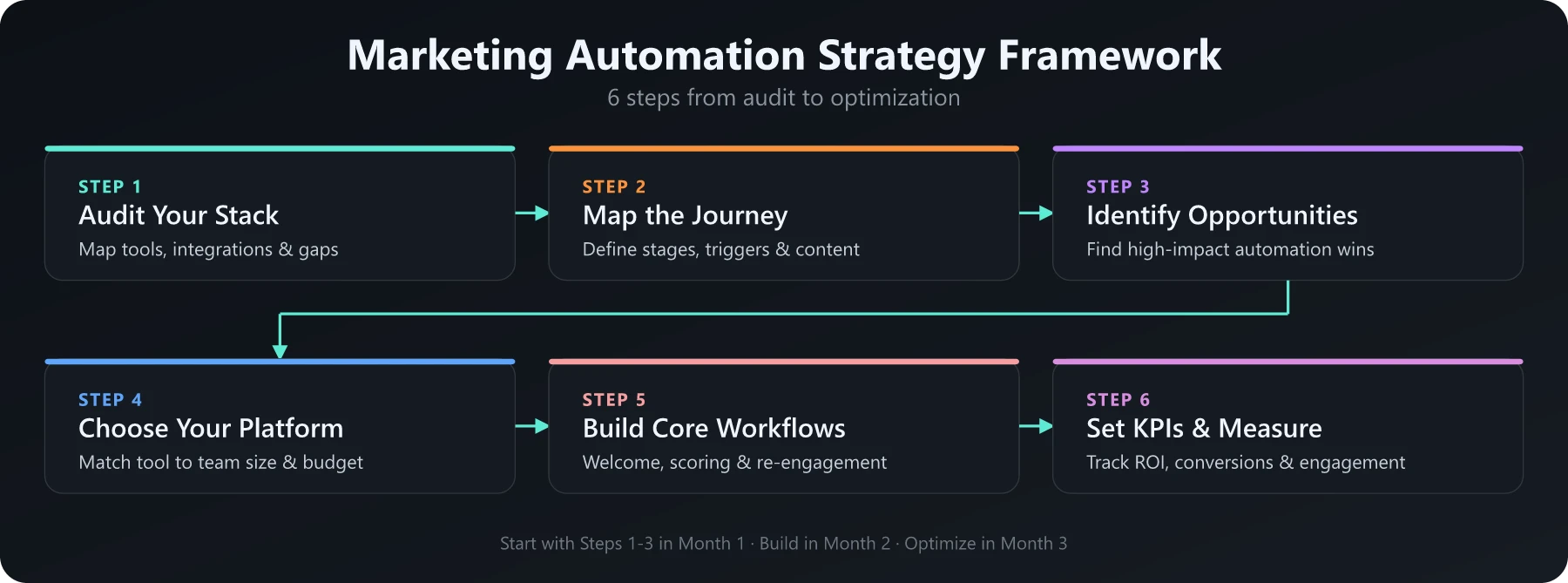
Step 1: Audit Your Current Marketing Stack
Before adding automation, map what you already have. List every tool, integration, and manual process your team uses.
| Category | Questions to Answer |
|---|---|
| What platform? Average open rate? Send frequency? | |
| CRM | What system? How clean is the data? Integration status? |
| Forms/Landing Pages | Where do leads enter? What data do you collect? |
| Content | What assets exist? What performs well? What gaps exist? |
| Analytics | What do you track? Where are the blind spots? |
Most teams discover they already have automation capabilities they are not using. Check your existing tools before buying new ones.
Step 2: Map the Customer Journey
Identify every stage a prospect moves through, from first touch to closed deal to renewal. For each stage, document:
- Entry trigger - What action brings them into this stage?
- Goal - What do you want them to do next?
- Content needed - What helps them move forward?
- Exit trigger - What signals they are ready for the next stage?
A typical B2B journey map:
- Awareness - Finds you through content, ads, or referral
- Engagement - Downloads content, subscribes, attends webinar
- Consideration - Visits pricing page, reads case studies, requests info
- Decision - Books demo, starts trial, talks to sales
- Onboarding - First use, setup, initial value
- Expansion - Upsell, cross-sell, advocacy
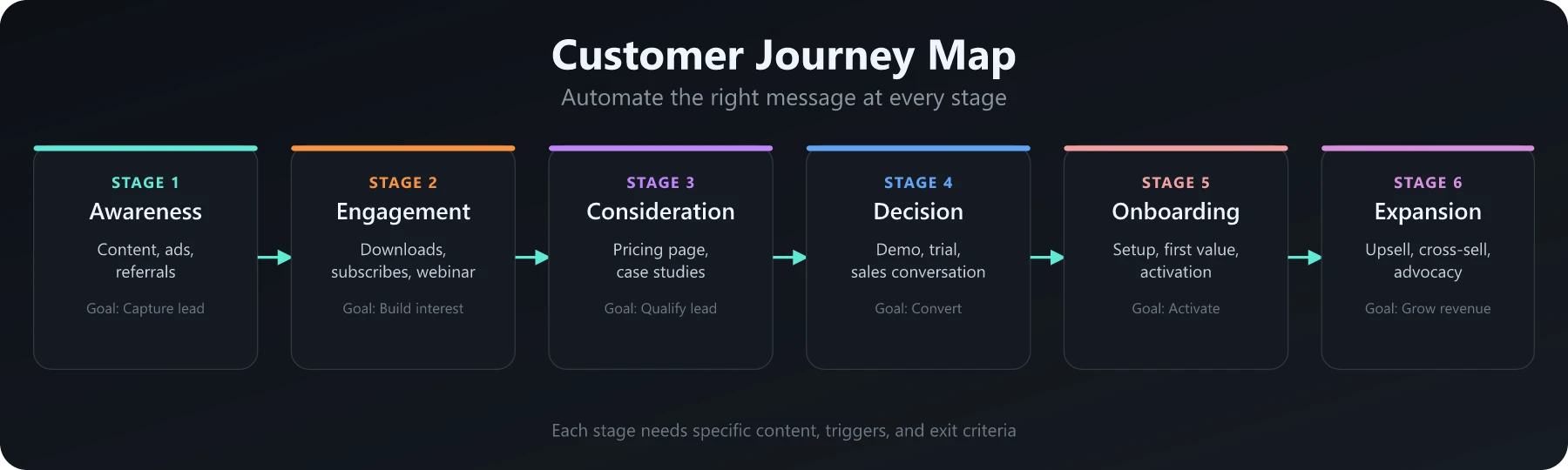
Your ICP and buyer personas should inform what content and messaging each stage requires.
Step 3: Identify Automation Opportunities
Not everything should be automated. Focus on tasks that are:
- Repetitive - You do it the same way every time
- Time-sensitive - Speed matters (lead follow-up, abandoned cart)
- Data-driven - Triggers based on behavior or attributes
- Scalable - Would break if done manually at volume
High-impact automation opportunities for most teams:
| Workflow | Impact | Complexity |
|---|---|---|
| Welcome email series | High | Low |
| Lead scoring | High | Medium |
| Abandoned cart/form recovery | High | Low |
| Lead nurture sequences | High | Medium |
| Re-engagement campaigns | Medium | Low |
| Internal notifications to sales | High | Low |
| Post-purchase onboarding | Medium | Medium |
| Review/testimonial requests | Medium | Low |
Start with 2-3 high-impact, low-complexity workflows. Expand after they prove results. For ready-to-use templates you can deploy immediately, see our 12 marketing automation workflow templates.
Step 4: Choose Your Platform
Your platform choice should match your team size, budget, and primary use case. Here is a quick comparison:
| Platform | Best For | Starting Price | Key Strength |
|---|---|---|---|
| ActiveCampaign | SMBs needing powerful automation | $15/mo annual (1,000 contacts) | Best automation builder |
| HubSpot | Mid-market all-in-one teams | $890/mo (Professional) | CRM + marketing unified |
| Brevo | Budget-conscious teams | $9/mo (5,000 emails) | Volume-based pricing |
| Klaviyo | Ecommerce brands | $20/mo (251-500 contacts) | Deep Shopify integration |
| Mailchimp | Simple email automation | $13/mo Essentials (500 contacts) | Easiest to start with |
Pricing sources: ActiveCampaign, HubSpot, Brevo
For B2B marketing automation, prioritize CRM integration and lead scoring. For B2C marketing automation, prioritize behavioral triggers and multi-channel support.
Step 5: Build Core Workflows
Every marketing automation strategy needs these foundational workflows:
Welcome Series (3-5 emails over 2 weeks)
- Email 1: Deliver the lead magnet + set expectations (immediate)
- Email 2: Share your best content on their topic (Day 3)
- Email 3: Social proof - case study or testimonial (Day 7)
- Email 4: Deeper educational content (Day 10)
- Email 5: Soft CTA - next step in the journey (Day 14)
Lead Scoring Model
- Assign points for demographics (job title, company size, industry match)
- Assign points for behavior (page visits, email clicks, content downloads)
- Set an MQL threshold that triggers sales handoff
- Subtract points for inactivity or negative signals
Re-engagement Sequence (3 emails over 3 weeks)
- Email 1: “We have something new” with your best recent content
- Email 2: Value-focused content addressing their original interest
- Email 3: Clear opt-out - “Should we stop emailing?”
Step 6: Set KPIs and Measurement
Automated emails account for 37% of all email-generated sales despite making up just 2% of email volume (Sender). But you need to track the right metrics to prove value.
| KPI | What It Measures | Target |
|---|---|---|
| Email open rate | Subject line + list quality | 35%+ for automated emails |
| Click-through rate | Content relevance | 5%+ for nurture sequences |
| MQL to SQL conversion | Lead quality | 25-35% |
| Workflow completion rate | Sequence effectiveness | 60%+ |
| Unsubscribe rate | Email fatigue | Below 0.5% per send |
| Revenue influenced | Pipeline impact | 40-60% of total pipeline |
| Automation ROI | Overall return | 5:1 or better |
Review these monthly. Adjust workflows that underperform and scale those that work. If your SaaS product depends heavily on automation for growth, tie these KPIs into your broader SaaS growth strategy.
Marketing Automation Strategy by Channel
Email Automation
Email remains the highest-ROI channel for automation. Focus on:
- Behavioral triggers - Send based on what users do, not calendar dates
- Dynamic content - Personalize sections based on segment or interest
- Send time optimization - Deliver when each contact is most active
- Frequency capping - Prevent contacts from receiving more than 3-4 emails per week across all workflows
Use AI tools to help write subject lines and email copy, then A/B test variations.
Social Media Automation
Automate scheduling and reporting, not engagement. Conversations should stay human. Key automations:
- Schedule content across platforms using Buffer, Hootsuite, or native scheduling
- Auto-share new blog posts to social channels
- Set up social listening alerts for brand mentions and competitor activity
- Route social leads into your CRM automatically
Ad Retargeting Automation
Connect your marketing automation platform to your ad platforms:
- Suppress converters - Stop showing ads to people who already bought
- Create lookalike audiences - Upload customer lists to find similar prospects
- Sequential messaging - Show different ads based on funnel stage
- Budget triggers - Pause or boost spend based on performance thresholds
CRM Automation
Your CRM and marketing platform should share a single source of truth:
- Sync lead scores to CRM contact records in real time
- Create sales tasks automatically when leads hit MQL threshold
- Log marketing touches to the deal timeline
- Update lifecycle stages based on both marketing and sales activity
Common Marketing Automation Strategy Mistakes
1. Automating before strategizing. Tools are not a strategy. Define your goals, customer journey, and success metrics before building any workflow.
2. Poor data hygiene. Automation amplifies bad data. If your contact database has duplicates, outdated info, or missing fields, clean it first. Schedule quarterly data audits.
3. Over-emailing. More emails does not equal more revenue. Set frequency caps and monitor unsubscribe rates. A contact getting daily emails from 4 different workflows will opt out fast.
4. Skipping personalization. “Hi {First Name}” is not personalization. Segment by behavior, interest, and stage. Send case studies from their industry. Reference the content they downloaded.
5. Set-it-and-forget-it mentality. Review performance monthly. Update content quarterly. Refresh lead scoring thresholds based on sales feedback. Marketing automation is a living system.
6. No sales alignment. If sales ignores your MQLs, the entire system fails. Get sales buy-in on lead scoring criteria and MQL definitions before launching. Hold weekly pipeline reviews together.
Build Your Marketing Automation Strategy This Quarter
Here is a realistic 90-day implementation plan:
Month 1 - Foundation
- Audit your current stack and data quality
- Map the customer journey for your primary ICP
- Choose your platform (or optimize your current one)
- Clean your contact database
Month 2 - Build
- Launch welcome series and lead scoring model
- Set up CRM integration and sales notifications
- Build your first nurture sequence
- Configure analytics dashboards
Month 3 - Optimize
- Review first month of data
- A/B test subject lines, send times, and CTAs
- Adjust lead scoring based on sales feedback
- Plan next wave of workflows (re-engagement, post-purchase)
Your marketing automation strategy does not need to be perfect on day one. Start with the workflows that have the highest impact, measure relentlessly, and improve every sprint. The companies that win are not the ones with the most complex automation - they are the ones that iterate fastest on what actually moves the needle.
Need help writing automation sequences faster? Check our ChatGPT prompts for marketing guide.
Frequently Asked Questions
What is a marketing automation strategy?
A marketing automation strategy is a planned approach to using software tools to automate repetitive marketing tasks like email sequences, lead scoring, and campaign triggers, aligned with specific business goals and customer journey stages.
How do I build a marketing automation strategy from scratch?
Start by mapping your customer journey, identifying repetitive tasks, choosing the right platform, building workflows for each stage (awareness, consideration, decision), and measuring results with clear KPIs.
What are the biggest marketing automation mistakes?
Common mistakes include automating without a strategy, poor data hygiene, over-emailing subscribers, skipping personalization, and not measuring ROI against clear benchmarks.