What Does a Product Marketing Manager Do? The 2026 Role Explained
What does a product marketing manager do? Real responsibilities, day-to-day tasks, skills, and salary data for the PMM role in 2026 - with industry survey data.

According to the Product Marketing Alliance State of Product Marketing 2025 report, 44.3% of PMM teams are still just 1 or 2 people - yet those same PMMs work closely with product (88.8%) and marketing (81%), making them the organizational glue between two of the most demanding functions in a modern company. The role looks small on paper and load-bearing in practice, which is why nobody can agree on what it actually involves.
Ask ten people what a product marketing manager does and you will get ten different answers. Some describe a copywriter, others a sales enabler, others a researcher. The confusion is not accidental: product marketing sits at the intersection of product, marketing, and sales, and every company scopes it a little differently based on what is missing in their org chart.
This post cuts through the ambiguity. What does a product marketing manager do in 2026? The short answer: they own the story that turns a product into revenue. The longer answer involves four core responsibilities, a set of cross-functional relationships, and a role that has become more strategic as AI has automated the rote parts of marketing.
What Does a Product Marketing Manager Do? The Core Definition
A product marketing manager (PMM) owns the go-to-market strategy for a product. That means deciding who it is for, what problem it solves, why it is better than the alternatives, and how sales should talk about it. Everything a PMM produces - positioning documents, launch plans, battlecards, pricing rationale, demo scripts - feeds one goal: making sure the product reaches the market in a way that drives revenue.
A good PMM turns a feature list into a story a buyer can repeat to their boss. A great PMM turns that story into a system that scales across every channel and touchpoint.
The 4 Core Responsibilities Every PMM Owns
The Product Marketing Alliance State of Product Marketing 2025 report describes positioning, messaging, launches, and research as the “Foundational Four” - the core work that defines the PMM role. Sales enablement and competitive intelligence have grown alongside them into an expected fourth pillar at most modern PMM functions.
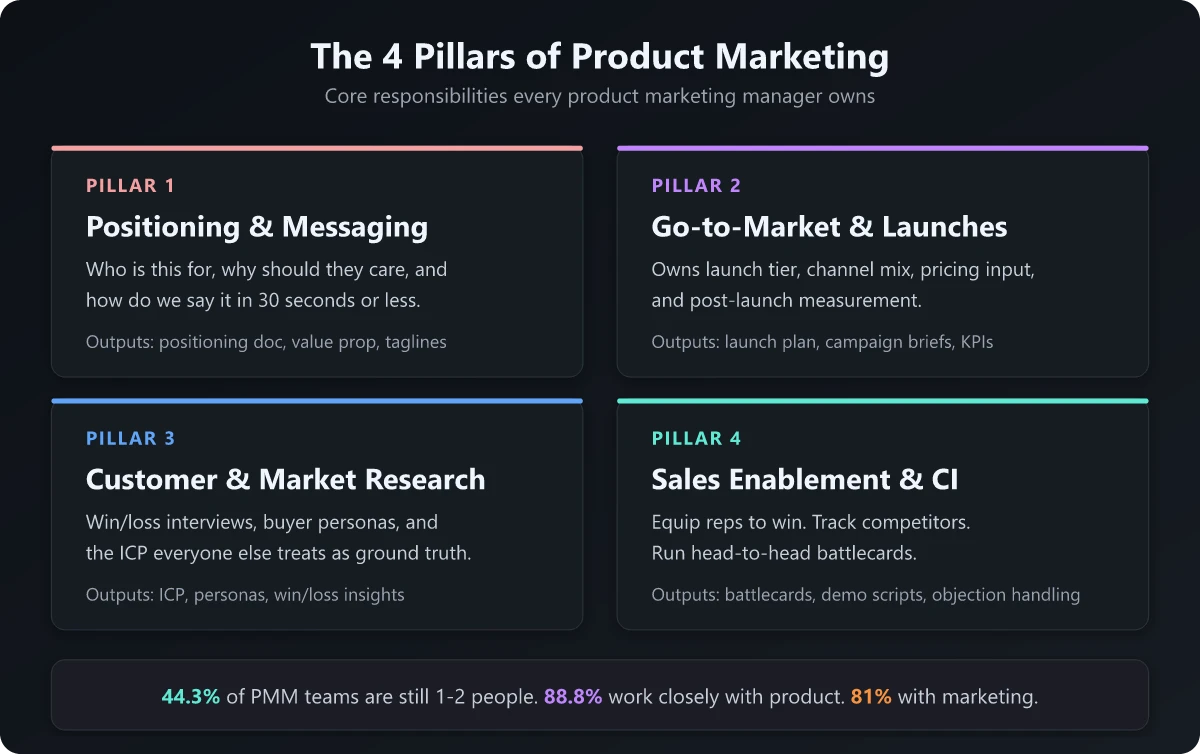
1. Positioning and Messaging
Positioning answers: who is this product for, and why should they choose it over the alternatives? Messaging answers: how do we say that in a way that makes them feel it?
A PMM writes the positioning statement, the value proposition, the tagline, the homepage hero copy, and the one-liner every sales rep uses in the first 30 seconds of a demo. Done well, positioning compresses a buyer’s decision from weeks to minutes. Done poorly, you get three marketing teams fighting over what the product even is.
For a deeper walkthrough, see our guide on product positioning.
2. Go-to-Market Strategy and Launches
When engineering ships something new, the PMM owns the plan for getting it into the market. This includes:
- Launch tier (major launch vs. feature release vs. quiet update)
- Target audience segmentation and messaging for each
- Channel mix (website, email, sales enablement, webinars, press)
- Pricing and packaging guidance
- Launch KPIs and post-launch measurement
A launch is where PMMs are most visible. It is also where the most things can go wrong if there is no clear owner. For frameworks around this, see our guide on go-to-market strategy for startups.
3. Customer and Market Research
You cannot position a product you do not understand, and you cannot understand the product without understanding the customer. PMMs run win/loss interviews, customer panels, survey work, and sit in on sales calls.
They read support tickets, study adoption data, and build the Ideal Customer Profile and buyer persona that the rest of the organization treats as ground truth.
The output of research is not a 40-page deck nobody reads. It is a short, sharp document that changes how the team talks about the product.
4. Sales Enablement and Competitive Intelligence
PMMs equip sales to sell. That means building battlecards, objection-handling scripts, demo flows, pitch decks, and competitive FAQs. It also means running competitive intelligence - tracking what competitors are shipping, how they are pricing, and how to beat them in a head-to-head.
This is the responsibility area that has grown the most in recent years. The Product Marketing Alliance report notes that PMMs are now expected to own “the customer experience across more touchpoints than ever before,” with sales enablement identified as a significant area of growth alongside website management.
Who a PMM Works With Every Day
The PMM role is structurally cross-functional. According to the Product Marketing Alliance State of Product Marketing 2025 report, 88.8% of PMMs work closely with product and 81% work closely with marketing - making them the organizational glue between the two functions.
| Partner | What the PMM Delivers | What the PMM Needs Back |
|---|---|---|
| Product Management | Market input on roadmap, launch plan, positioning | Roadmap visibility, feature context, beta access |
| Sales | Battlecards, demo scripts, objection handling, competitive intel | Deal feedback, win/loss insights, field objections |
| Marketing (Demand Gen) | Positioning, messaging, persona data, campaign briefs | Campaign performance, funnel data |
| Customer Success | Upsell narratives, adoption messaging, churn analysis input | Customer pain points, feature requests |
| Executive Team | Market POV, competitive landscape, launch readiness | Strategic priorities, budget |
The PMM’s value comes from being the one person in the building who can translate between all five of these audiences without losing the nuance.
A Typical Week in the Life of a PMM
The work varies enormously by company stage and product complexity, but most PMMs spend their week across four buckets:
- Research and analysis - reviewing customer interviews, analyzing win/loss data, studying competitive moves, reading analyst reports
- Content and collateral creation - writing positioning docs, launch plans, battlecards, demo scripts, one-pagers
- Cross-functional meetings and enablement - sales kickoffs, product reviews, launch planning, executive updates
- Measurement and iteration - checking launch metrics, pipeline influence, adoption data, updating messaging based on what is working
One trait that separates senior PMMs from mid-level ones: senior PMMs spend more time on research and strategic writing, and less time in meetings. They have earned the right to push back on calendar invites that do not move the product forward.
The PMM Team Size Reality
A common misconception is that PMM is a large, well-resourced function. The 2025 Product Marketing Alliance report shows the opposite: 44.3% of PMM teams are still just 1 or 2 people. That means most PMMs are single-threaded across multiple products, launches, and stakeholder groups.
The implication for anyone entering the role: you will be asked to prioritize constantly, and you will disappoint someone every week. Learning to say no is not optional, it is core to the job.
How Much Do Product Marketing Managers Make?
Salary data for PMMs varies significantly depending on the source, seniority level, location, and whether total compensation is included. Representative 2026 base salary figures from published salary trackers:
The spread reflects how the title itself is used differently at different companies. A “Product Marketing Manager” at a 20-person startup and a “Product Marketing Manager” at a 5,000-person SaaS company do meaningfully different jobs, and their pay reflects that. Total compensation in major tech hubs, including bonus and stock, typically runs well above base salary.
The Skills That Separate Good PMMs From Great Ones
The baseline skills are table stakes: clear writing, analytical thinking, customer empathy, and strong cross-functional communication. These get you hired. The skills that get you promoted are harder to list and harder to teach:
1. Strategic Prioritization
Every PMM has ten things on their plate and capacity for three. Great PMMs rank ruthlessly based on what moves revenue, not what the loudest stakeholder asked for.
2. Customer Synthesis
Anyone can record an interview. Few people can listen to ten customer conversations and extract the one insight that reshapes the go-to-market. That pattern-recognition skill is the difference between a PMM who parrots customers and one who shapes strategy.
3. Narrative Construction
PMMs are storytellers first. A launch plan with a sharp narrative lands, and a launch plan with a feature list does not.
The ability to build and defend a point of view - about the market, the competition, the buyer - is what earns a seat at the table.
4. Sales Fluency
PMMs who understand how deals actually close build better materials than PMMs who have never been on a sales call. Ride-along time is the single best investment a junior PMM can make.
How PMM Is Changing in 2026
AI has reshaped the rote parts of the job. Drafting first-pass battlecards, summarizing competitor news, generating copy variations, and pulling together research summaries used to take days and now take hours.
What has not changed: the judgment of which positioning is right, which launch tier to pick, and which buyer objection to prioritize. Those remain human work.
The effect on the role has been to compress the tactical layer and expand the strategic layer. PMMs who only did tactical work - writing decks, updating battlecards, building landing pages - are finding that work automated. PMMs who lead with research, positioning, and strategic sales enablement are more valuable than ever.
For more on this shift, see our take on the marketers’ AI maturity curve.
The Bottom Line: What Does a Product Marketing Manager Do?
A product marketing manager owns the story that turns a product into revenue. The job is four core responsibilities - positioning, launches, research, sales enablement - wrapped in heavy cross-functional work and protected by ruthless prioritization.
It is a role that rewards clear thinkers and strong writers, and it has become more strategic as AI has compressed the tactical side of marketing.
If you are considering the path, the best starting point is to write. Write positioning docs for products you admire, and write battlecards for companies you interview with. Writing is where the job actually happens, and it is the skill that compounds fastest.
For a broader view of what modern product marketing looks like, start with our primer on what is product marketing.
Frequently Asked Questions
What does a product marketing manager do?
A product marketing manager owns positioning, messaging, product launches, and sales enablement. They translate what the product does into why customers should care, and equip sales with the tools and content to close deals. The role sits at the intersection of product, marketing, and sales.
How is a product marketing manager different from a product manager?
A product manager decides what to build. A product marketing manager decides how to sell it. Product managers own the roadmap and internal product decisions; PMMs own the go-to-market strategy, positioning, and the story the market hears.
What skills do you need to become a product marketing manager?
Strong writing, customer research, analytical thinking, and cross-functional communication. You also need comfort with data, competitive analysis, and the ability to translate technical features into customer outcomes. Most PMMs come from marketing, sales, consulting, or product management backgrounds.
How much do product marketing managers make?
PayScale lists the average US PMM base salary at $105,620 in 2026, while Built In reports an average of $120,470. Total compensation ranges higher once bonus and stock are included, and varies significantly by seniority, industry, and location.