What Is Product Marketing? A PMM's Honest Guide (2026)
What product marketing actually is, what PMMs do all day, how it's different from other marketing roles, and what the career path really looks like - from someone who does it.

Everyone has a different answer to “what is product marketing?” Ask a founder, they’ll say launch strategy. Ask a sales rep, they’ll say battlecards. Ask a content marketer, they’ll say messaging.
They’re all partially right. And that’s exactly the problem.
Product marketing sits at the intersection of product, sales, marketing, and customer success. It’s the role that turns what your company builds into why anyone should care. And in 2026, with AI reshaping every function, it’s also one of the most strategic -and in-demand -roles in tech.
I work in product marketing. Here’s what the role actually looks like, not what the job descriptions say.
Product Marketing, Defined Simply
Product marketing is the function that connects what a product does with why customers buy it.
That’s it. Everything else -positioning, messaging, go-to-market strategy, sales enablement, competitive intelligence -flows from that core responsibility.
The Product Marketing Alliance defines it as:
Product marketing is the process of bringing a product to market and overseeing its ongoing success. It is the intersection of product, sales, and marketing.
But definitions only get you so far. Let me show you what this actually looks like day-to-day.
What Product Marketers Actually Do
Here’s a typical week in product marketing, broken into the four core pillars:
1. Market Intelligence
- Interviewing customers and prospects to understand pain points
- Analyzing competitor positioning, pricing, and feature changes
- Tracking industry trends and market shifts
- Running win/loss analyses on closed deals
Data point: According to PMA’s State of Product Marketing 2025 report, 88.8% of PMMs work closely with product teams and 81% with marketing -making it the most cross-functional marketing role by a wide margin.
2. Positioning & Messaging
- Defining how the product is positioned against competitors
- Crafting messaging frameworks for different personas and segments
- Writing value propositions that connect features to outcomes
- Testing messaging through customer interviews and A/B experiments
This is the highest-leverage work a PMM does. Get positioning right, and everything downstream -content, ads, sales conversations, onboarding -gets easier. For a deep dive on how to do this well, see our product positioning guide.
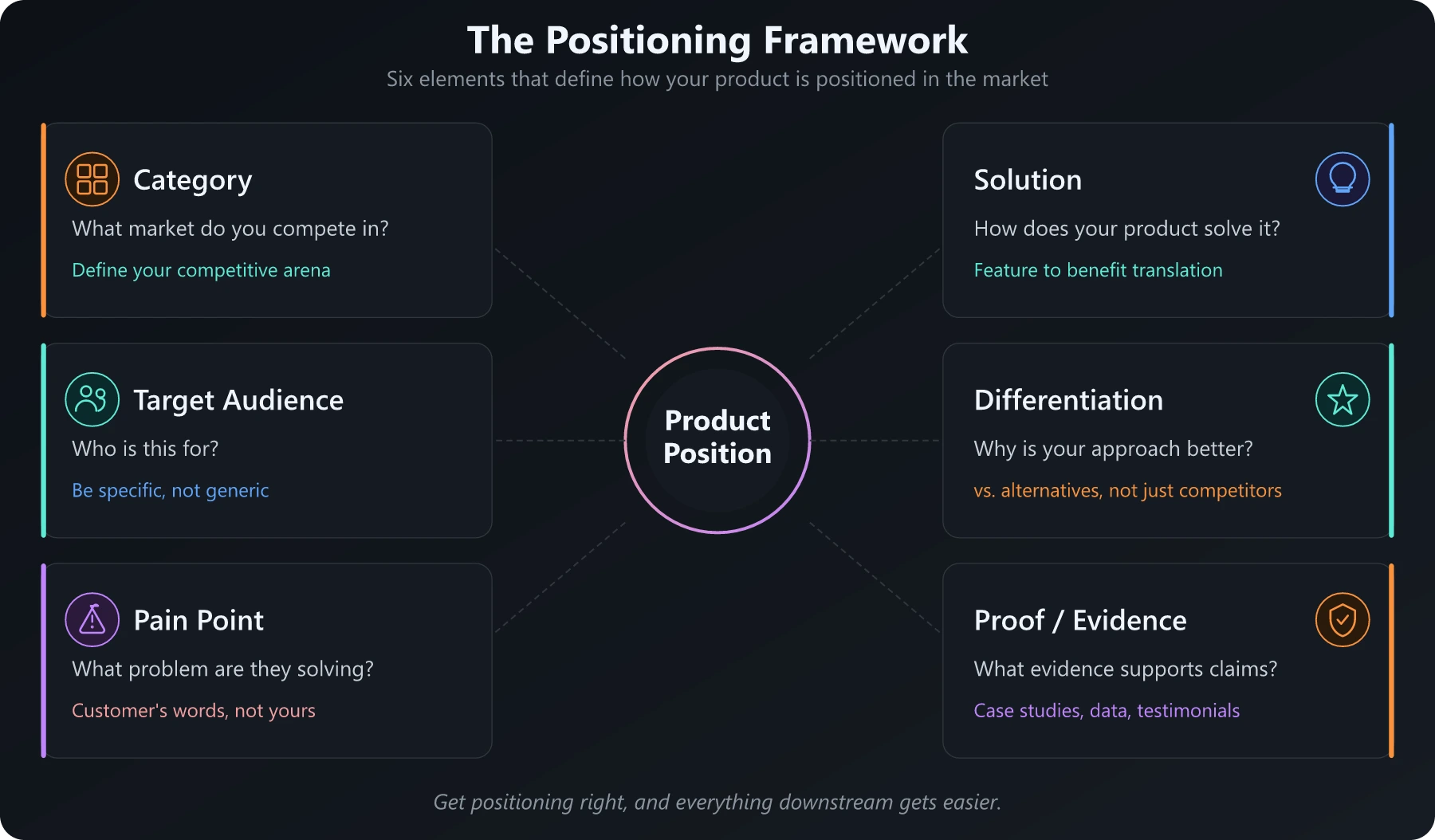
Framework I use:
| Element | Question It Answers |
|---|---|
| Category | What market do you compete in? |
| Target audience | Who is this for? |
| Pain point | What problem are they trying to solve? |
| Solution | How does your product solve it? |
| Differentiation | Why is your approach better than alternatives? |
| Proof | What evidence supports your claims? |
3. Go-to-Market Execution
- Planning and running product launches (see our go-to-market strategy template for the full framework)
- Creating launch materials: landing pages, emails, blog posts, press releases
- Coordinating across engineering, design, sales, support, and marketing
- Building sales enablement materials: battlecards, one-pagers, demo scripts
The data: A structured GTM process is the difference between a launch that drives adoption and one that falls flat. Without clear positioning, enablement, and cross-functional coordination, even great products struggle to gain traction.
4. Sales Enablement
- Training sales teams on new features, positioning, and competitive differentiators
- Creating competitive battlecards that help reps handle objections
- Building case studies and customer stories
- Joining sales calls to understand buyer objections first-hand
This is growing fast: Sales enablement is a core and expanding responsibility for PMMs. As buying committees grow larger - the average enterprise deal now involves 13 decision-makers (Salesmotion, 2026) - the need for PMM-driven enablement is only increasing.
Product Marketing vs. Other Marketing Roles
This is where it gets confusing. Here’s how product marketing differs from the roles it’s most often confused with:
Product Marketing vs. Content Marketing
Content marketing creates valuable content to attract and educate an audience. Blog posts, videos, podcasts, ebooks.
Product marketing defines what story to tell and to whom. Content marketing executes that story.
Think of it this way: Product marketing writes the messaging brief. Content marketing writes the blog post.
Product Marketing vs. Demand Generation
Demand gen fills the pipeline. It’s about driving leads, running campaigns, and optimizing conversion funnels.
Product marketing arms demand gen with the positioning, messaging, and audience insights that make those campaigns work.
A demand gen campaign without PMM input might get clicks but miss the mark on messaging. PMM without demand gen has great messaging that nobody sees.
Product Marketing vs. Brand Marketing
Brand marketing builds long-term awareness and emotional connection. It’s about perception.
Product marketing is more tactical and tied to specific products, features, and launches. It’s about conversion.
The relationship: Brand marketing provides the umbrella identity. Product marketing operates within it, translating brand values into specific product narratives.
The Quick Comparison
| Dimension | Product Marketing | Content Marketing | Demand Gen | Brand Marketing |
|---|---|---|---|---|
| Focus | Product positioning & GTM | Creating valuable content | Pipeline & leads | Perception & awareness |
| Success metrics | Win rates, adoption, revenue | Traffic, engagement, SEO | MQLs, pipeline, conversion | Awareness, sentiment, NPS |
| Funnel | Mid/bottom | Top/mid | Full funnel | Top of funnel |
| Time horizon | Launch cycles | Ongoing | Campaign-based | Long-term |
The PMM Career Path & Salary Data
Let’s talk about the career trajectory and compensation. This is real data from 2026:
Salary Ranges (US Market)
| Level | Average Salary | Total Comp Range |
|---|---|---|
| Associate/Junior PMM | $95K - $114K | $95K - $160K |
| Product Marketing Manager | $127K - $143K | $112K - $179K |
| Senior PMM | $152K - $188K | $151K - $237K |
| Director of PMM | $183K - $212K | $183K - $260K+ |
| VP of Product Marketing | $250K+ | $250K - $400K+ |
Sources: Glassdoor, Levels.fyi, ZipRecruiter
Big Tech Compensation
At companies like Google, Microsoft, and Meta, PMM total compensation (base + stock + bonus) hits $200K - $220K median at the mid-level (Levels.fyi, 2026).
Why PMMs are well-compensated: Product marketing is one of the marketing functions closest to revenue. 53.2% of PMMs have revenue as a direct KPI (PMA Report 2025). When you directly influence win rates and deal sizes, companies pay accordingly.
Career Progression
The typical path:
- Associate PMM (0-2 years) -Research, content creation, launch support
- PMM (2-5 years) -Own positioning, messaging, and GTM for a product line
- Senior PMM (5-8 years) -Lead strategic initiatives, mentor junior PMMs
- Director (8-12 years) -Manage teams, own portfolio-level strategy
- VP / Head of PMM (12+ years) -Set company-wide PMM strategy, C-suite collaboration
Alternative paths from PMM:
- Head of Marketing / CMO (many CMOs started in PMM)
- Product Management (lateral move, very common)
- Founder / startup advisor (PMM skills translate directly to early-stage companies)
Skills That Matter in 2026
The PMM skill set is evolving. Here’s what matters now:
Core Skills (Always Important)
- Strategic positioning and messaging
- Market research and competitive intelligence
- Go-to-market planning
- Cross-functional leadership
- Storytelling and narrative design
- Data analysis and insight translation
AI Skills (2026-Critical)
This is the shift. PMMs who can leverage AI have a significant advantage:
- Prompt engineering for marketing -Crafting effective prompts for content, research, and analysis
- AI-powered competitive intelligence -Using AI to monitor and analyze competitor moves in real-time
- Ask Engine Optimization (AEO) -Optimizing content for AI-driven search and answer engines
- AI content production -Using AI tools for drafting and optimization at scale
- AI-based customer analysis -Using AI to process customer feedback, reviews, and support tickets for insights
The data: AI competency is increasingly listed in marketing job postings, and the trend is accelerating. PMMs who can leverage AI tools for research, content, and competitive analysis have a clear edge in the job market.
The Soft Skills Gap
As AI handles more of the analytical and production work, soft skills become the differentiator:
- Empathy and customer intuition -Understanding what data can’t tell you
- Change management -PMMs are often the ones driving AI adoption across their teams
- Executive communication -Translating product and market complexity into clear strategic narratives
The State of Product Marketing in 2026
Some numbers that tell the story:
- 44.3% of PMM teams are only 1-2 people - This is a lean function doing outsized work
- 30.7% reported increased PMM investment this year - The function is growing
- 41% of companies now describe themselves as “product-first” (up from 31% in 2024) - Which means product marketing is more central than ever
Source: PMA State of Product Marketing 2025
Getting Into Product Marketing
If you’re considering a career in PMM, here’s my advice:
-
Start by understanding the product. The best PMMs are the ones who understand both the technology and the customer deeply.
-
Learn positioning. Read Obviously Awesome by April Dunford. It’s the definitive book on product positioning.
-
Build cross-functional muscles. PMM is a collaborative role. Get comfortable working with engineering, sales, and design simultaneously.
-
Get hands-on with AI tools. In 2026, a PMM who can’t use AI effectively is at a disadvantage. Start with ChatGPT and Claude for research, content, and competitive analysis.
-
Create a portfolio. Write positioning documents, messaging frameworks, or competitive analyses for products you use. You don’t need permission to practice PMM skills.
For SaaS companies specifically, our SaaS product marketing strategy guide covers the unique challenges of recurring revenue, product-led growth, and post-sale marketing. Product marketing is one of the most rewarding roles in tech -strategic, cross-functional, close to revenue, and constantly evolving. If you like the intersection of strategy, storytelling, and execution, it might be the right fit.
And if you’re already a PMM reading this: you’re in one of the best positions to ride the AI wave. The skills that make a great PMM -customer empathy, strategic thinking, messaging precision -are exactly the skills AI can’t replace.
Use AI for the analysis. Bring the judgment. That’s the formula.
Frequently Asked Questions
What is product marketing?
Product marketing is the function that connects a product to its market. It owns positioning, messaging, go-to-market strategy, competitive intelligence, and sales enablement - bridging the gap between product, marketing, and sales teams.
What does a product marketing manager do?
A product marketing manager (PMM) defines product positioning and messaging, launches new products, creates sales enablement materials like battlecards and one-pagers, conducts competitive analysis, and gathers customer insights to inform product and marketing strategy.
How is product marketing different from other marketing roles?
Product marketing focuses on the product-market fit and revenue impact, while content marketing focuses on audience building, demand gen focuses on pipeline, and brand marketing focuses on awareness. PMMs work cross-functionally across all these areas.
What skills do you need for product marketing?
Key skills include strategic thinking, storytelling, competitive analysis, cross-functional collaboration, data analysis, customer empathy, and the ability to translate technical features into business value.