How to Use ChatGPT for Sales and Marketing: 10 Proven Workflows (2026)
Learn how to use ChatGPT for sales and marketing with 10 proven workflows, prompts, and a framework that actually produces usable output - not generic AI slop.
Most marketers who try to learn how to use ChatGPT for sales and marketing start in the same place: they open the chat window, type “write me a blog post about X,” and paste the result into a draft. The output sounds like every other AI-generated post on the internet because the input was too thin to produce anything else. That is the gap between people who get value from ChatGPT and people who get AI slop.
This post covers how to use ChatGPT for sales and marketing in a way that produces usable output. Ten specific workflows, the prompt framework that actually works, and the mistakes that waste hours of rewriting. Every prompt below has been tested in real marketing and sales work.
According to the HubSpot State of AI report, which surveyed over 1,000 marketing and advertising professionals worldwide, 66% of marketers globally use AI in their roles and 91% of marketing leaders say employees or teams at their organization use AI to assist them. The question is no longer whether to use it. The question is how to use it well.
The Prompt Framework That Separates Good Output From Garbage
Before any specific use case, this framework matters more than any individual prompt. Use it every time.
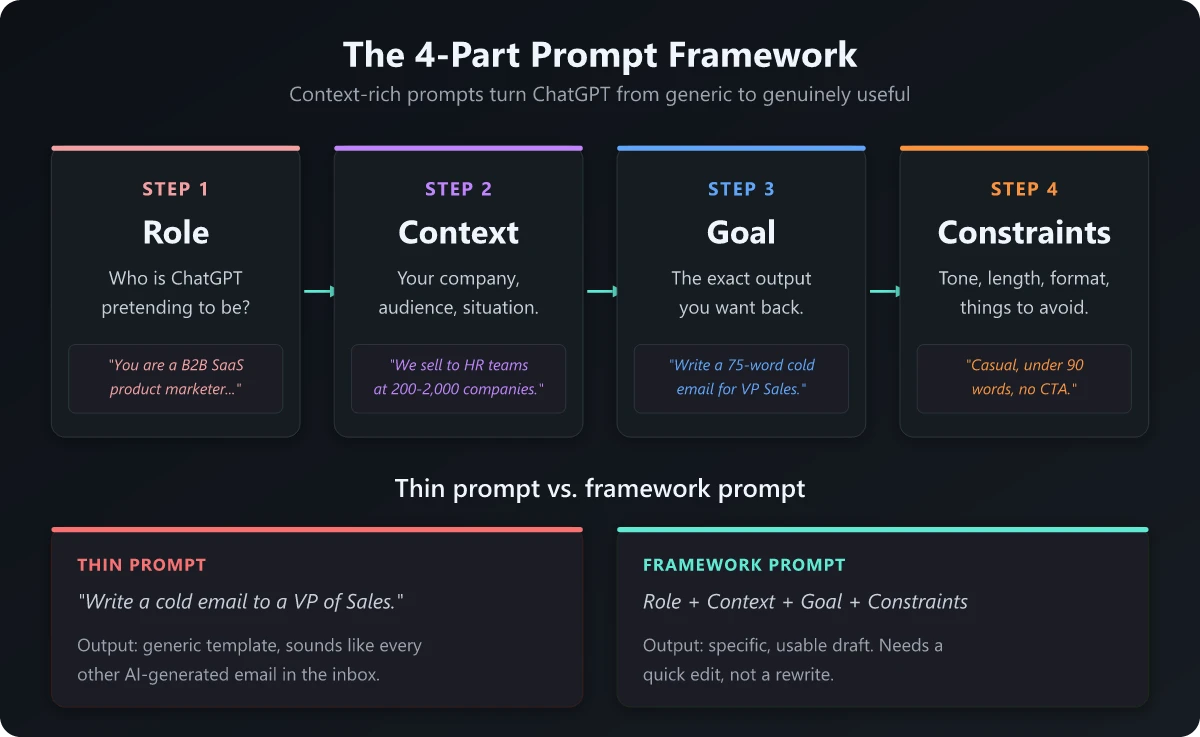
Role + Context + Goal + Constraints
- Role - who ChatGPT is pretending to be (“You are a B2B SaaS product marketer with 8 years of experience”)
- Context - what your company does, who the audience is, what the situation is (“We sell workflow automation to HR teams at 200-2,000 employee companies”)
- Goal - the exact output you want (“Write a 150-word cold email to a VP of HR”)
- Constraints - tone, length, format, anything to avoid (“Casual tone, no emdashes, no questions in the opening, under 90 words”)
Thin prompts like “write a cold email” produce thin output. Every minute you spend on the front end of the prompt saves ten minutes of rewriting.
10 Ways to Use ChatGPT for Sales and Marketing That Actually Work
1. Cold Email Personalization
The use case that gets abused the most, and the one with the biggest gap between bad and good.
Bad prompt:
Write a cold email to a VP of Sales.
Good prompt:
You are an outbound SDR at a sales engagement platform.
Write a 75-word cold email to a VP of Sales at a Series B
SaaS company (50-200 employees). Their team is struggling
with low cold email reply rates. We help by improving copy
and automating follow-ups. Tone: casual, direct. No
questions in the opening. Do not use emdashes. End with a
soft CTA asking if they'd like to see a 30-second demo.
The second prompt produces output you can actually send after a quick edit. The first produces a template anyone could have written.
2. Content Brief Generation
Content briefs that used to take an hour can take five minutes. The trick is feeding ChatGPT the SERP context.
You are a B2B content strategist. Create a content brief
for the keyword "marketing automation for small business."
Include: target reader, search intent, 8-10 H2 sections,
3 key questions to answer, 2 data points to include, and
the tone to match (practical, no fluff). Format as markdown.
Pair this with a screenshot or paste of the current top 5 ranking pages and you get a brief that knows what it is competing against.
3. Competitor Battlecard Draft
For product marketers, this is one of the fastest wins. Feed ChatGPT the competitor’s website and a transcript of their sales demo, and ask for a head-to-head battlecard.
You are a B2B product marketer. Create a competitive
battlecard for [Competitor X] based on the information
below. Structure: (1) Their positioning in one line,
(2) Top 3 strengths, (3) Top 3 weaknesses, (4) Best way
to beat them in a deal, (5) Objection handling for their
strongest claim. Be specific and avoid generic statements.
The key word is “avoid generic statements.” Without that constraint, ChatGPT will produce vague filler. See our competitive battlecard template for the full structure.
4. Customer Interview Synthesis
One of the highest-leverage uses. Paste a win/loss interview transcript and ask ChatGPT to pull out themes, quotes, and insights.
You are a customer insights analyst. Below is a transcript
from a win interview with a new customer. Extract: (1) the
exact words they used to describe the problem, (2) which
competitors they evaluated, (3) the decisive factor,
(4) one direct quote under 25 words that we could use in
marketing. Be literal and do not paraphrase.
The “be literal” constraint stops ChatGPT from inventing quotes, which is the most dangerous failure mode for this use case.
5. Sales Email Follow-Up Sequences
Sales reps hate writing follow-up sequences. ChatGPT produces decent drafts in seconds.
You are a B2B SDR. Write a 4-email follow-up sequence to
a prospect who downloaded our e-book on marketing
attribution but has not responded. Each email should be
under 90 words. Email 1: value-add insight. Email 2:
case study reference. Email 3: break-up attempt. Email 4:
last ask. No emdashes. Keep the tone conversational.
6. Landing Page Copy Variations
For A/B testing, you need multiple versions of the same core message. ChatGPT is fast at this.
You are a conversion copywriter. Write 5 variations of a
hero headline for a landing page selling marketing
automation software to HR teams. Each headline must be
under 10 words, benefit-led, and avoid the word "platform."
Include a 15-word subhead for each.
7. SEO Meta Descriptions at Scale
If you have a spreadsheet of 50 URLs that need meta descriptions, ChatGPT can process them in one pass.
You are an SEO specialist. For each URL and H1 below,
write a meta description between 150 and 160 characters.
Include the primary keyword naturally, front-load the
value, and end with a light CTA. Avoid clickbait.

[Paste URL + H1 + primary keyword for each page]
8. Social Media Post Variations
One blog post can become five social posts - if you brief ChatGPT properly.
You are a B2B social media manager. Below is a blog post
about [topic]. Write 5 LinkedIn posts, each under 150
words. Use different angles: (1) a contrarian take,
(2) a personal experience hook, (3) a data point,
(4) a question opener, (5) a "I learned this the hard
way" style. No hashtags. No emdashes.
9. ICP and Persona Refinement
Start with a rough ICP and let ChatGPT pressure-test it.
You are a customer research expert. Below is our
current ICP. Identify: (1) assumptions we are making
that might not be true, (2) buyer objections we are
probably missing, (3) segments we might be ignoring.
Be specific and challenge the document rather than
affirming it.
The “challenge rather than affirm” constraint is critical. ChatGPT defaults to being agreeable, which makes it useless as a critic unless you explicitly tell it otherwise. For more on ICPs, see our guide on ICP vs buyer persona.
10. Demo Script and Talk Track
For sales teams preparing for demos, ChatGPT can draft talk tracks that tie features to outcomes.
You are a sales engineer at a B2B SaaS company. Write a
10-minute demo script for our marketing automation product.
The prospect is a marketing ops lead at a 500-person SaaS
company. Focus on outcomes not features. Open with a pain
point, not a feature list. Include one place for a
customer story. End with a specific next step.
The Biggest Mistakes Marketers Make With ChatGPT
Mistake 1: Treating It as a Final Draft
ChatGPT produces first drafts. Every output needs a human edit before it ships. The marketers who publish unedited AI output are the ones producing the content everyone else learns to scroll past.
Mistake 2: Skipping the Context
Half the bad output on the internet comes from prompts like “write a LinkedIn post.” ChatGPT has no idea what your company does, who reads your content, or what your voice sounds like. If you do not give it that context, it will invent something generic.
Mistake 3: Not Challenging the Output
ChatGPT is trained to be helpful, which means it agrees with your premises by default. For strategic work, you need a model that pushes back. Prompts that include “identify weaknesses in this argument” or “what am I missing” are significantly more useful than prompts that say “improve this.”
Mistake 4: Uploading Sensitive Data to Free Accounts
Free and personal ChatGPT accounts can use your inputs as training data unless you opt out. Never paste customer data, financial information, internal roadmap documents, or contract terms into a free account. For company work, use an enterprise or team account with data controls enabled, or run it through a workflow your security team has approved.
Mistake 5: Using ChatGPT for Facts Without Verification
ChatGPT will hallucinate statistics, quotes, and case studies with total confidence. For any factual claim, verify the original source before using it. This is the single biggest reputation risk when using AI in content work.
Where ChatGPT for Sales and Marketing Fits in a Realistic Workflow
ChatGPT works best as a force multiplier on tasks you already know how to do, and it is terrible as a replacement for skills you do not have. A good copywriter with ChatGPT produces twice as much work, and a bad copywriter with ChatGPT produces twice as much bad work.
The tasks where it genuinely saves hours per week:
- First drafts of any structured content (emails, briefs, battlecards, meta descriptions)
- Variations of copy you have already validated (headline tests, subject line tests)
- Summarization and synthesis of long documents (interviews, reports, transcripts)
- Rewriting for tone or length when you have a clear direction
- Research scaffolding (list questions to ask, outline what to cover)
The tasks where it hurts more than it helps:
- Producing the strategic point of view a campaign needs
- Making judgment calls on positioning, messaging, or pricing
- Anything requiring up-to-date market data without verification
- Deeply original content where the voice matters more than the structure
For a broader view on how AI is reshaping the marketing function, see our AI future of SEO post and the marketers’ AI maturity curve.
The Bottom Line on How to Use ChatGPT for Sales and Marketing
Using ChatGPT for sales and marketing is not about writing clever prompts. It is about treating it like a junior team member you are managing: give it context, set clear constraints, verify its work, and edit before shipping.
Do that and it saves hours every week. Skip any step and you produce the same generic output the rest of the internet is already drowning in.
The marketers getting the most value from ChatGPT in 2026 are not the ones using the newest features. They are the ones who have built a repeatable prompt framework, know exactly where ChatGPT helps and where it hurts, and treat every output as a draft rather than a deliverable. Start there and the rest follows.
If you want a deeper prompt library to work from, see our collection of ChatGPT prompts for marketing.
Frequently Asked Questions
How do marketers use ChatGPT?
Marketers use ChatGPT for drafting blog posts, generating ad variations, summarizing customer interviews, writing email sequences, building landing page copy, creating social media posts, and producing first-pass positioning and messaging documents. The most effective users treat it as a junior writer that needs specific context and strong editing.
Is ChatGPT good for sales outreach?
Yes, for personalization at scale and first drafts - but not as a send-button tool. ChatGPT excels at researching prospects, generating opening lines, rewriting templates for specific personas, and drafting follow-up sequences. Every output still needs a human review before it hits a prospect's inbox.
What is the best prompt format for marketing tasks?
Use the Role + Context + Goal + Constraints format. Assign ChatGPT a specific role, provide context about your company and target audience, state the exact output you want, and list constraints like tone, length, and format. Generic prompts produce generic output.
Is it safe to put company data into ChatGPT?
Only if you use an enterprise or team tier with data controls, or if you have explicit permission from your security team. Free and personal accounts train on your inputs unless you opt out. Never paste customer data, contracts, financials, or roadmap documents into a free ChatGPT account.