B2C Marketing Automation: The Complete Guide for 2026
Master B2C marketing automation with proven workflows, tool comparisons, and real examples. From email sequences to AI-powered personalization.
75% of marketers now use at least one type of marketing automation tool (EmailMonday). Yet most of them are running B2B playbooks - lead scoring, drip nurture, MQL handoffs - that don’t translate to consumer brands.
B2C marketing automation operates on a fundamentally different playing field. Your customers don’t fill out demo request forms. They browse, abandon carts, scroll past ads, and make purchase decisions in minutes, not months. The automation workflows that win in B2C are built for speed, personalization, and scale.
This guide covers exactly what works - the workflows, tools, and strategies that drive real revenue for consumer brands.
What Is B2C Marketing Automation (And How It Differs from B2B)
B2C marketing automation uses software to trigger personalized messages and actions based on consumer behavior - purchases, browsing activity, cart abandonment, email engagement, and more. The goal is delivering the right message at the right moment without manual intervention.
The difference from B2B automation is significant:
| Factor | B2C Automation | B2B Automation |
|---|---|---|
| Sales cycle | Minutes to days | Weeks to months |
| Decision maker | Individual consumer | Buying committee |
| Primary channels | Email, SMS, push, social | Email, LinkedIn, webinars |
| Trigger focus | Behavior and purchase signals | Lead score and content engagement |
| Volume | Thousands to millions of contacts | Hundreds to thousands |
| Personalization | Product recommendations, dynamic content | Account-based, industry-specific |
| Goal | Direct purchase or repeat buy | Lead qualification and handoff |
B2B automation nurtures leads toward a sales conversation. B2C marketing automation drives immediate action - a purchase, a subscription renewal, a referral. For the B2B side, see our complete guide to B2B marketing automation.
Why B2C Marketing Automation Matters Now
The numbers make the case clearly. Companies earn an average of $5.44 for every $1.00 spent on marketing automation over the first three years (Oracle). Most businesses recoup their entire investment in under six months.
Three forces are making automation non-negotiable for B2C brands right now:
Consumer Expectations Have Shifted
74% of consumers expect brands to deliver personalized experiences (MoEngage). Generic batch-and-blast emails don’t cut it anymore. Consumers expect you to know what they browsed, what they bought, and what they’re likely to want next.
AI Has Made Personalization Accessible
You no longer need a data science team to deliver 1:1 personalization. Modern B2C marketing automation platforms use AI to generate product recommendations, optimize send times, and predict churn - all out of the box. If you’re exploring how AI fits into your marketing stack, check out these free AI tools for marketing that pair well with automation platforms.
The Revenue Impact Is Measurable
The ROI extends to specific workflows too. Abandoned cart emails consistently deliver the highest returns of any automated flow, with top-performing brands recovering 5-15% of otherwise lost revenue.
Core B2C Marketing Automation Workflows
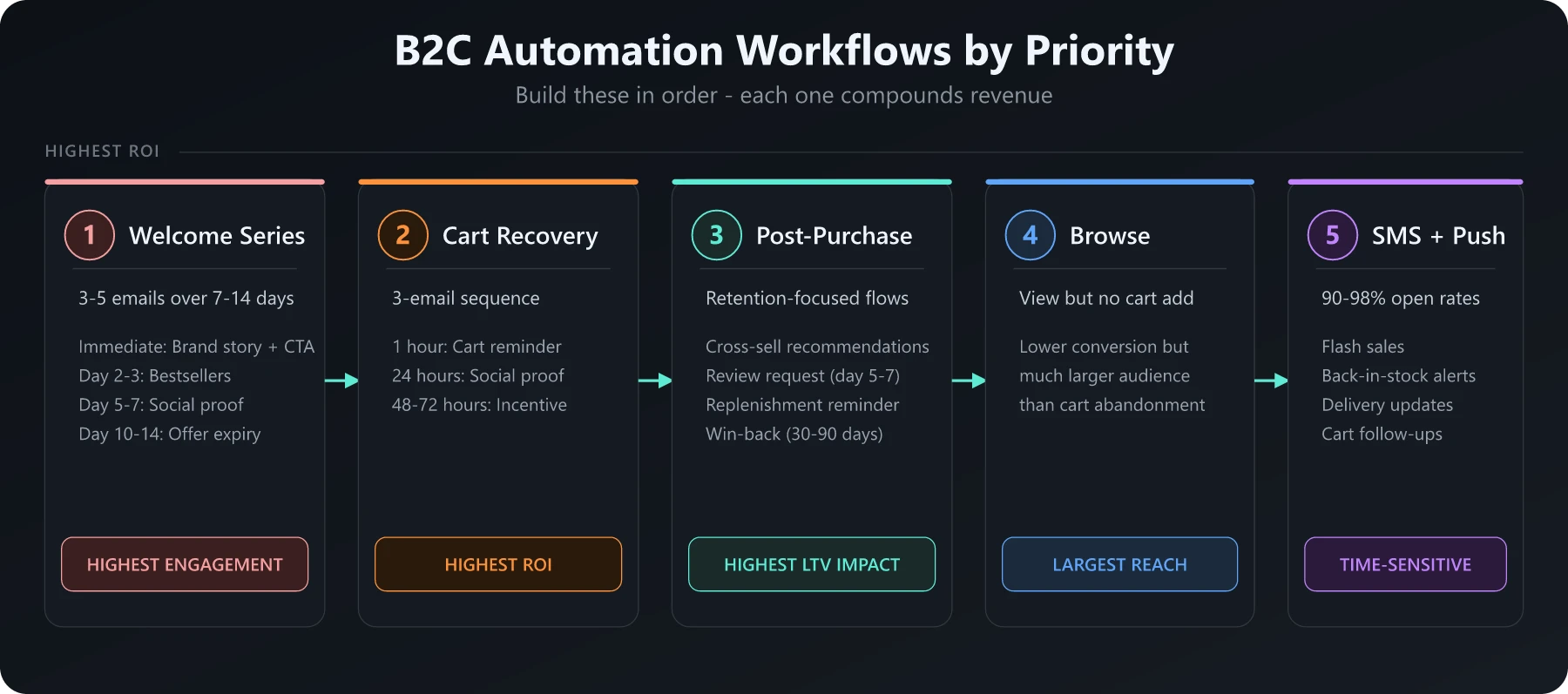
These are the workflows that generate the most revenue for consumer brands. Prioritize them in this order.
1. Welcome Series
The first email a subscriber receives sets the tone for the entire relationship. A well-designed welcome series (3-5 emails over 7-14 days) typically outperforms any other automated flow in terms of engagement.
A strong welcome series includes:
- Email 1 (immediate): Brand story, discount code if promised, clear CTA
- Email 2 (day 2-3): Product bestsellers or category highlights
- Email 3 (day 5-7): Social proof - reviews, UGC, customer stories
- Email 4 (day 10-14): Reminder of expiring welcome offer
2. Abandoned Cart Recovery
Cart abandonment emails are the highest-ROI automation you can build. They consistently see open rates well above standard promotional emails, often exceeding 40-50%.
Timing matters. Send the first email within 30-60 minutes of abandonment. A three-email sequence generates significantly more revenue than a single reminder - multiple touchpoints give you more chances to recover the sale.
A proven three-email sequence:
- Email 1 (1 hour): “You left something behind” with cart contents
- Email 2 (24 hours): Add social proof or urgency
- Email 3 (48-72 hours): Final reminder with incentive (free shipping, small discount)
3. Post-Purchase and Retention
Acquiring a new customer costs 5-25x more than retaining an existing one (Harvard Business Review). Post-purchase automation keeps buyers engaged and drives repeat purchases.
Key post-purchase flows:
- Order confirmation with cross-sell recommendations
- Shipping and delivery updates
- Review request (5-7 days after delivery)
- Replenishment reminder (for consumable products)
- Win-back sequence (30-90 days of inactivity)
4. Browse Abandonment
When a customer views products but doesn’t add to cart, browse abandonment emails nudge them back. These convert at lower rates than cart abandonment but reach a much larger audience.
5. SMS and Push Automation
SMS messages have a 98% open rate (EZ Texting), making it a powerful complement to email. Use SMS for time-sensitive messages - flash sales, back-in-stock alerts, delivery notifications, and abandoned cart follow-ups.
For ideas on making these messages more engaging, see our guide on email interactivity - many of the same principles apply to SMS and push.
Best B2C Marketing Automation Tools
Choosing the right platform depends on your business size, channel mix, and ecommerce platform. Here’s how the top options compare:
| Platform | Starting Price | Free Plan | Best For | Key Strength |
|---|---|---|---|---|
| Klaviyo | $20/mo (251-500 contacts) | 250 contacts, 500 emails | Ecommerce brands on Shopify | Deep ecommerce integrations, predictive analytics |
| Omnisend | $16/mo (500 contacts) | 250 contacts, 500 emails | SMB ecommerce | All-in-one email + SMS + push at lower cost |
| ActiveCampaign | $15/mo annual (1,000 contacts) | 14-day trial only | Complex automations | Most powerful automation builder |
| Brevo | $9/mo (5,000 sends) | 300 emails/day, up to 100K contacts | Budget-conscious teams | Volume-based pricing, transactional email |
Sources: Klaviyo Pricing, Omnisend Pricing, ActiveCampaign Pricing, Brevo Pricing
Klaviyo
The dominant choice for Shopify-based ecommerce. Klaviyo’s strength is its deep integration with ecommerce platforms - it pulls in purchase history, browsing data, and predicted lifetime value to power segmentation and automation.
Pricing model: Contact-based. Scales from $20/month for 500 contacts to $100+/month for 5,000 contacts. SMS adds cost - the combined Email + SMS plan starts at $35/month (Klaviyo).
Best for: Mid-size to large ecommerce brands that need advanced segmentation and predictive analytics.
Omnisend
Purpose-built for ecommerce with a simpler interface than Klaviyo. Bundles email, SMS, and push notifications into every plan - including the free tier.
Pricing model: Contact-based. Standard plan scales from $16/month for 500 contacts to $132/month for 10,000 contacts. The Pro plan ($59/month for 2,500 contacts) adds unlimited emails (Omnisend).
Best for: Small to mid-size ecommerce brands that want multichannel automation without complexity.
ActiveCampaign
The most powerful automation builder on this list. ActiveCampaign’s visual workflow editor supports conditional logic, split actions, and advanced branching that other platforms can’t match.
Pricing model: Contact-based with feature tiers. Starter at $15/month, Plus at $49/month, Pro at $79/month for 1,000 contacts with annual billing (ActiveCampaign). The Plus plan unlocks the full automation features most B2C brands need.
Best for: Brands with complex customer journeys that span multiple touchpoints and conditions.
Brevo (formerly Sendinblue)
The budget pick. Brevo charges by email volume instead of contact count, which makes it dramatically cheaper for brands with large lists and moderate sending frequency.
Pricing model: Volume-based. Free plan includes up to 100,000 contacts with 300 emails/day. Starter plan begins at $9/month for 5,000 monthly sends. The Standard plan (which includes automation) is the most popular tier (Brevo).
Best for: Early-stage brands with growing lists that need affordable email + automation.
How to Build Your First B2C Marketing Automation Stack
Don’t try to automate everything at once. Follow this phased approach:
Phase 1: Foundation (Week 1-2)
Set up your platform and data connections. Choose a tool from the comparison above, connect your ecommerce platform, and import your existing contacts. Configure these three flows first:
- Welcome series (3-4 emails)
- Abandoned cart recovery (3 emails)
- Post-purchase follow-up (2 emails)
These three workflows alone will capture the majority of your automation revenue. If you’re launching a new product alongside this, our marketing strategy for new product guide covers how automation fits into a broader launch plan.
Phase 2: Optimization (Week 3-6)
Add segmentation and testing. Segment your audience by purchase history, engagement level, and browsing behavior. Start A/B testing subject lines, send times, and offers within your existing flows.
Key segments to build:
- VIP customers (top 10% by lifetime value)
- At-risk customers (no purchase in 60+ days)
- Browse-but-didn’t-buy (product page views, no cart add)
- One-time buyers (purchased once, no repeat)
Phase 3: Expansion (Month 2-3)
Layer in additional channels and advanced flows. Add SMS automation for high-intent triggers. Build browse abandonment flows. Create a win-back series for lapsed customers.
This is also when you should explore AI-powered features - predictive product recommendations, send time optimization, and churn prediction. You can use ChatGPT prompts for marketing to draft automation copy faster.
B2C Marketing Automation Best Practices
Personalize Beyond First Name
Using someone’s first name in a subject line is table stakes. Real personalization means dynamic product recommendations based on browsing history, content blocks that change based on purchase behavior, and send times optimized per individual.
Respect Frequency Limits
The fastest way to kill your email program is over-sending. Set global frequency caps - most B2C brands find 3-5 emails per week is the maximum before engagement drops. Make sure your automation flows and campaigns share a unified suppression system.
Build for Mobile First
Around 46% of all email opens now happen on mobile devices (HubSpot). Every automated email should be designed for a phone screen first. Keep subject lines under 40 characters, use a single-column layout, and make CTAs thumb-friendly.
Test Continuously
Run A/B tests on every flow. The variables that move the needle most in B2C automation:
- Subject lines: Question vs. statement vs. urgency
- Send timing: Within 1 hour vs. 4 hours vs. 24 hours for cart abandonment
- Incentives: Free shipping vs. percentage discount vs. no discount
- Email length: Short and punchy vs. detailed with social proof
Track the Right Metrics
Don’t get distracted by open rates alone. The metrics that matter for B2C marketing automation:
| Metric | What It Tells You | Benchmark |
|---|---|---|
| Revenue per recipient | Direct financial impact | Varies by flow |
| Conversion rate | Effectiveness at driving purchases | 2-5% for email flows |
| List growth rate | Health of your acquisition | 2-5% monthly |
| Unsubscribe rate | Sending quality/frequency | Below 0.3% per send |
| Flow revenue share | Automation vs. campaign performance | 30-50% of email revenue |
Getting Started with B2C Marketing Automation
B2C marketing automation is no longer optional for consumer brands that want to compete. The tools are more accessible than ever, the ROI is proven at $5.44 per dollar spent over three years, and modern platforms handle much of the complexity through AI-powered features.
Start small. Build your welcome series, cart abandonment, and post-purchase flows first. These three automations will capture the lion’s share of available revenue. For a step-by-step framework covering both B2B and B2C, see our marketing automation strategy guide and our collection of marketing automation workflow templates. Then expand into SMS, browse abandonment, and advanced segmentation as you learn what your audience responds to.
The brands winning in 2026 aren’t sending more messages. They’re sending better ones - triggered by behavior, personalized to the individual, and timed for maximum impact. That’s what B2C marketing automation makes possible.