Competitive Product Analysis: A Step-by-Step Framework for Product Marketers (2026)
Learn how to run a competitive product analysis that drives real decisions. Includes frameworks, templates, and a step-by-step process used by top PMM teams.

Sellers face direct competition in 68% of deals, yet the average sales team rates its competitive preparedness at just 3.8 out of 10 (Crayon State of CI 2025). That gap between competitive reality and competitive readiness is costing companies millions in winnable deals.
A structured competitive product analysis closes that gap. It gives product marketers a systematic way to evaluate competitor offerings, identify positioning opportunities, and arm sales teams with intelligence that actually wins deals.
This guide walks through a complete framework for running competitive product analysis - from choosing what to evaluate to turning findings into battlecards, positioning shifts, and product roadmap recommendations.
Why Competitive Product Analysis Matters
Competitive product analysis is the foundation of every other competitive deliverable your team produces. Without it, your battlecards are guesswork, your positioning is reactive, and your sales team is improvising against competitors who came prepared.
The data backs this up. 61% of businesses report direct revenue impact from their competitive intelligence investments (Crayon). And companies using conversational intelligence tools for competitive insights report 82% higher sales effectiveness (Crayon State of CI 2025).
But the quality of those insights depends entirely on the rigor of your underlying analysis. Surface-level comparison tables don’t drive decisions. Structured, evidence-based product analysis does.
What Makes Product Analysis Different from General Competitive Intelligence
General competitive intelligence covers everything - funding rounds, leadership changes, marketing campaigns, pricing shifts. Competitive product analysis narrows the focus to the product itself: features, capabilities, architecture, user experience, and the problems each product solves.
This distinction matters because product marketing teams need to translate product-level differences into positioning narratives and sales enablement content. You can’t do that with high-level market intelligence alone.
What to Include in a Competitive Product Analysis
A thorough competitive product analysis covers seven dimensions. Not every competitor deserves deep analysis across all seven - prioritize based on how often you encounter them in deals.
| Dimension | What to Evaluate | Primary Sources |
|---|---|---|
| Core Features | Feature parity, unique capabilities, feature gaps | Product demos, trial accounts, documentation |
| User Experience | Onboarding flow, UI complexity, learning curve | Trial accounts, G2/Capterra reviews |
| Technical Architecture | Integrations, API depth, scalability, security | Developer docs, technical specs |
| Pricing & Packaging | Tiers, per-seat vs. usage pricing, hidden costs | Pricing pages, sales conversations |
| Target Audience | Who they build for, use cases they optimize for | Website messaging, case studies, job postings |
| Market Positioning | How they describe themselves, key differentiators | Homepage, about page, analyst reports |
| Customer Perception | Satisfaction, common complaints, switching reasons | Review sites, win/loss interviews, social media |
Prioritizing Your Competitor List
You don’t need deep analysis on every company in your space. Segment competitors into three tiers:
- Tier 1 - Primary: Show up in 20%+ of your deals. Full analysis, updated quarterly.
- Tier 2 - Secondary: Appear occasionally or target adjacent segments. Moderate analysis, updated semi-annually.
- Tier 3 - Emerging: New entrants or niche players. Light monitoring, revisit when they show up in pipeline.
Understanding who your ideal customer is makes this prioritization much easier. If you know exactly who you sell to, you can identify which competitors are fighting for the same buyers.
Step-by-Step Competitive Product Analysis Framework
This six-step framework works whether you’re building your first competitive product analysis or rebuilding one that’s gone stale.
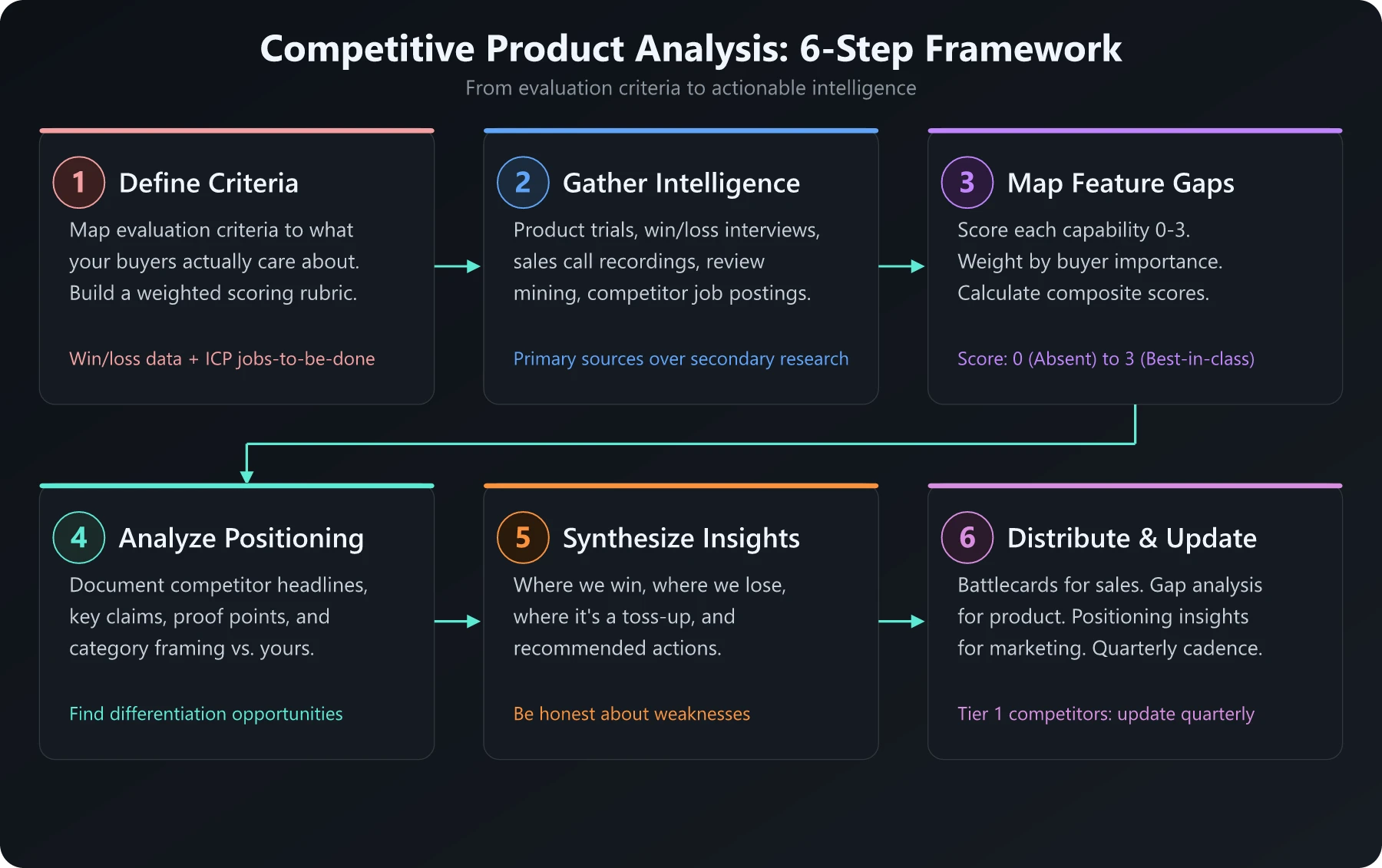
Step 1: Define Your Evaluation Criteria
Before you open a single competitor’s website, establish what you’re measuring and why. Your criteria should map directly to what your buyers care about - not what your engineering team finds interesting.
Start with these inputs:
- Win/loss interview themes (what capabilities come up repeatedly?)
- Sales call recordings (what features do prospects compare?)
- Support ticket patterns (where do customers hit limitations?)
- Your ICP and their top jobs-to-be-done
Build a weighted scoring rubric. A capability that influences 40% of deal outcomes deserves more weight than a nice-to-have feature.
Step 2: Gather Primary Intelligence
Secondary research (blog posts, analyst reports) gives you a starting point, but primary intelligence is what separates useful analysis from recycled marketing copy.
High-value primary sources:
- Product trials and demos: Sign up for competitor free trials. Document the onboarding flow, core workflows, and limitations you hit.
- Win/loss interviews: Talk to prospects who chose a competitor. Ask what capabilities tipped their decision.
- Sales call recordings: Tools like Gong and Chorus capture exactly how competitors come up in deals.
- Review mining: G2, Capterra, and TrustRadius reviews reveal what real users praise and complain about. Filter by company size and industry to match your target segment.
- Job postings: A competitor’s open roles reveal their product roadmap priorities. Hiring five ML engineers? They’re building AI features.
Step 3: Map Feature Parity and Gaps
Create a detailed feature comparison matrix. For each capability, don’t just mark “yes” or “no” - capture the depth and quality of implementation.
Use a four-level scoring system:
| Score | Meaning | Description |
|---|---|---|
| 3 | Best-in-class | Superior implementation, clear differentiator |
| 2 | Competitive | Solid implementation, meets buyer expectations |
| 1 | Basic | Feature exists but limited or clunky |
| 0 | Absent | Feature not available or requires workaround |
Weight each capability by buyer importance, then calculate a composite score per competitor. This gives you a quantified view of where you lead, where you’re at parity, and where you trail.
Step 4: Analyze Positioning and Messaging
Product capabilities are only half the picture. How competitors talk about their product shapes buyer perception just as much as what the product actually does.
See our competitive analysis examples for real-world positioning audit templates you can copy. For each primary competitor, document:
- Headline positioning: Their homepage H1 and tagline
- Key claims: The 3-5 benefits they emphasize most
- Proof points: Customer logos, case studies, specific metrics they cite
- Category framing: How they define the market category (and where they place themselves in it)
Compare this against your own product positioning. Where do you make the same claims? Where do you differentiate? Where does a competitor’s messaging expose a gap in your own narrative? This analysis feeds directly into your go-to-market strategy and informs how you position against alternatives during launches.
Step 5: Synthesize into Actionable Insights
Raw data isn’t useful until you translate it into decisions. For each competitor, summarize your findings into four outputs:
- Where we win: Capabilities and positioning angles where we have a clear advantage.
- Where we lose: Areas where the competitor genuinely outperforms us.
- Where it’s a toss-up: Parity areas where messaging and sales execution determine the outcome.
- Recommended actions: Specific changes to positioning, enablement content, or product roadmap.
Be honest about where you lose. Your sales team will lose credibility the first time a prospect pushes back with a competitor advantage you didn’t prepare them for.
Step 6: Distribute and Update
A competitive product analysis that lives in a Google Doc nobody reads is worthless. Distribution is part of the analysis itself.
Distribution channels:
- Sales: Turn key findings into competitive battlecards embedded in your CRM.
- Product: Present gap analysis in product review meetings with specific recommendations.
- Marketing: Feed positioning insights into campaign messaging and content strategy.
- Leadership: Quarterly competitive landscape briefings with trend analysis.
Set a cadence. Primary competitors deserve quarterly updates. Secondary competitors, semi-annual. And build a lightweight monitoring system so you catch major changes between cycles.
Competitive Product Analysis Tools (Free and Paid)
You don’t need an enterprise CI platform to run effective competitive product analysis. Match your tooling to your team size and budget.
Free and Low-Cost Options
| Tool | Best For | Cost |
|---|---|---|
| G2 Compare | Side-by-side product ratings and reviews | Free |
| BuiltWith | Identifying competitor tech stacks | Free tier available |
| SimilarWeb | Traffic estimates and channel mix | Free tier available |
| Google Alerts | Basic competitor monitoring | Free |
| LinkedIn Sales Navigator | Tracking competitor hiring and org changes | Paid ($120+/mo), but often already in the sales stack |
Dedicated CI Platforms
For teams running competitive programs at scale, dedicated platforms automate collection and distribution. The leading options include Klue, Crayon, and Semrush Kompyte (acquired by Semrush in 2022).
These platforms vary widely in pricing depending on features and team size, but expect enterprise-tier investment. They’re worth it when you have 5+ primary competitors and a sales team that encounters competitive deals daily.
Competitive Product Analysis Template
Here’s a ready-to-use structure. Copy this into a document for each primary competitor.
Section 1 - Competitor Profile
- Company name, founding year, funding, estimated revenue
- Target market and primary use cases
- Positioning statement (copied from their website)
Section 2 - Product Comparison Matrix
- 10-15 weighted capabilities with 0-3 scoring
- Composite score and visual comparison
Section 3 - Pricing and Packaging
- Tier breakdown with feature limits
- Per-seat vs. usage-based model
- Hidden costs (implementation, training, overages)
Section 4 - Strengths and Weaknesses
- 3-5 genuine strengths (be honest)
- 3-5 weaknesses backed by evidence
- Sources for each claim (reviews, trials, win/loss data)
Section 5 - Positioning Analysis
- Their key messages vs. yours
- Overlap areas and differentiation opportunities
- Category framing differences
Section 6 - Recommended Actions
- Positioning adjustments
- Sales enablement updates
- Product roadmap considerations
- Marketing content opportunities
Common Mistakes to Avoid
Treating It as a One-Time Exercise
Competitive landscapes shift constantly. A product analysis from six months ago may already be wrong. Build a quarterly update cadence for primary competitors at minimum.
Ignoring Your Own Weaknesses
The most common failure mode is analysis that only highlights where you win. Your sales team will lose credibility the first time a prospect pushes back with a competitor advantage you didn’t prepare them for.
Document competitor strengths honestly. Then equip your team with responses - not denial.
Over-Indexing on Features
Features matter, but buyers don’t make decisions on feature checklists alone. Pricing, brand trust, implementation complexity, and customer support quality all influence the outcome. Your competitive product analysis should cover the full buying experience, not just the product spec sheet.
Skipping Primary Research
Relying exclusively on competitor websites and review sites gives you a sanitized view. The most valuable competitive insights come from direct sources - win/loss interviews, product trials, and sales call analysis.
Building for Internal Consumption Only
If your analysis only circulates among product marketers, you’re capturing 20% of its value. The same intelligence, repackaged for sales, product, and leadership audiences, compounds its impact across the organization.
From Competitive Product Analysis to Action
Competitive product analysis only matters if it changes decisions. Every analysis should produce at least one concrete output: a positioning shift, a battlecard update, a product roadmap recommendation, or a new sales talk track.
Start by picking your top three competitors. Run through the six-step framework above. Produce a competitive product analysis for each one, distribute the findings across sales, product, and marketing, and set a quarterly review cadence.
The companies winning competitive deals aren’t the ones with the best products. They’re the ones with the best understanding of how their product compares - and the discipline to act on that intelligence consistently.