AI Overview Optimization: How to Get Cited by Google (2026)
AI overview optimization is not a separate discipline from SEO. Here's what Google actually requires to earn a citation - and the practical tactics that work.
AI overview optimization has become one of the most overcomplicated phrases in SEO. Every agency has a 15-step methodology, half the blog posts invent ranking factors that do not exist, and marketing leaders are being sold new services for what is mostly a structural layer on top of work they should already be doing. The reality, based on Google’s own documentation, is narrower and more useful: “There are no additional requirements to appear in AI Overviews or AI Mode, nor other special optimizations necessary.”
This post walks through what that means in practice. We will cover how AI Overviews pick their sources, what actually moves the needle, and the structural changes that consistently improve citation rates.
What Google Officially Says About AI Overview Optimization
Before anything tactical, read Google’s own guidance from the Search Central documentation. Three lines matter:
- “There are no additional requirements to appear in AI Overviews or AI Mode, nor other special optimizations necessary.”
- To appear as a supporting link, a page must “be indexed and eligible to be shown in Google Search with a snippet, fulfilling the Search technical requirements.”
- “You don’t need to create new machine readable files, AI text files, or markup to appear in these features. There’s also no special schema.org structured data that you need to add.”
Google is telling you that AI Overview optimization is a content quality and structure problem, not a new technical specification. That does not mean there is no optimization to do. It means the optimization happens inside the practices you already know, executed better.
AI Overviews are now available in more than 200 countries and territories and over 40 languages, and Google reports they drive “over 10% increase in usage of Google for the types of queries that show AI Overviews” in markets like the US and India. In other words: the surface is large, the traffic is different, and the queries most likely to trigger an AI Overview are the ones where your content has to earn its citation on the merits of what it actually says.
How AI Overviews Choose Their Sources
AI Overviews synthesize an answer from multiple indexed pages and cite a subset of them in the expandable source list. Google’s Search Central guidance on performing well in AI experiences sets out five focus areas: unique valuable content, great page experience, access for crawlers, correct use of preview controls (nosnippet, max-snippet, noindex), and structured data that matches visible content. Google states the guidance directly: “The underpinnings of what Google has long advised carries across to these new experiences.”
In practice, three signals compound to influence whether a page gets picked up:
- Index eligibility and snippet quality. Google says a page “must be indexed and eligible to be shown in Google Search with a snippet.” If it cannot appear as a Search result with a snippet, it cannot be cited. Strong, directly-answering snippets help.
- Content quality and people-first orientation. Google’s consistent guidance is to focus on “unique, non-commodity content that visitors from Search and your own readers will find helpful and satisfying.”
- Structure that makes extraction clean. Clear H2s that match question intent, short declarative first sentences under each heading, and scannable lists all make a page easier for a summarizer to lift from.
The third signal is where most of the optimization work happens in practice, because the first two are long cycle investments.
The Practical AI Overview Optimization Framework
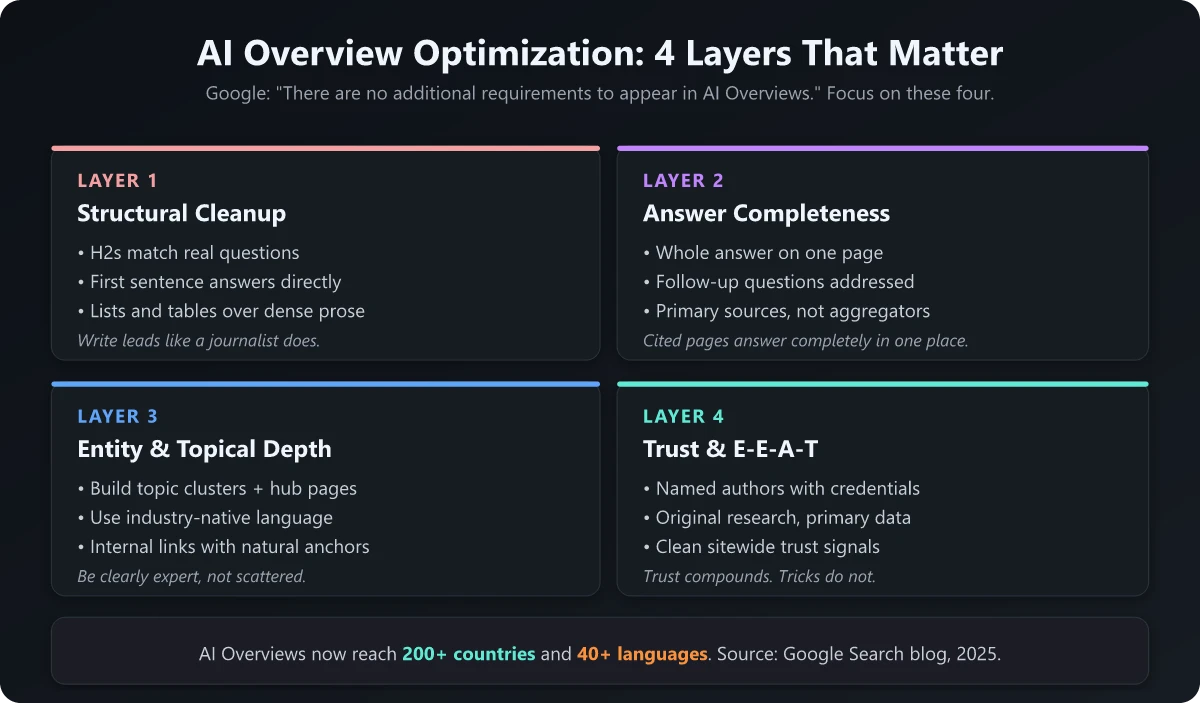
If you want to put work into AI Overviews this quarter, focus on four layers. Everything beyond these is diminishing returns.
1. Structural Cleanup
Go through your top 10-20 pages and rewrite them for extraction. For each H2:
- The heading should match a real question (“What is X?” or “How do I X?”), not a clever phrase.
- The first sentence under each heading should be a direct, standalone answer. 20-40 words. No setup.
- The supporting paragraphs come after. If you must lead with context, keep it to one short sentence.
- Lists and tables are lifted more often than dense prose. Use them where they are accurate, not for show.
Count is not part of this. Google documents no ideal number of headings, and the “one H2 per 250-500 words” rule that gets quoted in audits traces back to a Yoast readability heuristic with no research behind it, which is the longer answer in how many H2 tags a page should have.
This is not writing for robots. It is writing the way journalists write leads: the most useful sentence goes first. That it also happens to get pulled into AI Overviews is a side effect, not the point.
2. Answer Completeness
The pages that earn consistent citations are the ones that answer the question completely on the page. If a user would need to click three more times to understand the answer, the AI summarizer tends to pick a page that covered it in one place.
For each target query, ask:
- Does the first paragraph actually answer the question?
- Are the common follow-up questions addressed in the same document?
- Is there a clear primary source I can cite for the numbers, or am I relying on secondary blog summaries?
Link to authoritative sources when you quote them. Own your page when you say something original. The combination of citation and original insight is what distinguishes a page from the commoditized versions of the same answer.
3. Entity and Topical Depth
Google’s AI systems use entity understanding to determine whether a page is actually about the topic it claims to cover. You want to be clearly, visibly expert on a topic, not dabbling in it across random posts.
Practical application:
- Build topic clusters. A hub page with depth, supported by cluster pages that cover adjacent sub-topics, signals topical authority.
- Use the language your topic actually uses. If the industry says “ICP,” don’t translate every mention into “ideal customer profile” for keyword reasons. AI models parse the way real people write.
- Internal link from cluster posts back to the hub with natural anchor text. This reinforces the topical relationship.
For a worked example of cluster structure, compare how what is product marketing connects to product positioning, ICP vs buyer persona, and SaaS product marketing strategy on this site.
4. Trust Signals and E-E-A-T
Google’s guidance on AI Search repeatedly emphasizes creating helpful, reliable, people-first content - which in practice means the same E-E-A-T signals that have mattered for general Search. Tactical items:
- Named author bylines with bios and links to credentials or public profiles
- Original research or first-party data wherever possible (primary sources beat aggregators)
- Date of last update visible on the page
- Clean sitewide signals: about page, contact info, clear company information
- External corroboration: being cited by publications in your space compounds authority
What Does Not Move the Needle (Despite the Claims)
There is a lot of noise. Based on Google’s actual documentation and common-sense mechanics, these are not worth your time:
- “AI-specific schema” - Google explicitly says no special schema is needed
- Hidden prompts or instructions in pages - against spam policies and easily ignored by the model
- llms.txt as a ranking signal - useful as a navigational summary for crawlers, but Google has not said it influences AI Overview selection
- Stuffing Q&A blocks at the bottom of every page - can look manipulative and rarely outperforms a well-structured article
- Paying for “AEO audits” that don’t touch content quality or site structure - the audit describes the problem; the fix is still the work
This is not to say experimentation is wrong. It is to say the base rate of clever hacks working is low compared to the base rate of better structure and stronger content working. llms.txt is the cleanest example of that gap: Ahrefs checked 137,210 domains and found 97% of the published files received zero requests in a single month, which is what the server logs actually show about llms.txt.
Measuring AI Overview Performance
Measurement here is still maturing. A workable stack:
- Google Search Console surfaces AI-related impressions and clicks as the feature matures. Watch the Performance report for new filters.
- Ahrefs or Semrush track which keywords trigger AI Overviews and whether you appear in the citation set.
- Manual SERP checks on 20-30 key queries per month. Screenshot and log whether your page is cited.
- Traffic change on high-AI-Overview queries - look at CTR movement on informational queries even if rankings hold.
The honest answer is that most teams do not yet have clean attribution from AI Overviews to revenue. Treat this as a leading indicator program: improve the structural and content layer, watch citation counts grow, and expect the revenue attribution picture to improve as Google’s reporting catches up.
For how to track SEO movement more broadly, see our guide on how do I check my SEO ranking and what is an SEO report.
A 30-Day AI Overview Optimization Sprint
If you want a concrete starting plan, here is 30 days of work that will compound:
Week 1: Audit. List your top 20 organic pages by traffic. Check each one for H2 question match, first-sentence answer quality, internal linking, and dated freshness.
Week 2: Rewrite. Fix H2s and opening sentences. Add FAQ sections for pages targeting question-based queries. Update the last-modified date meaningfully (don’t just bump the stamp).
Week 3: Build cluster depth. Identify two topic clusters where you have scattered coverage. Add 3-5 supporting posts and wire them back to a clear hub page.
Week 4: Measure and iterate. Run a manual SERP sweep on your 30 most important queries. Track AI Overview presence and whether you are cited. Pick the three highest-impact queries where you are close but not cited, and rewrite the target page to answer the query more completely.
That 30 days will do more than any “AEO consulting package” at a fraction of the cost.
The Bottom Line
AI overview optimization is SEO done with more discipline. Google has said clearly that no special optimization is required. The work is to make your content so clearly structured, factually grounded, and topically authoritative that an AI summarizer would choose it over the commodity version of the same answer.
Fix the H2s. Lead with the answer. Build real topic depth. Keep your E-E-A-T signals credible. Do that consistently for 90 days and your citation rate will move. Chase AI-specific tricks and you will end up with a site that looks engineered and still does not get cited.
For the broader strategic context, see our guide on AI and the future of SEO and AI SEO strategy - and for the contrarian read on all of this, see AEO vs SEO, where we argue answer engine optimization is mostly SEO with better formatting. The same structural discipline applies beyond Google: see LLM optimization for getting cited by ChatGPT, Perplexity, and Gemini.
Frequently Asked Questions
What is AI overview optimization?
AI overview optimization is the practice of structuring content so that Google's AI Overviews and AI Mode are more likely to cite it as a source. Google's own guidance is that standard SEO fundamentals apply. The differentiator is clean content structure, strong E-E-A-T signals, and sections written to answer one question per H2.
Is AI overview optimization different from SEO?
According to Google's official documentation, there are no additional requirements to appear in AI Overviews or AI Mode beyond standard Search indexing. The page must be indexed, eligible for a snippet, and meet the same quality bar as any Search result. The optimization layer sits inside good SEO practice, not next to it.
How do I know if my content was cited in an AI Overview?
Google Search Console has been adding AI-related surfaces to the Performance report, and third-party tools like Ahrefs and Semrush now track AI Overview presence for keywords. The cleanest way remains manual - search your target queries regularly and see whether your domain is listed in the source citations below the AI summary.
Does schema markup help for AI Overviews?
Google's own guidance is that no special schema is required to appear in AI Overviews. Standard structured data - Article, FAQ, Product, Organization - still helps general Search eligibility and visibility, which indirectly improves the chance of being picked up as an AI source. There is no AI-specific schema to add.