AEO vs SEO vs GEO: The Real Differences (2026)
AEO vs SEO vs GEO: what actually differs across the three, what does not, and what Google's own documentation says. A sourced, side-by-side comparison.
AEO vs SEO vs GEO in one line: SEO is the practice of earning visibility in search engines. AEO (answer engine optimization) is structuring that same content so the answer layer inside a search engine - AI Overviews, featured snippets, voice - can lift it. GEO (generative engine optimization) is the same work aimed at citations inside a standalone model’s answer, in ChatGPT, Claude, or Perplexity. Per Google’s own documentation, these are subsets of SEO, not replacements: the ranking signals (quality content, crawlability, E-E-A-T, topical authority) are identical. The surface is new; the work is the same.
Every year, SEO gets a rebrand. This year the rebrand is AEO, short for answer engine optimization. A wave of agencies has discovered a new acronym to sell, a new methodology to consult on, and a new audit to price at three times the old one. The entire argument rests on the claim that AEO is a distinct discipline from SEO.
It is not. Based on Google’s own Search Central documentation, AEO is SEO executed with more discipline on formatting. Everything else is marketing by the people selling the services. This post walks through what the AEO pitch claims, what the evidence says, and where the real work sits.
The AEO Pitch, Restated
The typical AEO agency pitch goes like this:
- Search is being replaced by answer engines (ChatGPT, Perplexity, Google AI Overviews)
- These engines pick sources differently from traditional search
- Therefore, you need a new optimization discipline, with new tactics, new tools, and usually a new retainer
- Also, if you don’t start now, your competitors will
Parts of this are true. Parts are consulting theater. The true parts are that AI Overviews are a real surface, citations matter, and content that reads well to an LLM tends to get picked up. The theater is the claim that SEO cannot address it.
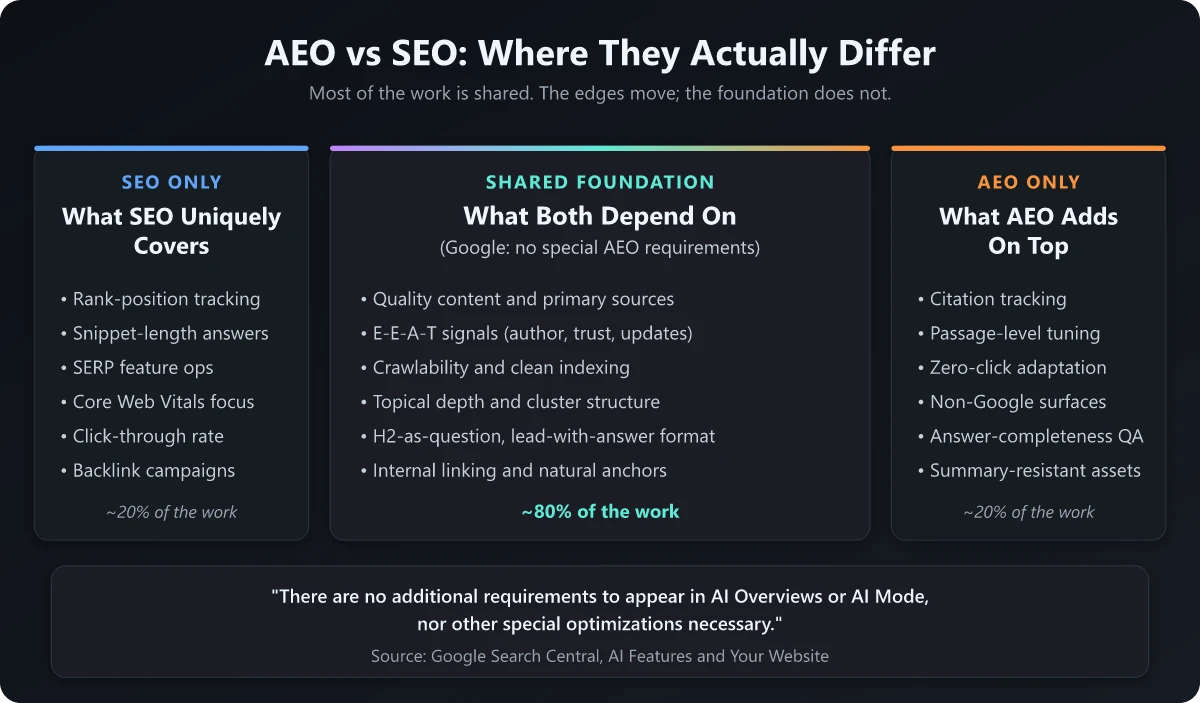
What Google Actually Says
Google’s AI Features and Your Website documentation is the canonical source, and it is unambiguous:
- “There are no additional requirements to appear in AI Overviews or AI Mode, nor other special optimizations necessary.”
- To appear as a supporting link, a page must “be indexed and eligible to be shown in Google Search with a snippet, fulfilling the Search technical requirements.”
- “You don’t need to create new machine readable files, AI text files, or markup to appear in these features. There’s also no special schema.org structured data that you need to add.”
Google is saying the quiet part out loud: the way to earn a citation in an AI Overview is to be the kind of page that should already have been ranking. The machinery in front of the answer changed. The substrate underneath did not. Google’s own Search Central team puts it even more directly in their May 2025 guidance: “The underpinnings of what Google has long advised carries across to these new experiences.”
If you run the same test against ChatGPT or Perplexity, the answer is similar. Their models pull from the same public web. The signals that make content trustworthy to a human evaluator - clear authorship, primary sources, coherent structure, substantive depth - are the same signals that make content easier for an LLM to cite.
The Five “AEO Tactics” That Are Actually SEO
Here are the tactics that show up most often in AEO service decks. Each one is either a subset of SEO or a formatting refinement inside an SEO program.
1. “Optimize for question-based queries”
This is keyword research. Specifically, it is the part of keyword research that has been taught for fifteen years where you organize content around the questions a buyer asks at each stage of their journey. The difference with AEO is that you are more disciplined about making the H2 match the question exactly and the first sentence answer it directly. What matters there is the fit of each H2 to a question rather than how many you use: Google documents no ideal heading count, and the one H2 every 250 to 500 words rule traces back to a WordPress readability check that cites no research.
That is not a new discipline. That is better structure inside the existing one.
2. “Write for featured snippets and passage answers”
Google began surfacing featured snippets in 2014 and has documented them publicly for years. Writing concise, direct answer blocks that can be lifted into the top of a SERP is a practice older than most marketers doing AEO now. AI Overviews extend the same logic to longer summarized answers, but the underlying craft is the same: lead with the answer, support with the explanation.
3. “Strengthen E-E-A-T”
E-A-T (Expertise, Authoritativeness, Trustworthiness) has been one of the most discussed concepts in SEO since Google’s 2018 “Medic” core update, and Google added an extra E for Experience in December 2022 to form E-E-A-T. Google’s Search Quality Rater Guidelines have been public for years. When an AEO agency tells you to name your authors, cite primary sources, and build topical authority, they are reading from the same playbook those documents have described for most of the last decade.
4. “Build topical authority through clusters”
Hub-and-spoke content models, topic clusters, and internal linking architecture were taught by HubSpot starting in 2017 and experimented with internally before that. The AI Overview era rewards them more consistently than before, which is a reason to do more of this work, not a reason to rename it.
5. “Use clean, crawlable HTML”
Technical SEO. The entire field, renamed.
If this were five unrelated tactics that happened to be SEO-adjacent, it might be coincidence. When the entire AEO methodology lines up item-for-item with SEO practices that predate the AI Overview launch by 5-15 years, the only honest conclusion is that AEO is SEO rebranded for the current news cycle.
Where the “AEO Is Different” Argument Has a Point
To be fair, there are three real differences in the AI Overview era. They do not add up to a new discipline, but they do matter.
1. The answer often replaces the click. For some queries, the AI Overview answers completely and the user does not click a single source. This is real, measurable, and the strategic response is to prioritize queries where the click still matters and to develop content forms that can’t be summarized away (original research, interactive tools, deeply personalized recommendations). Which queries those are is measurable on your own property: splitting my Search Console export by query length put four-plus-word queries at 42% of impressions and 10% of the attributable clicks.
2. Citation counts are a new, lower-resolution signal. Traditional SEO tracked rank position. AEO asks you to track whether you are cited in an AI Overview at all. It is a less granular signal, which means the feedback loop on what works is slower. The response is patience and better measurement, not a new methodology.
3. Language and formatting choices matter more at the surface. A traditional SERP snippet is a short preview of a page. An AI Overview citation can pull an entire passage directly into the summary. The difference rewards content that is written for direct extraction at the paragraph level, not just the snippet level. This is a formatting discipline, and it is the one legitimate “AEO” upgrade to SEO practice.
For a practical framework, see our full AI Overview optimization guide.
Where GEO Fits: Generative Engine Optimization vs AEO vs SEO
Generative engine optimization (GEO) is the practice of getting your content cited inside the output of a generative model such as ChatGPT, Claude, or Perplexity. SEO is the underlying discipline. AEO is the answer surface inside a search engine. GEO is the citation surface inside a model’s answer.
GEO has one thing AEO does not, which is an academic origin rather than an agency one. The term was introduced in a 2024 KDD paper, “GEO: Generative Engine Optimization”, whose abstract reports that its methods “boost visibility by up to 40% in generative engine responses.” Then you read the method list and the punchline lands differently. The tactics that moved the benchmark most were adding quotations, adding statistics, and citing sources, while keyword stuffing produced little to no improvement in generative responses. Those first three are what editors have asked writers for since long before anyone had a model to optimize against.
So the three-way version of this argument has the same shape as the two-way one. Three acronyms, three surfaces, one craft. AEO describes what happens when a search engine summarizes an answer above the blue links. GEO describes what happens when a standalone model assembles an answer and footnotes its sources. Both are the output of a pipeline that begins with a crawler reading a page it can parse and concluding the page is worth trusting.
The documentation gap is identical too. Google’s line quoted above - “There are no additional requirements to appear in AI Overviews or AI Mode, nor other special optimizations necessary” - has no GEO counterpart from any model vendor either. Nobody has published a GEO specification. There is no GEO markup, no GEO file, no GEO schema type. What exists is a research paper finding that well-sourced, quotable, statistic-bearing writing gets picked up more often, and a market that turned that finding into a service line.
If you want the longer treatment of the generative side on its own terms - how models select sources, and what changes when traffic arrives as a citation instead of a click - see AI and the future of SEO, which goes deeper on GEO as a standalone surface.
SEO vs AEO vs GEO: The Real Comparison
Here is what is actually different, side by side. Most of this table is shared rows, which is the point.
| Dimension | SEO | AEO | GEO | Actually different? |
|---|---|---|---|---|
| Goal | Be found when users search | Be cited when users ask | Be cited inside a generated answer | Surface differs, goal is the same |
| Primary signals | Content quality, links, E-E-A-T, UX | Content quality, links, E-E-A-T, UX | Content quality, links, E-E-A-T, UX | No |
| Technical foundation | Crawlability, indexing, Core Web Vitals | Crawlability, indexing, Core Web Vitals | Crawlability, indexing, Core Web Vitals | No |
| Structure discipline | H2s, lists, schema, FAQ blocks | H2s matched to questions, lead sentences, lists | Extractable passages, quotations, statistics | Degree, not kind |
| Measurement | Rankings, traffic, conversions | Citation presence, rankings, traffic | Citation share in LLM outputs | New metric added |
| Writing craft | Answer the query well | Answer the query well, at the passage level | Answer the query well, at the passage level | Slightly tighter |
| Strategy horizon | 6-24 months | 6-24 months | 6-24 months | No |
Three of the seven rows are word-for-word identical across all three columns. Two are a matter of degree. One adds a metric. One changes the surface without changing the goal. That is one discipline with three shop windows, not three disciplines.
Who Actually Benefits From Calling It AEO
Three groups.
Agencies. Rebranding lets them raise prices and sell a new retainer to clients who would not authorize another “SEO audit.” The deliverable is often identical to the SEO audit they did 18 months ago with a different cover page.
Tool vendors. AEO dashboards, AEO scorecards, and AEO tracking features justify new SKUs. Some of this work is useful - tracking citations in AI Overviews is a legitimate capability. Much of it repackages existing SEO features.
Content writers who want a fresh start. If you have been embarrassed about SEO content for the last five years, AEO gives you a clean brand. Same craft, new label, fewer jokes at parties.
None of these are scams. The services are often genuinely useful. It is the framing that is off: what is being sold is SEO done better, not a new discipline that replaces it.
What to Actually Do (If You Want the Results Without the Theater)
- Keep your SEO program. Do not fire the SEO team to hire an AEO team.
- Audit your content for extraction readiness. For top 20 pages, check H2-to-question fit, first-sentence answer quality, list and table use, dated freshness, and author byline.
- Tighten the opening of every H2. 20-40 word direct answer, then supporting context. This is the single highest-impact change.
- Build topical depth. Cluster your coverage. Link a hub page to its cluster posts. Use real industry language.
- Invest in E-E-A-T signals. Named authors, primary sources, visible update dates, clean company information.
- Add citation tracking. Use Ahrefs, Semrush, or a manual sweep to watch whether you are cited on your top 30 queries, in AI Overviews and in generative engines like ChatGPT and Perplexity alike.
- Protect query coverage where the click still matters. Original research, templates, interactive tools, and deeply specific implementation guides get summarized less cleanly.
For related context, see AI and the future of SEO, AI SEO strategy, AI overview optimization, and our guide on how to conduct a technical SEO site audit - because the technical foundation remains the foundation regardless of the surface.
The Bottom Line
AEO vs SEO vs GEO is not a debate worth having. It is a branding exercise running on top of the same craft that has defined search visibility for twenty years. Google has said, in writing, that no special optimization is needed. The agencies claiming otherwise are not wrong about the tactics - they are wrong about the framing.
Do good SEO. Format for extraction. Build topical authority. Strengthen your trust signals. Track citations as they become visible. That is your AEO strategy. It is also your SEO strategy. The fact that those two statements describe the same work is the entire argument.
Next time someone tells you AEO is a new discipline, ask them to name one requirement Google has published that is not already in the Search Central documentation. The quiet answer is the honest one.
Frequently Asked Questions
What is the difference between AEO and SEO?
AEO (answer engine optimization) is the practice of structuring content so AI-powered answer engines like Google AI Overviews, ChatGPT, and Perplexity can cite it. SEO is the broader practice of earning visibility across search engines. Based on Google's own documentation, AEO is a subset of SEO, not a replacement for it. The core requirements - quality content, crawlability, topical authority, strong E-E-A-T - are identical.
Is AEO replacing SEO?
No. AEO is a new surface and a new citation format, not a new discipline. The content that gets cited in AI Overviews is the same content that ranks well in regular Search: indexed, well-structured, factually grounded, topically authoritative. The work is the same. The output is new.
Do I need separate AEO and SEO strategies?
Almost always no. A single content strategy that prioritizes answer-led formatting, topical depth, and E-E-A-T will perform in both surfaces. Separating them produces two half-good strategies and a lot of consulting invoices.
What does Google say about AEO?
Google's Search Central documentation explicitly states: 'There are no additional requirements to appear in AI Overviews or AI Mode, nor other special optimizations necessary.' Standard SEO best practices apply. There is no separate AEO specification from Google.
What is the difference between SEO, AEO, and GEO?
SEO is the underlying discipline of earning visibility in search. AEO is structuring content for the answer layer inside a search engine: AI Overviews, featured snippets, People Also Ask, and voice results. GEO is earning citations inside standalone generative tools like ChatGPT, Claude, and Perplexity. All three run on the same signals - indexability, content quality, E-E-A-T, and topical authority.
Is GEO the same as AEO?
They are near-synonyms with different emphasis, not different disciplines. AEO describes the answer surface inside a search engine. GEO, a term coined in a 2024 KDD research paper, describes citation inside a generative model's output. In practice the optimization work is identical, and neither Google nor any model vendor has published a separate requirement for either.