SaaS Product Marketing Strategy: The Complete PMM Playbook (2026)
Build a SaaS product marketing strategy that drives pipeline and retention. Covers positioning, launch, adoption, and expansion with frameworks PMMs actually use.
Acquiring a new SaaS customer costs 5-25x more than retaining an existing one (Lighter Capital). Meanwhile, the median net revenue retention for bootstrapped SaaS companies ($3M-$20M ARR) sits at just 104% (SaaS Capital). These two numbers explain why a SaaS product marketing strategy demands a fundamentally different approach than marketing a one-time purchase product.
In traditional product marketing, the job is largely done after the sale. In SaaS, the sale is just the beginning. Your SaaS product marketing strategy must drive acquisition, activation, retention, and expansion - all at the same time.
What Makes SaaS Product Marketing Strategy Different
If you understand what product marketing is at a foundational level, SaaS product marketing builds on every one of those principles - then adds layers of complexity.
Three structural differences set SaaS apart:
Recurring Revenue Changes Everything
A SaaS customer who churns after three months destroys your unit economics. The median annual churn rate for B2B SaaS is 3.5% (Shno), with higher churn rates among SMB customers. Product marketing owns the narrative that keeps customers engaged past the initial purchase decision.
The Product Is the Marketing Channel
58% of B2B SaaS companies now run a product-led growth motion (ProductLed). See our product-led growth examples for how top companies like Slack, Figma, and Canva execute this. When users can try before they buy, the in-product experience becomes your most powerful marketing asset. PMMs must collaborate with product teams to optimize onboarding flows, activation milestones, and upgrade prompts.
Buyers and Users Are Often Different People
The VP who signs the contract is rarely the person using the product daily. SaaS product marketers need messaging for both the economic buyer (ROI, security, compliance) and the end user (ease of use, time saved, workflow fit). Your ICP and buyer personas must account for this split.
The SaaS Product Marketing Strategy Framework
A complete SaaS product marketing strategy covers six pillars. Each one maps to a stage of the customer lifecycle.
| Pillar | Lifecycle Stage | Key Question |
|---|---|---|
| Positioning & Messaging | Pre-awareness | Why should anyone care? |
| Competitive Intelligence | Evaluation | Why us over alternatives? |
| Launch Strategy | Acquisition | How do we generate demand? |
| Sales Enablement | Decision | How do we close deals faster? |
| Adoption & Onboarding | Activation | How do we deliver first value? |
| Expansion & Retention | Growth | How do we grow existing accounts? |
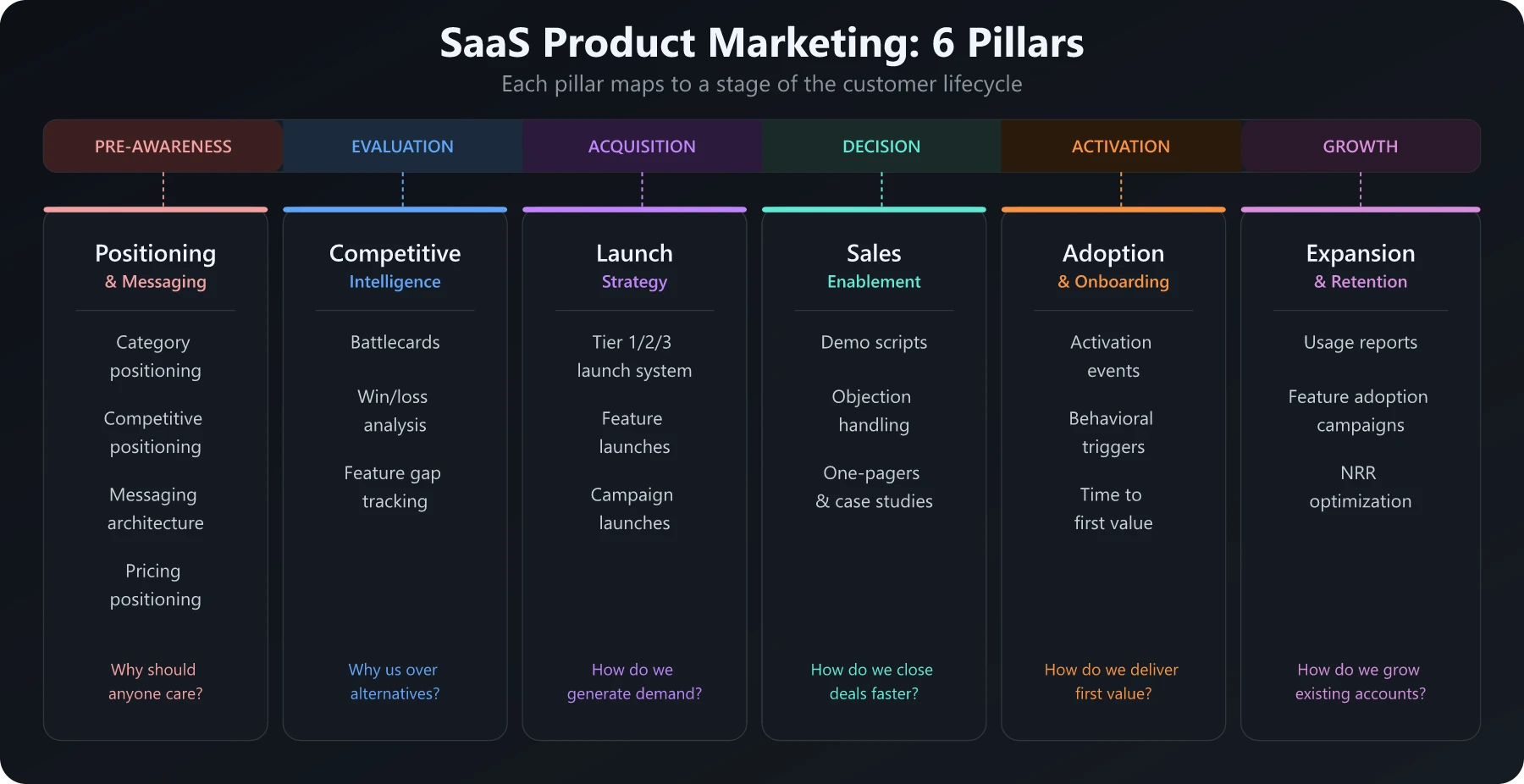
Most PMMs spend the majority of their time on the first three pillars and neglect the bottom three. That’s a mistake. In SaaS, the post-sale pillars often have a higher revenue impact.
Positioning and Messaging for SaaS
Product positioning in SaaS requires you to answer a question that shifts over time: as your product evolves, so does your competitive landscape.
The SaaS Positioning Stack
Build your positioning in layers:
- Category positioning - What market do you compete in? Pick a category buyers already understand.
- Competitive positioning - Why you over alternatives? Build a competitive battlecard for every major rival.
- Use-case positioning - Different personas use the product differently. A project management tool positions itself as “collaboration software” for teams but “resource planning” for managers.
Messaging Architecture
Structure your messaging into three tiers:
- Strategic narrative - The big-picture story of why the market is changing and why your approach wins. This stays consistent for 12-18 months.
- Persona messaging - Tailored value propositions for each buyer and user persona. Address their specific pain points and desired outcomes.
- Feature messaging - How individual capabilities map to benefits. This changes with every release.
The most common SaaS messaging mistake is leading with features instead of outcomes. Nobody buys “AI-powered analytics.” They buy “finding revenue leaks in minutes instead of hours.”
Pricing Positioning
SaaS pricing is itself a positioning tool. Your tier structure communicates who the product is for. A free tier says “we’re product-led and confident in our product.” Enterprise pricing says “we solve complex problems for large organizations.”
Align your pricing tiers with your personas. Each tier should feel like it was designed for a specific type of customer.
SaaS Launch Strategy
SaaS launches are not one-time events. You’re running three types of launches constantly:
| Launch Type | Frequency | Goal | Typical Tactics |
|---|---|---|---|
| New product launch | Rare (1-2/year) | Market entry, new revenue stream | PR, analyst briefings, launch events, paid campaigns |
| Feature launch | Frequent (monthly+) | Activation, retention, expansion | In-app announcements, email, blog, changelog |
| Campaign launch | Quarterly | Pipeline generation, category awareness | Content, webinars, ads, partner co-marketing |
The Feature Launch Playbook
Feature launches tend to consume the bulk of a PMM’s launch workload. Here’s the framework:
Tier 1 - Major (changes how customers use the product): Full GTM motion. Press, webinar, dedicated landing page, sales enablement, email sequence, in-app walkthrough.
Tier 2 - Medium (meaningful improvement to existing workflow): Blog post, in-app notification, email to relevant segment, updated help docs, sales one-pager.
Tier 3 - Minor (quality-of-life improvement): Changelog entry, in-app tooltip, support doc update.
Tiering prevents launch fatigue. If everything is a “major launch,” nothing is.
Coordinating with Your Go-to-Market Plan
Every significant launch needs a go-to-market strategy that coordinates timing, channels, messaging, and enablement. The GTM plan ensures marketing, sales, product, and customer success are aligned before launch day.
Driving Product Adoption and Retention
This is where SaaS product marketing strategy diverges most sharply from traditional product marketing. After the sale, PMMs must drive users to their “aha moment” as fast as possible.
The Activation Framework
Opt-in free trials convert at roughly 18% on average, while opt-out trials (requiring payment info upfront) convert at around 49% (First Page Sage). The difference comes down to activation - getting users to experience core value before the trial expires.
Map your activation framework:
- Define your activation event - The specific action that correlates with long-term retention. For Slack, it’s sending 2,000 team messages. For your product, it might be completing a workflow, inviting a teammate, or running a first report.
- Remove friction before the activation event - Every unnecessary step between signup and activation is a leak. Audit your onboarding flow ruthlessly.
- Use behavioral triggers - Send targeted messages based on what users have (and haven’t) done. A user who signed up but hasn’t completed setup needs a different nudge than one who’s active but hasn’t tried a key feature.
Retention Through Ongoing Value
Retention marketing in SaaS is about continuously reinforcing the value your product delivers. Practical tactics:
- Usage reports - Monthly emails showing customers how much time/money they’ve saved
- Feature adoption campaigns - Target users of Plan A features who haven’t tried Plan B capabilities
- Customer education - Webinars, certification programs, and best-practice guides that deepen engagement
- Executive business reviews - For enterprise accounts, quarterly reviews that tie product usage to business outcomes
SaaS Product Marketing Strategy Metrics
You can’t improve what you don’t measure. Here are the metrics that matter at each stage, along with benchmarks to calibrate against.
Acquisition Metrics
| Metric | What It Measures | Benchmark |
|---|---|---|
| Trial signup rate | Landing page to trial conversion | 8-15% for targeted traffic |
| Trial-to-paid conversion | Free trial to paying customer | ~18% opt-in; ~49% opt-out (First Page Sage) |
| CAC payback period | Months to recover acquisition cost | 12-18 months median |
| Pipeline influenced by PMM | Revenue from PMM-sourced content and enablement | Track by UTM and attribution |
Retention and Expansion Metrics
| Metric | What It Measures | Benchmark |
|---|---|---|
| Net revenue retention (NRR) | Revenue from existing customers including expansion | 104% median; 118% at 90th percentile (SaaS Capital) |
| Logo churn rate | Percentage of customers lost | 3.5% annual median B2B (Shno) |
| Expansion revenue % | Share of new ARR from existing customers | 30-40% for high-performing SaaS |
| Feature adoption rate | Users actively using newly launched features | 20-30% within 30 days |
| Time to first value | Time from signup to activation event | Under 10 minutes for top performers |
The Metric That Matters Most
Net revenue retention is the single most important metric for SaaS product marketers. An NRR above 100% means your existing customer base grows even without new logos. Companies with strong NRR are valued at significantly higher multiples than those with NRR below 100%.
Every pillar of your SaaS product marketing strategy should ultimately ladder up to improving NRR - better positioning reduces churn from misaligned expectations, better onboarding drives activation, and better expansion messaging drives upsells.
Building Your SaaS Product Marketing Strategy
If you’re starting from scratch or rebuilding your approach, here’s the sequence that works.
Phase 1: Foundation (Months 1-2)
- Nail your positioning. Interview 15-20 customers and 5-10 churned customers. Understand why people buy, stay, and leave.
- Build your ICP. Define your ideal customer profile based on data, not assumptions. Look at your highest-NRR accounts for patterns.
- Audit your competitive landscape. Create battlecards for your top three competitors using insights from your competitive intelligence analysis. Update them quarterly.
Phase 2: Enablement (Months 2-3)
- Create a messaging framework. Document your strategic narrative, persona messaging, and feature messaging in a single source of truth.
- Build sales enablement assets. One-pagers, demo scripts, objection-handling guides, and competitive comparisons.
- Establish your launch tiering system. Align with product on what constitutes Tier 1, 2, and 3 launches.
Phase 3: Scale (Months 3-6)
- Optimize onboarding and activation. Partner with product to instrument activation events and build triggered messaging flows.
- Launch expansion campaigns. Target accounts with low feature adoption for upsell and cross-sell motions.
- Build a content engine. Bottom-of-funnel content (comparisons, use cases, ROI calculators) that supports both acquisition and retention.
Phase 4: Measure and Iterate (Ongoing)
- Track the metrics from the table above monthly.
- Run quarterly positioning reviews - markets shift fast in SaaS.
- Conduct win/loss analysis on every enterprise deal.
- Survey churned customers within 48 hours of cancellation.
Conclusion
A strong SaaS product marketing strategy is not just about launching features or creating sales decks. It’s a system that spans the entire customer lifecycle - from first awareness through expansion and renewal. The PMMs who drive the most impact are the ones who obsess over what happens after the sale, not just before it.
Start with positioning and customer research. Build enablement that helps your sales team tell a consistent story. Then invest heavily in adoption, activation, and expansion - because in SaaS, the real revenue comes from customers who stay and grow. For the full picture of scaling beyond your PMM foundation, see our SaaS growth strategy playbooks and our guide on marketing automation strategy to systematize your nurture and retention workflows.
The benchmarks are clear: companies with strong NRR outperform on every dimension. Your SaaS product marketing strategy is the engine that makes that happen.