Go-to-Market Strategy for Startups: A Practical Framework (2026)
Build a go-to-market strategy for startups that works with limited budget and team. Covers ICP validation, channel selection, pricing, and launch execution.
One of the top reasons startups fail is building something nobody wants. CB Insights’ analysis of startup post-mortems ranks “no market need” among the leading failure reasons (CB Insights). Not because the product was bad. Because the founders never figured out who to sell to, how to reach them, or why anyone should care.
That is a go-to-market problem. And for startups, where runway is measured in months and every dollar matters, a go-to-market strategy for startups is not optional - it is the difference between traction and failure.
This framework is built for early-stage teams. No 50-person marketing department required. No six-figure ad budget assumed. Just a repeatable process for getting your first customers and scaling from there.
Why Startups Need a Go-to-Market Strategy (Not Just a Product)
Most technical founders default to “build it and they will come.” They spend months perfecting features while ignoring the harder question: how will anyone find out this exists?
A go-to-market strategy forces you to answer that question before you burn through your runway. It aligns your small team around who you are targeting, what you are saying, and where you are showing up.
Without one, you get scattered efforts. The founder posts on LinkedIn. An engineer writes a blog post. Someone buys Google Ads. None of it connects, and none of it compounds.
What Makes Startup GTM Different
Enterprise GTM and startup GTM share the same vocabulary but almost nothing else. If you need a broader framework first, start with our go-to-market strategy template.
| Startup GTM | Enterprise GTM | |
|---|---|---|
| Budget | $0 - $50K | $500K+ |
| Team | 1-3 people wearing multiple hats | Dedicated teams per function |
| Timeline | Weeks, not quarters | 6-12 month planning cycles |
| Data | Minimal - mostly qualitative | Rich historical data and benchmarks |
| Goal | Find product-market fit | Scale proven playbook |
| Risk tolerance | High - can pivot quickly | Low - large investments at stake |
The startup advantage is speed. You can test a positioning change on Monday, run a campaign on Tuesday, and talk to five customers by Friday. Use that.
Go-to-Market Strategy for Startups: The 7-Step Framework
This framework is sequential for a reason. Each step builds on the previous one. Skip ahead and you will waste time and money on the wrong audience, wrong message, or wrong channel.
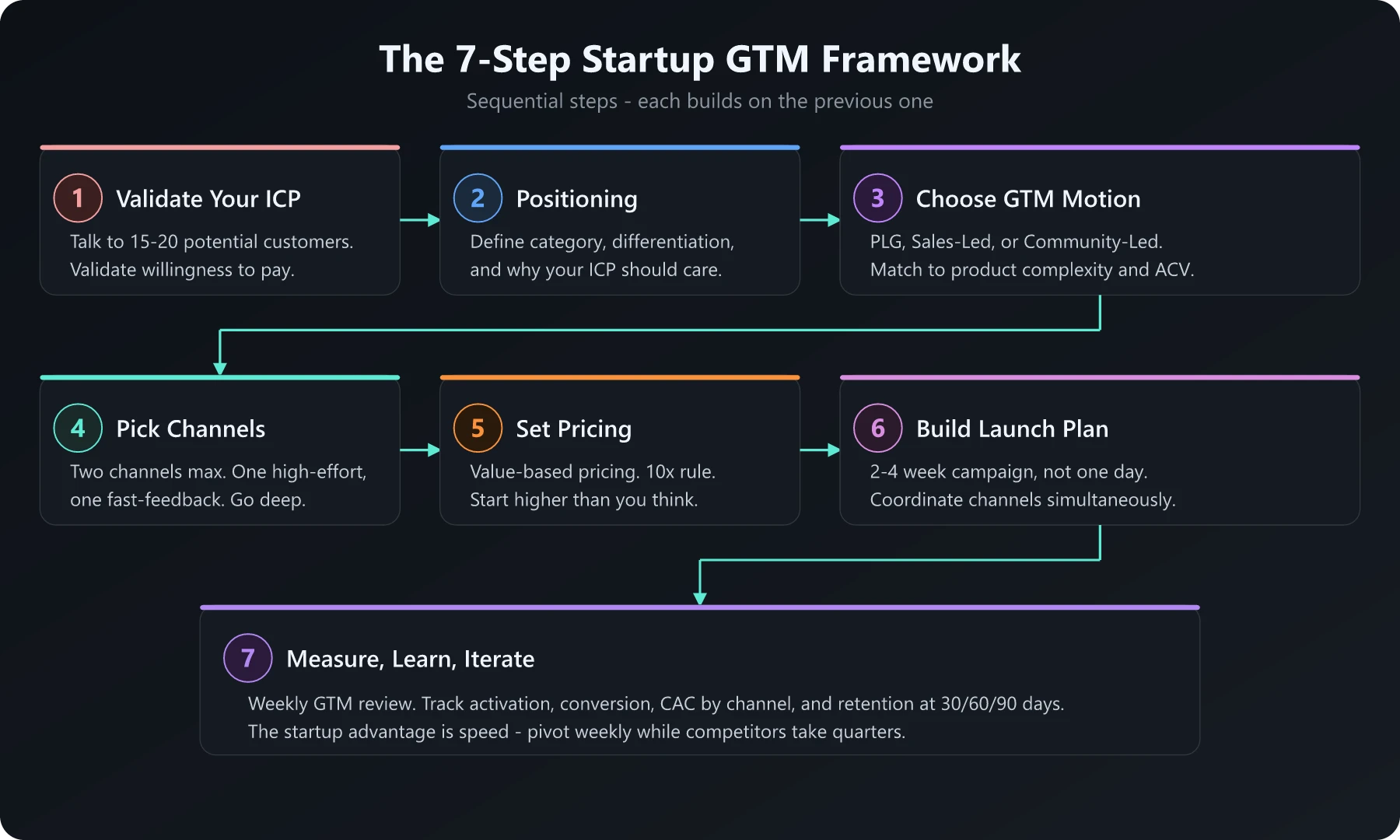
Step 1: Validate Your ICP Before Anything Else
Your Ideal Customer Profile is the foundation of every GTM decision. Get it wrong and nothing downstream works - not your messaging, not your channels, not your pricing.
Start narrow. The biggest ICP mistake startups make is going too broad. “SMBs who need better project management” is not an ICP. “Series A B2B SaaS companies with 20-50 employees who lost deals because their onboarding process takes longer than 30 days” - that is an ICP.
For a deep breakdown of how to build one, read our guide on ICP vs buyer persona. The short version:
- Talk to 15-20 potential customers before writing a single line of marketing copy
- Identify the trigger event that makes someone actively look for a solution like yours
- Document the buying process - who has the budget, who influences the decision, who blocks it
- Validate willingness to pay - interest is cheap, purchase intent is what matters
The “10 Paying Customers” Test
Do not invest in scalable channels until you have at least 10 paying customers acquired through direct outreach. These first customers teach you everything: which pain points resonate, what objections come up, and how long the sales cycle takes.
Step 2: Define Your Positioning and Messaging
Positioning is not your tagline. It is the strategic decision about how your product fits into the market relative to alternatives. Strong product positioning answers three questions:
- What category do you compete in? (This sets buyer expectations)
- What do you do differently? (Your actual differentiation, not aspirational)
- Why should your ICP care? (The “so what” for their specific situation)
Messaging Framework for Startups
Keep it simple. You need three things:
- One-liner: What you do, for whom, and why it matters - in one sentence
- Three value props: The top three reasons your ICP should choose you over the status quo
- Proof points: Customer quotes, metrics, or case studies that back up each value prop
If you cannot explain your product in one sentence that makes your ICP say “tell me more,” your positioning needs work. This is a core product marketing function - even if your startup does not have a dedicated PMM yet.
Step 3: Choose Your GTM Motion
This is one of the most consequential decisions in your go-to-market strategy for startups. Your GTM motion determines your cost structure, hiring plan, and growth trajectory.
| Product-Led Growth (PLG) | Sales-Led Growth (SLG) | Community-Led Growth (CLG) | |
|---|---|---|---|
| How users enter | Free trial or freemium | Demo request or sales call | Community participation |
| Best for | Self-serve products, low ACV | Complex products, high ACV ($15K+) | Developer tools, platforms |
| Startup budget fit | High - product does the selling | Medium - need sales hires early | High - organic but slow |
| Time to revenue | Medium (weeks to months) | Fast (if you can close deals) | Slow (months to build trust) |
| CAC profile | Low per user, high volume | High per deal, lower volume | Very low, but hard to scale |
| Example | Slack, Notion, Canva | Salesforce (early days), HubSpot (early days) | HashiCorp, dbt, Figma |
| Key risk | Low conversion from free | High burn on sales team | Community may not convert |
Slack’s PLG approach is the textbook startup example. When they launched their preview release in August 2013, they saw explosive organic growth driven entirely by team-to-team virality. Within two years, Slack had millions of daily active users and became one of the fastest-growing business apps in history. The product sold itself because it was built for viral adoption within teams.
But PLG is not the right motion for every startup. If your product requires significant configuration, serves a niche enterprise buyer, or has an ACV above $15K, a sales-led approach may close revenue faster.
Most startups today end up with a hybrid. Start with the motion that matches your product complexity and price point, then layer in the other as you scale. For detailed case studies of companies that nailed PLG, see our product-led growth examples.
Step 4: Pick Your Channels (With a Startup Budget)
Customer acquisition costs remain a major challenge for startups. B2B SaaS CAC varies wildly by segment - from a few hundred dollars for SMB self-serve to over $10,000 for enterprise deals (First Page Sage). Either way, that is significant math for a startup with limited capital.
The fix: pick two channels maximum and go deep. Spreading thin across five channels means you will be mediocre at all of them.
Channel Selection Framework
Choose based on where your ICP already spends time and what you can execute with your current team:
High-effort, high-reward (pick one):
- Content + SEO - Long payback period (3-6 months), but compounds over time. Best if your ICP searches for solutions.
- Outbound sales - Direct outreach via email and LinkedIn. Fast feedback, but labor-intensive. Best for high-ACV products.
- Partnerships/integrations - Piggyback on established platforms. Slow to set up, but low CAC once live.
Low-effort, fast feedback (pick one):
- Founder-led social - Your founder’s LinkedIn, Twitter/X, or relevant communities. Zero cost, high authenticity.
- Community participation - Answer questions where your ICP hangs out (Reddit, Slack groups, Discord, Stack Overflow). Not scalable, but great for early learning.
- Paid ads (small budget) - $500-2,000/month on Google or LinkedIn to test messaging. Only after you have validated your ICP and positioning.
For a full breakdown of channel strategy in context, see our guide on marketing strategy for new product.
Step 5: Set Pricing That Drives Adoption
Most startups underprice. They fear rejection, so they charge $19/month for something that saves customers thousands of dollars.
Value-based pricing is the only sustainable approach for differentiated products. The rule of thumb: your customer should receive at least 10x the value of what they pay. If your product saves them $100K annually, a $10K price tag is a no-brainer purchase.
Pricing Principles for Startups
- Price on value, not cost. Your server costs are irrelevant to what you should charge.
- Start higher than you think. It is easier to discount than to raise prices on existing customers.
- Keep it simple. Two or three tiers maximum. Complex pricing creates friction and slows deals.
- Include a free entry point if you are PLG. Make the free tier useful enough to demonstrate value, limited enough to create upgrade pressure. Slack’s free tier limits (like restricted message history) are the classic example - they kick in right when teams are fully dependent on the platform.
- Revisit quarterly. Your pricing should evolve as you learn what customers value most.
Step 6: Build Your Launch Plan
A launch plan is not a press release and a Product Hunt post. It is a coordinated sequence of activities designed to drive awareness, trial, and conversion within your ICP.
The Startup Launch Checklist
Two weeks before launch:
- Landing page live with clear positioning and a single CTA
- Email list of early prospects and design partners ready
- Three to five pieces of content (blog posts, social threads, or videos) drafted and scheduled
- Personal outreach list of 50-100 people who should know about this
Launch week:
- Announce across your chosen channels simultaneously
- Activate your early advocates - ask them to share, comment, or post testimonials
- Respond to every comment, question, and sign-up personally
- Track activation metrics (not just sign-ups, but first meaningful actions)
Two weeks after launch:
- Follow up with every trial user who did not convert
- Collect feedback from both converters and drop-offs
- Identify your top-performing channel and double down
What Most Startups Get Wrong About Launches
They treat launch as a single day. A startup launch is a two to four week campaign. The initial spike of attention fades within 48 hours. The real work is the sustained follow-up that turns attention into pipeline.
Step 7: Measure, Learn, Iterate
Your go-to-market strategy for startups will be wrong on the first try. That is expected. The goal is not perfection - it is a system for learning fast.
The Only Metrics That Matter Early On
Forget vanity metrics. Track these five:
- Activation rate - What percentage of sign-ups complete the first meaningful action?
- Time to value - How long from sign-up to “aha moment”?
- Conversion rate - Free to paid, or lead to customer
- CAC by channel - Which channel delivers customers most efficiently?
- Retention at 30/60/90 days - Are customers staying?
The Weekly GTM Review
Set a 30-minute weekly meeting (even if your “team” is just you and a co-founder) to review these metrics and make one decision:
- What is working? Do more of it.
- What is not working? Fix it or kill it.
- What did we learn about our ICP this week? Update your assumptions.
This cadence is the startup’s secret weapon. While larger companies take quarters to adjust strategy, you can pivot weekly.
Go-to-Market Strategy for Startups: Common Mistakes
After the framework, here are the patterns that consistently kill startup GTM efforts:
Targeting everyone. “Our product is for anyone who uses email” means you are targeting no one. Narrow your ICP until it feels uncomfortably specific. You can expand later.
Skipping customer conversations. Surveys and analytics are not substitutes for talking to real people. The founders who struggle most with GTM are the ones who avoid picking up the phone.
Copying a competitor’s playbook. Their GTM motion was built for their team, budget, and market position. Yours needs to be built for yours.
Optimizing before you have signal. Do not A/B test your landing page headline when you have 50 visitors a week. Get volume first, then optimize.
Hiring for scale before finding fit. Hiring a VP of Sales before you have a repeatable sales process is one of the most expensive mistakes a startup can make. The founders should close the first 20-30 deals themselves.
Your Go-to-Market Strategy for Startups Starts Now
A go-to-market strategy for startups does not need to be complicated. It needs to be focused, fast, and grounded in real customer insight.
Start with your ICP. Talk to 15 potential customers this week. Validate that the problem you are solving is real, urgent, and worth paying for. Everything else - positioning, channels, pricing, launch - flows from those conversations.
Once you have traction, your next challenge is scaling. Our SaaS growth strategy guide covers the playbooks that work from $1M to $10M+ ARR. The startups that win are not the ones with the best product. They are the ones that figure out how to get the right product in front of the right people with the right message - faster than anyone else.
Your framework is here. Your first 15 customer calls are the next step.