Antigravity vs Cursor: Which Models Your Plan Price Covers
Antigravity vs Cursor, checked 24 November 2026: Google AI Pro at $19.99 includes Gemini 4 and Claude 5.5; Cursor covers Grok, and Claude bills per token from $30.
Google’s homepage for Antigravity calls it “our agentic development platform, allowing anyone to build in the agent-first era”, and its product menu lists the Antigravity IDE as one of five products, next to a desktop app, a CLI, editor extensions and a Python SDK. Cursor’s homepage reads “Cursor is your coding agent for building ambitious software”, and its docs say Cursor “is sold as part of The X Subscription, one subscription for Grok, Cursor, and X.” So Antigravity vs Cursor in November 2026 compares two agent products, each sold inside a larger subscription, one from Google and one from X Subscription Corp. Comparisons that still quote Cursor Pro at $20 a month describe a plan that Cursor’s legacy plans page lists as legacy, adding that “New customers start on The X Subscription”.
I read both vendors’ pricing pages, plan docs and model docs logged out from an Indian connection on 24 November 2026 (Cloudflare’s trace returned loc=IN). At the top end the two cost the same within a cent: Google AI Ultra at $99.99 or $199.99 a month, Cursor Super at $100 and Ultra at $200. With the top tiers priced alike, the decision comes down to whose models the monthly price includes. Google’s paid AI Pro plan puts Claude Sonnet 5.5 and Claude Opus 5.5 inside Antigravity’s quota; Cursor’s plans include its own Grok and Composer models, and Claude, GPT and Gemini bill per token on top.
| Google Antigravity | Cursor | |
|---|---|---|
| How the vendor describes it | ”agentic development platform" | "your coding agent” |
| Sold by | Google, through Google AI plans on a personal account, or Google Cloud for organisations | X Subscription Corp, as part of The X Subscription |
| $0 plan | Yes: “Baseline agent quota refreshed weekly” | Yes: “Limited agent requests” |
| Cheapest plan with more quota | Google AI Pro, $19.99 a month | Plus, $8 a month, Grok models only |
| Models inside the plan price | Gemini 4 models; on paid AI Pro and Ultra also Claude Sonnet 5.5 and Opus 5.5 | Grok 4.7, Grok 4.6, Grok 4.5 and Composer 2.5 |
| Claude models | Claude Sonnet 5.5 and Opus 5.5 on paid AI Pro and Ultra (Claude 4.6 on the $0 plan and Pro trials until 30 November 2026) | Premium ($30) and up, per token: from prepaid credit at API list price, or billed by Anthropic with your own key |
| Quota refresh | Weekly with no plan; every 5 hours plus a weekly limit on AI Pro and Ultra | Weekly |
| Your own API key | Not supported | Premium and up; not on Plus |
Sources: Antigravity’s pricing page, Antigravity’s plans docs, Google’s US AI plans page, Cursor’s pricing page, Cursor’s Models and Pricing docs and Cursor’s API keys help page, all read on 24 November 2026. This compares published plans and documented features, not speed or code quality.
Antigravity vs Cursor: Which Is Better?
Neither wins for every buyer: Antigravity is the better buy if you want Gemini 4 and Claude 5.5 models inside one $19.99 Google AI Pro price, and Cursor is the better buy if you want Grok models in the plan plus Cursor’s cloud agents and code review, and accept per-token bills for Claude, GPT or Gemini.
The questions that settle most cases:
- Which model will you run most days? If it is Claude Sonnet 5.5 or Claude Opus 5.5, Antigravity includes it on paid AI Pro. Cursor never includes Claude in the plan price: you pay per token, either to Cursor from prepaid credit or to Anthropic with your own key.
- Do you already pay for X or Grok? Cursor’s plans carry X benefits and the Grok apps, which a Google AI plan does not.
- Do you sign in with a work Google Workspace account? Google AI Pro and Ultra need a personal Google Account, which leaves a Workspace user with a personal account, pay-as-you-go or Gemini Enterprise.
- Do you want cloud agents, code hosting and AI code review in the same plan? Those are Cursor Premium rows; no Antigravity plan lists them.
Antigravity and Cursor Surfaces: App, IDE, CLI and SDK
Google sells Antigravity as a set of surfaces that share one sign-in and one quota. Cursor sells an editor with a CLI and cloud agents around it, and shares its usage pool with Grok. From each vendor’s product pages on 24 November 2026:
| Surface | Google Antigravity | Cursor |
|---|---|---|
| Desktop app | Antigravity App: “Your command center to manage multiple local agents in parallel” | Cursor Desktop, the editor named in the homepage demo |
| Editor | Antigravity IDE: “The fully-featured, agentic IDE” | Cursor’s own editor |
| Terminal | Antigravity CLI: “the terminal-first surface to interact with Antigravity agents” | Cursor CLI: “interact with AI agents directly from your terminal to write, review, and modify code” |
| Inside other editors | Extensions for VS Code, Visual Studio, JetBrains IDEs, Android Studio, Zed, Xcode and Eclipse | Cursor’s agent in JetBrains IDEs through the Agent Client Protocol (ACP), on a paid plan |
| Agents in the background | ”Parallel background agents, subagents, browser use, and scheduled tasks” on every plan, free included | ”Cloud agents & automations” from Premium ($30) up |
| SDK | Antigravity SDK, “Simple Python scripts to iterate on agentic applications” | SDK pages for TypeScript and Python in Cursor’s docs |
Sources: Antigravity’s product page, Antigravity CLI, Antigravity’s IDE extensions docs, Cursor’s homepage, Cursor CLI docs, Cursor’s JetBrains docs, Cursor’s Xcode docs and Cursor’s SDK docs.
The extensions row is where the two differ most. Antigravity’s docs list seven editors and say the extensions let you “converse with agents in dedicated side panels” inside the editor you already use, and that one sign-in “determines your model entitlements, quota limits, and data privacy policies” across the extensions, the CLI and the app. Cursor’s docs describe one way to run its agent inside another editor (JetBrains IDEs through ACP, with “A paid Cursor plan” as a prerequisite), plus an Xcode integration that lets Cursor’s agent work on Xcode projects through Xcode’s built-in MCP server while you stay in Cursor.
Models Included in Each Plan Price
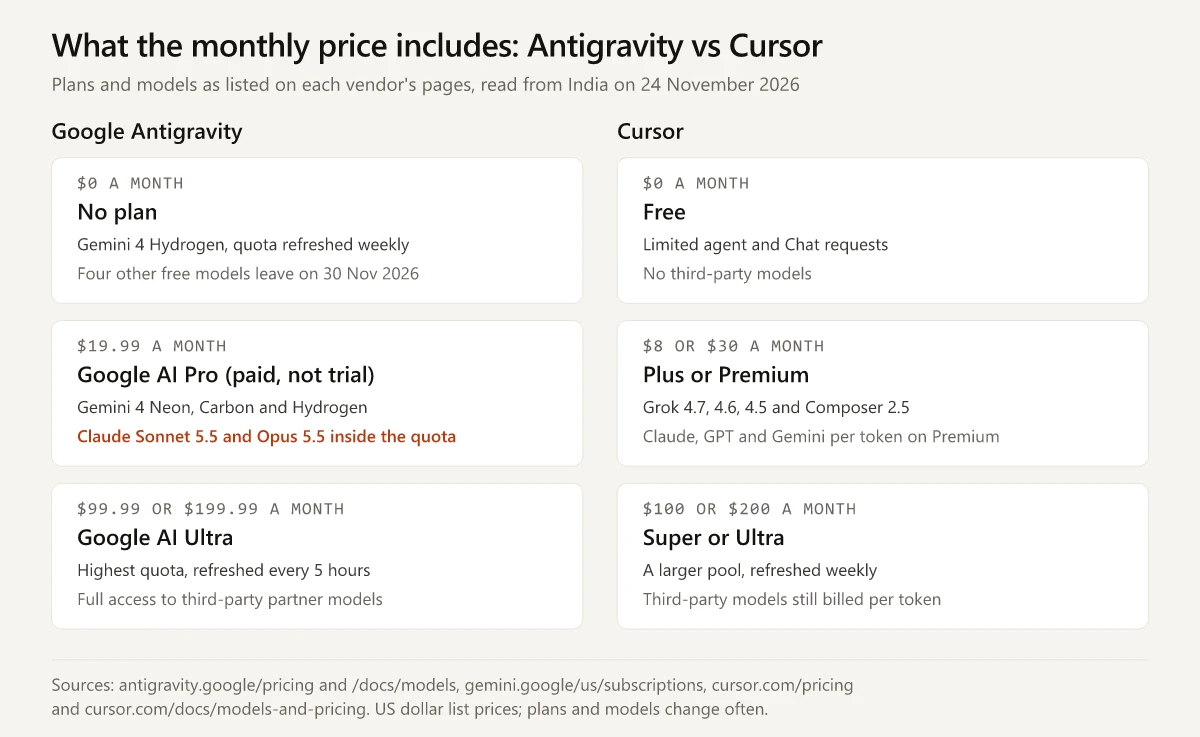
“Inside the plan price” means the model draws from the plan’s quota or pool; “billed on top” means a separate charge.
| Plan | Price a month | Models inside the plan price | Billed on top |
|---|---|---|---|
| Antigravity, no plan | $0 | Gemini 4 Hydrogen; Gemini 3.8 Flash, Claude Sonnet 4.6, Claude Opus 4.6 and GPT-OSS-120b until 30 November 2026 | Nothing can be added: no AI credits, no own key |
| Google AI Pro, paid | $19.99 | Gemini 4 Neon, Gemini 4 Carbon, Gemini 4 Argon (leaving 30 November 2026), Gemini 4 Hydrogen, Orchestrator, Claude Sonnet 5.5 and Claude Opus 5.5 (thinking), and Gemini 3.8 Flash and GPT-OSS-120b until 30 November 2026 | ”Optional AI credit overages above baseline quota” |
| Google AI Ultra | $99.99 or $199.99 | The same set, with “Full access to third-party partner models” | AI credit overages |
| Cursor Free | $0 | ”Limited agent requests” | Third-party models not available |
| Cursor Plus | $8 | Grok 4.7, Grok 4.6, Grok 4.5 and Composer 2.5, at fixed settings | Cursor-model usage past the weekly pool, from prepaid top-ups; no third-party models (“Only Grok models are available on this plan”) |
| Cursor Premium | $30 | The same pool, with more usage than Plus | Cursor-model usage past the weekly pool, from prepaid credit; Claude, GPT and Gemini at API list price |
| Cursor Super or Ultra | $100 or $200 | The same pool, larger again | Cursor-model usage past the weekly pool, from prepaid credit; Claude, GPT and Gemini at API list price |
Antigravity’s pages add rules that change what a buyer gets:
- Trials get less. Antigravity’s pricing page marks Claude Sonnet 5.5 and Opus 5.5 “Available on Google AI Pro for non-trial subscriptions only”, and says trial subscriptions get the two Claude 4.6 models instead. On AI Pro, Gemini 4 Neon, Carbon, Argon and Orchestrator need a paid plan or a trial bundled with an eligible premium device.
- Five models leave on 30 November 2026. Antigravity’s Models page says “Gemini 4 Argon, Gemini 3.8 Flash, GPT-OSS-120b, and Claude 4.6 models are leaving on November 30, 2026.” As the page stands today, the free column then lists one model, Gemini 4 Hydrogen.
- Google AI Plus counts as free here. The plans docs put “Free and Google AI Plus users” in one group with “A meaningful quota, refreshed weekly”, so the $4.99 Plus plan does not reach the five-hour refresh.
Cursor’s side has one rule that matters as much: its docs say “Plus and Free don’t include third-party models”, so Claude, GPT and Gemini start at Premium. When the weekly pool runs out, the same docs offer three routes: wait for the reset, “Use prepaid credit”, or upgrade.
Claude in Antigravity, Gemini in Cursor
Paid AI Pro and Ultra list Claude Sonnet 5.5 and Claude Opus 5.5 (thinking) as included models. The usage panel on Antigravity’s Models page has two sets of bars, one for “Gemini Models” and one for “Claude and GPT models”, each with a weekly and a five-hour limit, and none of Google’s Antigravity pages I read gives a token allowance for either. In the Antigravity App on Pro and Ultra, Orchestrator can also plan with Claude Opus 5.5 and hand steps to Claude Sonnet 5.5 as the executor. What separates the two Claude models on price and on the kind of work each suits is covered in my Claude Sonnet vs Opus breakdown.
Cursor’s Models and Pricing docs list Gemini 4 among the third-party models available “at the model’s API list price from the first request, paid from your prepaid credit”, per million tokens:
| Gemini model in Cursor | Input | Cache read | Output |
|---|---|---|---|
| Gemini 4 Neon | $3 | $0.15 | $15 |
| Gemini 4 Carbon | $2 | $0.10 | $10 |
| Gemini 4 Argon | $2 | $0.10 | $10 |
| Gemini 4 Hydrogen | $1.50 | $0.075 | $7.50 |
At those rates, 10 million input tokens and 1 million output tokens on Gemini 4 Neon cost $45 (10 x $3 + 1 x $15) on top of Premium’s $30 in Cursor. The same model sits inside Google AI Pro’s quota in Antigravity, which Google states as a rate limit, not a token count, so the two figures do not convert into each other.
Watch one date if you plan to run Gemini 4 Carbon or Argon in Cursor. Google’s Gemini API pricing page lists both at $2.00 input and $10.00 output per million tokens “through November 30, 2026” and $4.00 and $20.00 “starting December 1, 2026”. Cursor’s table read the same day showed the lower pair. Calling the same models from your own code, with a key from Google AI Studio, is a separate bill, set out in how to get a Gemini API key.
Claude in Cursor follows the same per-token rule, and the per-model Claude rates, the own-key route, a worked month and the Claude Code alternative (included in Anthropic’s Claude Pro plan, per Anthropic’s pricing page) are in my Cursor vs Claude Code billing comparison.
Antigravity vs Cursor Pricing for Teams and Light Users
Both pricing pages list US dollars, and neither printed a rupee figure or the letters INR when I fetched it from India. The individual plan prices are in the models table above; for a team, the two pricing pages list:
| For a team | Google, for Antigravity | Cursor |
|---|---|---|
| Per-seat plan | Gemini Enterprise “Standard/Plus plans starting at $30 USD per seat per month”, for eligible customers | Teams, “$30 +/user/month” |
| Other route | ”Pay-as-you-go plan with $0 seat fee and consumption-based pricing” | Enterprise, custom price |
For a light user, the cheapest paid entries are Google AI Plus at $4.99, which the plans docs keep in the free weekly-quota group, and Cursor Plus at $8, which keeps you on Grok and Composer models. Cursor’s pricing page adds that its “Prices shown do not include applicable taxes or fees (e.g. VAT)”.
Rupee prices come from other checkouts. Google AI Pro’s rupee price on Google’s India plan page, the Pro and Ultra usage multiples, and what each Google plan means for Antigravity’s quota are in Antigravity pricing in India. Cursor’s dollar web prices, its usage multiples, Apple’s rupee prices and the legacy Rs 649 Start plan are in what a new Cursor buyer in India pays.
Cursor vs Antigravity Free Plan
Both vendors sell a $0 plan, and they include different things:
| On the $0 plan | Antigravity | Cursor |
|---|---|---|
| What the plan is | ”Experience Antigravity without a subscription plan” | Agent and Chat with “Limited” AI usage |
| Surfaces | ”Access across the Antigravity app, CLI, IDE Extensions, and Python SDK” | Agent, per the feature table |
| Agent work | ”Parallel background agents, subagents, browser use, and scheduled tasks" | "Limited agent requests” and “Limited Chat requests” |
| Cloud agents, code hosting, AI code review | Not a line in any Antigravity plan | Not on Free; Premium and up |
| Extras outside coding | None listed on the free plan | X: “Post, reply, and follow”; limited Grok Chat and Imagine |
Both refresh weekly, and neither vendor gives a number for its free allowance. Antigravity’s plans docs say its limits “correlate with the amount of work done by the agent”, and Cursor’s pricing page says “Limited”.
Storage, Grok, X and the Rest of Each Bundle
The paid plans are bundles, and much of each bundle has nothing to do with code. Google AI Pro at $19.99 against Cursor Premium at $30, from Google’s US plans page and Cursor’s pricing page on 24 November 2026:
| Included | Google AI Pro ($19.99) | Cursor Premium ($30) |
|---|---|---|
| Coding agent | Antigravity, “Entry rate limits” | Cursor, 4x Plus usage |
| Chat assistant | Gemini app with Gemini 4 Neon and Gemini 4 Hydrogen | Grok Chat, Voice, Imagine and Build |
| Storage | 5 TB across Gmail, Drive and Photos | None listed |
| Creative tools | 1,000 Google Flow Credits | Image and video generation in Grok |
| Social and media | YouTube Premium Lite individual plan, in select countries | X benefits: Premium checkmark, ad-free scrolling on most surfaces, preferred @handle |
| Developer extras | None listed beyond Antigravity | Cloud agents, code hosting via Origin, AI code reviews via Bugbot, Grok API access |
Cursor’s pricing FAQ says Grok API usage “is billed separately at standard model rates and doesn’t draw from your plan’s usage pool”, and its X Subscription help page says X benefits apply “when you add a personal X account”. How The X Subscription compares with X’s original Premium tiers is in the X Premium price guide.
Account and Billing Rules on Each Side
Some buyers are decided by the account rules before the models come up:
| Rule | Side | Vendor wording |
|---|---|---|
| AI Pro and Ultra need a personal Google Account | Antigravity | ”Google AI Pro and Ultra plans require a personal Google Account”; the plans docs add that “Google Workspace plans don’t include Antigravity plans or higher rate limits.” A Workspace user can use a personal account, pay as you go through a Google Cloud project, or set up Gemini Enterprise |
| No API key of your own | Antigravity | The plans docs list “Bring-your-own-key (BYOK) or bring-your-own-endpoint for additional rate limits” under options with no support |
| Sold only direct | Cursor | ”Subscriptions are only sold directly through X Subscription Corp”, with no authorised resellers |
| The plan switch is one-way | Cursor | A legacy customer can stay put, but moving to The X Subscription “can’t be undone, and Support can’t undo it for you” |
| Team plans start at Premium | Cursor | ”Plus isn’t available for teams.” |
Antigravity or Cursor, by What You Need
Each row rests on a line from the vendor pages above, as read on 24 November 2026:
| You want | Pick | Why |
|---|---|---|
| Claude Sonnet 5.5 or Opus 5.5 inside a monthly price | Antigravity on paid Google AI Pro | Listed as included; Cursor bills Claude per token (or Anthropic does, with your own key) |
| Gemini 4 Neon as your daily model | Antigravity on Google AI Pro or Ultra | Included in the quota; Cursor charges $3 input and $15 output per million tokens |
| Grok models, and you already pay for X | Cursor Plus or Premium | Grok and Composer are the plan’s pool, and X benefits come with it |
| To start at $0 with background agents and scheduled tasks | Antigravity with no plan | Listed on the free plan; Cursor Free lists limited agent requests |
| An agent inside Visual Studio, Xcode, Eclipse, Zed or Android Studio | Antigravity’s IDE extensions | Google lists these editors; Cursor runs inside JetBrains IDEs through ACP, and reaches Xcode projects only from Cursor |
| Cloud agents, code hosting and AI code review in one plan | Cursor Premium ($30) and up | All three are rows in Cursor’s plan table |
| To bring your own model API key | Cursor Premium and up | Antigravity lists BYOK as not supported |
| To sign in with a Google Workspace work account | Cursor, or Antigravity through pay-as-you-go or Gemini Enterprise | Google AI Pro and Ultra need a personal account |
| A plan for a team | Either | Cursor Teams from $30 a user; Gemini Enterprise Standard/Plus from $30 a seat, or pay-as-you-go with a $0 seat fee, for eligible customers |
Antigravity vs Cursor: Choose the Models, Then the Bundle
The top tiers cost the same, so the Antigravity vs Cursor choice comes down to whose models your subscription pays for. Google AI Pro includes Gemini 4 and Claude 5.5 in Antigravity’s quota and adds storage and Google apps; Cursor includes Grok models, adds X and Grok, and meters every other model. Both sides change often: Antigravity drops five models on 30 November 2026, and Cursor’s pricing page says “Prices subject to change.”
Before you subscribe, write down the one model you will run most, then find it in each vendor’s model table.
Frequently Asked Questions
Does Cursor or Antigravity have the better free plan?
They give different things for $0. Antigravity's free plan lists the app, CLI, IDE extensions and Python SDK, background agents and scheduled tasks, and a quota refreshed weekly on Gemini 4 Hydrogen. Cursor Free lists limited agent and Chat requests and no third-party models, as of 24 November 2026.
Can you use Claude in Antigravity?
Yes. Antigravity's pricing page lists Claude Sonnet 5.5 and Claude Opus 5.5 (thinking) on paid Google AI Pro and on Google AI Ultra, inside the plan's quota. Pro trials get Claude Sonnet 4.6 and Opus 4.6 instead, and those leave Antigravity on 30 November 2026.
Can you use Gemini models in Cursor?
Yes, on Premium ($30 a month) and above, billed per token from prepaid credit. On 24 November 2026 Cursor listed Gemini 4 Neon at $3 per million input tokens and $15 per million output tokens. Cursor Free and Plus include no third-party models.
Antigravity vs Cursor vs Claude Code: which should I choose?
Choose by the models you want included in the price. Antigravity's paid Google AI Pro plan includes Gemini 4 and Claude 5.5 models, Cursor's plans include Grok models while Claude bills per token, and Claude Code is included in Anthropic's Claude Pro plan.
Is Antigravity an IDE like Cursor?
Partly. Google lists the Antigravity IDE as one of five products, next to a desktop app, a CLI, IDE extensions and a Python SDK, and the extensions run inside VS Code, JetBrains IDEs, Xcode and other editors. Cursor ships its own desktop editor, a CLI and cloud agents, and its agent also runs in JetBrains IDEs on a paid plan.