What Is Lifecycle Marketing? The Complete Framework (2026)
Lifecycle marketing explained: the five stages, the metrics that matter, and the channel-by-stage playbook PMMs and growth teams use in 2026.
Bain & Company’s Frederick Reichheld found that increasing customer retention rates by 5% increases profits by 25% to 95%. Most marketing budgets are still stacked toward acquisition and thin on retention, which is why the math rarely works out. Lifecycle marketing is the discipline that rebalances it - by treating the customer journey as a sequence of distinct stages, each with its own playbook.
This guide explains what lifecycle marketing is, the five stages every framework agrees on, the difference from demand gen and customer lifecycle marketing, and the channels, metrics, and tools that make a lifecycle program work in 2026.
What Is Lifecycle Marketing?
Lifecycle marketing is the practice of designing distinct campaigns and experiences for each stage a customer moves through - from first awareness, through purchase, to renewal and referral. Instead of running one generic nurture sequence for everyone, you change the message, channel, and offer based on where the person is in their relationship with your product.
The core idea is simple. A first-time visitor needs education. A free trial user needs activation. A paying customer needs success. A multi-year customer needs new reasons to expand. Lifecycle marketing maps the right intervention to the right moment.
It is the discipline that connects product marketing, growth, and customer marketing into a single operating system.
The Five Stages of the Customer Lifecycle
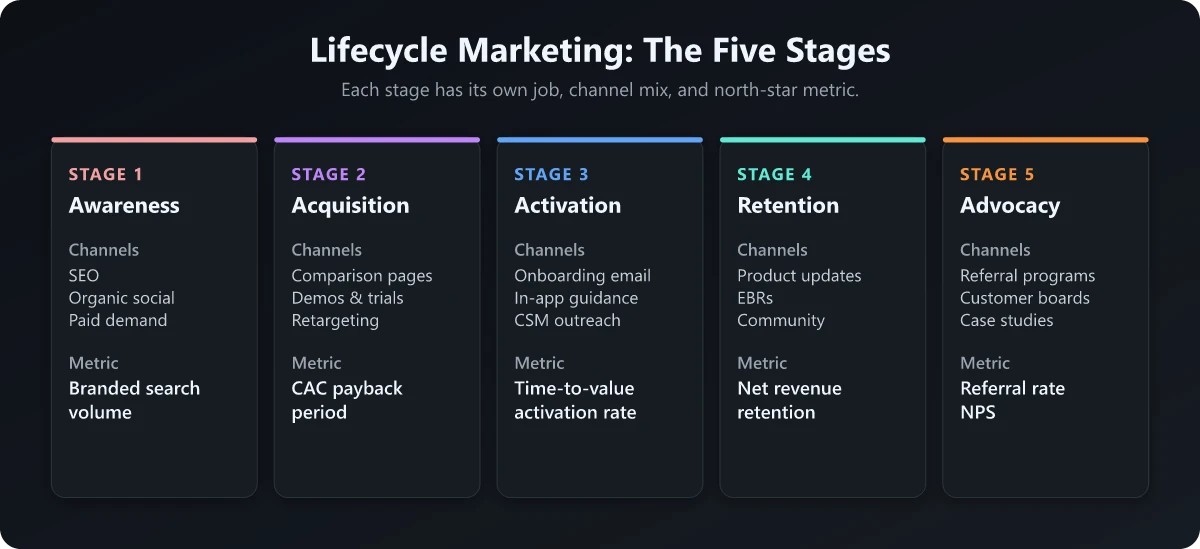
Every lifecycle framework you will encounter is some version of these five stages.
| Stage | Customer state | Marketing job |
|---|---|---|
| Awareness | Doesn’t know you exist | Create demand and visibility |
| Acquisition | Considering you | Convert intent into a trial, demo, or purchase |
| Activation | Just signed up or bought | Drive first value (the “aha moment”) |
| Retention | Using the product regularly | Keep them, expand them |
| Advocacy | Loves the product | Turn them into a referral source |
Some frameworks split acquisition into “consideration” and “conversion.” Others fold advocacy into retention. The stage labels matter less than the principle: each phase has a different goal, a different message, and a different success metric.
Stage 1: Awareness
The job is to be findable when the buyer realizes they have a problem. The campaigns are content-led: SEO, organic social, podcasts, paid demand creation. Success is measured in reach and brand recall, not lead volume.
A good awareness program does not chase a lead capture form. It chases category presence. If somebody Googles “what is lifecycle marketing” three times before converting, the first two visits are wins.
Stage 2: Acquisition
Now the buyer knows the category and is comparing options. The job is to make the case for you specifically. Campaigns shift to comparison content, case studies, free trials, demos, and bottom-of-funnel SEO. This is where most demand gen budget lives.
The handoff from marketing to sales (or to self-serve onboarding) sits at the seam between this stage and the next. Most lifecycle programs leak here, not earlier.
Stage 3: Activation
A new sign-up has not yet experienced the value the product promised. Activation marketing exists to close that gap - the time between sign-up and the moment the user does the thing that makes them want to come back.
The most-cited public example is Slack: in an early interview with First Round Review, Stewart Butterfield reported that teams which exchanged 2,000 messages had a 93% chance of still being active customers. The exact threshold is product-specific. The marketing question is: what email, in-app message, or onboarding nudge gets users to whatever your equivalent moment is faster?
This stage is where lifecycle marketing diverges most from traditional marketing. The channel is often the product itself.
Stage 4: Retention
The customer is paying and using the product. The job becomes habit reinforcement and expansion. Tactics include feature announcements, usage milestones, executive business reviews, in-app prompts to adopt new modules, and renewal reminders. Much of this runs through customer enablement, the one-to-many capability layer of docs, courses, and in-app guidance that teaches customers to get more value so they expand and renew.
Net revenue retention is the metric that matters here. A 110% NRR business doubles every seven years even with zero new logos. A 90% NRR business shrinks no matter how much it spends on acquisition.
Stage 5: Advocacy
A subset of customers love the product enough to recommend it. The lifecycle job is to identify them, equip them, and reward them. Tactics: referral programs, customer advisory boards, case study features, community programs, user conferences.
The economics here are strongest. A referred customer typically converts faster, churns less, and costs almost nothing to acquire. The whole stage is built on a single insight - your best growth channel is people who already pay you.
Lifecycle Marketing vs Customer Lifecycle Marketing
The terms get used interchangeably, which causes confusion in job descriptions and org charts.
- Lifecycle marketing covers all five stages - awareness through advocacy. It is the umbrella discipline.
- Customer lifecycle marketing is the subset that begins after the prospect becomes a customer. It owns activation, retention, expansion, and advocacy.
In a typical org, demand gen owns awareness and acquisition. Customer marketing or lifecycle marketing owns the rest. In smaller teams, one person owns all five stages and just calls themselves a lifecycle marketer.
Lifecycle Marketing vs Demand Generation
Demand gen and lifecycle marketing share a database and often a marketing automation platform. They differ in three ways.
| Dimension | Demand generation | Lifecycle marketing |
|---|---|---|
| Goal | Create and capture pipeline | Activate, retain, expand customers |
| Stage focus | Awareness, acquisition | Activation, retention, advocacy |
| Primary metric | Pipeline, CAC, MQL to SQL | Activation rate, GRR, NRR, NPS |
| Time horizon | Quarterly | Multi-year |
| Owner | Marketing/demand team | Lifecycle, customer marketing, product marketing |
The teams should share a customer data platform but report on different metrics. If one person owns both, they should still keep separate dashboards.
For the demand gen side, see the full playbook in What Is B2B Demand Generation.
A Channel-by-Stage Playbook
The point of the framework is not the labels. It is the channel choice. Each stage uses a different mix.
| Stage | Primary channels | Example tactic |
|---|---|---|
| Awareness | SEO, organic social, podcasts, paid demand | Topic cluster on a category-defining keyword |
| Acquisition | Comparison pages, case studies, demos, retargeting | ”X vs Y” pages and a 14-day free trial |
| Activation | Onboarding emails, in-app messaging, lifecycle hooks, customer success outreach | A 5-email sequence to first value, triggered by sign-up |
| Retention | Product update emails, EBRs, in-app announcements, community | Quarterly executive review with usage benchmarks |
| Advocacy | Referral programs, NPS surveys, customer advisory boards, community | Reward program for verified referrers |
The trap most teams fall into is using one channel across every stage. Email is great for activation and retention but a weak demand-creation channel. Paid ads are great for acquisition but a poor activation tool. The right answer is always channel diversity matched to stage intent.
Metrics That Actually Matter
Pick one north-star metric per stage. Roll the five into one composite view of customer lifetime value.
| Stage | North-star metric | Supporting metrics |
|---|---|---|
| Awareness | Branded search volume, share of voice | Organic traffic, podcast downloads, share of search |
| Acquisition | CAC payback period | Conversion rate, MQL to SQL, opportunity rate |
| Activation | Time-to-value, % activated in 30 days | Onboarding completion, day-1 / day-7 / day-30 active |
| Retention | Net revenue retention | Gross retention, logo churn, expansion revenue |
| Advocacy | Referral rate, NPS | Customer-sourced pipeline, case studies published |
The single number worth tracking above all of these is the LTV/CAC ratio. A healthy SaaS business runs at 3:1 or better. If you are below 1:1, no amount of clever lifecycle automation will save you. Track its direction as well as its level, because a ratio that keeps sliding while ad budget climbs points at the lifecycle stages rather than the ad account, a split I break down in buying conversions versus compounding them.
The Lifecycle Marketing Tech Stack
A modern lifecycle stack has four layers. Smaller teams can compress them into two.
- Data layer - a customer data platform (Segment, RudderStack, Census) or warehouse-native setup (Hightouch, Census on top of Snowflake/BigQuery). This is the source of truth for who the customer is and what they have done.
- Orchestration layer - the marketing automation platform that decides who gets which message and when. HubSpot, Customer.io, Braze, Iterable, Marketo.
- Channel layer - email, SMS, push, in-app, ads, direct mail. Each channel has its own tool, all reading from the same customer profile.
- Insight layer - product analytics (Amplitude, Mixpanel, PostHog), survey tools (Delighted, Refiner), session replay (FullStory, LogRocket).
The non-negotiable: every layer reads from a single customer ID. The moment a tool runs on stale or siloed data, the lifecycle program breaks.
For the orchestration side, see Marketing Automation Strategy and Marketing Automation Workflows for the workflows that map cleanly to each stage.
Common Mistakes That Kill Lifecycle Programs
After dozens of audits, the same five mistakes show up.
- One generic nurture for everyone. A 12-email “drip” that runs the same regardless of whether the user signed up, churned, or never converted is not lifecycle marketing. It is just email.
- No definition of activation. If you cannot articulate what “activated” means for your product, you cannot build campaigns to drive it.
- Owning every stage in the same team. Demand gen and customer marketing have different rhythms. Forcing them into one quarter-long planning cycle creates compromise on both sides.
- Stage-blind reporting. Reporting only on email open rate or pipeline numbers hides whether the program is improving the actual stage transition - awareness to acquisition, activation to retention, etc.
- No customer research. The lifecycle is a hypothesis. Without win-loss interviews, churn interviews, and onboarding research, you are guessing where the friction is.
For the persona work that underpins all of this, see ICP vs Buyer Persona.
How to Build a Lifecycle Program in 90 Days
If you are starting from zero, do not try to build all five stages at once. Sequence the work.
- Days 1-30: instrument the data. Pick a CDP or warehouse-native setup. Define the customer ID. Pipe product events into the marketing automation platform.
- Days 31-60: build activation. The single highest-ROI lifecycle workflow is the first-30-days onboarding sequence. Ship it before anything else.
- Days 61-90: build retention. Add usage-based triggers - feature adoption, login frequency, NPS - and the campaigns that respond to them.
- Quarter 2 onward: build acquisition lifecycle (segmented nurture, product-led trials) and advocacy (referral programs, customer marketing).
Awareness rarely belongs in the lifecycle team’s first 90 days. It is owned by content and demand gen and benefits from the lifecycle infrastructure later.
The Bottom Line
Lifecycle marketing is not a tactic. It is the operating system that makes every marketing tactic land harder. Get the stage definitions right, instrument the data once, and the campaigns - and the metrics they ladder up to - get easier every quarter.
The teams that win are the ones who treat retention with the same rigor they treat acquisition. The math on customer lifetime value is unforgiving, and lifecycle marketing is the only discipline built specifically to bend that math.
Frequently Asked Questions
What is lifecycle marketing?
Lifecycle marketing is the practice of designing distinct campaigns and experiences for each stage a customer moves through with your product, from first awareness to advocacy. Instead of treating every prospect the same, you match the message, channel, and offer to where the person is in their journey across the five stages - awareness, acquisition, activation, retention, and advocacy.
What is customer lifecycle marketing?
Customer lifecycle marketing is the post-acquisition half of lifecycle marketing - the campaigns that begin once a buyer becomes a customer. It focuses on activation, retention, expansion, and advocacy. The acquisition side (awareness and conversion) is usually owned by demand gen; lifecycle marketing owns the rest.
What is the difference between lifecycle marketing and demand generation?
Demand gen creates and captures intent before the sale. Lifecycle marketing manages the relationship after - or across - the sale. They share the same customer database and often the same tools, but the metrics, owners, and timing differ. Demand gen is graded on pipeline; lifecycle is graded on activation, retention, and net revenue retention.
How do you measure lifecycle marketing?
Pick one north-star metric per stage. Awareness: branded search volume and share of voice. Acquisition: CAC payback period. Activation: time-to-value and activation rate. Retention: net revenue retention. Advocacy: referral rate and NPS. Roll those into one composite view of customer lifetime value.
What tools do you need for lifecycle marketing?
At minimum: a CDP or warehouse-native data layer, a marketing automation platform (HubSpot, Customer.io, Braze), a product analytics tool (Amplitude, Mixpanel, PostHog), and a survey tool for NPS. Smaller teams can compress this to one platform like HubSpot or Customer.io plus PostHog.