What Is Customer Onboarding? Frameworks That Reduce Churn
Customer onboarding explained: the four-stage framework, activation metrics, the email and in-app sequence, and the B2B SaaS playbook to cut early churn.
Wyzowl’s research found that 86% of customers say they would stay loyal to a business that invests in onboarding content. Most SaaS churn does not show up at renewal - it is set in motion in the first 90 days, before the customer experiences enough value to justify the line item on next year’s budget. Customer onboarding is the discipline of making sure they get to that value before the window closes.
What follows: what customer onboarding is, the four-stage framework that works across self-serve and enterprise, the activation metrics that actually predict retention, and the playbook B2B SaaS teams use to cut early churn.
What Is Customer Onboarding?
Customer onboarding is the structured process that takes a new customer from sign-up to first meaningful value with your product. It typically spans the first 7-90 days depending on product complexity and combines:
- Product experience - the welcome flow, empty states, tooltips, in-app guidance
- Lifecycle communications - email sequences, in-app messages, push notifications
- Human touch - customer success calls, training sessions, implementation support
- Internal alignment - executive sponsor outreach, success criteria, mutual action plans
The goal is unambiguous: compress time-to-value (TTV). Every day a new customer spends without experiencing the value they bought is a day their initial enthusiasm decays. Eventually it decays enough that they cancel, churn at renewal, or just never log in again.
Strong onboarding is the highest-leverage retention investment a company can make. Weak onboarding is the most common silent killer of SaaS metrics.
Customer Onboarding vs User Onboarding
The two terms get used interchangeably, which leads to ownership confusion.
| Dimension | User onboarding | Customer onboarding |
|---|---|---|
| Unit | Individual user | Account/customer |
| Scope | In-product experience only | Product + comms + human + commercial |
| Time horizon | Minutes to days | Days to months |
| Owner | Product, design, growth | Customer success, product marketing, ops |
| Metric | Activation rate per user | Account activation, time-to-value, early renewal indicator |
In B2C and PLG SaaS, user and customer onboarding often collapse into the same workflow. In B2B mid-market and enterprise, they are distinct programs with different owners.
The mistake most teams make: building a great in-product user onboarding flow and assuming the account-level work takes care of itself. It does not. An account where 1 of 12 invited seats activates is a churn risk no matter how good the user flow was.
The Four Stages of Customer Onboarding
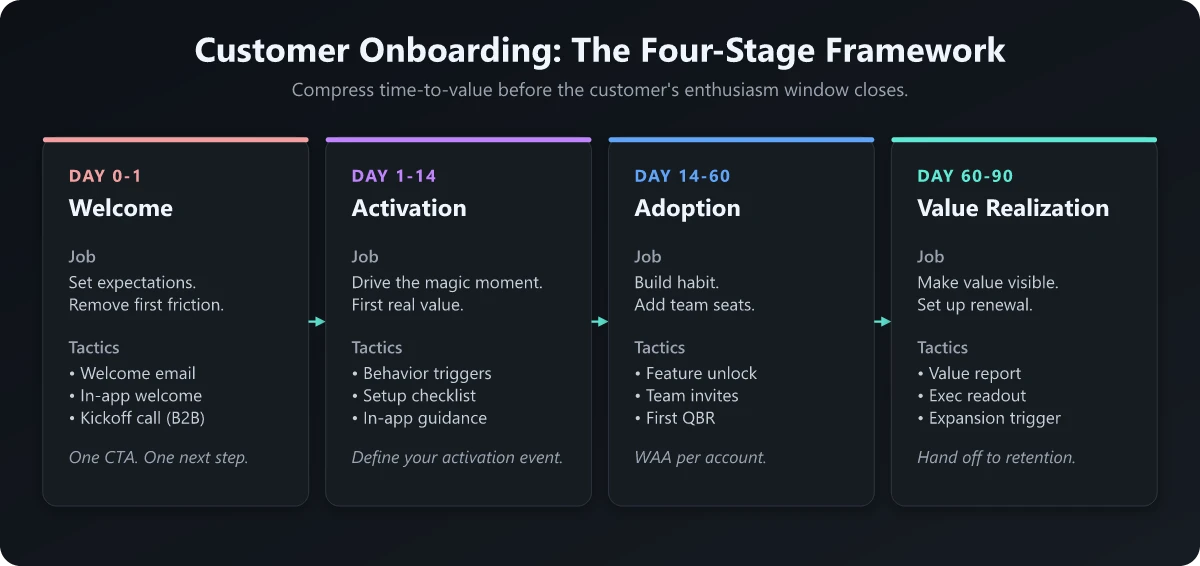
Every working onboarding program has four stages. The labels vary. The sequence does not.
Stage 1: Welcome (Day 0-1)
The customer just signed up or signed the contract. The window of attention is widest here. The job is to set expectations and remove the first friction.
| Element | What good looks like |
|---|---|
| Welcome email | Sent within 5 minutes of sign-up, names a real person, links to a single next action |
| In-app welcome | Names the user, restates the value, removes any blank-state paralysis |
| Implementation kickoff (B2B) | Scheduled within 48 hours of contract signature |
| Mutual onboarding plan | Shared doc with milestones, owners, dates - signed off by both sides |
The trap most teams fall into: a welcome email packed with seven CTAs, a list of features, and a generic “we are excited to have you.” The customer leaves more confused than when they arrived. One next action. One CTA. One outcome.
Stage 2: Activation (Day 1-14)
Activation is the moment a user does the thing that makes them want to come back. It is product-specific. The most-cited public example is Slack: in an early interview with First Round Review, Stewart Butterfield said that teams which exchanged 2,000 messages had a 93% chance of still using Slack later. The exact threshold matters less than the pattern - find a behaviour that, once it happens, is highly correlated with retention.
For your own product, the activation event might be the first integration connected, the first report shared with a teammate, or the first piece of content published. The marketing job in this stage: identify the activation milestone, then design every email, in-app message, and CSM touch around getting users there faster.
A useful lens - “the magic moment.” If you cannot describe in one sentence the moment a new user thinks “okay, this is actually useful,” your activation strategy is a hypothesis, not a plan.
Stage 3: Adoption (Day 14-60)
The user has activated. The job becomes habit reinforcement and breadth - how do you get them using more of the product, more of the time, with more of their team?
| Tactic | Why it works |
|---|---|
| Feature unlock emails | Trigger when usage signals readiness for the next feature |
| In-app guidance for advanced flows | Surface when the user has mastered the basics |
| Team invitation prompts | Most B2B products only stick when 3+ users are active |
| First QBR or check-in (B2B) | Calibrate against initial success criteria |
| Usage milestone celebrations | ”You sent your 100th message” - small but works |
The metric to watch in this stage: weekly active users per account, not total accounts. A 100-seat account where 12 users log in weekly is a different account than the one where 73 do.
Stage 4: Value Realization (Day 60-90)
The customer experiences the outcome they bought. Time-to-value lands here. The job is to make that value visible, attribute it back to the product, and set up the conditions for renewal and expansion.
- First value report - “in 60 days you have done X, saved Y, gained Z”
- Executive readout - structured review with the buyer, not just the user
- Expansion trigger - if usage exceeds the original spec, set up the conversation early
- Reference qualification - the customers seeing the most value become case studies, advocates, and referrers
This stage is where customer onboarding hands off to retention, the next phase of lifecycle marketing. Once first value lands, the ongoing job shifts to customer enablement, the one-to-many system that keeps deepening what customers can do on their own.
The Activation Metrics That Predict Retention
Onboarding measurement done badly looks at email opens and call-completion rates. Done well, it looks at the metrics that actually predict 12-month retention.
| Metric | Definition | Why it matters |
|---|---|---|
| Time-to-first-value (TTFV) | Days from sign-up to first activation event | The most predictive single number |
| Activation rate | % of new users who reach the activation milestone in 30 days | Cohort comparison reveals onboarding regressions |
| Day-7, Day-30 retention | % of users still active 7 and 30 days after sign-up | Catches early churn before it shows in renewal data |
| Weekly active accounts | Accounts with at least one user active per week | Account-level health, not just user activity |
| Onboarding completion | % of accounts that finish a defined onboarding plan | Discipline metric - did the program actually run |
| Net Promoter Score at 30 days | Survey response 30 days post-sign-up | Leading indicator of renewal sentiment |
Track these as cohorts, ideally tied into customer journey analytics so you can see where activation breaks down. Comparing one calendar month’s day-30 retention to the same month a year ago is the only honest read - April 2026 against April 2025, not April against December. Aggregate metrics hide the lessons.
The Onboarding Communication Playbook
A standard B2B SaaS onboarding sequence runs 8-12 emails plus in-app messaging across the first 30 days.
Days 0-7: Setup and First Value
| Day | Channel | Message |
|---|---|---|
| 0 | Welcome + one next action + named human | |
| 0 | In-app | Welcome modal; clear primary CTA |
| 1 | Setup checklist + how to invite team | |
| 3 | Tip: how to do [activation event] | |
| 5 | In-app | Trigger if activation event not yet done |
| 7 | Recap of progress + offer of help |
Days 8-30: Adoption and Habit
| Day | Channel | Message |
|---|---|---|
| 10 | Feature unlock - second-order capability | |
| 14 | Customer story or use-case inspiration | |
| 18 | In-app | Advanced tip based on observed usage |
| 21 | Invite team prompt if seat utilization is low | |
| 25 | NPS survey | |
| 30 | First-month value report |
The point is not to ship more emails. It is to ship the right email at the right trigger. A behavior-triggered sequence beats a calendar-triggered one in every test.
For the broader email infrastructure, see Marketing Automation Workflows and Marketing Automation Strategy.
Onboarding for PLG vs SLG
The mechanics differ between product-led and sales-led GTM motions.
| Element | PLG onboarding | SLG onboarding |
|---|---|---|
| First touch | In-app welcome | Implementation kickoff call |
| Owner | Growth + product | Customer success + sales engineering |
| Time-to-value target | Hours to days | Weeks to months |
| Communication mix | 80% in-product + lifecycle email, 20% human | 50% human, 30% lifecycle email, 20% in-product |
| Activation event | Single-user behavior (sent first message, etc.) | Account-level (5+ users, integration live, first report run) |
| Success criteria | Defined by product team | Defined jointly with customer in a mutual onboarding plan |
For the full account-level program, see B2B customer onboarding best practices. Most B2B SaaS teams run a hybrid - a self-serve trial with PLG onboarding for individual users, and SLG onboarding for accounts that move to a contract. Designing both to share the same database is the operational unlock.
For PLG patterns, see Product-Led Growth Examples.
Common Customer Onboarding Mistakes
The same six mistakes show up in audit after audit.
- No defined activation event. If you cannot name the moment a customer thinks “this is working,” you cannot design onboarding around it.
- Calendar-triggered emails only. Day 1, Day 3, Day 7 sends regardless of behavior. Behavior-triggered always wins.
- One-shot kickoff with no follow-up. A great kickoff call followed by silence for three weeks is worse than no kickoff. The silence reads as abandonment.
- Account-level blindness. Optimizing user-level activation while one account has 1 of 25 seats live is a churn risk you are missing.
- No first-value report. The customer experiences value but does not see it attributed back to the product. Renewal sentiment suffers.
- Onboarding owned by nobody. “Everyone is responsible” means nobody runs the program. Single named owner per stage.
Onboarding Tools That Actually Help
A workable stack:
- Lifecycle email/messaging: Customer.io, Braze, HubSpot, Iterable
- In-app guidance: Pendo, Appcues, Userflow, Chameleon
- CS workflow: Gainsight, Vitally, Totango, ChurnZero
- Product analytics: Amplitude, Mixpanel, PostHog, Heap
- Survey: Delighted, Refiner, Survicate (feed responses into your voice of the customer program)
- Mutual action plans (B2B): Recapped, Aligned, GetAccept
Smaller teams can compress this to one or two tools (HubSpot + PostHog + Loom). Larger teams add specialized layers as the cost of switching tooling becomes higher than the cost of a new vendor.
A 90-Day Plan to Build Customer Onboarding from Zero
If you are starting without a real onboarding program:
- Days 1-30: define the activation event, instrument it in product analytics, baseline TTFV and 30-day retention.
- Days 31-60: ship the lifecycle email sequence and a basic mutual onboarding plan template for B2B accounts.
- Days 61-90: layer in in-app guidance, NPS at day 30, and a first-value report.
- Quarter 2: add cohort dashboards, segment by ICP, and start A/B testing the sequence.
The fastest gains come from defining activation and shipping behavior-triggered messaging. Everything else is optimization on top. The one piece worth borrowing rather than inventing is the plan document itself, so start the day 31-60 build from a fillable stage table with owners, exit criteria, and target dates instead of a blank page.
The Bottom Line
Customer onboarding is not a phase of the customer journey - it is the phase. The customers who reach value in their first 30 days renew, expand, and refer at multiples of those who do not. The economics of onboarding investment dwarf almost any acquisition channel.
The hard part is not knowing this. It is sustaining the operational rigor: defining activation, instrumenting it, shipping behavior-triggered communications, and reviewing cohort data quarterly. Every team agrees onboarding matters. Few build the discipline that makes it real.
Frequently Asked Questions
What is customer onboarding?
Customer onboarding is the structured process that takes a new customer from sign-up to first meaningful value with your product. It usually spans the first 7-90 days and combines product UX, email and in-app sequences, customer success outreach, and milestone tracking. The goal is to compress time-to-value before the customer's initial enthusiasm decays.
Why is customer onboarding important?
Early-stage churn is set in motion in the first 90 days, before the customer experiences enough value to justify the spend. Strong onboarding is the single highest-leverage retention investment a company can make - it determines whether someone becomes a long-term customer or an early cancellation.
What is the difference between customer onboarding and user onboarding?
User onboarding is the in-product experience for an individual user - the welcome flow, tooltips, empty states. Customer onboarding is the broader account-level program that wraps around it: implementation, training, success outreach, executive alignment. In B2C and PLG SaaS the two often merge. In B2B and enterprise they are distinct workflows with different owners.
How long should customer onboarding take?
Match it to your product's natural time-to-value. Self-serve SaaS typically targets first value in 24 hours and core activation in 7-14 days. Mid-market B2B targets first value in week one and full deployment in 30-60 days. Enterprise often spans 60-90 days. The metric to optimize is not 'fast onboarding' but 'first value before the customer's enthusiasm window closes'.
Who owns customer onboarding?
It varies by GTM motion. PLG companies usually have product own the in-app experience with growth marketing running lifecycle email. SLG companies assign customer success or onboarding specialists, with product marketing owning the content and sales engineering owning technical setup. The non-negotiable: one named owner per stage of the journey, not a shared responsibility that becomes nobody's job.