What Is a Value Proposition? Examples and How to Write One
A value proposition is the one sentence that says why a buyer should choose you. Frameworks, examples, and the writing process PMMs actually use.
Gartner research, cited by Brent Adamson in HBR, found that B2B customers dedicate only 17% of their purchase process to talks with potential suppliers. The other 83% is independent research, and most of it happens on a website that has to make its case in seconds. A value proposition is the sentence that website opens with - the single most compelling reason a buyer should choose you over every alternative.
This guide explains what a value proposition is, the difference between a unique, customer, and employee value proposition, the frameworks that work, examples worth copying, and a step-by-step process for writing one.
What Is a Value Proposition?
A value proposition is the single most compelling reason a specific customer should choose your product over every other option, including doing nothing. It names four things:
- Who the product is for
- What job they are trying to do
- What outcome the product delivers
- What makes the product different from anyone else who claims to do the same thing
Most companies can write the first three. The fourth is what makes a value proposition useful. Without a clear point of difference, a value prop is just a description.
A great value proposition is not a tagline. It is not a mission statement. It is not a feature list. It is the strategic answer to “why us?” - written in language a buyer recognizes as their own.
A Value Proposition Example
Compare two homepages.
Generic: “The leading platform for sales productivity.”
A real value prop (paraphrased from Gong’s positioning): Gong captures every customer interaction across phone, email, and web, then uses AI to show revenue teams what is working, what is at risk, and what to do next.
The first one is a category label. It could belong to fifty other companies. The second one is a value proposition because it tells you who it is for (revenue teams), what it does (captures interactions, surfaces patterns), and why it is different (AI on every interaction, not just dashboards).
A value proposition is not better when it is more clever. It is better when it is more specific.
The Anatomy of a Value Proposition
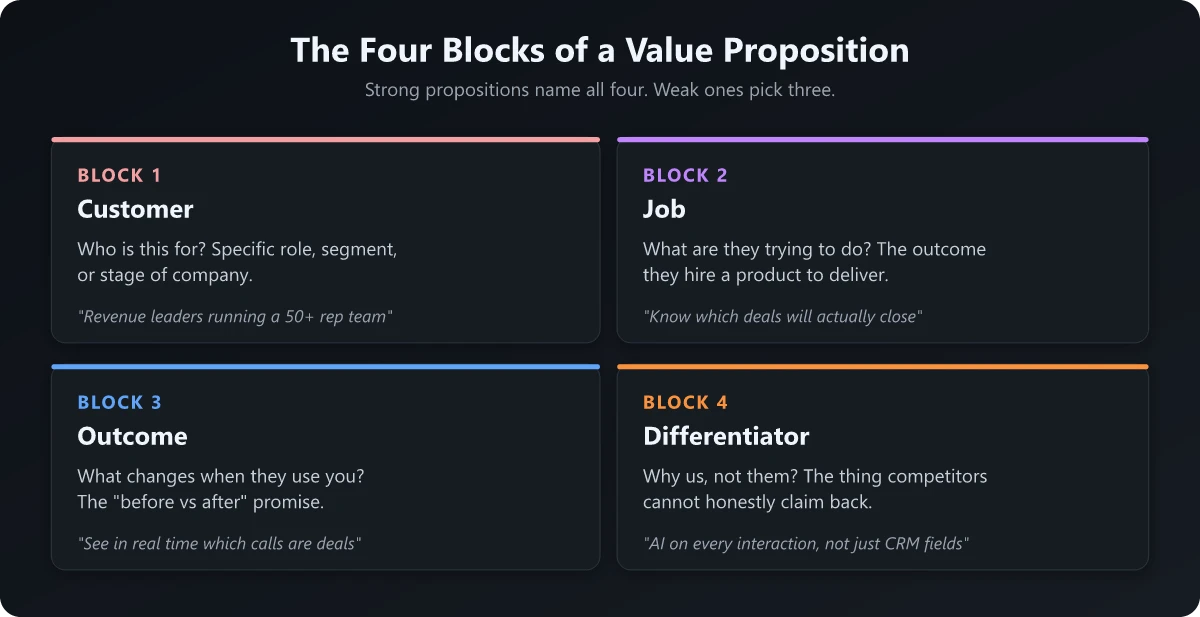
Every strong value proposition contains four building blocks. The order varies. The blocks do not.
| Block | What it answers | Example |
|---|---|---|
| Customer | Who is this for? | ”For revenue leaders running a 50+ rep team” |
| Job | What are they trying to do? | “who need to know which deals will close” |
| Outcome | What changes? | ”Gong shows you in real time which calls are deals and which are stalls” |
| Differentiator | Why us, not them? | “by analyzing every interaction, not just CRM fields” |
Strong value props compress the four blocks into a sentence or two. Weak ones either pick three of the four or use language so abstract that all four blur together.
What Is a Unique Value Proposition?
A unique value proposition (UVP) is the same idea with sharper teeth. The “unique” part is not a feature claim. It is the answer to “what would a competitor not be able to say back?”
Three tests for whether your value prop is actually unique:
- The mirror test. Could your closest competitor put the same sentence on their homepage? If yes, it is not a UVP.
- The opposite test. Does the opposite of your value prop sound stupid? “Faster software” is not a UVP because nobody markets slow software. “The CRM that requires zero manual data entry” is, because the opposite (“the CRM that requires hours of manual data entry”) is true for most competitors.
- The customer test. If you read the value prop to a current customer, do they recognize it as the reason they bought you? Or do they describe a different reason?
If any of those tests fail, the prop is generic. Generic propositions waste expensive ad clicks and leave deals to be won on price alone.
What Is a Customer Value Proposition?
A customer value proposition is written from the buyer’s perspective, not the company’s. The grammar shift is small. The impact is large.
| Company-led | Customer-led |
|---|---|
| ”We help marketing teams scale content." | "Marketing teams cut content production time by 70% with our platform." |
| "Our platform unifies your customer data." | "You see one customer profile across every tool, automatically." |
| "AI-powered sales coaching." | "New reps hit quota in their second quarter, not their fourth.” |
The customer-led version starts with the buyer’s reality and ends with the product. It is not a stylistic preference - it is the difference between a homepage that reads like an internal pitch deck and one that reads like the answer to a buyer’s question.
What Is an Employee Value Proposition?
An employee value proposition (EVP) applies the same logic to a different audience. Instead of “why should a customer buy?”, it answers “why should a candidate join, and a current employee stay?”
A strong EVP names four things:
- The kind of work the person will do
- The kind of people they will work with
- The kind of growth they can expect
- What the company asks in return
EVPs that read like a careers page banner (“we’re a fast-paced team that values impact”) are noise. EVPs that read like a real promise (“you will own a P&L within 18 months and we expect you to ship monthly”) attract the right candidates and repel the wrong ones. Both are wins.
How to Write a Value Proposition: A 5-Step Process
The process below is what most product marketing teams actually use. It assumes you have customer interviews, competitive intelligence, and a positioning point of view in place.
Step 1: Interview Your Best Customers
Talk to 8-12 customers who already pay you. Ask them three questions, in this order:
- What were you trying to do when you started looking for a product like ours?
- What did you try before us, and why did it not work?
- If we shut down tomorrow, what would you say in the goodbye email to your team?
The third answer is gold. Customers describe the value prop you actually deliver in language a marketer cannot invent.
Step 2: Map the Jobs, Pains, and Gains
Use a value proposition canvas (Strategyzer’s framework, from Alex Osterwalder’s Value Proposition Design, still works). On one side, list the customer’s:
- Jobs: what they are trying to accomplish
- Pains: what gets in the way
- Gains: what success looks like
On the other side, list your product’s:
- Pain relievers: how you remove friction
- Gain creators: how you produce upside
- Products and services: what you actually sell
Match the two columns. The strongest value proposition is the one where pain reliever and customer pain align tightly. A pain reliever that maps to no listed pain is the tell that you are solving a problem the customer never raised, which is far easier to catch when you lay all six fields out side by side instead of keeping the two lists in separate docs.
Step 3: Write the One-Sentence Version
Use this template as a starting point - then break it.
For [target customer] who [job to be done], [product name] is the [category] that [unique outcome] - unlike [alternative], we [point of difference].
That is Geoffrey Moore’s classic positioning template from Crossing the Chasm, lightly adapted. It is wordy on purpose. Once you have the long form, cut it to a homepage-ready 10-15 word headline.
Step 4: Pressure Test Against the Three Tests
Run the mirror, opposite, and customer tests above. Most first drafts fail at least one. Rewrite until all three pass.
Step 5: Test on a Live Audience
The cheapest test is a five-second test. Show the value prop to five people in your ICP. Ask them what the product does, who it is for, and why they would care. If they cannot tell you in their own words, the prop is too clever.
A more expensive test: change your homepage hero, run it for a week, and look at scroll depth, demo conversion, and outbound reply rates. Numbers move within 14 days when the prop is clearly better - or clearly worse.
Between those two sits the quantitative version, where you score several variants against the same axes and read the gap rather than the winner. The copy-paste instrument, the scoring rubric and the sample sizes that make a small B2B panel defensible are in message testing examples.
Value Proposition Statement vs Value Proposition
A value proposition is the underlying strategic truth. A value proposition statement is the written articulation, usually one sentence long, used on a homepage hero or sales deck. They are not the same thing.
You can have the right value proposition and a poorly written statement. You can also have a clean statement built on a weak proposition. The first is fixable in an afternoon. The second is the harder problem - it requires going back to customer research and positioning work.
Common Mistakes That Make Value Propositions Weak
After auditing dozens of homepages, the same patterns show up.
- Feature lists pretending to be value props. “Built-in CRM, AI scoring, and automated workflows” is not a value prop. It is a feature shelf. To fix one, sort each line into feature, benefit or value, then write the prop’s outcome as a value line, one that names the change to a goal or number the buyer already reports on.
- Adjective inflation. “The world’s leading,” “the most advanced,” “the easiest.” Every category claims these. Buyers ignore them.
- Inside-out language. “Our platform unifies” is company-led. “You see one profile” is customer-led.
- Targeting everyone. A value prop that fits five different ICPs fits none of them well. Pick the one that pays.
- Confusing proposition with positioning. Positioning is the strategic frame. The value prop is the headline that lives inside it. You need both.
For the broader frame, see What Is Market Positioning and Product Positioning.
Value Proposition Patterns Worth Studying
Specific homepage taglines change every quarter, so live copy is a moving target. The structural patterns underneath them are what compound. A few worth borrowing:
| Company | Structural pattern | Why it works |
|---|---|---|
| Linear | An issue tracker built specifically for high-performance product teams | Names the buyer and the standard, not a feature list |
| Notion | Replaces an entire category of tools, not a single tool | Reframes what the buyer is actually buying |
| Vercel | Compresses the developer workflow into three verbs | Owns a workflow, not a single capability |
| Superhuman | Owns one extreme (speed) and defends it ruthlessly | Single-attribute positioning, hard to copy |
| Stripe | Reframes the category from “payments” to “financial infrastructure” | Category expansion that pulls in a wider buyer set |
Steal the structure, not the words. Each pattern would fail if a competitor copied it without the underlying truth - and each company’s exact homepage copy will have changed by the time you read this.
The Bottom Line
A value proposition is the most expensive sentence in your marketing. The homepage hero, the cold email subject line, the sales pitch opener, and the cold outbound ad copy all derive from it. Get it right and every downstream asset compounds. Get it wrong and you are paying for clicks that never had a chance to convert.
The path is unglamorous. Talk to customers. Map jobs, pains, and gains. Write the long form. Cut to one sentence. Pressure test. Ship and measure. Most teams skip the first two steps and wonder why their homepage does not convert.
Frequently Asked Questions
What is a value proposition?
A value proposition is the single most compelling reason a specific customer should choose your product over the alternatives. It names the customer, the job they are trying to do, the outcome you deliver, and what makes you different from anyone else who claims to do the same thing.
What is a unique value proposition?
A unique value proposition (UVP) is a value proposition with a defensible point of difference baked in. The 'unique' part is not a claim about your features. It is the answer to the question 'why us, and not the alternative?' that a competitor cannot honestly say back.
What is a customer value proposition?
A customer value proposition is a value proposition written from the customer's perspective rather than the company's. It leads with the buyer's job, pain, or desired outcome, and then names the product as the means to that end. Most weak value props get this backwards.
What is the difference between a value proposition and a value proposition statement?
A value proposition is the underlying truth - who you serve, what you do for them, why you are different. A value proposition statement is the written articulation of it, usually one sentence long, used on a homepage hero or sales deck. You can have the right value proposition and a bad statement, or a clean statement built on a weak proposition.
How long should a value proposition be?
Short enough to read in five seconds. The headline version is one sentence (10-15 words). The supporting block adds 1-2 sentences explaining who, how, and why different. Anything longer is a positioning document, not a value proposition.