Ecommerce Marketing Automation: Workflows That Drive Revenue
A practitioner's guide to ecommerce marketing automation: the workflows, triggers, and sequencing that turn browsers into repeat buyers in 2026.
A shopper added a $120 jacket to their cart, got distracted by a Slack ping, and closed the tab. Nothing in your store knows that just happened, so nothing reaches out. That single unaddressed moment, repeated thousands of times a month, is the most expensive leak in most online stores - and it is exactly the kind of gap ecommerce marketing automation exists to close.
I have built and audited these systems for consumer brands, and the pattern is always the same. The stores that win are not the ones with the fanciest tech stack. They are the ones that map the buying journey honestly and let behavior trigger the next message instead of guessing.
This is a practitioner’s guide to the workflows that actually move revenue, the order to build them in, and the judgment calls that separate a system that prints money from one that just sends a lot of email.
The data backs the approach. Omnisend’s analysis of billions of ecommerce messages found that abandoned cart, welcome, and browse abandonment emails accounted for 87% of all automated orders - which is exactly why the order you build these workflows in matters so much.
What Ecommerce Marketing Automation Actually Is
Strip away the jargon and you get a simple definition. Ecommerce automation is software that watches shopper behavior and responds with a personalized message or action, automatically, at the moment that behavior happens.
Browsing a collection, adding to cart, abandoning checkout, buying, leaving a review, going silent for sixty days - each of these is a signal. Automation turns each signal into a triggered response without anyone manually building a campaign for it.
The trap I see most often is treating this like a B2B nurture program ported into a consumer store. Consumers do not request demos or sit in a 90-day buying committee. They decide in minutes, they are driven by emotion and timing, and they respond to relevance over volume. If you want the contrast spelled out, my breakdown of B2C marketing automation covers why consumer playbooks need their own logic.
Triggers, Not Calendars
The mental shift that matters most is moving from a calendar to a trigger. A calendar says “send the newsletter Thursday.” A trigger says “this person abandoned a cart 40 minutes ago, send the reminder now.”
In my experience, triggered flows reliably outperform batch sends because they hit people when intent is highest. Your batch newsletter still has a role, but the revenue engine is the set of behavior-driven flows running quietly in the background.
The Core Ecommerce Marketing Automation Workflows, In Order
You do not need fifteen flows to start. You need the right three or four, built well, before you expand. Here is the sequence I follow and why.
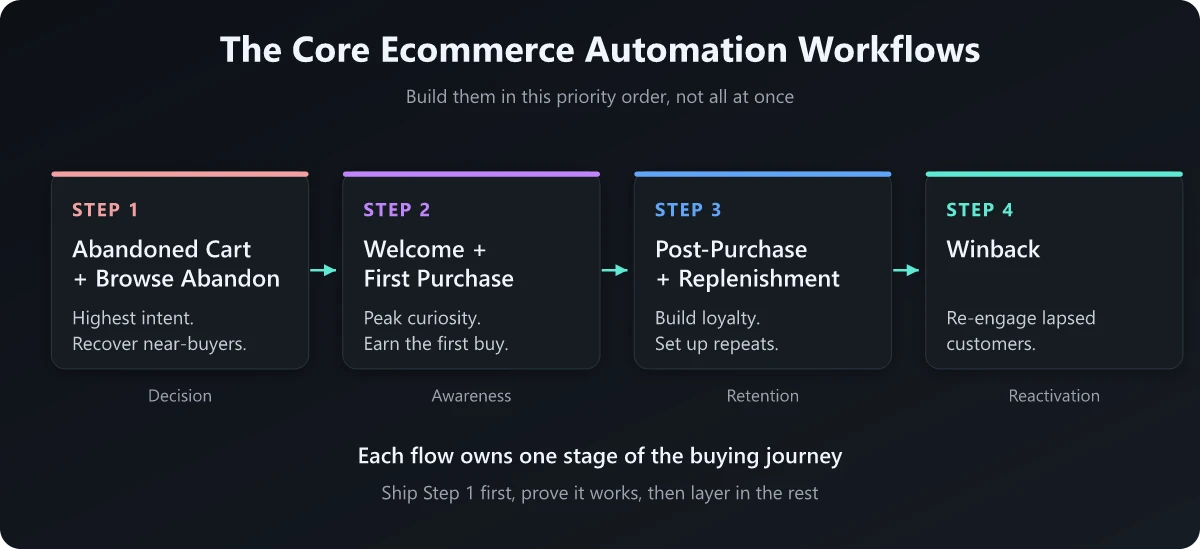
1. Abandoned Cart and Browse Abandonment
This is the first flow I build, every time, because it captures the highest-intent moment in the entire journey. Someone told you exactly what they want and then stopped short. That is recoverable revenue sitting on the table.
A strong cart sequence is two to three messages over roughly a day or two:
- Message one: a simple, friendly reminder with the exact item and a one-click path back to checkout. No discount yet.
- Message two: address friction - shipping, returns, sizing, a review, or a question prompt. Help, do not nag.
- Message three: if and only if margin allows, a modest incentive or urgency cue.
Browse abandonment is the lighter cousin. Someone viewed a product but never added to cart. The intent is softer, so the message is softer - a “still thinking it over?” nudge, not a hard checkout push.
2. Welcome and First-Purchase Flow
New subscribers and first-time visitors are at peak curiosity. The welcome flow sets expectations, tells your brand story, and gives a reason to make that first purchase.
I keep it to three or four messages: who you are, why you are different, your bestsellers or a starter pick, and a gentle nudge to buy. If you offered a signup incentive, the welcome flow is where you deliver and remind people of it before it expires.
3. Post-Purchase and Replenishment
The sale is not the finish line. It is the start of the relationship, and the post-purchase flow is where loyalty is built or lost.
- Order confirmation and shipping: transactional but high open rates, so use them to reinforce the brand and set delivery expectations.
- Education: how to use, care for, or get the most out of what they bought.
- Review request: timed for after the product has actually arrived and been used.
- Replenishment or cross-sell: for consumables, trigger a reorder reminder near the typical runout window. For durables, suggest the natural next product.
4. Winback for Lapsed Customers
Every store accumulates customers who bought once and drifted. A winback flow targets people who have gone quiet past a threshold you define - say, double their normal purchase interval.
The message acknowledges the absence without guilt-tripping, reminds them what they liked, and gives a reason to return. If a sequence of a few messages over a few weeks gets no response, let them rest. Chasing dead contacts only drags down your deliverability.
Mapping Workflows to the Buying Journey
The reason this order works is that each flow owns a distinct stage of the journey. Here is how they line up, the trigger that fires each one, and the goal it serves.
| Workflow | Journey stage | Trigger | Primary goal |
|---|---|---|---|
| Welcome | Awareness to consideration | Signup or first visit | Build trust, earn first purchase |
| Browse abandonment | Consideration | Product viewed, no cart add | Re-engage soft intent |
| Abandoned cart | Decision | Cart created, checkout incomplete | Recover near-purchase |
| Post-purchase | Retention | Order placed | Reinforce, educate, set up repeat |
| Replenishment | Repeat | Time since purchase | Drive the next order |
| Winback | Reactivation | Inactivity threshold | Reactivate lapsed buyers |
When you see it mapped this way, the gaps in your own store become obvious. Most brands have a cart flow and call it a day, leaving the entire retention and reactivation half of the journey silent. That broader sequencing logic is something I dig into in my guide to marketing automation workflows.
Choosing Channels: Email, SMS, and Push
A flow is not the same as a channel. The same abandoned-cart trigger can fire an email, an SMS, a push notification, or a coordinated mix. Picking the right channel for each moment is where a lot of judgment lives.
| Channel | Best for | Watch out for |
|---|---|---|
| Detail, education, longer sequences, storytelling | Crowded inboxes, slower to be seen | |
| SMS | Time-sensitive, high-intent moments, flash drops | Cost per send, strict consent rules, easy to annoy |
| Push | App users, lightweight nudges | Requires an app and opt-in, limited reach |
My rule of thumb: email is your workhorse, SMS is your scalpel. Reserve SMS for moments where immediacy genuinely changes the outcome, like a cart about to expire or a limited drop. Spray SMS at everything and you will train people to unsubscribe.
The deeper point is consistency. A shopper should feel one coherent brand across channels, not three disconnected systems shouting over each other. Coordinating that is a strategy problem before it is a tooling problem, which is why I treat channel choice as part of the overall marketing automation strategy rather than a setting you flip on.
How to Roll It Out Without Drowning
The biggest mistake is trying to launch everything at once. You end up with a dozen half-built flows, no clear data, and no idea what is working. Build in layers instead.
- Week 1 - Foundation: clean up your data and tagging, confirm purchase and behavior events are tracking correctly, and pick one platform.
- Week 2 - First flow: ship the abandoned cart sequence. It is the fastest path to visible revenue and proves the system works.
- Week 3 - Acquisition and retention: add the welcome flow and the post-purchase flow. Now both ends of the journey are covered.
- Week 4 - Expansion: layer in browse abandonment, replenishment, and winback once the core flows are stable.
- Ongoing: segment, test subject lines and timing, and refine. This is the work that never ends and where the real gains compound.
If you want a fuller playbook for the rollout itself, my step-by-step on how to implement marketing automation walks through the data and platform groundwork in more depth.
Segmentation Is the Real Lever
Once your flows are live, segmentation is what separates good from great. The same winback message should not go to a one-time discount hunter and a lapsed VIP who used to spend monthly.
Segment by purchase history, average order value, category affinity, and engagement recency. A relevant message to a small, well-defined segment will out-earn a generic blast to your whole list almost every time.
A Quick Word on Tooling
I am deliberately not handing you a “best platform” verdict, because the right tool depends on your stack, your catalog size, and your budget. What matters is the capability checklist, not the logo.
Whatever platform you choose should handle behavioral triggers natively, support both email and SMS, integrate cleanly with your store and your data, and let you segment without a data science degree. If a tool makes any of those hard, it will quietly cap how good your automation can get.
One caution from experience: do not over-buy. Plenty of stores pay for enterprise platforms and use a fraction of the features. Match the tool to the flows you will actually run this quarter, not the roadmap you imagine for next year.
The Takeaway
Ecommerce marketing automation is not about sending more email. It is about reading shopper behavior honestly and responding at the moments that matter, with the right message on the right channel. Done well, it recovers revenue you have already half-earned and turns one-time buyers into repeat customers without adding headcount.
Start narrow. Build the abandoned cart flow, prove it works, then layer in welcome, post-purchase, and the rest in order. Map every flow to a real stage of the buying journey, let triggers replace the calendar, and treat segmentation as the lever that compounds over time.
The brands that win at ecommerce marketing automation are not the ones with the most flows. They are the ones whose flows actually match how their customers shop. Get the foundation right, and once your store is converting better, point that same discipline at acquisition with an ecommerce SEO checklist so the traffic feeding these flows keeps growing.
Frequently Asked Questions
What is ecommerce marketing automation?
It is software that triggers personalized messages and offers based on what a shopper actually does - browsing a category, abandoning a cart, buying, or going quiet. The point is to send the right message at the right moment without a human pressing send.
Which ecommerce automation workflow should I build first?
Start with abandoned cart, then welcome, then post-purchase. These three cover the highest-intent moments in the buying journey, and they recover or expand revenue you have already half-earned.
Is email or SMS better for ecommerce automation?
Use both, but for different jobs. Email carries detail, education, and longer sequences. SMS is for time-sensitive, high-intent moments like a cart about to expire or a flash drop, where immediacy matters more than length.
How often should ecommerce automation emails send?
Let behavior set the pace, not a calendar. A cart sequence of two to three messages over a day or two works well, while a winback might stretch over weeks. Cap total volume so engaged buyers do not get fatigued.
Do I need a big team to run ecommerce marketing automation?
No. One person can launch the core flows in a few weeks using a single platform. The work that scales a team is segmentation, testing, and creative, not the plumbing of the automation itself.