What Is Customer Journey Analytics? Frameworks and Tools
Customer journey analytics explained: mapping vs analytics, the four data layers, the metrics that matter, and the tools PMMs and growth teams actually use.

Zendesk’s CX Trends 2026 report found that 74% of customers find it frustrating to have to tell their story over and over to different agents - a clean signal that most companies have fragmented journey data and broken handoffs. Most also have a customer journey map taped to a wall, drawn from internal opinions and a handful of interviews. Far fewer have a working customer journey analytics capability - the running, data-backed view of how customers actually move through the journey.
The gap between the map and the reality is where customers churn, deals stall, and acquisition cost compounds - often invisibly, because the dashboard says “growing” while the cohort underneath is decaying.
What follows: what customer journey analytics is, the four data layers required, the metrics that actually predict revenue impact, the tools that power it, and the workflow PMMs and growth teams use to improve the journey one experiment at a time.
What Is Customer Journey Analytics?
Customer journey analytics is the practice of measuring and analyzing every interaction a customer has with a company - across channels, devices, sessions, and stages - to understand what drives conversion, retention, expansion, and churn. It combines:
- Behavioral data - clicks, sessions, feature use, in-app events
- Identity data - who the user is across devices, accounts, and sessions
- Voice data - surveys, NPS verbatims, support tickets, reviews
- Revenue data - pipeline, deal velocity, ARR, expansion, churn
The output is not a dashboard. It is a continuous read of the journey that operations teams - marketing, product, sales, CS - act on every week.
Journey Analytics vs Journey Mapping
The two are often confused. They are different artifacts with different purposes.
| Dimension | Customer Journey Mapping | Customer Journey Analytics |
|---|---|---|
| Output | Static visual diagram | Running data view |
| Source | Workshops, interviews, opinion | Behavioral and revenue data |
| Time horizon | Snapshot | Continuous |
| Use | Strategic alignment, planning | Operational decisions, optimization |
| Owner | CX, marketing strategy | Growth, product analytics, CX ops |
| Update cadence | Annual or on major change | Real-time or weekly |
You need both. The map gives you the framework - the stages, the touchpoints, the moments that matter. Analytics tells you what is actually happening at each stage and where the leaks are.
Companies that only have the map operate on hope. Companies that only have analytics chase local optima without strategic shape.
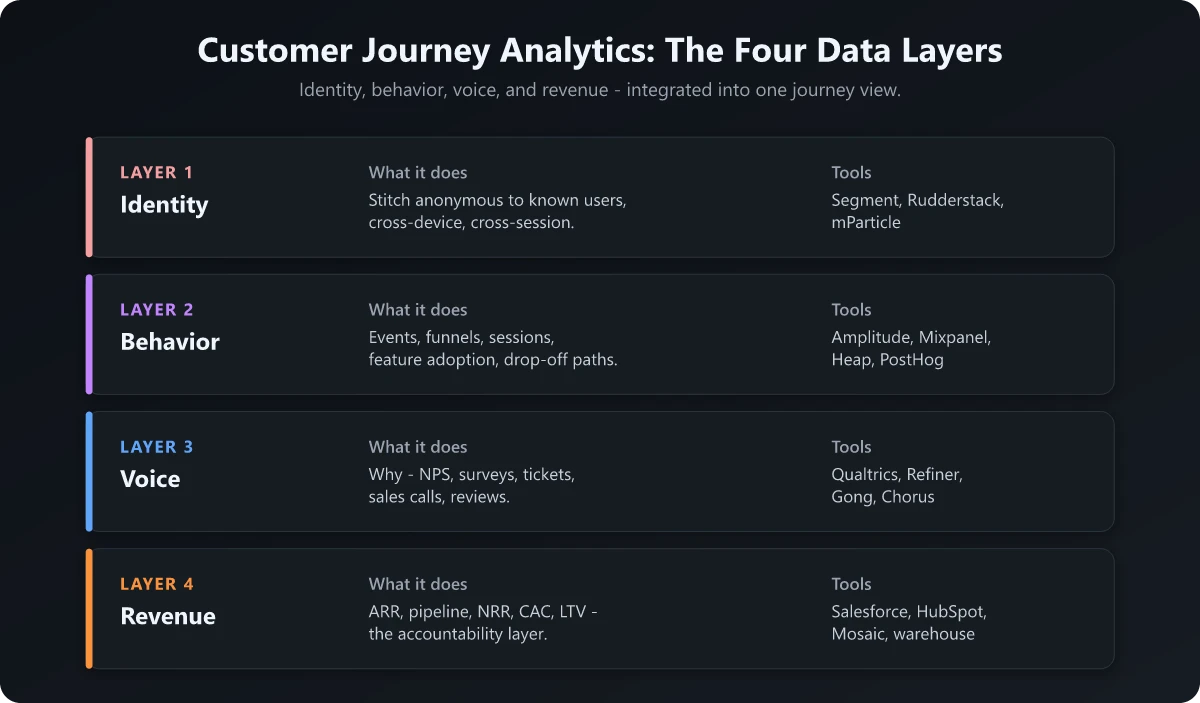
The Four Data Layers of Customer Journey Analytics
Layer 1: Identity
The foundation. Without resolved identity, every other data point is anonymized noise.
- Stitch user activity across devices and sessions
- Resolve anonymous browsing to known account when sign-up happens
- Match account-level activity to revenue records in the CRM
- Handle multi-user accounts (B2B) where seats matter as much as individual users
Tools: CDPs (Segment, Rudderstack, mParticle), identity resolution services, your own backend identity service.
Layer 2: Behavior
What users actually do. Events, sessions, paths, feature adoption.
- Page views, clicks, in-app events
- Funnel completion at each stage
- Time-in-state and recency
- Session recordings for qualitative drill-down
Tools: Amplitude, Mixpanel, Heap, PostHog for product analytics. FullStory, LogRocket, Hotjar for session recording.
This is the layer most teams have already. The mistake is treating it as the whole picture. Behavior shows what people did - it does not tell you why.
Layer 3: Voice
Why people did what they did. The qualitative layer that sits underneath behavior.
- NPS, CSAT, CES scores tied to specific journey stages
- Open-ended survey verbatims
- Support tickets categorised by journey moment
- Sales call recordings
- Public reviews and social mentions
Tools: Qualtrics, Delighted, Refiner for surveys. Gong, Chorus for sales calls. The same channels covered in voice of the customer feed this layer.
The voice layer is where the strategic insight usually lives. Behavior tells you 14% of users drop off at step 3. Voice tells you why - the field labels are confusing, the loading state looks broken, the price feels disproportionate.
Layer 4: Revenue
The accountability layer. Without it, journey analytics is interesting but not load-bearing.
- ARR by cohort
- Pipeline velocity by stage
- Win rates by source and segment
- Net revenue retention
- Customer acquisition cost by channel
- Lifetime value by ICP
Tools: CRM (Salesforce, HubSpot), revenue analytics (Mosaic, Recurly), data warehouse joins to product data.
The integration of these four layers is what turns analytics from a vanity exercise into a revenue lever. Most teams have layers 1, 2, and 4 in disconnected systems. The work of customer journey analytics is connecting them.
The Metrics That Actually Matter
Not every journey metric is signal. Here are the ones that consistently predict revenue impact:
Acquisition Stage
- Channel-attributed conversion rate - of visitors arriving from a channel, what percentage convert to a known event (sign-up, demo request). Treat this as descriptive, not causal: a journey view shows which paths preceded conversion, and only an experiment shows which spend caused it. Marketing mix modeling vs attribution vs incrementality covers where each method breaks.
- Cost per qualified lead by channel and segment - not just CPL, but CPL filtered by who fits the ICP
- Time from first touch to qualified opportunity - long times signal weak targeting; short times signal strong fit
Activation Stage
- Time to first value - how long from sign-up to the moment a user completes the action that predicts retention
- Activation rate by cohort - what percentage of new users complete the activation event in their first 7-14 days
- Drop-off by step in the onboarding funnel
Engagement / Retention Stage
- Weekly active accounts (B2B) or weekly active users (B2C)
- Feature adoption per segment - which features the high-value cohort uses that the churn-risk cohort does not
- Retention curves by cohort - the shape of the curve, not just the absolute number, predicts future ARR
Expansion Stage
- Net revenue retention - the single most powerful SaaS metric, because it folds expansion and churn into one number
- Cross-feature adoption - users on one feature who try a second, who try a third
- Lead-to-expansion conversion - how marketing-qualified expansion signals convert to closed expansion deals
Churn Stage
- Predictive churn score by account - usage trends, support volume, NPS, executive sponsor change
- Time-to-churn from first warning signal - lets CS prioritize
- Reason for churn in customer’s own words - the voice layer at the moment of departure
The discipline is to pick three to five metrics per stage that the team operates on every week. More metrics produces a dashboard nobody reads.
Tools for Customer Journey Analytics
The stack depends on the customer model. There is no single right answer.
| Category | Tools | Best for |
|---|---|---|
| Product analytics | Amplitude, Mixpanel, Heap, PostHog | PLG, self-serve SaaS, behavioral funnels |
| Customer Data Platform | Segment, Rudderstack, mParticle | Identity resolution, data plumbing |
| Session replay | FullStory, LogRocket, Hotjar | Qualitative drill-down on drop-off points |
| Journey orchestration | Salesforce Marketing Cloud, Braze, Iterable | Multi-channel lifecycle messaging |
| Enterprise CJA | Adobe Customer Journey Analytics, Pointillist | Large enterprise, complex omnichannel |
| Marketing analytics | Looker, Tableau, Sigma on a warehouse | Self-serve dashboards for stakeholders |
| Voice of customer | Qualtrics, Delighted, Refiner | Survey + verbatim integration |
| Revenue intelligence | Gong, Chorus, Clari | Sales-side journey signal |
The recurring failure: buying the platform before defining the journey. Tools encode opinions. If the journey is not clear, the tool produces shape without substance.
The Journey Analytics Workflow
Working journey analytics looks more like an operating loop than a project. The loop has five steps.
Step 1: Define the Journey Map
Workshop the ideal journey: stages, touchpoints, and expected behavior at each stage. Keep it simple - 5-7 stages, no more. This is the journey mapping artifact, not the analytics.
Step 2: Instrument Each Stage
For every stage, define:
- The conversion event that signals movement to the next stage
- The drop-off events that signal stall
- The voice question that captures sentiment at that stage
- The revenue tie-in at the customer level
Without instrumentation, the analytics layer cannot run.
Step 3: Build the Unified View
Connect the four data layers in one place - usually a warehouse joined to BI, or a dedicated journey analytics platform. The “single view” requirement is not optional. Disconnected dashboards produce disconnected decisions.
Step 4: Find the Highest-Impact Drop-offs
Two questions:
- Where is the largest volume of customers stalling?
- Where is the highest-value cohort stalling?
The two answers are often different. The first is where most teams focus. The second is often where the bigger revenue lift is.
Step 5: Run Experiments, Measure, Iterate
For each high-impact drop-off, design one experiment, ship it, measure the stage conversion rate. If it lifted, keep. If not, kill and move to the next.
The teams that improve journeys fastest are not the teams with the best dashboards. They are the teams that run two to four experiments per week at known friction points.
What Journey Analytics Unlocks in Practice
The pattern across companies that do this well:
Instrumented onboarding funnels. PLG teams that wire up activation events end-to-end can see exactly which step new users stall on - the integration setup, the empty state, the field that asks for a credit card. The instrumentation is the unlock. Without it, every “improve onboarding” project is a guess.
Cross-functional dashboards. When marketing, sales, product, and CS see the same journey view, the conversation changes. Marketing learns which content actually correlates with closed-won deals, sales learns which feature adoption predicts expansion, and CS learns which usage decline predicts churn. The cross-team view is the source of the operating gains, not the dashboard itself.
Cohort retention at scale. Mature consumer companies report cohort retention sliced by acquisition channel, device, region, and content type, joined to lifetime value. The infrastructure investment is large. The decisions it enables - which campaigns to scale, which originals to commission, which segments to retire - are larger.
Slicing by acquisition channel only works if the channel values are consistent in the first place, and that breaks earlier than most teams expect: two spellings of the same campaign become two rows that never rejoin, so a naming system a machine can group is the unglamorous prerequisite for every cohort chart above.
The pattern: investment in the unified data view always precedes the operating gains. Companies that skip the data work and buy a journey platform get dashboards. Companies that build the data foundation first get decisions.
How to Improve the Customer Journey
The improvement playbook is simple in structure, hard in discipline.
1. Pick One Stage Per Quarter
Trying to improve every stage at once produces no improvement on any. Pick the stage with the highest revenue impact for the quarter - usually activation or expansion.
2. Find the Specific Friction
Drill into the data layer at that stage. Where are users dropping off, by exact step, and what does session replay show them doing? What do the surveys say at that moment? Session replay only ever shows one visitor at a time, so pair it with an aggregated view of the same step: click maps surface the dead clicks on elements users mistake for buttons, and scroll maps tell you whether the step is even reaching the screen, which is where interpreting click, scroll, and move maps turns a vague drop-off into a specific fix.
3. Prioritize by Potential Impact
For each friction, estimate the lift if it were resolved: (current drop-off rate) × (downstream value of recovered users) × (probability the fix lands). Pick the top three.
4. Ship Experiments Weekly
Small changes shipped weekly compound. Large redesigns shipped quarterly often regress. The journey analytics loop favors short cycles.
5. Communicate the Lift
Each quarter, publish “the journey changed X to Y because we shipped Z.” This is what funds the next quarter of work. Teams that cannot tell the lift story lose budget.
Common Customer Journey Analytics Mistakes
| Mistake | Why it happens | Fix |
|---|---|---|
| Mapping without measuring | Workshops feel productive | Map + instrument in the same quarter |
| Behavior-only view | Easier to ship | Layer in voice and revenue from the start |
| Buying a platform before defining the journey | Vendor influence | Map first, instrument second, buy third |
| Dashboards nobody operates on | Built for executives, not operators | Build dashboards the people who can change things actually use |
| Averaging across all customers | One number is easier | Always segment by ICP and customer lifecycle stage |
| Chasing every drop-off | More felt productive | Pick one stage per quarter |
How Journey Analytics Connects to PMM and Growth
For PMMs, customer journey analytics is the data layer that proves whether product positioning, messaging, packaging, and launch decisions actually move the needle. The PMM artifacts - the new web page, the new sales deck, the new pricing tier - have to show up as a change in journey metrics to count.
For growth teams, it is the foundation of every experiment, every channel decision, every retention play. Without it, growth becomes anecdote-driven.
For more on how PMMs use data and instrumentation, see SaaS product marketing strategy and marketing automation strategy.
Conclusion
Customer journey analytics is the running, data-backed read of how customers actually move through the journey - across channels, devices, and stages. It is not a dashboard or a tool. It is a four-layer integration of identity, behavior, voice, and revenue that produces decisions teams act on weekly.
The companies that improve journeys fastest do not have the best maps. They have the best instrumentation, the tightest experiment cadence, and the discipline to pick one stage per quarter and ship until the metric moves. Customer journey analytics is how that discipline becomes operational - and how journey improvement becomes the compounding growth lever it is supposed to be.
Frequently Asked Questions
What is customer journey analytics?
Customer journey analytics is the practice of measuring and analyzing every interaction a customer has with a company - across channels, devices, and stages - to understand what drives conversion, retention, and churn. It combines behavioral data, qualitative feedback, and revenue signals into a single view of the journey.
What is the difference between customer journey mapping and customer journey analytics?
Customer journey mapping is the static visualization of how a customer ideally moves through stages - it is a planning artifact. Customer journey analytics is the running measurement of how customers actually move - it is an operational discipline. Mapping is what you draw on the wall. Analytics is what the data tells you is really happening.
What metrics matter in customer journey analytics?
Stage conversion rates (how many move from one stage to the next), time in stage, drop-off points, channel attribution, retention curves by cohort, and journey-level NPS. The metrics depend on the journey stage - acquisition focuses on conversion, retention focuses on engagement and renewal predictors.
What tools are used for customer journey analytics?
Behavioral analytics tools (Amplitude, Mixpanel, Heap), CDPs (Segment, Rudderstack), session recording (FullStory, LogRocket, Hotjar), and journey-specific platforms (Adobe Customer Journey Analytics, Pointillist, Salesforce Marketing Cloud). The right stack depends on the customer model - PLG SaaS uses different tools than enterprise sales-led.
How do you improve the customer journey?
Instrument every stage with data, find the highest-impact drop-off points, prioritize fixes by potential revenue lift, run small tests, measure the result on stage conversion. Improvement is iterative, not a redesign. The teams that improve journeys fastest are the ones that run weekly experiments at known friction points.