Product Marketing OKRs: 15 Ready-to-Use Examples (2026)
Product marketing OKRs that actually move revenue. 15 ready-to-use examples across positioning, launches, enablement, competitive intel, and research.
Most product marketing OKRs fail the same way. The objective is vague (“drive product awareness”), the key results are activity metrics (“publish 12 pieces of content”), and by the end of the quarter the PMM team has shipped a lot of work that nobody can tie back to revenue. A good OKR should make it painful to do the wrong work, not easy to look busy.
This post walks through what makes a product marketing OKR effective, shares 15 ready-to-use examples across the core PMM pillars, and flags the mistakes that turn OKRs into bureaucracy. The goal: a set of quarterly commitments a PMM team can stand behind when the CEO asks what marketing shipped.
What Makes a Product Marketing OKR Actually Work
An OKR has two parts. The objective is a short, qualitative statement of what you want to be true at the end of the quarter. The key results are the 2-4 measurable outcomes that prove you got there. As What Matters (John Doerr’s site) documents, “the OKR methodology was created by Andy Grove at Intel and taught to John Doerr by him,” with Doerr later introducing the philosophy to Google’s founders in 1999.
A strong product marketing OKR does three things:
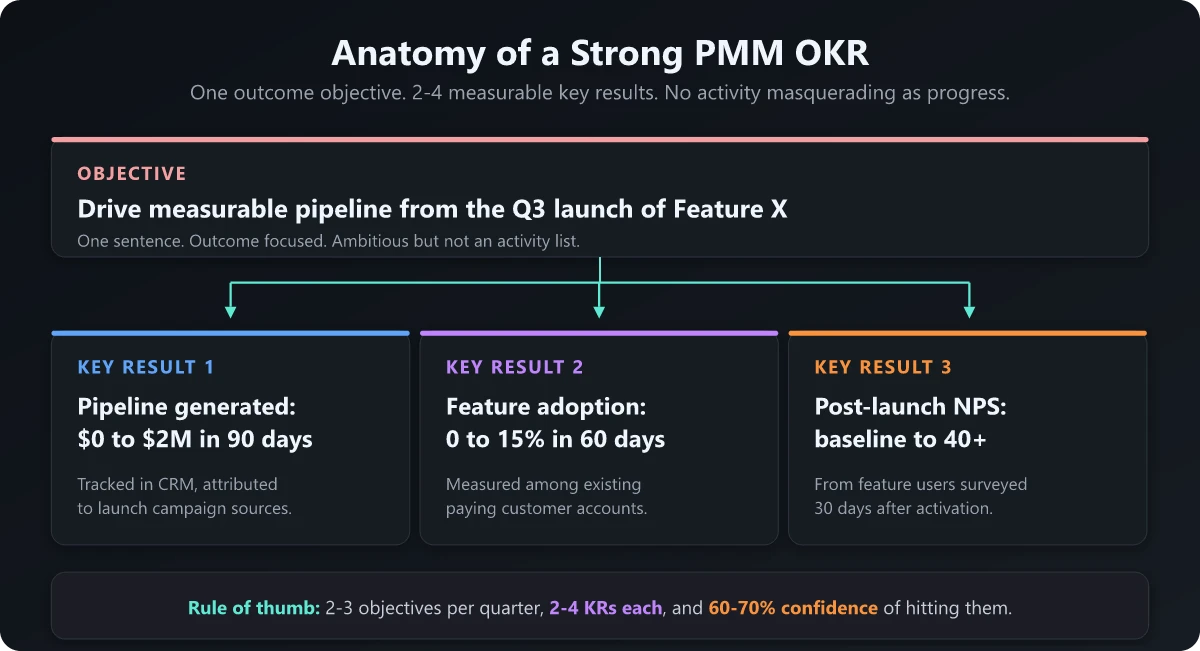
- States an outcome, not an activity. “Launch feature X” is a task. “Drive $2M pipeline from feature X in its first quarter” is an outcome.
- Ties back to a business lever. Pipeline, win rate, retention, ARR by segment, expansion revenue. If the KR does not roll up to one of these, question whether it belongs in an OKR at all.
- Is uncomfortable. If you are 90% confident you will hit every KR, the bar is too low. 60-70% confidence is closer to right.
The 5 Categories of Product Marketing OKRs
Every PMM team should have OKRs that span the core responsibilities of the role. The Product Marketing Alliance’s State of Product Marketing 2025 report describes PMMs as sharpening positioning, messaging, and launches, alongside the customer research, sales enablement, and competitive intel work most modern teams also own. That gives you five OKR categories.
1. Positioning and Messaging OKRs
Positioning OKRs are the hardest to measure because the outcome is clarity, not a number. The trick is to measure proxies: buyer language adoption, sales rep fluency, message recall in customer interviews.
Example OKRs:
| Objective | Key Results |
|---|---|
| Tighten positioning for our enterprise tier | Rewrite and ship the enterprise positioning document, tested with 8 target-account interviews; 80% of interviewed buyers repeat our positioning language unprompted; enterprise win rate moves from 22% to 28% |
| Make our homepage message resonate with the ICP | Homepage visit-to-demo conversion rate moves from 2.1% to 3.0%; 5-second unmoderated test shows 70% of target-persona viewers correctly identify who the product is for; bounce rate on the homepage drops below 45% |
| Align the company on one messaging framework | Ship a messaging house document; 90% of sales, marketing, CS, and support leaders can name the three core message pillars in a survey; all outbound sequences and landing pages rewritten to the new framework |
2. Launch OKRs
Launches are where PMM is most visible, which means launch OKRs must be revenue-tied or they will collapse into activity lists.
Example OKRs:
| Objective | Key Results |
|---|---|
| Nail the Q3 launch of feature X | Generate $2M in qualified pipeline from feature X in the first 90 days; achieve 15% adoption among existing customers within 60 days of launch; post-launch NPS for the feature hits 40+ |
| Improve our launch process so the next one is 2x faster | Ship a launch tiering framework and brief template adopted by all PMMs; average time from roadmap handoff to launch day drops from 8 weeks to 4 weeks; 100% of Tier 1 launches ship with a win/loss plan in place before go-live |
| Land the category expansion launch | Win 3 analyst briefings with positive reports; secure coverage in 2 of our top 5 target publications; generate 500 demo requests in the 30 days post-launch; 20 reference-worthy customer quotes collected |
For more on launch planning, see our guide on the go-to-market strategy template.
3. Sales Enablement OKRs
Sales enablement OKRs are the most naturally measurable because the outcome (win rate, time-to-close, ramp time) is a number sales already tracks.
Example OKRs:
| Objective | Key Results |
|---|---|
| Equip sales to win more competitive deals | Battlecard usage logged in 65% of qualified deals with a named competitor; competitive win rate moves from 34% to 42% in the top 3 competitor matchups; rep self-reported confidence score in competitive conversations rises from 3.1 to 4.2 out of 5 |
| Shorten new hire ramp time | Time to first closed-won deal drops from 120 to 85 days for new AEs; 90% of new hires pass a demo certification within 6 weeks of start; onboarding CSAT hits 4.5+ |
| Improve the quality of discovery | 80% of first-call decks rewritten to the new discovery framework; 50% of closed-lost deals cite “right solution, wrong time” vs. “not a fit” in win/loss interviews; deal stage velocity from discovery to demo improves by 20% |
4. Competitive Intelligence OKRs
Competitive OKRs should move a real number sales cares about: competitive win rate, deal size against a specific competitor, or the number of deals where we win on value vs. price.
Example OKRs:
| Objective | Key Results |
|---|---|
| Win more head-to-head deals against our top competitor | Competitive win rate against Competitor A moves from 38% to 50%; battlecard for Competitor A refreshed monthly with new objection handling; 100% of AEs pass a Competitor A objection-handling role play |
| Build a real win/loss program | Conduct 40 win/loss interviews across a full quarter; ship a quarterly insights report to product, marketing, and sales; 3 product-roadmap items shaped by win/loss findings |
| Turn competitive intel into revenue | Competitive displacement pipeline grows to $5M; 10 case studies published featuring wins against named competitors; competitive objections drop from top 3 to top 5 in lost-deal reason coding |
For tactics, see competitive intelligence analysis and the competitive battlecard template.
5. Research and Insights OKRs
These OKRs are often skipped because the outputs are qualitative. Skip them at your peril: positioning, pricing, and launches all fail when the customer insight underneath is weak.
Example OKRs:
| Objective | Key Results |
|---|---|
| Deeply understand our new mid-market ICP | Conduct 25 mid-market buyer interviews; ship refreshed ICP and buyer persona documents; identify top 3 trigger events and validate with a 200-response survey |
| Improve the voice-of-customer loop | Tag 100% of Gong calls with customer pain themes; publish a monthly VOC digest to the company; 5 product or positioning decisions citing VOC data as the primary input |
| Pricing research we can act on | Run a Van Westendorp price sensitivity study with 300 responses; conduct 15 willingness-to-pay interviews with target accounts; ship a pricing recommendation adopted by the pricing committee |
For the foundational work here, see ICP vs buyer persona.
How to Write a Product Marketing OKR in Practice
The format matters. An OKR written in a hurry during a planning meeting almost always comes out as a wish or a task. Use this structure:
Objective: [One sentence. Outcome. No metrics. Should feel ambitious.]

KR 1: [Baseline value] -> [Target value] by [date]
KR 2: [Baseline value] -> [Target value] by [date]
KR 3: [Binary: ship X adopted by Y, or conduct Z interviews]
A few rules that save teams from themselves:
- Include the baseline. “Improve competitive win rate” is useless. “Move competitive win rate from 34% to 42%” tells you exactly what is being asked.
- No more than 4 KRs per objective. Past 4, you are describing a project, not a goal.
- Aim for stretch, not safety. Google’s re:Work OKR guide describes the sweet spot for an OKR grade as 60-70% - if a team consistently fully attains its objectives, the OKRs are not ambitious enough.
Common Mistakes PMM Teams Make With OKRs
Every PMM team I have seen sets OKRs the same way the first time. The mistakes are consistent.
1. Activity Masquerading as Outcome
“Publish 12 blog posts” is not an OKR. It is a project plan. The OKR would be “grow organic traffic from ICP-relevant queries from 20K to 40K monthly” and the 12 blog posts are how you might get there. The same activity-versus-outcome trap shows up on dashboards, which is why the product marketing metrics you promote to KPIs should measure impact, not effort.
2. Too Many Objectives
A team with 6 objectives has no objectives. Pick 2-3. If a stakeholder asks why their pet project is not an OKR, the answer is: because it is not in the top 3.
3. OKRs That Avoid Revenue
PMM OKRs that never touch pipeline, win rate, or ARR eventually get questioned by the CFO. At least one objective per quarter should sit adjacent to a revenue number the finance team would recognize.
4. Setting OKRs in Isolation
Product marketing does not control product roadmap, sales motion, or marketing spend. OKRs set in a PMM bubble without input from the CRO, VP Product, and VP Marketing will miss. Hold a 30-minute alignment session with each counterpart before finalizing.
5. Not Reviewing Until the End
The teams that hit OKRs review them weekly. Not to report up, but to notice when a KR is drifting and decide whether to change tactics or change the KR. A KR that is not checked until week 12 is usually missed.
How to Score and Learn From OKRs
Score OKRs on a 0.0 to 1.0 scale. An average of 0.6 to 0.7 is the expected range under Google’s model - anything consistently at 1.0 signals the goals were not ambitious enough, and anything routinely below 0.4 signals the team is missing meaningfully. The scoring is a prompt for reflection, not a performance review.
At the end of the quarter, hold a 60-minute retro with three questions:
- Which KRs did we hit and what made them land?
- Which did we miss and was it the goal, the tactics, or something outside our control?
- What would we write differently if we were starting next quarter today?
Write the answers down. Over 4 quarters, you will see patterns in where your PMM team is strong and where it consistently overestimates. That pattern is worth more than any single OKR score.
The Bottom Line
Product marketing OKRs are where a PMM team’s strategy becomes accountable. Done well, they force the team to pick the 2-3 things that matter most, measure them in numbers the business cares about, and review them often enough to correct course mid-quarter. Done poorly, they become a reporting exercise that produces slide decks and no revenue.
Start with outcomes, not activities. Keep the list short. Tie at least one objective to a revenue lever every quarter. And review weekly, not quarterly. The PMM teams that operate this way become the ones the CEO calls when something needs to move.
If you are building the PMM function from scratch, pair these OKRs with a clear view of the role itself: see what does a product marketing manager do and what is product marketing to anchor scope before you write your first objective.
Frequently Asked Questions
What are product marketing OKRs?
Product marketing OKRs are the objectives and key results a PMM team commits to each quarter. A strong PMM OKR pairs a clear, outcome-based objective (e.g. improve sales confidence in our top three competitors) with 2-4 measurable key results (e.g. rep confidence score moves from 3.1 to 4.2, battlecard usage hits 65% of logged deals).
How many OKRs should a PMM team set per quarter?
Two to three objectives, with 2-4 key results under each. Five objectives is a to-do list; one objective is a job description. The job of an OKR is to force prioritization, so keep the list short enough that everyone on the team can recite it without looking.
What is the difference between a PMM OKR and a KPI?
A KPI is a metric you monitor continuously, like win rate or pipeline influenced. An OKR is a time-boxed stretch goal with a start value, a target value, and a deadline. KPIs describe the weather. OKRs describe where you want to move the weather to this quarter.
Should product marketing OKRs be revenue-based?
Some should, some should not. Revenue-adjacent KRs (pipeline influenced, win rate in a segment, launch ARR) keep PMM accountable to the business. But positioning, messaging clarity, and sales confidence are leading indicators and belong in OKRs too. A PMM team measured only on revenue will end up doing sales enablement at the cost of strategic work.