What Is Market Positioning? Frameworks and Examples (2026)
Market positioning explained: the modern definition, April Dunford's 5-component framework, real examples, and a 4-step workshop to find your own positioning.

Market positioning usually decides the deal before a sales conversation happens. 6sense’s 2025 B2B Buyer Experience Report found that 95% of the time, the winning vendor is already on the buyer’s Day One shortlist, and four out of five deals are won by the pre-contact favorite. Whichever vendor owns the right position in the buyer’s mind during the independent-research phase wins. Everyone else is competing for second place. This guide answers what market positioning is, walks through April Dunford’s 5-component framework, and ends with a 4-step workshop to find your own.
What Is Market Positioning?
Market positioning is the deliberate choice of where your product sits in the buyer’s mind relative to the alternatives they are actually considering. It is the answer to three connected questions:
- What is this? (the market category the buyer should compare you in)
- Who is it for? (the specific best-fit customer who will get the most value)
- Why is it better? (the differentiated value vs the alternatives that customer is weighing)
That third question is the one that decays. Competitors close feature gaps, and the answer that won deals last year stops landing, so it is worth knowing which claims survive being copied before you rebuild the whole position.
The output of positioning is not a tagline. It is a one-page document that drives every downstream message: pricing pages, sales decks, ad copy, demo scripts, even the homepage hero. When positioning is strong, every asset feels written by the same person. When it is weak, the homepage promises one thing and the sales call delivers another.
For the product-level cousin of this concept, see product positioning.
Market Positioning vs Related Concepts
The terms get used interchangeably in pitch decks. They are not the same.
| Concept | Scope | Lifespan | Owner |
|---|---|---|---|
| Market positioning | Where the product sits in a category for a specific buyer | 1-3 years | Product marketing |
| Product positioning | A specific product or feature within the broader portfolio | 6-18 months | Product marketing |
| Brand positioning | What the company stands for emotionally | 5-10 years | Brand / CMO |
| Value proposition | The headline value statement on the homepage | Months | Marketing |
| Messaging | The downstream language: taglines, ad copy, decks | Quarterly | Marketing + sales |
| Category design | Defining or claiming a brand-new category | Multi-year bet | Founder + CMO |
The row that causes the most trouble in practice is the last-but-one. If a launch is underperforming and nobody can agree whether the problem sits in the strategy or the words, positioning vs messaging works through the symptoms that tell the two apart.
If positioning is the foundation, messaging is the paint. Most teams obsess over the paint and never inspect the foundation.
Positioning is also segment-specific, which means the segment list comes first. If you cannot say which segments you serve and why each one buys for a different reason, you are writing one position for an average customer who does not exist. The B2B customer segmentation test is the upstream step that keeps that list honest.
The table also assumes a question already settled, which is whether each product carries the company name at all. That branded house or house of brands decision is what determines how much equity a new launch inherits on day one.
April Dunford’s 5-Component Positioning Framework
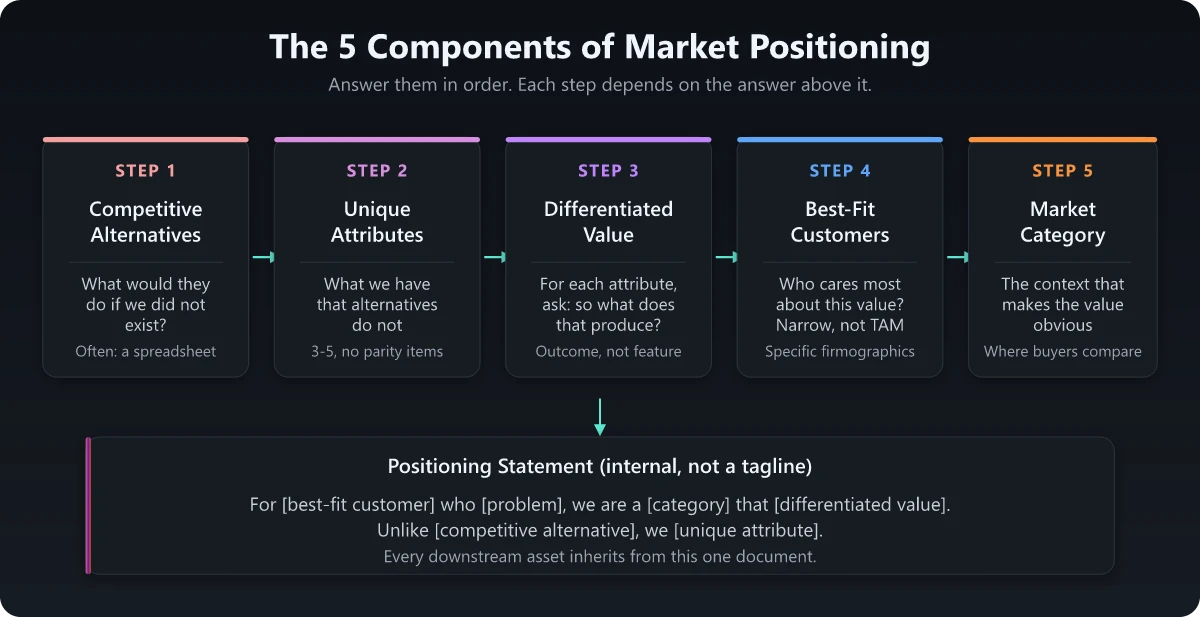
The most widely adopted modern positioning framework comes from April Dunford’s Obviously Awesome. It works because it forces specificity at every step. The five components in the order they should be answered:
1. Competitive Alternatives
What would your customer do if your product did not exist? This is the real comparison set, and it is rarely “the other vendors in our category.” Most often it is a spreadsheet, a manual process, an internal tool, or doing nothing. The alternative defines the standard you are measured against.
2. Unique Attributes
What does your product have that those alternatives do not? Not features for their own sake. The specific capabilities that exist in your product and not in the buyer’s current alternative. List 3-5. Be ruthless about cutting the parity items.
3. Value (and Why It Matters)
For each unique attribute, ask “so what?” The answer is the value. A unique attribute that does not produce a meaningful customer outcome is feature trivia, not differentiation.
4. Best-Fit Customers
Who are the customers who care most about that value? This is not your TAM. It is the segment for whom the differentiated value is mission-critical. Best-fit customers usually share firmographics, a specific use case, and a current pain that the alternatives fail at. For the deeper segmentation work, see ICP vs buyer persona.
5. Market Category
What context should the buyer compare you in so the value is obvious? Pick the category that makes your differentiation matter most. The wrong category is the most expensive positioning mistake: it puts you next to the wrong competitors and lets them set the comparison criteria.
These five components are the input to every other piece of marketing the company will produce. Done well, they take 4-6 weeks of cross-functional work. Done poorly, they get filled in during a 90-minute leadership offsite and never revisited.
Positioning Statement Format
Once the five components are locked, a working positioning statement reads like this:
For [best-fit customer] who [specific problem], [product] is a [market category] that [differentiated value]. Unlike [competitive alternative], we [unique attribute].
Example, applied to a fictional product analytics tool:
For B2B SaaS product teams who need to understand activation behavior across 50+ events, Lumen is a product analytics platform that ships pre-built activation models out of the box. Unlike Amplitude or homegrown SQL dashboards, we produce a working activation funnel in week one instead of quarter two.
The statement is an internal alignment document rather than customer-facing copy. Its job is to get every team to the same answers. Once the statement is locked, marketing translates it into customer-facing language for the homepage, ad copy, and sales decks.
A 4-Step Workshop to Find Your Positioning
A working positioning workshop takes a focused team 4-6 weeks. Anything faster is theater. Anything slower means people are arguing about words instead of evidence.
Week 1: Customer Interviews
Interview 8-12 best-fit customers and 4-6 lost prospects. Three questions form the core:
- Walk me through how you decided to evaluate a tool like ours.
- What were you using before, and what was broken?
- If you could not use us anymore, what would you do?
The answers to question 3 are the real competitive alternatives. They are almost never what your sales deck says they are.
Week 2: Internal Alignment
Run separate workshops with sales, product, and customer success. Ask each to list the top 5 reasons customers buy and the top 5 reasons they leave. The gaps between teams are where positioning is currently incoherent.
Week 3: Draft and Test
Draft the five components. Write the positioning statement. Test it with three audiences in this order:
- Five customers (do they recognize themselves?)
- The sales team (can they pitch it without translating?)
- The product team (does it match what is actually in the roadmap?)
Reject the draft if any of the three groups push back materially. Iterate.
Week 4: Roll Out
Lock the document. Update the messaging house, homepage, sales deck, and demo script. For the sales-facing translation, see the sales enablement checklist.
Schedule a 6-month review. Positioning that is not reviewed becomes the version sales actively works around.
When to Reposition
Repositioning is expensive. Do it when one of these triggers fires.
| Trigger | Symptom | Action |
|---|---|---|
| New competitor enters category | Win rate drops on deals where they show up | Reposition against the new alternative, not the old one |
| Major product expansion | The current positioning describes a smaller product | Restate the category to fit the broader product |
| Buyer shift | Sales is closing a different segment than the docs target | Revisit best-fit customers; update the statement |
| Stagnant pipeline at top of funnel | Branded search and inbound flatten | Test if the category is the wrong one for the buyer |
| Sales is “translating” the deck | Reps say “marketing’s deck doesn’t work, here’s mine” | The positioning lost the sales team. Rebuild with them |
Common Positioning Mistakes
Six patterns show up across most underperforming positioning work.
| Mistake | Why it happens | Fix |
|---|---|---|
| Hedging on the customer | Fear of narrowing the market | Pick the best-fit customer. The broader market follows the narrow one |
| Generic differentiation | ”Easy to use”, “all-in-one” - all competitors say this | Force specificity: what specifically, vs which specific alternative |
| Wrong category | Picked the category leadership wants to win, not the one the buyer compares in | Use customer interview answers to set the category |
| Internal language | Words from the leadership team, not the buyer | Use buyer language verbatim from interviews |
| Treating positioning as a tagline | Skipping the framework, jumping to copywriting | Lock the 5 components before any tagline work |
| Set-and-forget | No review cadence, no triggers | Annual review + trigger-based mini-reviews |
Real Positioning Shifts Worth Studying
A few well-documented modern repositioning moves illustrate what good looks like:
- HubSpot moved from “inbound marketing software” to “customer platform” as the product expanded beyond marketing into sales, service, and CRM. The category shift made the broader product obvious.
- Notion moved from the generic “all-in-one workspace” framing to “The AI workspace that works for you” on the current homepage, sharpening the category as productivity tools became a crowded space.
- Slack famously did not position as enterprise messaging. Stewart Butterfield’s widely-shared internal memo We Don’t Sell Saddles Here framed the company as selling organizational transformation, with email replacement named as one of the outcomes - a category move that made the comparison set very different from other chat tools.
The pattern in each case is the same: the company chose a different competitive alternative, told a different story about it, and let that choice cascade into every other asset.
The Bottom Line
Market positioning is the single decision that compounds across every other marketing decision the company will make. Get the five components right and the homepage, sales deck, ad copy, and pricing page write themselves. Get them wrong and every downstream team spends time translating, hedging, and losing winnable deals.
The teams that do this well treat positioning as a forced specificity exercise: a specific best-fit customer, a specific competitive alternative, a specific differentiated value, and a specific market category. Vague positioning is not “broad reach.” It is invisible.
For the wider operating frame this work plugs into, see what is product marketing and go-to-market strategy template.
Frequently Asked Questions
What is market positioning in simple terms?
Market positioning is the deliberate choice of where your product sits in the buyer's mind relative to alternatives. It is the answer to 'what is this, who is it for, and why is it better than what they would do otherwise.' Strong positioning makes the buyer's decision obvious. Weak positioning forces them to do the comparison work themselves.
What is the difference between market positioning and brand positioning?
Market positioning answers 'where does our product sit in the market and why is it the best choice for a specific customer?' Brand positioning answers 'what does our company stand for and how do customers feel about us?' Market positioning is sharper, often product-level, and shorter-lived. Brand positioning is the long-arc emotional identity.
Who owns market positioning in a company?
In SaaS and most B2B companies, product marketing owns positioning, with sign-off from the CMO and the founder or CEO. Sales contributes the daily reality check, and customer research provides the ground truth. Positioning that is owned by no one drifts into whichever team writes the next landing page.
How often should market positioning be reviewed?
Annually as a standing review, and on three triggers: a new competitor entering the category, a major product expansion, or a meaningful shift in the buyer (segment, persona, use case). Most teams reposition too rarely. The cost of stale positioning is paid by sales every quarter in lost deals.
What makes market positioning weak?
Three patterns. First, hedging - trying to be everything to everyone, which becomes nothing to no one. Second, vague differentiation - claims like 'easy to use' that competitors also claim. Third, internal language - positioning written for the leadership team instead of the buyer. The fix is always the same: be specific about who, what, and against what alternative.