How to Launch a SaaS Product: The Complete Playbook (2026)
How to launch a SaaS product without burning your one shot at attention. A pre-launch to T+90 playbook with tiering, run-of-show, and the metrics that matter.
The SaaS launch problem is not visibility. It is conversion. CB Insights’ analysis of recent VC-backed shutdowns found 70% ran out of capital and 43% had poor product-market fit. Most of those companies got launch coverage. They just could not turn attention into activation, and activation into revenue. This guide is about how to launch a SaaS product so that all three connect.
What follows is the playbook used by PMM teams running disciplined launches: a tiering system, a 12-week pre-launch timeline, a launch-week run-of-show, and the post-launch loop that turns a single moment into a quarter of compounding pipeline.
What “Launching a SaaS Product” Actually Means
A SaaS launch is not a press release. It is the orchestrated sequence of moves that take a product from internal-ready to revenue-generating. Three things make it different from a physical product launch:
- The funnel is the acquisition channel. A free trial, freemium tier, or interactive demo is doing the work paid media used to do.
- Onboarding is launch marketing. The first session inside the product converts more of your launch traffic than any landing page.
- Every release is a mini-launch. A SaaS company runs 20-50 small launches a year between the 2-4 Tier 1 ones.
If you are launching a brand-new SaaS product (not a feature), this scope expands further. For the surrounding GTM frame, see go-to-market strategy for startups.
The Launch Tier System
Not every launch deserves the same energy. The single biggest fix for over-burned PMM teams is honest tiering before any work starts.
| Tier | Trigger | Surface area | Deliverables |
|---|---|---|---|
| Tier 1 | New product, major repositioning, category-defining feature | Full external PR, paid spend, exec attention | Brief, narrative, press, full sales enablement, customer comms, in-product, paid, social, webinar |
| Tier 2 | Significant feature, new integration, segment expansion | Targeted external + full internal | Brief, blog, email, social, sales one-pager, in-product banner |
| Tier 3 | Improvements, minor releases, bug-fix bundles | Internal + customer comms | Release notes, in-product changelog, customer email |
A SaaS company should run two to four Tier 1 launches per year, six to twelve Tier 2, and dozens of Tier 3. If everything is Tier 1, nothing is. Sales tunes out, customers tune out, and the actual category-defining moment lands like every other Tuesday.
For the full operational checklist that sits underneath this tiering, see product launch checklist.
The 12-Week Pre-Launch Timeline
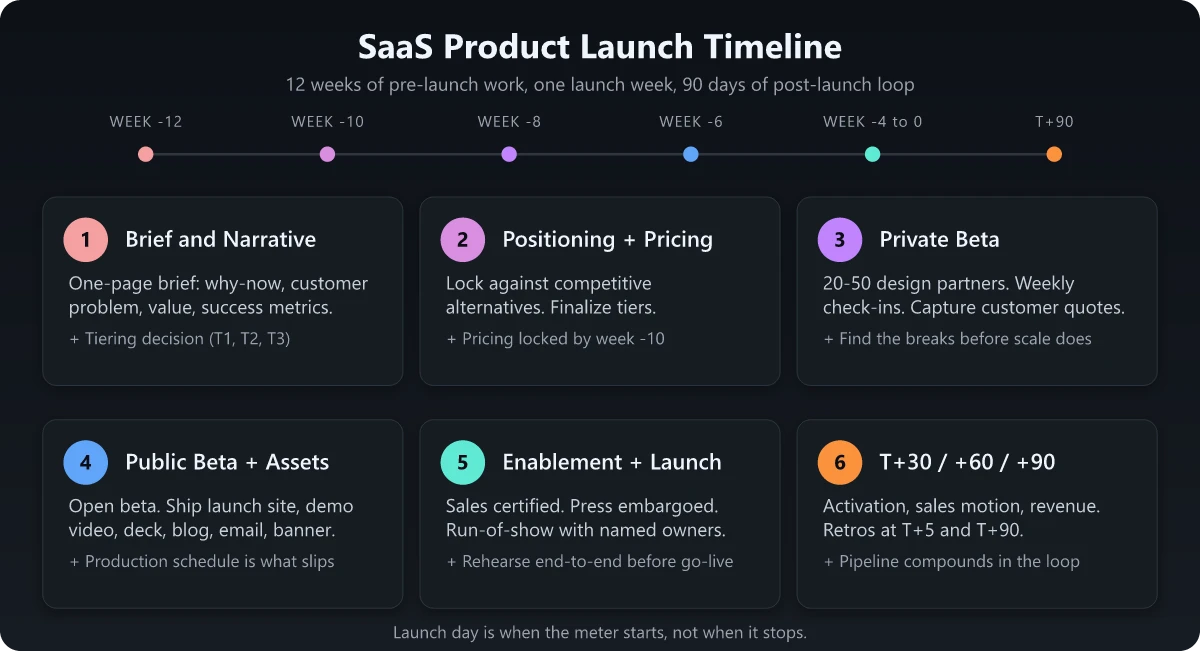
A focused team can run a Tier 1 SaaS launch in 12 weeks of pre-launch work. Compress this and quality breaks; stretch it and momentum dies.
Week -12 to -10: Brief and Narrative
Lock the launch brief and the narrative before anything else.
- Launch brief captures the why-now, the customer problem, the differentiated value, and the success metrics. One page. No exceptions.
- Narrative is the 200-word story that every asset will inherit from. Pricing pages, press, sales decks, in-product banners all flow from this.
- Tiering decision is locked here. Tier 1, 2, or 3 with a one-paragraph rationale.
Week -10 to -8: Positioning and Pricing
- Positioning articulated against competitive alternatives, not abstract market categories. For the framework, see product positioning.
- Pricing finalized: who pays, how much, what is the upgrade path. Late pricing changes are one of the largest single sources of post-launch firefighting, because every asset has to be republished.
- Packaging decided: which features in which tier, free trial length, freemium gates.
Week -8 to -6: Private Beta
Run a private beta with 20-50 design partners. The goal is not feedback; the goal is to find what is broken before scale finds it. Which of the two you are running here matters: design partner or beta customer turns on whether the design is still open, or only the durability.
- Recruit a mix of segments and use cases.
- Weekly check-ins with each partner for 4 weeks.
- Capture quotes. The strongest customer language always comes from beta, never from focus groups.
Week -6 to -4: Public Beta and Asset Production
- Open beta to a wider opt-in list.
- Build the launch site, demo video, customer story, sales deck, blog, email sequence, and in-product banner.
- Asset production is the bulk of the workload; the schedule is what slips, not the strategy.
Week -4 to -2: Sales Enablement and Internal Comms
- Sales enablement package: pitch deck update, one-pager, demo script, FAQ, competitive battlecard. For what to ship, see the sales enablement checklist.
- Sales kickoff session with live Q&A and certification for Tier 1 launches.
- Customer success, support, finance, legal, and ops all briefed by week -2.
The order those internal briefings happen in is not arbitrary, and sequencing every audience from the executive sponsor down to the public announcement is worth writing once rather than improvising per launch.
Week -2 to 0: Press, Paid, and Final Rehearsal
- Press embargo and analyst briefings.
- Paid media campaigns scheduled to fire at launch hour.
- Full launch rehearsal end-to-end. Walk every link, every form, every email.
- Status page and incident plan in place.
The Launch Week Run-of-Show
Launch week is execution, not strategy. Every move is scheduled to the hour.
| Day | Surface | Action |
|---|---|---|
| Mon | Internal | Final go/no-go review with exec sponsor |
| Tue | Press | Embargo lifts at 6am PT, press goes live |
| Tue | Web | Launch site, pricing page, blog, demo video go live |
| Tue | Launch announcement to existing list (segment by stage) | |
| Tue | Product | In-product banner and changelog post |
| Tue | Sales | Outbound sequences fire to ICP-match prospects |
| Wed | Social | Founder and exec posts, customer quote thread |
| Wed | Webinar | Live launch demo with Q&A |
| Thu | Community | AMA on Reddit, Slack, LinkedIn community |
| Fri | Internal | Launch retro #1: what shipped, what slipped, what we learned |
The run-of-show is also a forcing function for cross-functional alignment. Every cell in the table has a named owner. If a cell has no owner two weeks out, that surface gets cut from the launch.
Post-Launch: T+30, T+60, T+90
Most SaaS launches over-invest in launch day and under-invest in the 90 days after. That is where the pipeline actually compounds.
T+30: Activation Health
- Top metric: week-1 retention of new signups.
- Action: debug the onboarding flow with session recordings. Most launches have one specific drop-off point that is responsible for the majority of churn.
- Pivot signal: if branded search is up but trial-to-paid is flat, the issue is product, not marketing.
This is also the window where existing customers find out what shipped. Well-written SaaS release notes do adoption work that launch-day PR cannot, because they reach the people already paying you.
T+60: Sales Motion
- Top metric: opportunities sourced from launch attribution.
- Action: review sales call recordings. Are reps using the launch narrative? Where are deals stalling? Update the battlecard.
- Pivot signal: if reps are pitching the old positioning, the enablement was not sticky enough. Re-deliver with shorter assets.
T+90: Revenue Reality
- Top metric: pipeline created and closed-won attributable to the launch.
- Action: full launch retro with the exec team. What shipped, what slipped, what we would do again, what we never repeat.
- Pivot signal: if pipeline impact is below 50% of forecast, segment performance by ICP. Usually one segment is overperforming and one is dragging the average.
Common SaaS Launch Mistakes
Six mistakes account for most underperforming SaaS launches. They overlap heavily with the broader risks of launching a new product, so treat this as the SaaS-specific cut of that list.
| Mistake | What it looks like | Fix |
|---|---|---|
| Treating launch day as the finish line | Asset cadence drops to zero by week 2 | Build a 90-day comms calendar before launch day |
| No tiering | Every launch is Tier 1, every launch underperforms | Force-rank launches at the start of each quarter |
| Missing the activation funnel | Traffic is up but trial-to-paid is flat | Instrument signup-to-value time before launch |
| Sales enablement as an afterthought | Reps still pitch the old narrative | Lock enablement at week -4, certify before launch |
| Pricing change at week -2 | Marketing assets are wrong by launch day | Lock pricing at week -10 |
| No retro | The next launch repeats the same mistakes | 30-min retro at T+5 days, full retro at T+90 |
How to Tell If Your Launch Worked
Three layers, in order. A launch that hits awareness but fails activation is a failed launch. A launch that hits activation but fails revenue is a partial launch.
- Awareness: branded search lift, qualified traffic, share of voice in launch-week category coverage
- Activation: signups, signup-to-activation rate, week-1 retention, free-to-paid rate
- Revenue: pipeline sourced, opportunities created, closed-won, payback period vs forecast
Pick one number per layer before launch. Hold the team to those three numbers, not the dashboard of 40.
The Bottom Line
A successful SaaS product launch is not the press hit. It is the connected sequence of moves from beta through T+90 that turns one moment of attention into a quarter of compounding pipeline. The teams that get this right do four things consistently: they tier launches honestly, they lock the brief and the narrative early, they treat sales enablement as a launch dependency, and they measure activation as ruthlessly as awareness.
Everything else is execution. And execution is just a 12-week run-of-show with named owners on every cell.
Lock your run-of-show on one page. Use the free Product Launch Plan Template to build a sharable launch plan in 5 minutes - tier, positioning, goals, owners, channels, milestones, risks. PNG export, no signup.
For the broader SaaS PMM operating model that sits around the launch, see SaaS product marketing strategy and marketing strategy for new product.
Frequently Asked Questions
How long should a SaaS product launch take?
Plan for 12 weeks of pre-launch work for a Tier 1 launch and a 90-day post-launch window where most of the pipeline impact actually shows up. The mistake is treating launch day as the finish line. Launch day is when the meter starts.
What is the difference between a SaaS launch and a generic product launch?
A SaaS launch has three things a physical product launch does not: a free trial or freemium funnel as the main acquisition channel, in-product onboarding that doubles as activation marketing, and a post-launch update cadence where every release becomes a smaller launch. The motion is closer to ongoing release marketing than a one-time event.
Should I do a private beta before a SaaS launch?
Yes for any launch beyond a minor feature. A private beta of 20 to 50 design partners surfaces the messaging gaps, pricing objections, and onboarding friction that you cannot find from internal review. The cost of finding them post-launch is much higher than the cost of a six-week beta.
What is a Tier 1 launch?
A Tier 1 launch is reserved for new products, major repositioning, or category-defining features. It gets full PR, full sales enablement, dedicated paid spend, and exec attention. Most SaaS teams run two to four Tier 1 launches per year. Everything else is Tier 2 or Tier 3.
What metrics define a successful SaaS product launch?
Awareness: branded search lift, share of voice, qualified traffic. Activation: signups, time-to-first-value, week-1 retention. Revenue: pipeline created, opportunities sourced, payback period. A launch that hits awareness but fails activation is a failed launch, even if the press was glowing.