What Is B2B Demand Generation? The Modern Playbook (2026)
B2B demand generation explained: the four-stage funnel, the difference from lead gen and ABM, the modern tech stack, and the metrics buyers actually act on.
The most cited stat in B2B marketing is also the most uncomfortable one. 6sense’s 2025 B2B Buyer Experience Report found that the point of first contact with sales has shifted to 61% of the buying journey, down from 69% the prior year. That is the case for B2B demand generation in one number. By the time a buyer raises a hand, most of the meaningful work has already happened. Either you were in the consideration set during those independent-research months or you were not.
This guide explains what B2B demand generation actually is in 2026, how it differs from lead generation and ABM, the four-stage funnel that organized teams run, the tech stack that makes it work, and the metrics that hold up in a board meeting.
What Is B2B Demand Generation?
B2B demand generation is the discipline of creating awareness and intent for your category and product among the right accounts, then capturing and accelerating that intent into pipeline. It spans the entire path from first impression to sales-accepted opportunity.
The word that matters in the definition is demand. Demand gen does two things at once:
- Creates demand by educating a market that does not yet know it has a problem (or know your category exists).
- Captures demand that already exists by being the most credible answer when a buyer starts looking.
A team that only captures demand is a lead gen team with a fancier name. A team that only creates demand without a capture motion produces traffic that competitors close. The skill is doing both, and sequencing them.
Demand Gen vs Lead Gen vs ABM
These three terms get used interchangeably in vendor decks and incorrectly in most job descriptions. They are different layers of the same motion.
| Dimension | Demand generation | Lead generation | ABM |
|---|---|---|---|
| Goal | Create + capture intent | Capture contact data | Convert named accounts |
| Audience | Whole addressable market | Self-identified prospects | Pre-selected accounts |
| Primary channels | SEO, paid social, content, podcasts, communities | Gated content, webinars, paid search | Targeted ads, 1:1 outbound, custom landing pages |
| Time horizon | 6-12 months | Days to weeks | 3-9 months |
| Success metric | Pipeline created (sourced + influenced) | MQLs / form fills | Account engagement, opportunity win rate |
| Common failure | No tied-to-revenue measurement | Volume without quality | Spending on accounts that will never buy |
A common modern motion: broad demand gen builds category awareness and content authority, ABM concentrates 1:1 budget on the top 200-500 accounts inside that aware audience, and lead gen tactics harvest the form fills that result. Treating these as alternatives instead of layers is the most expensive mistake in B2B marketing. Sequence beats labels here: the engagement data from broad demand gen is what tells you which accounts have warmed enough to earn 1:1 budget, the same reason the wide net and the narrow list work better as one loop than as competing bets.
The Four Stages of B2B Demand Generation
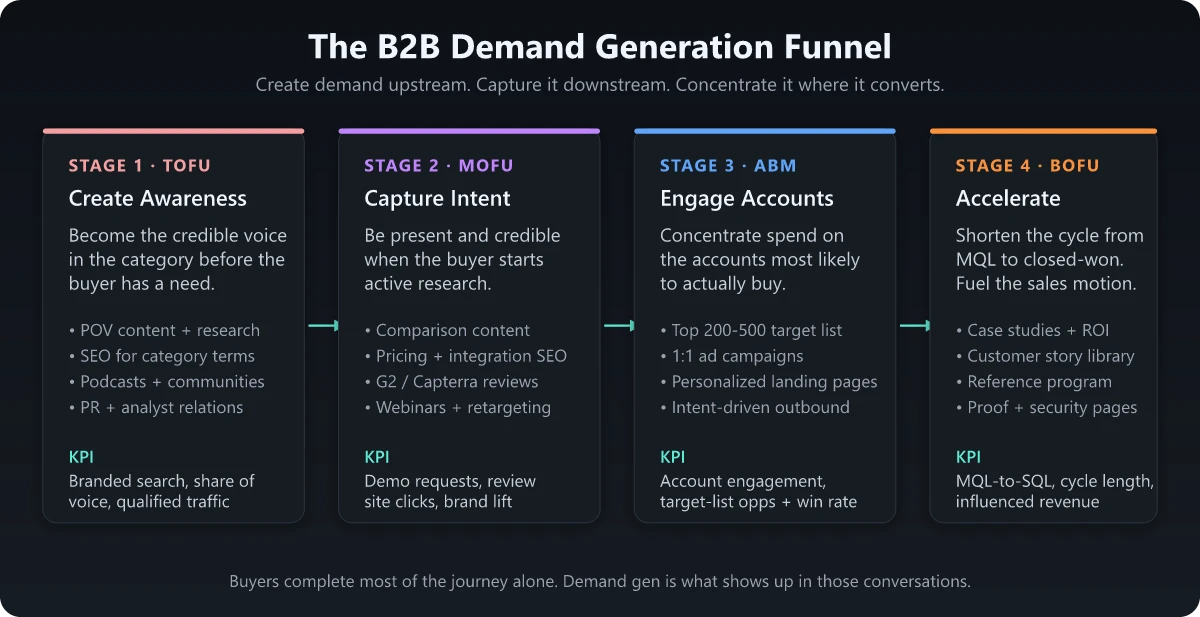
A complete B2B demand generation program has four stages. Each stage has its own playbook, its own KPIs, and its own failure modes.
1. Create Awareness (Top of Funnel)
The job: become the credible voice in your category before the buyer has a need.
- POV content: opinionated essays, original research, industry POVs your buyers want to share.
- SEO: build for category-defining queries (head terms) and the question-stage queries that compound.
- Podcasts and communities: long-form formats that build trust at depth.
- Paid social: thought leadership ads on LinkedIn and Reddit.
- PR and analyst relations: independent validation that compounds the rest.
KPI: branded search volume, share of voice in category, qualified organic traffic, podcast and community reach. Not MQLs. Top-of-funnel measured on MQL volume becomes a click-bait machine.
Share of voice needs a denominator before it means anything, and in most B2B software categories nobody buys category advertising, so the textbook formula returns no number at all. I work through the substitutes that do compute, and how each one breaks, in share of voice vs market share. You can run the arithmetic on your own figures with the share of voice calculator.
2. Capture Intent (Mid-Funnel)
The job: be present and credible when the buyer starts actively researching.
- Comparison content: “X vs Y”, category guides, buyer’s guides.
- Bottom-funnel SEO: pricing page SEO, integration page SEO, alternative-to pages.
- Review sites: G2, Capterra, TrustRadius. Active campaign management, not passive presence.
- Retargeting: serve high-intent ads to the audience that engaged with awareness content.
- Webinars and live events: hand-raise channels for in-market buyers.
KPI: high-intent traffic, demo requests, webinar registrations, review site clicks, branded search lift over time.
3. Engage Accounts (ABM Layer)
The job: concentrate budget on the accounts most likely to buy. Run high-relevance, multi-channel sequences.
- Account targeting: define the top 200-500 accounts using firmographics + intent data.
- 1:1 ad campaigns: account-targeted ads on LinkedIn, programmatic, retargeting.
- Personalized landing pages: dynamic content by account or industry.
- Outbound + email: SDRs working off intent signals, not cold lists.
- Customer marketing: expansion plays on existing accounts.
KPI: account engagement scores, opportunities created from target list, win rate vs non-ABM accounts, deal velocity.
4. Accelerate Pipeline (Late-Funnel + Sales Hand-Off)
The job: shorten the cycle from MQL to closed-won. Demand gen does not end at the form fill.
- Sales enablement assets: case studies, ROI calculators, customer references. For what to ship, see the sales enablement checklist.
- Customer story library: by ICP, by use case, by competitor displaced.
- Reference program: warm references that AEs can drop into late-stage deals.
- Proof content: third-party validation, security pages, integration galleries.
KPI: MQL-to-SQL conversion, sales cycle length, opportunity-to-close rate, influenced revenue.
The B2B Demand Generation Tech Stack
You can run a demand gen program with five categories of tooling. Anything beyond this is optimization and can wait.
| Category | Examples | Job |
|---|---|---|
| CRM | Salesforce, HubSpot CRM | Source of truth for accounts and opportunities |
| Marketing automation | HubSpot, Marketo, Customer.io | Workflows, scoring, lifecycle, email |
| Analytics + attribution | GA4, BigQuery, Dreamdata, HockeyStack | Multi-touch attribution and pipeline reporting |
| Intent + ABM | 6sense, Demandbase, Bombora | Account intent signals and ABM orchestration |
| Content + SEO | Ahrefs, Clearscope, Webflow/Astro | Content engine and discovery |
For implementation sequencing of the marketing automation layer, see how to implement marketing automation and B2B marketing automation.
KPIs That Belong in Your Board Deck
Pipeline-sourced revenue is the only metric that matters at the top. Underneath it, four metrics hold up to scrutiny.
- Pipeline created by source (organic, paid, ABM, partner, outbound)
- Opportunity win rate by source
- Sales cycle length by source
- CAC payback period by source
Notice what is not on this list: MQLs in isolation, opens, clicks, and traffic. Those are diagnostic numbers, not headline numbers. A team that walks into a board meeting with MQL counts and no revenue tie-back will be replaced inside a year.
For the upstream work of defining who counts as the right account, see ICP vs buyer persona.
Common B2B Demand Gen Mistakes
Five mistakes show up in nearly every underperforming demand gen program.
| Mistake | What it looks like | Fix |
|---|---|---|
| Volume-only goals | MQLs are up, pipeline is flat | Tie every campaign to opportunity creation, not form fills |
| No measurement of created demand | Branded search lift is not tracked | Build a quarterly brand-search index |
| ABM and broad demand gen targeting the same accounts with different messages | Account confusion, wasted spend | Run a single message stack across both motions |
| Late-funnel content is missing | Sales has nothing to send mid-deal | Build the proof content library before the next campaign |
| Sales-marketing SLA is theoretical | Reps complain about lead quality, marketing complains about follow-up | Joint definition of MQL, follow-up SLA in hours, monthly pipeline review |
How to Build a B2B Demand Gen Program From Scratch
If you are starting today, do not chase the maximalist version. Sequence the minimum viable program.
- Define the ICP and the top 200 accounts inside it.
- Stand up the measurement before the first campaign. Pipeline attribution that starts on day 90 retroactive is worthless.
- Pick one upper-funnel and one lower-funnel play. Ship them. Run them for 90 days.
- Add the ABM layer once the upper-funnel has built awareness in the target accounts.
- Layer in late-funnel content as the first sales conversations expose what is missing.
- Quarterly review: kill what does not work, double-down on what does.
Most teams do this in reverse: they buy the ABM tool first, then realize they have no awareness in the accounts, no late-funnel content for sales, and no measurement to prove anything. The platform spend gets cut, the team gets blamed, and the cycle restarts.
The Bottom Line
B2B demand generation is the orchestrated motion that creates and captures intent across an entire buying cycle, not the team that produces gated PDFs. The teams that outperform do four things: they create demand upstream, capture it downstream, concentrate the highest-intent accounts in an ABM motion, and measure pipeline impact instead of activity volume.
Get the four stages right, the tech stack right-sized, and the KPIs tied to revenue, and demand gen stops being a cost center sales tolerates and becomes the engine they ask for by name.
For the GTM frame around all of this, see go-to-market strategy for startups and SaaS product marketing strategy.
Frequently Asked Questions
What is B2B demand generation in simple terms?
B2B demand generation is the discipline of creating awareness and intent for your category and product among the right accounts, then capturing and accelerating that intent into pipeline. It is everything that happens before a lead becomes a tracked record in the CRM, and the orchestrated motion that gets that record to a sales-accepted opportunity.
What is the difference between demand gen and lead gen?
Lead gen captures contact information from people who already know they have a need. Demand gen creates the need or makes you the obvious answer to a need that exists. Lead gen is downstream; demand gen is upstream. Modern B2B teams usually run both, with demand gen feeding the engine that lead gen later harvests.
Is ABM part of demand generation?
Yes. Account-based marketing is a high-precision execution layer of demand generation. Broad demand gen creates category awareness; ABM concentrates spend on the named accounts most likely to buy. The two reinforce each other when sequenced well, and cannibalize each other when they target the same accounts with different messages.
How long does it take B2B demand generation to show ROI?
Plan for 90 days to see signal and 6 to 9 months to see pipeline impact. The buying cycle for most B2B SaaS is 90-120 days from first touch to opportunity, and longer for enterprise. A demand gen program judged on month-one MQL volume will be killed before it has a chance to work.
What is the right team to run B2B demand generation?
A minimal team is one demand gen lead, one content owner, one paid media owner, and a marketing operations partner. Larger SaaS teams add an ABM specialist, a webinar program owner, and a partner marketer. The non-negotiable is the marketing-ops partner. Without them the data falls apart in 90 days.