Wati Pricing in India: Plans, Message Rates and Worked Bills
Wati pricing on 21 November 2026: Growth from Rs 2,199 a month, Pro and Business across three billing periods, Wati's India message rates and three worked bills.
Read a Wati plan card and it looks like the monthly bill: ₹2,199 to ₹18,499 a month in India, depending on the plan and the billing period. Wati pricing runs on two meters, though, and the card shows one of them. The other is a per-message charge for every marketing, utility and authentication message and, since 1 October 2026, every service reply past the first 1,000 a month. In the three worked bills further down, built from Wati’s own rate cards and illustrative message counts, the plan fee came to between about 30% and 44% of the total.
Here is what Wati’s pricing page served to a logged-out visitor in India on 21 November 2026, in rupees:
| Plan | Monthly billing | Billed quarterly | Annual option | Users included | Extra user |
|---|---|---|---|---|---|
| Growth | ₹2,999 a month | ₹2,699 a month | ₹2,199 a month | 3 | ”No additional users” |
| Pro | ₹6,499 a month | ₹5,799 a month | ₹4,899 a month | 5 | ₹1,299 per user per month |
| Business | ₹18,499 a month | ₹16,799 a month | ₹14,799 a month | 5 | ₹2,199 per user per month |
Source: Wati’s pricing page, 21 November 2026. The quarterly figures are the page’s default view; the monthly and annual figures come from the plan data the same page loads for its Monthly and Annual toggle. Every card adds: “Additional charges apply for template messages.”
So I would budget Wati from the message mix first and pick the plan second. The plan decides your seats, your broadcast cap and your per-message rate, but in two of my three worked bills the messages cost more than the plan fee and the extra seats combined. I checked the page from India without signing up, starting a trial or reaching a checkout, and Wati can change any of these prices.
Wati Pricing by Plan, Checked 21 November 2026
Each card lists usage limits under its price.
| Limit on the card | Growth | Pro | Business |
|---|---|---|---|
| Broadcasts | 15k a month, “Standard rates” | Unlimited, “Standard rates” | Unlimited, “Volume discounts” |
| Free automation triggers | 1,000 a month | 2,000 a month | 5,000 a month |
| Wati AI credits | 2,000 a month | 5,000 a month | 20,000 a month |
| Astra AI agents | 1 | 2 | Unlimited |
| Integrations | 2 select Commerce/CRM integrations | 5, including HubSpot | Unlimited, including Salesforce |
| API calls | 10k a month, “No webhooks” | 200k a month, “Limited webhooks” | 20M a month, “Extensive webhooks” |
| Support | Email, 24x5, basic SLA | Email and chat, 24x7, standard SLAs | Priority 24x7 email and chat, dedicated CSMs |
Source: Wati’s pricing page plan cards, 21 November 2026.
The limits that sort most teams:
- Seats. Growth includes 3 users and its card reads “No additional users”. A fourth person on the inbox means Pro.
- Broadcasts. Growth stops at 15k broadcasts a month. Pro and Business list unlimited broadcasts.
- Webhooks. Growth’s API allowance comes with “No webhooks”, so a team that pushes WhatsApp events into its own systems starts at Pro.
Business adds the features a larger support desk asks for: extra WhatsApp numbers, round-robin assignment, number masking and IP whitelisting, all named on its card. Its card also says “4k messages/min”, with a Blitz add-on for 12k messages a minute.
Monthly, Quarterly or Annual: The Yearly Cost of Each Plan
The label beside the billing toggle read “Save up to 10%” in the default quarterly view. That is close to the quarterly saving, 9.2% to 10.8% below the monthly price depending on the plan (my arithmetic). The annual option sits further below:
| Plan | 12 months on monthly billing | 12 months billed quarterly | 12 months on the annual option | Annual vs monthly |
|---|---|---|---|---|
| Growth | ₹35,988 | ₹32,388 | ₹26,388 | 26.7% lower, ₹9,600 a year |
| Pro | ₹77,988 | ₹69,588 | ₹58,788 | 24.6% lower, ₹19,200 a year |
| Business | ₹2,21,988 | ₹2,01,588 | ₹1,77,588 | 20.0% lower, ₹44,400 a year |
Source: monthly figures from Wati’s pricing page, 21 November 2026. The yearly totals and percentages are my arithmetic (12 times the per-month figure), before any tax.
Billing rules from the page’s FAQ that affect which period you pick:
- You can upgrade, or move from monthly to annual, at any time; charges are prorated. Downgrades take effect “only at the end of your current billing cycle.”
- There is no cancellation fee, but Wati says “we do not provide any refunds on payments made for your existing subscription or credits.”
- Wati accepts “credit cards enabled for international online transactions”, and bank transfer if you choose an annual plan.
- “Onboarding support is included with the annual plan for all recurring subscriptions.” Otherwise the page lists Dedicated Onboarding at a Custom price, as a “one time fee”.
Upgrades are prorated at any time but downgrades wait for the cycle to end, so I would start on the lower plan you might need and on quarterly rather than annual: a wrong guess costs at most three months, against twelve on annual, which in exchange includes onboarding.
Wati’s Per-Message Rates for India, Rate Cards Dated 1 October 2026
Wati publishes a separate rupee rate card for each plan, linked from the “View Rate Card” line on the plan cards. Each is titled “Cost per message and minute call in INR” and dated October 1, 2026. The India row of each:
| Message type, to an Indian (+91) number | Growth | Pro | Business |
|---|---|---|---|
| Marketing | ₹1.0357 | ₹0.9926 | ₹0.9667 |
| Utility | ₹0.1495 | ₹0.1495 | ₹0.1380 |
| Authentication | ₹0.1495 | ₹0.1495 | ₹0.1380 |
| Authentication, international | ₹3.2462 | ₹3.2462 | ₹2.9965 |
| Service | ₹0.1380 | ₹0.1380 | ₹0.1231 |
| WhatsApp calling, per minute | ₹0.4662 | ₹0.4662 | ₹0.4429 |
Sources: Wati’s India rate cards for Growth, Pro and Business, each dated October 1, 2026, downloaded 21 November 2026.
The Growth card says “For pro and business plan there’s an additional discount on top of this.” On the India row, Pro’s discount is on marketing messages only; every other Pro rate matches Growth. Business is lower on every column. Each card also carries these lines:
- “Every business gets 1000 free service messages every month and the free limit resets monthly.”
- “Conversation that initiates from the CTWA Ad is free.” CTWA is a click-to-WhatsApp ad, which you buy from Meta; the ad spend itself is a separate cost, covered in what Meta publishes about ad costs in India.
- “User-initiated calling is available in every location and is free of cost.”
- International authentication rates “only apply if you receive eligibility email from Meta”.
Message charges are paid from Wati credits in a wallet you top up, apart from the plan subscription. Wati’s help article on topping up credits, updated 2 November 2026, says customers on INR plans must keep a minimum wallet balance of ₹500, and that campaigns and automated messages stop when the credits run out.
Does the Pro discount justify the upgrade on its own? On the annual option, Pro costs ₹2,700 a month more than Growth (₹4,899 against ₹2,199), and its marketing rate is ₹0.0431 lower. My arithmetic puts the break-even at about 62,600 marketing messages a month, more than four times the 15k broadcasts Growth allows, so the marketing-rate gap alone rarely pays for Pro.
Meta’s 1 October 2026 Change: Service Messages Now Cost Money
Wati’s Growth card lists an “Official API” setup, which is Meta’s WhatsApp Business Platform, and the message categories on Wati’s rate cards follow Meta’s own rules. Meta’s WhatsApp pricing page, updated 18 November 2026, sets the rules this way:
| Rule | What Meta’s page says |
|---|---|
| Billing unit | Effective 1 July 2025, Meta charges “on a per-message basis”, by category and market, and “only for messages from businesses to users” |
| When a charge applies | ”Businesses are only charged when a message is delivered” |
| Service messages | They “became free as of Nov. 1, 2024”; charged again as of 1 October 2026, after “a free tier of 1,000 service messages per month” for each business phone number, with no roll-over |
| Utility messages in an open service window | Free from 1 July 2025, charged again as of 1 October 2026 |
Wati’s message-based pricing article, updated 14 October 2026, says the same about service messages: “Effective October 1, 2026, these free-form replies (service messages) are billable per message.” Two wording differences are worth knowing before you add a second number:
- Meta gives the 1,000 free service messages to each business phone number. Wati’s article says “for each WhatsApp Business Account”, and its rate cards say “Every business”. If you run two numbers, ask Wati which count applies to your bill.
- Meta charges only delivered messages. Wati’s article says you pay for messages with “SENT status” and that “Failed messages are not charged.”
The per-field character limits for messages sent through the same API are in my field-by-field WhatsApp character limit check.
Three Worked Monthly Bills From Wati’s Published Prices
Each bill uses the plan fee, the seat price and the India rate card for its own plan, all from the pages above. The message volumes are my illustrative assumptions, not data from any business, and every bill assumes one WhatsApp number, all messages to Indian numbers, and the 1,000 free service messages applied once.
| Line, per month | D2C store: Growth, annual option, 3 users | Coaching lead-gen team: Pro, billed quarterly, 7 users | Support desk: Business, annual option, 10 users |
|---|---|---|---|
| Plan fee | ₹2,199 | ₹5,799 | ₹14,799 |
| Extra users | ₹0 (3 included) | 2 x ₹1,299 = ₹2,598 | 5 x ₹2,199 = ₹10,995 |
| Marketing messages | 4,000 x ₹1.0357 = ₹4,142.80 | 10,000 x ₹0.9926 = ₹9,926.00 | 2,000 x ₹0.9667 = ₹1,933.40 |
| Utility messages | 1,500 x ₹0.1495 = ₹224.25 | 3,000 x ₹0.1495 = ₹448.50 | 20,000 x ₹0.1380 = ₹2,760.00 |
| Service messages after 1,000 free | 1,500 x ₹0.1380 = ₹207.00 | 5,000 x ₹0.1380 = ₹690.00 | 29,000 x ₹0.1231 = ₹3,569.90 |
| Monthly total, before GST | ₹6,773.05 | ₹19,461.50 | ₹34,057.30 |
| Plan fee as a share of the total | 32.5% | 29.8% | 43.5% |
Sources: Wati’s pricing page and the three India rate cards linked above, 21 November 2026. Totals and shares are my arithmetic. The store’s bill excludes the Shopify integration, which Wati prices at USD 4.99 a month and which I have not converted.
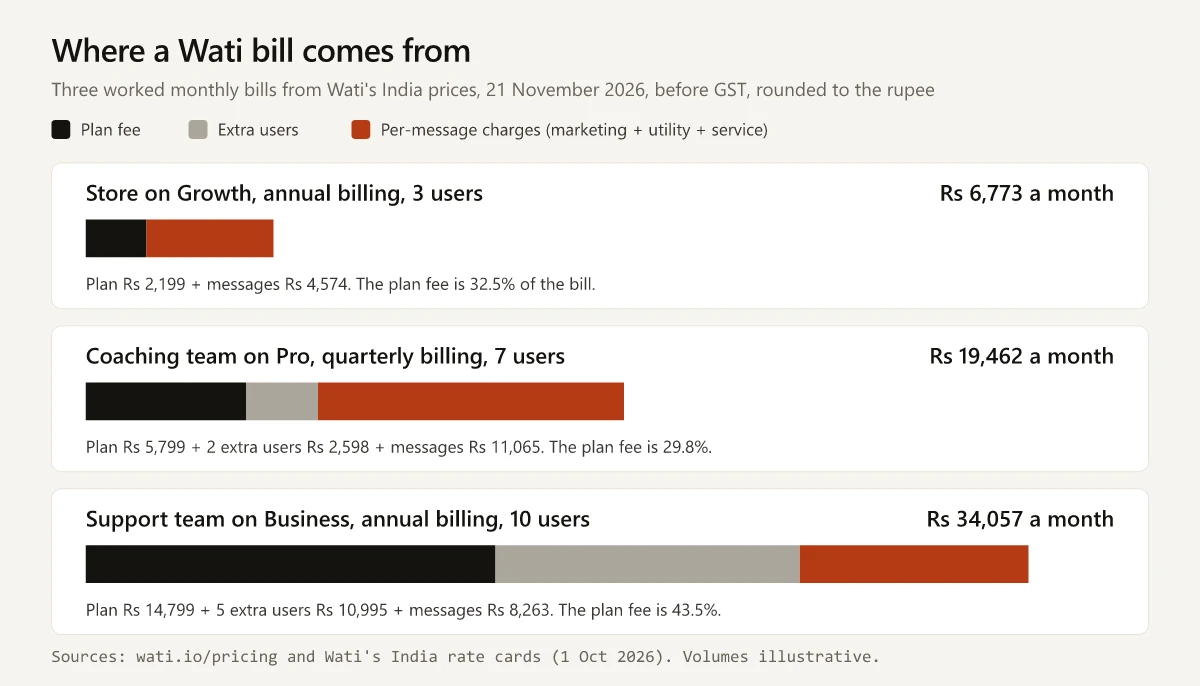
What the three bills show:
- For the store and the coaching team, messages are the biggest line. The coaching team’s 10,000 marketing messages cost more than its plan and both extra seats together.
- For the support desk, seats are the second-biggest line. Five extra users at ₹2,199 cost ₹10,995 a month, which is 74% of the Business plan fee (my arithmetic).
- Service replies are now a real line for a busy inbox. 29,000 billable replies add ₹3,569.90 a month on Business rates, for replies Meta did not charge for from 1 November 2024 to 30 September 2026.
Run your own version of this table with last month’s counts by message type. If you do not know the split, the marketing count is the one to find first, because its rate is 6.6 to 7 times the utility rate on each plan’s India row (my arithmetic).
Add-Ons That Change a Wati Bill
The pricing page prices these add-ons in rupees, apart from Shopify:
| Add-on | Price on 21 November 2026 |
|---|---|
| Extra WhatsApp number | ₹2,499 per month per number (an add-on on Business only, per Wati’s plan comparison page) |
| Automation triggers | ₹1,000 a month for 1,000; ₹8,800 for 10,000; ₹47,000 for 100,000 |
| Wati AI credits | ₹1,600 a month for 2,000 |
| Shopify integration | USD 4.99 a month |
| Dedicated Onboarding | Custom one-time fee (included with annual plans) |
| Technical Account Management | Custom annual fee, Business Annual customers only |
| Professional Services | Custom hourly fee |
Sources: Wati’s pricing page add-on section and its quantity selectors, 21 November 2026, and the “Multiple WhatsApp Numbers” row of Wati’s plan comparison page, 22 November 2026, which marks it “Not included” on Growth and Pro and “Add-on” on Business.
Automation triggers are the add-on a busy chatbot reaches first. Wati’s FAQ on the page explains a trigger this way: each time a chatbot, keyword or other rule you set up is invoked for a customer, “that counts as a chatbot session”, and once your plan’s allowance is used “you will have to respond to your customers manually.” Triggers can be bought monthly even on an annual plan. If your store also sells through Shopify, its own rupee plan fees and transaction charges are in my Shopify price check for India.
Does Wati Have a Free Plan?
No. Wati’s pricing page on 21 November 2026 showed three paid plans and a 7-day free trial, with the header “7 days free trial, zero setup fees and affordable pricing”. There is no free plan card and no ₹0 tier on the page. AiSensy, a rival WhatsApp platform, does list a Free Forever plan, though without broadcasting, as AiSensy’s plans and message rates show.
MSG91, which also sells WhatsApp access, waives its WhatsApp platform fee for the onboarding month and the month after, per MSG91’s channel-by-channel pricing.
Two more routes exist:
- Customers already on a paid plan can try a higher plan free for 14 days, per Wati’s higher plan trial article, updated 17 June 2026. Your current billing continues during it, and data created with higher-plan-only features “will be removed once the 14-day trial ends” unless you upgrade.
- Wati’s help center has carried articles about a pay-as-you-go (PAYG) plan. The two I opened on 21 November 2026, at addresses that still show up in search results, returned “Article not found”, and the pricing page has no PAYG plan card, so I would not plan around one.
Older third-party prices circulate as well. A GoKwik guide dated 18 June 2026 prints Growth at ₹1,999, Pro at ₹4,499 and Business at ₹13,499 a month. On 21 November 2026 the live page was higher than each of those figures in every billing period, so check the date on any guide before you trust its table.
Does Wati Pricing Include GST?
Wati’s page does not say. I searched the pricing page and all three India rate cards on 21 November 2026 for “GST” and “tax”, and none of them carries either word. The rupee figures above are what the pages print; I have added no tax to them and cannot tell you whether Wati adds GST at checkout.
Mailchimp and HubSpot both state their tax treatment in writing; Wati’s pricing page does not, which is why I would ask for it in writing. Mailchimp’s tax help says its advertised prices exclude tax, as covered in my Mailchimp rupee pricing check, and HubSpot’s rupee rates, tier by tier cover how HubSpot treats GST. For Wati, the pricing page lists billing@wati.io for billing questions; ask for a quote that shows the tax line on both the plan invoice and wallet top-ups. Interakt’s plan prices carry a (+taxes) note, though its page states no tax rate either, per Interakt’s plans and per-message rates.
Which Wati Plan to Pick
Decision rules from the tables above, in the order I would apply them:
| If your team | Pick | Why, from the page |
|---|---|---|
| Has 3 or fewer people on the inbox and sends under 15k broadcasts a month | Growth | 3 users included; 15k broadcasts a month |
| Needs a 4th seat, webhooks or HubSpot | Pro | 5 users plus ₹1,299 per extra user; “Limited webhooks”; HubSpot named |
| Needs a second WhatsApp number, Salesforce or number masking | Business | All three are named on the Business card; the plan comparison page offers extra numbers as an add-on on Business only |
| Is unsure which of the first two | Growth, billed quarterly | Downgrades only apply at the end of a cycle, and quarterly is the shorter commitment of the two discounted periods |
| Sends over a million messages a month | Talk to Wati sales | The page offers “attractive discounts for over 1 million messages per month” |
Recheck Wati Pricing Before 1 January 2027
Wati’s rate cards are dated 1 October 2026, and Meta does revise India rates: Wati’s message-based pricing article lists a Meta revision effective 1 January 2026 under which marketing rates “have increased for India”. Meta’s pricing page also tells eligible India accounts to migrate to INR billing by 31 December 2026. A new rate card would change the per-message column.
Before you sign, open the pricing page and the rate card for your plan, read the date on the card, and price last month’s message mix against it. Wati pricing is a plan fee plus a message bill, so your first number to collect is last month’s marketing message count.
Frequently Asked Questions
How much does Wati cost per month in India?
On 21 November 2026 Wati's pricing page, opened from India, listed Growth at ₹2,999 a month on monthly billing, ₹2,699 a month billed quarterly and ₹2,199 a month on the annual option. Pro was ₹6,499, ₹5,799 and ₹4,899, and Business ₹18,499, ₹16,799 and ₹14,799. Per-message charges come on top of every plan.
How much does Wati charge per message in India?
Wati's Growth plan rate card dated 1 October 2026 lists ₹1.0357 per marketing message to an Indian number, ₹0.1495 per utility or authentication message and ₹0.1380 per service message. The Pro and Business rate cards list lower marketing rates of ₹0.9926 and ₹0.9667.
Does Wati have a free trial?
Yes. Wati's pricing page offers a 7-day free trial with no setup fee, and it shows no free plan. Customers already on a paid plan can also try a higher plan free for 14 days, according to Wati's help center.
Are service messages free on Wati?
Only the first 1,000 a month. Since 1 October 2026 Meta charges for service messages, the free-form replies sent inside the 24-hour customer service window, and Wati's Growth rate card prices each one after the free 1,000 at ₹0.1380 for an Indian number.
Does Wati pricing include GST?
The pricing page does not say. On 21 November 2026 neither wati.io/pricing nor Wati's three India rate cards printed any GST or tax wording, so ask Wati's billing team for a written quote that shows the tax line.