What Is YMYL? Google's 'Your Money or Your Life' Explained
YMYL (Your Money or Your Life) is the content Google holds to its highest quality bar. Here is what YMYL means, the 4 categories, and how to optimize for it.
Google’s quality raters work from a 182-page manual, and one short section near the front carries a warning the rest of the document does not: a class of topics that gets “very high Page Quality rating standards” because getting them wrong can hurt people. That class is YMYL - “Your Money or Your Life.”
If you publish content about health, finance, safety, or civic life, YMYL is the single most important concept in Google’s quality framework, and most explanations of it are vague. This post uses Google’s actual Search Quality Rater Guidelines - the September 11, 2025 edition - to define what YMYL really means, walk through the four categories, and explain what to do about it.
What YMYL Actually Means
Here is Google’s definition, taken verbatim from the guidelines:
“Some topics have a high risk of harm because content about these topics could significantly impact the health, financial stability, or safety of people, or the welfare or well-being of society. We call these topics ‘Your Money or Your Life’ or YMYL.”
Two things are worth pulling out of that sentence.
First, YMYL is about topics, not pages or sites. A single domain can have YMYL and non-YMYL pages side by side. A bank’s blog post on retirement planning is YMYL; the same bank’s post about its office holiday party is not.
Second, the test is potential for harm. Google lists two ways a topic earns YMYL status: the topic is inherently dangerous (self-harm, violent extremism, criminal acts), or the topic could cause harm if the content is inaccurate (symptoms of a heart attack, how to invest money, who can vote, what to do in an earthquake).
YMYL is also not a ranking factor and not a score. The guidelines are explicit that rater judgments do not work that way: “No single rating can directly impact how a particular webpage, website, or result appears in Google Search.” Raters apply the label to decide how strict the quality bar should be; separately, Google says its systems give “even more weight” to strong E-E-A-T on YMYL topics. There is no “YMYL score” to optimize, and most “YMYL ranking factor” advice gets that wrong.
The Four YMYL Categories
Google groups YMYL topics by the kind of harm an inaccurate page could cause. As of the September 2025 guidelines, there are four:
| Category | What it covers |
|---|---|
| YMYL Health or Safety | Topics that could harm mental, physical, or emotional health, or any form of safety, including online safety |
| YMYL Financial Security | Topics that could damage a person’s ability to support themselves and their family |
| YMYL Government, Civics & Society | Topics affecting groups of people, public interest, trust in public institutions, and election and voting information |
| YMYL Other | Topics that could otherwise hurt people or negatively impact the welfare or well-being of society |
The third category is the one to watch. The current guidelines explicitly fold in elections, voting information, and “trust in public institutions that benefit society.” If you publish anything touching government processes or public information, you are squarely in scope.
YMYL Is a Spectrum, Not a Label
The most common YMYL mistake is treating it as a binary: a page either “is YMYL” or it isn’t. Google is explicit that this is wrong.
“Because YMYL assessment is a spectrum, it may be helpful to think of topics as clear YMYL, definitely not YMYL or something in between.”
The guidelines use a table of side-by-side examples to make the gradient concrete. Here is a condensed version of Google’s own examples:
| Topic type | Clear YMYL | May be YMYL | Not YMYL |
|---|---|---|---|
| Information | Tsunami evacuation routes | Weather forecast | Music award winners |
| Advice | When to go to the emergency room | How often to replace a toothbrush | How frequently to wash jeans |
| Commerce | Purchasing prescription drugs | A review of a type of car | Purchasing pencils |
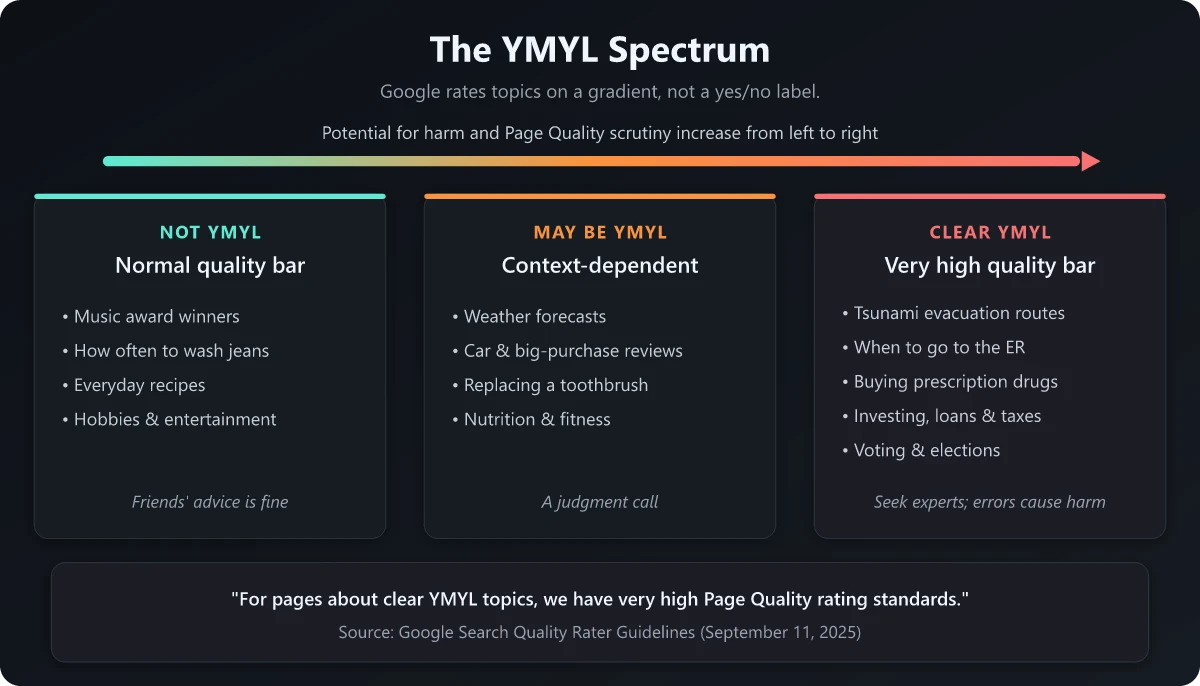
Only the “clear YMYL” end gets the strictest treatment. Google says it plainly: “For pages about clear YMYL topics, we have very high Page Quality rating standards.” A weather page is held to a normal bar. A page on when to call an ambulance is held to the highest one.
To place a topic on the spectrum, Google gives raters two diagnostic questions. They work just as well for the person writing the content:
- “Would a careful person seek out experts or highly trusted sources to prevent harm? Could even minor inaccuracies cause harm? If yes, then the topic is likely YMYL.”
- “Is the specific topic one that most people would be content with only casually consulting their friends about? If yes, the topic is likely not YMYL.”
Why YMYL Matters: The E-E-A-T Connection
YMYL on its own does nothing. It matters because of what it triggers: a higher bar for E-E-A-T - Experience, Expertise, Authoritativeness, and Trust. Google added the extra “E” for Experience in December 2022, and the link to YMYL is direct. As Google’s helpful content documentation states:
“Our systems give even more weight to content that aligns with strong E-E-A-T for topics that could significantly impact the health, financial stability, or safety of people, or the welfare or well-being of society. We call these ‘Your Money or Your Life’ topics, or YMYL for short.”
That is the whole mechanism. YMYL raises the stakes; E-E-A-T is the bar that gets raised. The same dynamic shows up across modern search surfaces, which is exactly why E-E-A-T keeps appearing in the AEO-versus-SEO debate and in AI Overview optimization - the requirements are the same, the surface is new. The same trust signals also drive brand visibility in AI search engines.
Within E-E-A-T, Google is clear that not all four letters carry equal weight:
“The most important member at the center of the E-E-A-T family is Trust.”
The guidelines illustrate why with a memorable example: “a financial scam is untrustworthy, even if the content creator is a highly experienced and expert scammer who is considered the go-to on running scams.” Experience, expertise, and authoritativeness all exist to support trust. On YMYL topics, where harm is on the table, trust is non-negotiable.
YMYL and the Experience-vs-Expertise Question
A common misreading of YMYL is that every YMYL page must be written by a credentialed expert. The guidelines are more nuanced, and this nuance is worth getting right.
Google dedicates a section to it: “YMYL Topics: Experience or Expertise?” The answer depends on the page’s purpose.
- If the purpose is to give information or advice on a clear YMYL topic - safe medications during pregnancy, treatment options for liver cancer, how to fill out tax forms - “a high level of expertise may be required for the page to be trustworthy.”
- If the purpose is to share personal experience - what helped someone sleep in their last trimester, a sincere forum discussion about saving for retirement - first-hand experience can be exactly what the reader needs.
Google’s verdict on the second case:
“Pages that share first-hand life experience on clear YMYL topics may be considered to have high E-E-A-T as long as the content is trustworthy, safe, and consistent with well-established expert consensus.”
The practical takeaway: match the credential to the claim. Medical dosing advice needs a clinician. A patient’s account of living with a diagnosis needs lived experience and a clear boundary that it is not medical advice. Both can be high quality. Neither should pretend to be the other.
How to Tell if Your Pages Are YMYL
Run every important page through Google’s two questions above. If a careful reader would want an expert and a small error could cause harm, treat the page as YMYL and raise the bar accordingly. In practice, you will find most sites have a YMYL core surrounded by non-YMYL content:
- Almost always YMYL: medical conditions and treatments, drug information, mental health, investing, taxes, loans and mortgages, insurance, legal rights, immigration, voting and elections, child safety, emergency and disaster guidance.
- Sometimes YMYL: nutrition and fitness, parenting, career advice, major purchases (cars, homes), home repairs involving electrical or gas work.
- Rarely YMYL: entertainment, hobbies, recipes for everyday meals, product reviews for low-stakes items, most lifestyle and travel content.
The difference is bigger than the label suggests: a travel piece like my own five-experience guide to Kerala in winter is judged mainly on whether the writer actually went, while a page of the same length on mortgage refinancing is judged on credentials, sourcing and how recently it was reviewed.
The borderline cases are where judgment matters. A recipe is not YMYL - unless it is a recipe for an infant or someone managing diabetes, at which point accuracy starts to affect health.
How to Optimize YMYL Pages
You cannot “add YMYL” to a page, and you cannot remove it. What you can do is meet the higher bar it triggers. For YMYL content specifically, prioritize the following:
- Put a real, qualified author on the page. Name them, link to a bio, and state the credential that matters for this topic. Google’s first E-E-A-T check is literally “what the website or content creators say about themselves.”
- Cite primary sources and align with expert consensus. On YMYL topics, Google repeatedly stresses that content should be “consistent with well-established expert consensus.” Link to the original study, the government page, or the standards body - not a competitor’s blog summarizing them.
- Remove conflicts of interest from advice. Google warns that “reviews” from a product’s manufacturer or a paid influencer are “not as trustworthy due to the conflict of interest.” Keep commercial intent out of pages whose job is to inform.
- Get the facts right and keep them current. A heart-attack symptoms page from 2019 is a liability. Date your content, review it on a schedule, and correct errors fast.
- Build the trust signals the page type needs. For a YMYL store, that means secure payments, clear customer service, and refund policies. For an informational page, it means citations, author credentials, and editorial transparency.
- Fix the technical foundation. Trust erodes fast on a slow, insecure, or hard-to-crawl page. A technical SEO audit catches the HTTPS, indexing, and structured-data gaps that quietly undermine YMYL credibility.
None of this is a trick. It is the same standard a careful reader would apply on their own. That is the entire point of the YMYL framework: hold the highest-stakes content to the bar a thoughtful person would already demand.
YMYL Myths That Waste Your Time
“YMYL is a ranking factor I can optimize.” It is not. It is a classification that changes how strictly E-E-A-T is judged. Optimize the trust signals, not a phantom YMYL score.
“My whole site is YMYL.” Unlikely. YMYL is assigned per topic, and most sites are a mix. Spend your effort on the genuinely high-stakes pages.
“Only doctors and lawyers can rank for YMYL terms.” False. Authoritative organizations, well-sourced publishers, and people sharing genuine first-hand experience can all earn high E-E-A-T, as long as the content is accurate and safe.
“AI-written YMYL content is fine if it reads well.” Risky. Reading well is not the same as being accurate or accountable. Google’s guidelines now include explicit scrutiny of low-effort, mass-produced “scaled content abuse,” and they single out YMYL topics like human health as exactly where unverified machine output causes harm. If you use AI on YMYL pages, an expert must verify every claim. This applies just as much to how your content surfaces in AI search and LLM answers, where accuracy and source credibility decide whether you get cited.
The Bottom Line
YMYL is not a tactic, a tag, or a score you chase. It is Google’s way of asking a simple question about your content: if a reader trusts this and it is wrong, could it hurt them? When the answer is yes, the bar goes up - more expertise, more trust, more accuracy, fewer conflicts of interest.
So audit your most important pages against Google’s two questions, find your YMYL core, and hold it to the standard a careful person would. That is not gaming the system. On Your Money or Your Life topics, it is the job.
Want a structured way to find the gaps on your highest-stakes pages? Start with a technical SEO site audit and pair it with an honest review of author credentials and sourcing.
Frequently Asked Questions
What does YMYL stand for?
YMYL stands for 'Your Money or Your Life.' It is Google's label for topics that could significantly impact a person's health, financial stability, or safety, or the welfare or well-being of society. Google defines it in its Search Quality Rater Guidelines and holds YMYL pages to its highest quality standards.
What are examples of YMYL topics?
Clear YMYL topics include medical advice, prescription drug information, investment and tax guidance, legal information, voting and election information, and safety instructions like evacuation routes. Topics like a weather forecast or a car review sit in the middle, and topics like music award winners are not YMYL.
Is YMYL a ranking factor?
No. YMYL is not a ranking factor or a score. It is a classification Google's quality raters use to decide how strict the quality bar should be for a page. For YMYL topics, Google's systems give more weight to content with strong E-E-A-T, so the practical effect on rankings is real even though YMYL itself is not a direct signal.
How does YMYL relate to E-E-A-T?
E-E-A-T (Experience, Expertise, Authoritativeness, and Trust) is how Google assesses content quality. For YMYL topics, Google gives even more weight to strong E-E-A-T because inaccurate content can cause real harm. Trust is the most important element of E-E-A-T, and on clear YMYL topics it often requires demonstrated expertise.
How do I know if my page is YMYL?
Ask two questions from Google's guidelines: would a careful person seek out experts or highly trusted sources on this topic to prevent harm, and could even minor inaccuracies cause harm? If yes, the page is likely YMYL. If the topic is one people are happy to casually ask friends about, it is likely not YMYL.