Improve Brand Visibility in AI Search Engines: 9 Strategies
Nine field-tested strategies to improve brand visibility in AI search engines like ChatGPT, Perplexity, Gemini, and Google AI Overviews, with steps to start.
About half of US adults - 49% - now use AI chatbots like ChatGPT, Gemini, or Copilot, up from 33% two years earlier, according to Pew Research Center. A meaningful slice of buyer research now happens inside an answer box, not a list of blue links. If your brand is not part of that answer, you are invisible to a fast-growing audience, which is exactly why the strategies to improve brand visibility in AI search engines have become essential.
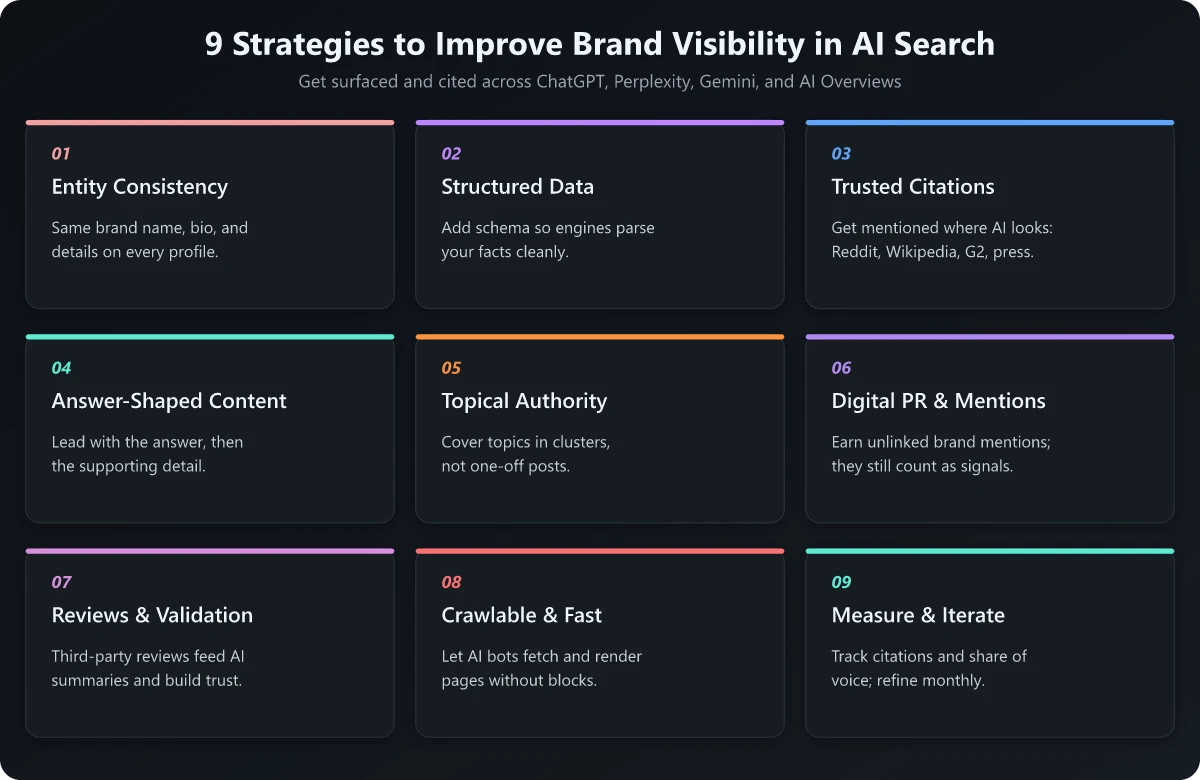
This is the pillar guide to the strategies to improve brand visibility in AI search engines that actually move the needle. Each tactic below maps to how ChatGPT, Perplexity, Gemini, and Google AI Overviews decide what to mention and cite. Where a tactic deserves its own playbook, I link to the deeper post.
Why Strategies to Improve Brand Visibility in AI Search Engines Differ From Rankings
Traditional SEO is about position. AI search is about whether you get mentioned and cited at all inside a synthesized answer.
The mechanics are different too. AI engines retrieve a set of pages, summarize them, and attribute a handful of sources. Being on page one is no longer enough on its own.
Ahrefs analyzed 863,000 keyword SERPs and roughly 4 million AI Overview URLs and found that only 38% of pages cited in AI Overviews also rank in the top 10 for that query, down from 76% a year earlier, per the Ahrefs study. The other citations come from deeper rankings or pages outside the top 100 entirely.
The lesson is direct. You can earn an AI citation without ranking first, and you can rank first and still get left out. This shift is reshaping the future of SEO. The strategies to improve brand visibility in AI search engines below close that gap.
1. Lock Down Entity Consistency
AI models build a mental model of your brand as an entity - a named thing with attributes, relationships, and a category. Inconsistent descriptions confuse that model and dilute how confidently a model will recommend you.
Use the same brand name, one-line description, founding details, and category language everywhere: your site, LinkedIn, Crunchbase, Wikipedia, G2, and press. Pick one canonical positioning sentence and repeat it verbatim.
Treat your “About” page, founder bios, and product category as fixed facts. When every source agrees on who you are and what you do, models surface you with less hesitation.
2. Mark Up Everything With Structured Data
Schema markup translates your content into a format machines parse without guessing. It is one of the highest-leverage technical moves for AI visibility.
Prioritize Organization, Product, FAQPage, Article, and BreadcrumbList schema. Organization schema with sameAs links ties your site to your verified social and directory profiles, reinforcing the entity.
Clean structured data also feeds rich results and answer engines at the same time. For the full breakdown of how answer formatting drives citations, see AEO vs SEO.
3. Earn Citations From Sources AI Engines Already Trust
AI engines lean heavily on a small set of high-trust domains. Reddit and Wikipedia repeatedly rank among the most-cited sources across ChatGPT, Perplexity, and Google’s AI surfaces, based on Semrush’s analysis of over 100 million AI citations.
You cannot buy your way onto those platforms, but you can show up authentically. Answer questions in relevant subreddits, keep your Wikipedia presence accurate where you qualify, and maintain current G2 and industry-directory profiles.
The goal is simple. Be present, accurate, and useful on the pages AI models already pull from.
Your own pages can earn citations too, but only when they carry something an engine cannot find in ten other places: a claim with a position, original data, or a method you actually ran. That is the working definition of thought leadership content, and it is why most branded content gets published and never cited.
4. Publish Answer-Shaped Content
AI engines reward content that is easy to lift and quote. Long, meandering pages get skipped in favor of pages that answer a question cleanly in the first two sentences.
Lead each section with a direct answer, then support it. Use clear H2 questions, short paragraphs, comparison tables, and bulleted takeaways that a model can extract without rewriting.
This format helps with featured snippets and AI Overviews simultaneously. Dig deeper in AI Overview optimization.
Match Content To Real Buyer Questions
Map the actual questions buyers ask an AI tool: “best X for Y,” “X vs Z,” “is X worth it.” Build a page or section for each, with your brand presented as one credible option, not a hard sell.
5. Build Topical Authority, Not One-Off Posts
Models trust brands that demonstrate depth across a topic, not a single thin article. Coverage signals expertise.
Depth means covering the questions a buyer asks rather than sprinkling related terms across a page. The tactic usually sold for that, “LSI keywords”, falls apart under the math: I ran a truncated SVD over 147 posts and what the algorithm hands back is document and term vectors, never a keyword list you can paste into a brief.
Cluster your content. A pillar page like this one links to focused posts on each sub-tactic, and those posts link back, forming a tight, crawlable web of authority.
That structure tells both search crawlers and AI retrieval systems that you own the topic. For the broader playbook, see LLM optimization.
6. Invest In Digital PR And Brand Mentions
Unlinked brand mentions matter more in AI search than in classic SEO. Models weigh how often and how favorably your brand is described across the open web.
Pursue earned coverage, expert quotes, podcast appearances, and data-led studies that journalists cite. Each mention adds a vote to your entity and increases the odds a model repeats your name.
Prioritize publications and communities your buyers already read. Relevance beats raw domain authority when an AI engine is deciding who to trust on a specific topic.
7. Cultivate Reviews And Third-Party Validation
When a user asks an AI tool to recommend a tool or vendor, the model often leans on review platforms and roundups. Your review profile becomes part of the answer.
Maintain strong, current profiles on G2, Capterra, Trustpilot, and category-specific directories. Encourage real reviews and keep product details accurate so models quote correct facts. This lever is big enough to deserve its own playbook: here is how product reviews impact AI search visibility and how to earn AI citations from them.
Third-party “best of” lists are especially powerful. Getting included in a credible roundup can put you in an AI answer even when your own site is not cited.
8. Keep Your Site Crawlable And Fast
None of this works if AI crawlers cannot reach your content. Retrieval-based engines need to fetch and parse your pages in real time.
Allow the relevant AI user agents in robots.txt, ship a clean sitemap, and keep core content in HTML rather than locked behind heavy JavaScript. Fast, accessible pages get retrieved; slow or blocked ones get skipped.
Run a technical pass regularly so nothing silently breaks. A recurring SEO audit catches crawl issues before they cost you citations.
9. Measure AI Visibility And Iterate
You cannot improve what you do not track. AI visibility needs its own measurement loop, separate from rankings.
Run your top buyer questions through ChatGPT, Perplexity, Gemini, and Google AI Overviews on a fixed schedule and log whether you are mentioned, cited, or absent. Tools like Ahrefs Brand Radar, Semrush, and Profound automate this across hundreds of prompts.
The payoff is real. The average AI search visitor is 4.4x more valuable than the average traditional organic visitor by conversion rate, per MarTech, citing Semrush data, because they arrive better informed and closer to a decision.
Strategy Summary
| Strategy | Primary signal it strengthens | Effort |
|---|---|---|
| Entity consistency | Brand identity clarity | Low |
| Structured data | Machine readability | Medium |
| Trusted-source citations | External validation | Medium |
| Answer-shaped content | Extractability | Medium |
| Topical authority | Expertise and depth | High |
| Digital PR and mentions | Brand authority | High |
| Reviews and validation | Recommendation signals | Medium |
| Crawlability and speed | Retrievability | Low |
| Measurement and iteration | Continuous improvement | Low |
Where To Start With Strategies to Improve Brand Visibility in AI Search Engines
The reach is already enormous. Google AI Overviews alone serve 2.5 billion monthly users, and AI Mode has crossed 1 billion monthly active users, Google confirmed at I/O 2026. Waiting is the expensive option.
If you do only three things, fix your entity consistency, ship structured data, and start measuring weekly. Those three strategies to improve brand visibility in AI search engines compound faster than any single content push.
From there, work down the list and link your tactic pages into one tight cluster. AI engines reward brands that are consistent, well-structured, widely cited, and easy to quote - so build for all four, and keep checking the answer box to confirm you are in it.
Frequently Asked Questions
What does brand visibility in AI search engines mean?
It means how often AI tools like ChatGPT, Perplexity, Gemini, and Google AI Overviews mention, cite, or recommend your brand when users ask related questions. Unlike traditional rankings, it is measured by mentions and citations, not blue-link positions.
How do AI search engines decide which brands to recommend?
They pull from their training data and live retrieval of high-authority pages, then synthesize an answer. Brands that are described consistently across many reputable third-party sites, have clean structured data, and earn citations from sources AI engines trust tend to surface more often.
Is SEO still relevant for AI search visibility?
Yes. Most AI engines retrieve from the live web, and a large share of citations still come from pages that rank somewhere in organic results, even if fewer now sit in the top 10. Strong SEO fundamentals - crawlable content, schema, and authority - remain the foundation for AI visibility.
How do I track whether my brand appears in AI search engines?
Run your top buyer questions through ChatGPT, Perplexity, Gemini, and Google AI Overviews on a fixed schedule and log whether you are mentioned or cited. Dedicated AI visibility trackers like Ahrefs Brand Radar, Semrush, and Profound automate this at scale.
How long does it take to improve brand visibility in AI search engines?
Google AI Overviews can reflect new content within days to weeks once it is crawled. ChatGPT and other models that lean on training data may take longer, since changes only stick after their next data refresh or through live retrieval.