Competitive Analysis Template: A Free Framework PMMs Use
A free competitive analysis template that PMMs actually use - a step-by-step framework to map rivals, score them, and turn the findings into real action.

The worst competitive analysis I ever inherited was a 40-tab spreadsheet that nobody had opened in eight months. It had everything and told you nothing. By the time I finished reading it, two of the “competitors” had pivoted and one had shut down.
That is the core problem with most competitive work: people confuse collecting information with creating clarity. A good competitive analysis template fixes this by forcing you to answer a specific question and stop. This post gives you that framework - the exact structure I use, why each field exists, and how to turn a filled-in grid into decisions your sales and product teams actually make.
I am writing this as a product marketer who has run this process at companies of very different sizes. The mechanics scale down to a scrappy startup and up to a crowded enterprise category.
The work matters because competition is now the default. According to Crayon’s 2025 State of Competitive Intelligence, sellers go head-to-head with a competitor in 68% of deals. If two out of three of your deals are contested, a clear-eyed view of your rivals is not optional.
Why Most Competitive Analysis Fails
Before the template, it helps to know what you are avoiding. I have seen the same three failure modes over and over.
The first is scope creep. You set out to understand three rivals and end up profiling fourteen, including a vendor your buyers have never heard of. More entries means less depth, and depth is where the insight lives.
The second is the data graveyard. The analysis gets built once, looks impressive in a deck, then rots. Nobody assigns ownership or a refresh cadence, so it ages into fiction.
The third, and the most expensive, is no decision attached. The document describes competitors beautifully but never says what you should do differently. If a row of your template does not change a price, a message, a roadmap call, or a sales answer, it is decoration.
A template cannot fix lazy thinking, but a well-designed one makes lazy thinking obvious. Empty “so what” columns are very hard to hide in a meeting.
What Goes In a Competitive Analysis Template
Here is the structure. I keep the core grid deliberately small - one row per competitor, columns that map to real decisions. You can build it in a spreadsheet, Notion, or whatever your team lives in. The tool does not matter. The discipline does.
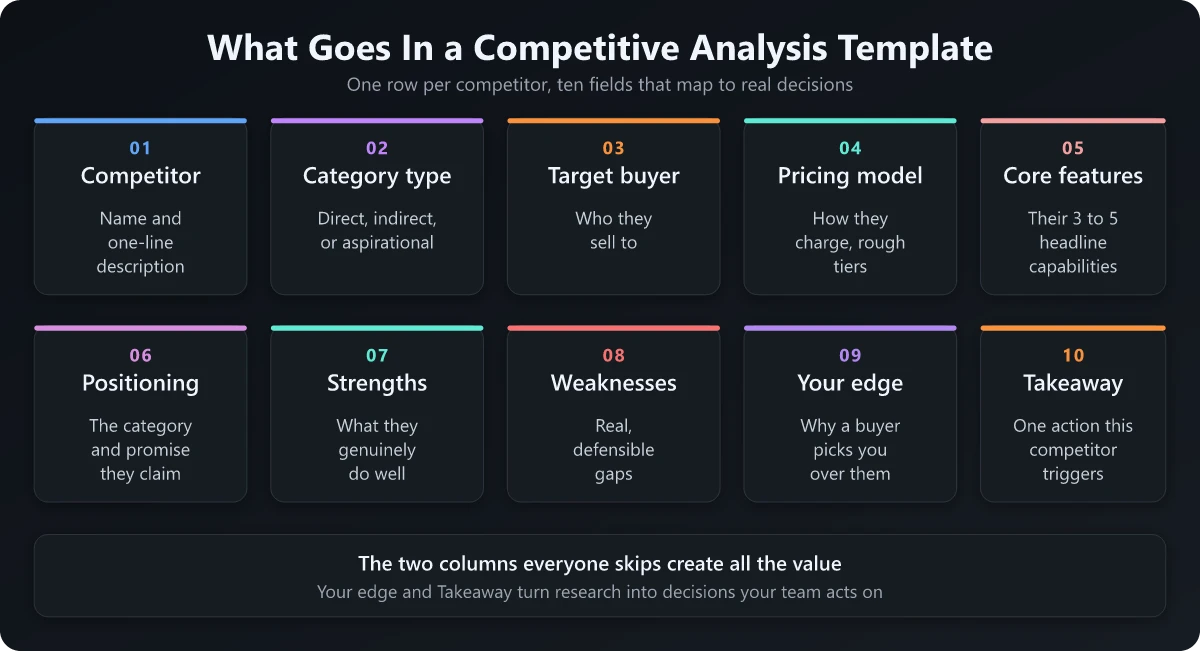
| Field | What it captures | Why it earns its place |
|---|---|---|
| Competitor | Name and one-line description | Forces you to define who actually competes |
| Category type | Direct, indirect, or aspirational | Stops you comparing apples to status quo |
| Target buyer | Who they sell to | Reveals overlap and white space |
| Pricing model | How they charge, rough tiers | The fastest way to spot positioning |
| Core features | Their 3 to 5 headline capabilities | Grounds the comparison in reality |
| Positioning | The category and promise they claim | Where messaging battles are won |
| Strengths | What they genuinely do well | Builds credibility, prevents wishful thinking |
| Weaknesses | Real, defensible gaps | The wedge you will sell against |
| Your edge | Why a buyer picks you over them | The single most important column |
| Takeaway | One action this competitor triggers | Converts research into a decision |
The last two columns are the ones people want to skip, and the only two that create value. If you fill in everything except “your edge” and “takeaway,” you have written a brochure for your competitors.
Direct, indirect, and aspirational
That category-type column does more work than it looks. Direct competitors solve the same problem for the same buyer. Indirect competitors solve the same problem a different way, including spreadsheets, manual processes, and “we just do nothing.” Aspirational competitors are the ones you want to be measured against even if you are not there yet.
Mixing these is the most common rookie mistake. A startup obsessing over the category leader while ignoring the spreadsheet that quietly wins many of its lost deals is fighting the wrong war.
How to Fill It In: A Step-by-Step Process
A template without a process is just an empty grid. Here is how I work through it, in order.
- Pick the question first. Are you sharpening pricing, arming sales, or shaping the roadmap? The question decides which competitors and columns matter. Never start with “let’s analyze competitors.”
- Cap the list at three to five. Choose the rivals you actually lose to or beat, based on real deal data, not vibes. If you are unsure who those are, pull names from your CRM closed-lost reasons.
- Source from primary, not pundits. Read their pricing page, sit through their demo, install the free trial, and read their G2 reviews - especially the three-star ones, which are the most honest.
- Write strengths before weaknesses. Steelman each competitor first. If your analysis says a real rival has no strengths, your analysis is wrong, and sales will know it on the first call.
- Force a takeaway per row. Every competitor gets one sentence starting with a verb: “Reposition our onboarding as the fast path,” “Add migration messaging,” “Hold pricing.” No verb, no value.
- Date it and assign an owner. Put a “last updated” stamp and a name on the file. Unowned analysis is dead analysis.
This usually takes a focused day or two for a tight list, not a quarter. The instinct to make it exhaustive is the instinct that kills it.
A quick worked example
Say you sell a project management tool to small agencies. Your direct rival is a feature-rich incumbent, your indirect rival is spreadsheets, and your aspirational target is the category giant.
The incumbent’s strength is depth; its weakness is that agencies find it bloated and slow to set up. Your edge is time-to-value. The takeaway writes itself: lead every agency conversation with “live in a day, not a quarter,” and build that into the demo, the homepage, and the sales pitch. That is one row turning into three coordinated actions.
Turning the Template Into Action
Filling in the grid is the middle of the job, not the end. The analysis only pays off when it leaves the document and changes behavior across three teams.
For sales, distill the grid into something usable mid-call. The full analysis is too dense for a live conversation, which is exactly why the battlecard exists as its sharper, sales-facing sibling. If you want the deeper how-to on that handoff, my guide to building a competitive battlecard template walks through the one-page format reps actually pull up.
For product, the weaknesses and white-space columns feed the roadmap conversation. This is where a structured competitive product analysis goes deeper than the summary grid, comparing capabilities feature by feature so you can argue for what to build with evidence instead of opinion.
For marketing and positioning, the positioning column tells you which messages are crowded and which lanes are open. Two competitors claiming “the easiest tool” means easy is taken; find the adjacent claim you can own. To see those lanes at a glance, plot two of the grid’s columns on a two-axis competitive positioning map and check that the axes measure different things, because when one tracks the other, an empty corner says nothing about demand.
If you want to see completed grids before you build your own, I keep a set of competitive analysis examples covering different business models and scoring approaches you can copy and adapt.
Keeping It Alive: Cadence and Inputs
A competitive analysis template is a living document or it is nothing. The most common reason good analysis goes stale is that no one feeds it new signal after launch day.
Build a simple intake habit. Win-loss interviews are the richest source, because customers tell you in plain language why they chose you or a rival - my walkthrough of win-loss analysis shows how to run those conversations without leading the witness. Pair that with ongoing monitoring so you catch pricing and feature changes as they ship rather than at the next quarterly review.
Here is the cadence I recommend.
| Trigger | Action |
|---|---|
| Quarterly | Full refresh of every row and re-validate the list |
| Competitor changes pricing | Update pricing and positioning columns same week |
| Competitor ships a major feature | Revisit strengths, weaknesses, and your edge |
| You lose three deals to the same rival | Deep-dive that competitor, rebuild the row |
| New entrant appears | Add a row, run the full fill-in process |
For categories that move fast, this monitoring discipline becomes its own function. If competition is central to your strategy, it is worth formalizing into a repeatable competitive intelligence analysis program rather than a one-off project.
Adapt it to your channel
The base template flexes by use case. If your battleground is search and content, the same grid logic applies to a content marketing competitor analysis, where the columns become topics owned, content gaps, and ranking strength instead of features and pricing. The structure travels; the dimensions change with the question.
The Takeaway
A competitive analysis template is not paperwork. It is a decision-forcing tool, and the only version worth building is the one tied to a specific question with an action in every row.
Keep the list short, source from primary research, steelman your rivals, and never let a row exist without a takeaway. Then refresh it on a real cadence so it stays a map of the market instead of a fossil of last year’s market.
If you take one thing from this, take the two columns everyone skips: your edge and the takeaway. Fill those in honestly and a competitive analysis template stops being a spreadsheet you maintain and becomes the reason your team wins deals it would otherwise have lost. Start with three competitors this week, and write a verb in every takeaway box before you call it done.
Frequently Asked Questions
What is a competitive analysis template?
It is a reusable structure - usually a grid or document - that standardizes how you research and compare competitors across dimensions like pricing, features, positioning, and strengths. The point is consistency, so every competitor gets evaluated the same way.
What should a competitive analysis template include?
At minimum: competitor names, target segment, pricing model, core features, positioning and messaging, strengths, weaknesses, and the single takeaway or action per competitor. Add proof points and objection handling if sales will use it.
How is a competitive analysis different from a battlecard?
A competitive analysis is the full research artifact built for strategy. A battlecard is the one-page, sales-facing distillation of it, focused on how to win a live deal against one named competitor.
How often should you update a competitive analysis?
Refresh it at least quarterly, and immediately whenever a competitor changes pricing, ships a major feature, rebrands, or enters a new segment. A stale template is worse than none because it creates false confidence.
Who owns the competitive analysis in a company?
Product marketing typically owns it, with input from sales, product, and customer success. PMM is best positioned because the work sits at the intersection of market, product, and messaging.