ABM Campaign Examples: 8 Real Plays B2B Teams Run in 2026
Eight concrete ABM campaign examples across one-to-one, one-to-few, and one-to-many tiers, with the trigger, channels, and what good looks like for each play.
Most of the ABM campaign examples floating around the internet are not campaigns. They are diagrams of the concept, a funnel with “personalization” written across the middle and no instruction for what a team should actually ship on Monday. That gap is why so many account-based programs stall after the platform purchase.
I have run account-based plays that worked and a few that quietly burned budget, and the difference was never the tooling. It was whether the play was concrete enough to hand to a demand-gen lead and an SDR and have them execute the same week. So this post skips the theory and gives you eight real ABM campaign examples, organized by tier, with the trigger, the channels, and what good looks like for each one.
Here is the reframe that makes all of these plays worth running. ABM is not “ads for a target list.” It works because it aligns marketing and sales around the buying group instead of the individual lead, and that shift changes the math. Demandbase’s State of ABM 2026 report puts it plainly: organizations that align around buying groups achieve up to 2-3x higher win rates than teams that still center execution on individual leads. Every campaign example below is really a way to organize effort around the group of people who actually decide, not the one who filled out a form.
How to Read These ABM Campaign Examples
Before the plays, the structure. Account-based marketing splits into three tiers, and the tier decides how much you personalize and how many accounts you can realistically cover.
One-to-one is deep, custom work for a handful of strategic accounts. Bespoke content, named-account research, sometimes executive-to-executive involvement. High effort, tiny list.
One-to-few is light personalization across a cluster of similar accounts, usually grouped by industry, use case, or persona. You build one asset that fits the whole cluster, then run it against ten to fifty accounts at once.
One-to-many is programmatic. Intent data and dynamic personalization let you run relevant-feeling campaigns across hundreds or low thousands of accounts without hand-building anything per account.
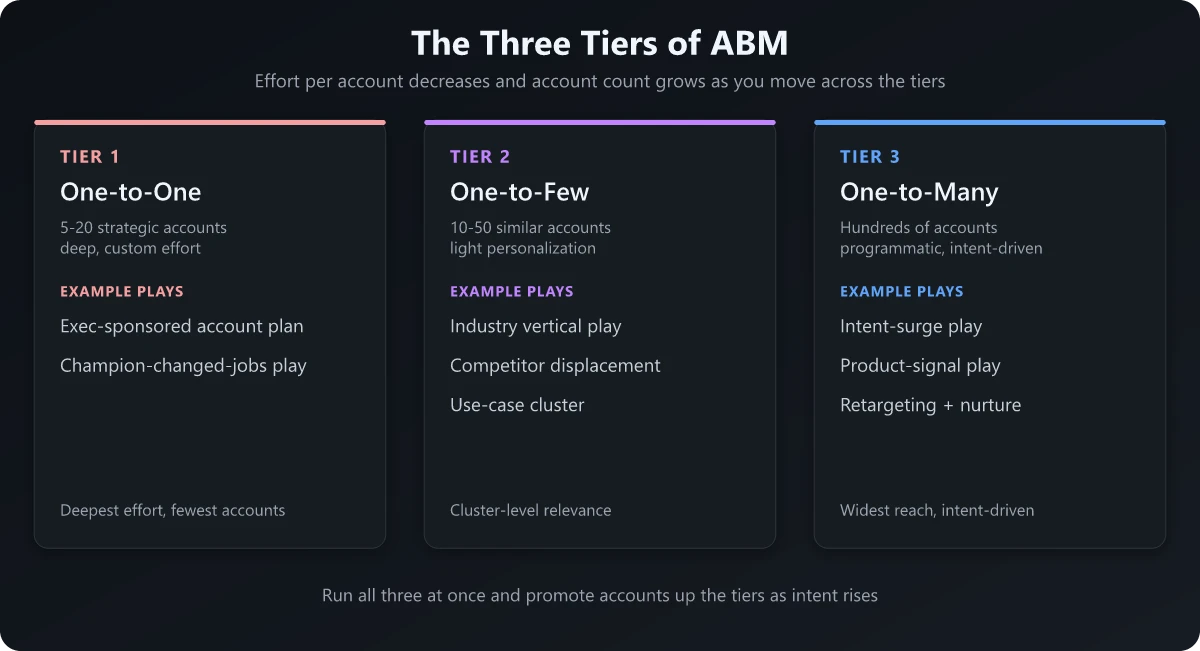
The mistake I see most often is treating these as a choice. They are not. Strong programs run all three at once and promote accounts up the tiers as intent rises. A one-to-many campaign surfaces an account that is heating up, you move it into a one-to-few cluster, and if it turns into a strategic opportunity you graduate it to one-to-one. The tiers are a conveyor belt, not three separate roads.
One more thing before the plays. None of this works if you have not defined who belongs on the list. If your target accounts are fuzzy, every ABM campaign example here becomes expensive spray-and-pray. Get the ICP and buyer persona work done first so the plays have a real audience to point at, then prioritize those accounts so your effort flows to the ones most likely to buy rather than the biggest logos. All eight plays below are aimed at target accounts; brand-level campaigns from 2025 and 2026, grouped by the mechanic behind each one, are in my list of recent innovative marketing examples. If the brief calls for brand-level B2B work rather than an account-based play, I would start from B2B campaigns that each hold a jury award or a stated result.
One-to-One ABM Campaign Examples
These are the plays you run against your five to twenty most valuable accounts. The effort per account is high, so the account has to be worth it.
Play 1: The executive-sponsored account plan
Who it targets: A single strategic account, usually a named logo your sales leadership already wants.
The trigger: A qualifying opportunity opening (renewal window, expansion signal, or an active deal that has gone quiet and needs air cover).
The channels: A custom microsite or landing hub built for that one account, an executive-to-executive email or LinkedIn touch, a tailored value deck, and a physical gift or event invite for the buying committee.
What good looks like: Multiple stakeholders inside the account engaging with the custom hub, not just your champion. The whole point of one-to-one is reaching the buying group, so if only one contact is clicking, the play is doing lead gen wearing an ABM costume.
Play 2: The champion-changed-jobs play
Who it targets: A former customer or power user who just moved to a new company that fits your ICP.
The trigger: A job-change alert. This is one of the highest-intent signals in B2B, because your champion already knows the product works and now has budget authority somewhere new.
The channels: A warm, personal outreach from the AE who owned the old relationship, a “welcome to the new role” note, and a light custom one-pager showing how the product would map to the new company’s stack.
What good looks like: A meeting booked inside two weeks. This is a warm play running on a relationship, so a cold-looking sequence here wastes the single best signal you get all year.
One-to-Few ABM Campaign Examples
This is the tier most teams under-invest in, and it is usually the highest-leverage one. You build one thing and point it at a cluster.
Play 3: The industry vertical play
Who it targets: A cluster of ten to fifty accounts in one industry (manufacturing, healthcare, fintech).
The trigger: A shared industry event, a regulatory change, or a wave of intent across the vertical picked up by your intent data.
The channels: One vertical-specific landing page, one webinar built around that industry’s exact pain, account-targeted LinkedIn ads to the cluster, and coordinated SDR outreach referencing the sector.
What good looks like: The webinar and landing page convert noticeably better than your generic equivalents, because relevance is the whole trade. If the vertical version performs like the generic version, you did not go deep enough on the industry’s language.
Play 4: The competitor-displacement play
Who it targets: Accounts you know are using a competitor and approaching a renewal or showing frustration signals.
The trigger: A competitor’s renewal window, a review-site complaint, or intent data showing the account researching alternatives.
The channels: A “switching from [competitor]” landing page, a migration-focused case study, comparison content, and SDR outreach armed with the exact objections that competitor’s users raise. This is where a sharp competitive battlecard does most of the heavy lifting, since the sales team needs the displacement talk track ready.
What good looks like: Accounts self-identifying by clicking the comparison assets, then converting to a “tell me more” conversation. The signal you want is the buying committee questioning their status quo, not just your champion nodding along.
Play 5: The use-case cluster play
Who it targets: Accounts that share a specific use case regardless of industry (for example, everyone trying to consolidate three tools into one).
The trigger: A product-usage or search-intent signal pointing at that specific job to be done.
The channels: A use-case landing page, a short ROI or “what this replaces” calculator, targeted ads, and email sequences that lead with the outcome rather than the feature list.
What good looks like: Prospects engaging with the outcome framing and self-selecting into the cluster. Use-case plays are how B2B demand generation and ABM stop competing and start compounding, because the demand-gen content feeds the cluster that ABM then works.
One-to-Many ABM Campaign Examples
These are programmatic. You are not hand-building per account. Intent data and dynamic personalization do the personalizing so you can cover hundreds of accounts.
Play 6: The intent-surge play
Who it targets: Your full target-account list, filtered in real time to whichever accounts are spiking on intent this week.
The trigger: A third-party intent spike (Bombora, 6sense, Demandbase surfacing accounts researching your category).
The channels: Automated account-targeted display and LinkedIn ads that fire when an account crosses an intent threshold, plus an alert that routes the hot account to an SDR for same-week follow-up.
What good looks like: Speed. The value of an intent signal decays fast, so good means the account gets touched by ads and a human within days of the spike, not at the end of the sprint.
Play 7: The product-signal play (freemium and trials)
Who it targets: Accounts with users inside a free trial, freemium tier, or product-led motion who are not yet talking to sales.
The trigger: A product-usage signal (multiple users from the same company signing up, a workspace hitting a usage limit, a key feature getting adopted).
The channels: In-product prompts, lifecycle email tied to the usage milestone, and account-targeted ads that reinforce the value the account is already experiencing. Sales gets alerted only when the account crosses a real product-qualified threshold.
What good looks like: Product-qualified accounts converting to sales conversations at a higher rate than cold outbound, because you are reaching a buying group that is already using the thing. This is where SaaS demand generation and ABM overlap most cleanly, since the product itself is generating the signal.
Play 8: The retargeting-plus-nurture play
Who it targets: Accounts that engaged with your top-of-funnel content but have not raised a hand.
The trigger: Anonymous or known engagement from a target account (content views, ad clicks, repeat site visits deanonymized to the account).
The channels: Sequenced retargeting ads that step the account from awareness content to mid-funnel proof, paired with an email nurture that matches the account’s stage.
What good looks like: Accounts moving down the funnel over weeks, measured by depth of engagement across the buying group rather than a single click. This is the patient tier, so judging it on this week’s demos misreads what it is for.
Mapping the Plays to Tier and Intent Signal
Here is the whole set in one view. When someone asks which ABM campaign examples to start with, I point at this table and ask which signal they can actually detect today.
| Play | Tier | Primary intent signal | What good looks like |
|---|---|---|---|
| Executive-sponsored account plan | One-to-one | Open opportunity or expansion window | Multiple committee members engaging the custom hub |
| Champion-changed-jobs | One-to-one | Job-change alert | Meeting booked within two weeks |
| Industry vertical | One-to-few | Vertical intent surge or industry event | Vertical assets outperform generic ones |
| Competitor displacement | One-to-few | Competitor renewal or research signal | Committee questioning their status quo |
| Use-case cluster | One-to-few | Use-case search or usage signal | Prospects self-selecting into the cluster |
| Intent surge | One-to-many | Third-party intent spike | Ads plus human touch within days |
| Product signal | One-to-many | In-product usage threshold | PQAs convert above cold outbound |
| Retargeting plus nurture | One-to-many | Deanonymized content engagement | Account depth rising across the group |
Notice that every row is anchored to a signal you can detect and a definition of success you can check. That is the difference between a real play and a slide. If you cannot name the trigger and cannot describe what good looks like, you do not have an ABM campaign, you have a target list and a hope.
Where These Plays Break
A quick set of traps, because I have hit most of them.
The first is running one-to-many effort against a one-to-one account. A strategic logo deserves a custom hub, not a display ad in a rotation of four hundred accounts. Match the effort to the tier or the account feels the mismatch.
The second is measuring these plays on lead volume. ABM is about depth of account engagement across the buying group, so a play that produces one deeply engaged committee beats a play that produces thirty scattered form fills. If you want the fuller argument on why account depth beats lead count, the difference between ABM vs inbound marketing makes it concrete.
The third is starting ABM before you have any demand to concentrate. ABM does not create awareness from nothing; it focuses spend on accounts that already have some. If nobody in your market knows the category exists, fix that first. The relationship between broad reach and focused capture is the same one at the heart of demand generation vs lead generation, and ABM sits squarely on the capture side.
Conclusion: Pick One ABM Campaign Example and Run It This Week
The reason most account-based programs feel stuck is that they treat ABM as a strategy to admire rather than a set of plays to run. These eight ABM campaign examples are deliberately small enough to start. Pick the tier that matches a signal you can already detect, and ship one play against a real cluster of accounts.
Do not try to run all eight at once. Choose the one where you can name the trigger, list the channels, and describe what good looks like, then execute it against a handful of accounts and measure engagement across the buying group instead of form fills. The 2-3x win-rate edge that comes from aligning around buying groups is not a feature of the software. It is a feature of running plays like these with discipline.
The teams that win with ABM are not the ones with the longest deck of campaign examples. They are the ones who took one concrete play, ran it against the right accounts, and let the results earn the budget for the next tier.
Frequently Asked Questions
What are the three tiers of ABM?
The three tiers are one-to-one (deep personalization for a handful of strategic accounts), one-to-few (light personalization for clusters of similar accounts, usually by industry or use case), and one-to-many (programmatic, intent-driven campaigns across a larger target list). Most strong programs run all three at once and move accounts between tiers as intent rises.
What is a good example of an ABM campaign?
A common one-to-few example is an industry-specific play: you take fifteen manufacturing accounts showing intent, build one landing page and one webinar tailored to their sector, and run account-targeted ads plus SDR outreach against the whole cluster. It is personalized enough to feel relevant but efficient enough to scale beyond a single account.
How do you trigger an ABM campaign?
You trigger ABM plays on signals, not calendars. The most reliable triggers are third-party intent spikes, a champion changing jobs, a competitor renewal window, product-usage signals from a free trial or freemium tier, and a hand-raise like a demo request from a target account. The signal decides which play fires and how fast.
What is the difference between one-to-one and one-to-many ABM?
One-to-one ABM concentrates deep, custom effort on a few named accounts, often with bespoke content and executive involvement. One-to-many ABM runs lighter, automated campaigns across a much larger list using intent data and dynamic personalization. One trades scale for depth; the other trades depth for reach.
How many accounts should an ABM campaign target?
It depends on the tier. One-to-one plays usually run against five to twenty strategic accounts, one-to-few against clusters of roughly ten to fifty similar accounts, and one-to-many against hundreds or low thousands. The list should be small enough that you can actually personalize at the level the tier demands.