B2B Lead Generation Funnel: Stages, Metrics, Fixes (2026)
The B2B lead generation funnel explained by a PMM: the real stages, the MQL-to-SQL handoff, the metric that matters at each step, and how to fix the leaks.
Every deck about the B2B lead generation funnel shows the same tidy triangle: awareness at the top, a few clean arrows, a closed deal at the bottom. Real B2B buying looks nothing like that. It is a group of a dozen people, moving at different speeds, going dark for months, and doubling back to stages you thought they had left behind.
I have built and rebuilt these funnels, and the teams that struggle are almost always the ones who mistake the diagram for the territory. They optimize a straight line while their buyers move in loops. So this guide treats the B2B lead generation funnel as what it actually is: a model of the stages a buying group passes through, with a specific job, a specific metric, and a specific leak at each one.
Start with the number that reframes the whole thing. At any given moment, the Ehrenberg-Bass 95:5 rule holds that only about 5% of your target customers are actively looking to buy, while the remaining 95% are present but not yet ready. A funnel built only to catch this quarter’s ready buyers ignores almost the entire market that will fund next year’s pipeline. The top of the B2B lead generation funnel is not a capture problem. It is a patience problem.
What the B2B Lead Generation Funnel Actually Is
The B2B lead generation funnel is a model of how an anonymous market becomes a set of named, sales-ready opportunities. It is a way to organize the work of turning strangers into buyers, and its value is that it tells you what job you are doing at each stage and how to tell whether that job is working.
The word funnel is slightly misleading, because it implies a smooth downward slide. In B2B, a better mental image is a series of gates. At each gate, a buyer either qualifies deeper or stalls, and the job at every stage is to help the right accounts through the next gate while quietly letting poor-fit ones fall away.
The other thing the classic triangle hides is that you are almost never moving one person. You are moving a buying committee, and the funnel has to account for the fact that different members enter at different stages. The champion may be deep in consideration while the economic buyer has never heard your name.
Why the B2B funnel is not linear
A linear funnel assumes a lead enters at the top, descends in order, and exits as a customer. B2B buyers refuse to cooperate. They binge three months of your content, disappear, resurface after a reorg, and land straight in an evaluation with a shortlist you did not know you were on.
This is why obsessing over a clean stage order wastes energy. What matters is that each stage does its job well, so that whenever a buyer is ready to move, the next gate is open and obvious. Build the funnel so it works no matter where a buyer enters or how many times they loop.
It also means demand and capture are not the same activity. Reaching the 95% who are not ready is B2B demand generation work, while converting the 5% who are is lead generation work. The funnel only performs when both are running, a tension I unpack fully in demand generation vs lead generation.
The Stages of the B2B Lead Generation Funnel
Here are the five working stages, top to bottom, with what happens at each and where the buyer’s head is at.
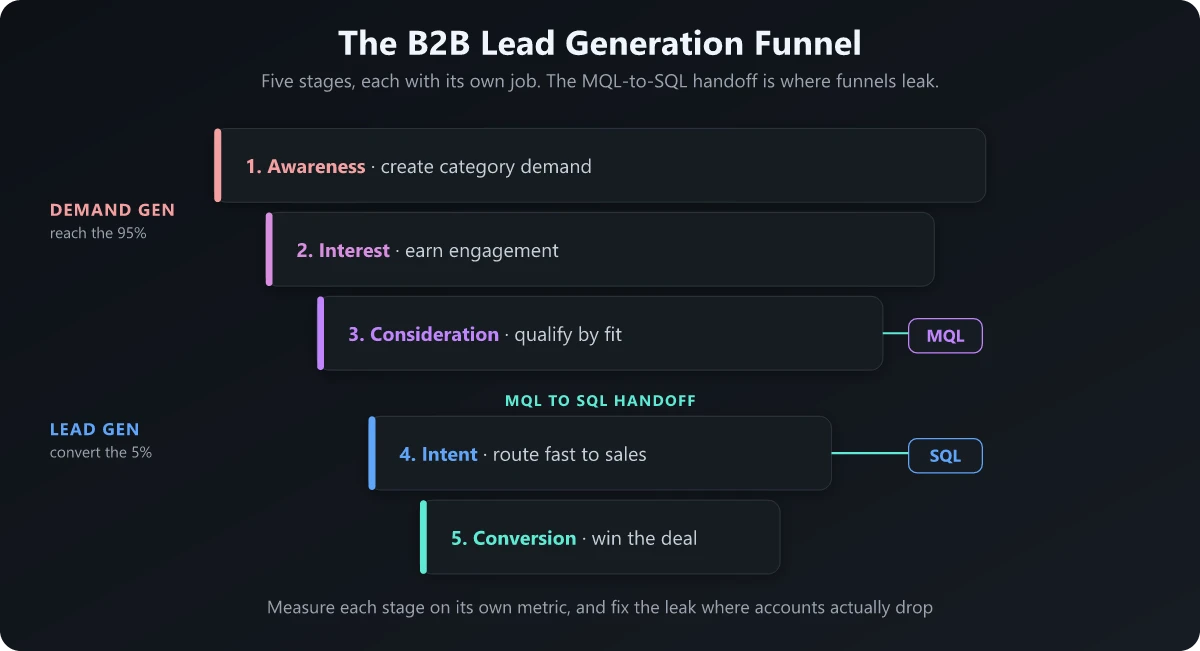
Stage 1: Awareness
At the top, the buyer does not know you exist, and often does not yet know they have the problem you solve. Your job is to make a market aware that the problem is real, that a category solves it, and that you are a credible name in that category.
This is the widest and most patient stage, the one that reaches the 95%. Most of the people you touch here will never fill out a form while they are paying attention to you, and that is fine. You are planting recognition that pays off months later. For awareness campaigns backed by a jury award or a stated result, see the B2B campaigns I sorted by what each source states.
Stage 2: Interest and Engagement
A subset of that aware audience starts engaging: reading a second article, following you, downloading something, coming back to the site. They have not raised their hand to buy, but they are leaning in.
Your job here is to reward the lean with genuinely useful content and to start recognizing which accounts are warming up. Engagement is the first behavioral signal you can actually act on, and it is the raw material your later qualification depends on.
Stage 3: Consideration
Now the buyer is actively researching. They are comparing options, reading about how you stack up, and quietly building a shortlist in their head. This is where an engaged contact becomes a marketing qualified lead, because their behavior plus their fit suggests they are worth a closer look.
Your job is to make the comparison easy and to make your case where the buyer is doing their homework. Get this stage right and you land on the shortlist before a rep is ever involved.
Stage 4: Intent
Intent is where the buyer signals they are evaluating with a real chance of purchasing: a demo request, a pricing page visit, a high-intent search, a reply to outreach that says “tell me more.” This is the handoff zone, where a marketing qualified lead becomes a sales qualified lead that a rep accepts and works.
Your job is speed and relevance. Intent signals decay fast, and a hot account that waits three days for a follow-up cools into a lost one.
Stage 5: Conversion
At the bottom, the account becomes an opportunity and, if the work upstream was sound, a customer. Sales is now multi-threading across the buying committee, handling objections, and driving to a close.
Your job shifts to enablement: giving reps the proof, the competitive angles, and the collateral that move a committee decision. The funnel does not end at the signature either, because customers feed the next round of awareness with proof and referrals.
The B2B Lead Generation Funnel in One Table
When someone asks me to explain the whole funnel fast, I hand them this. Each row ties a stage to the buyer’s mindset, your job, the metric that matters, and the leak to watch for.
| Stage | Buyer mindset | Your job | Key metric | Common leak |
|---|---|---|---|---|
| Awareness | ”I did not know this was a problem” | Reach fit buyers, create category demand | Reach and audience fit | Reaching volume but not the right accounts |
| Interest | ”This is worth my attention” | Reward engagement, identify warming accounts | Engagement depth and return visits | Traffic that never engages a second time |
| Consideration | ”Who are my options?” | Make the comparison easy, qualify by fit | MQL volume and quality | Fuzzy MQL definition that passes junk |
| Intent | ”I am ready to evaluate” | Route fast, hand off cleanly to sales | MQL-to-SQL rate and speed to follow-up | Slow or contested handoff |
| Conversion | ”Can I defend this choice internally?” | Enable the rep, arm the champion | Win rate and deal velocity | Champion cannot sell it to the committee |
Notice that every stage has a different metric. Judging your awareness stage on form fills, or your intent stage on reach, is how good funnels get misdiagnosed. Measure each gate on the job it is actually doing.
The MQL-to-SQL Handoff: Where Funnels Break
If a B2B lead generation funnel is going to fail, it usually fails right here, at the seam between marketing and sales. Marketing declares a lead qualified, sales looks at it, disagrees, and lets it rot. Multiply that by a quarter and you get two teams blaming each other while pipeline quietly evaporates.
The root cause is almost always a definition problem. Marketing optimizes for MQL volume because that is what it is measured on, so it lowers the bar until the number looks good. Sales, drowning in low-fit leads, stops trusting anything marketing sends. The fix is not a better scoring model. It is a shared, written definition of what qualified means, agreed by both teams and enforced.
The tighter your upstream targeting, the less this hurts. A funnel fed by a sharp ICP and buyer persona produces leads that already fit, so the handoff argument mostly disappears. Most handoff fights are really targeting fights wearing a disguise.
That definition problem is also why the published numbers for this stage are close to useless: the same funnel reports anything from 13% to 45% depending on where the qualifying test sits. I audited where each circulating figure actually comes from in the MQL to SQL conversion rate benchmarks, traced to source.
The Most Common Leaks and How to Fix Them
Every stage leaks in its own way. Diagnosing the funnel means finding the specific gate where accounts drop, not just noting that “conversion is low.”
Awareness leak: reaching volume, not fit. If your top of funnel is busy but nothing qualified emerges, you are reaching the wrong people. Fix it by narrowing your content and channels to the accounts your ICP actually describes, even if the raw traffic number falls.
Interest leak: one-and-done visitors. If people arrive and never come back, your content is not earning a second visit. Fix it with a genuine point of view and a reason to return, not another gated checklist. This is where consistent SaaS demand generation content compounds, because familiarity is built over many touches, not one.
Consideration leak: junk MQLs. If marketing is passing leads sales ignores, your MQL definition is too loose. Fix it by qualifying on fit and real buying behavior, not just an ebook download.
Intent leak: slow handoff. If hot accounts go cold before anyone calls them, your routing is too slow. Fix it by alerting a human the moment a real intent signal fires and making follow-up a same-day expectation.
Conversion leak: the champion cannot sell internally. If deals stall late, your champion is failing to carry the decision to a committee you never meet. Fix it by arming them with the proof and the objection handling they need to sell for you when you are not in the room.
Email is often the connective tissue that stops these leaks, carrying an engaged contact from interest to intent without a rep. If that is your weak point, the B2B lead generation email templates give you sequences that keep accounts moving between stages.
How to Measure the B2B Lead Generation Funnel
A funnel you cannot measure is just a drawing. The measurement that matters most is stage-to-stage conversion rate, because it turns a vague “we need more leads” into a precise “we lose most accounts between consideration and intent, so the problem is our handoff, not our traffic.”
Here is the sequence I use to instrument it.
- Define every stage as an event, not a vibe. A lead is in consideration when it does X, in intent when it does Y. If a stage has no clear entry trigger, you cannot measure movement through it.
- Track conversion between adjacent stages, not just top and bottom. The overall lead-to-customer rate hides the leak. The stage-to-stage rates expose it.
- Watch time-in-stage. An account stuck in intent for weeks is a signal, usually of a stalled handoff or a champion losing the internal argument.
- Segment by fit. Split your rates by ICP fit. High volume with low-fit conversion means a targeting problem; low volume with high-fit conversion means you just need more reach.
- Close the loop to revenue. Tie converted opportunities back to the stage and source that created them, so you fund what fills the funnel, not just what closes it.
Once the funnel is measured, you can concentrate your best accounts into a focused motion rather than treating every lead the same. That is where the ABM campaign examples come in, taking the highest-fit accounts your funnel surfaces and working them as a buying group instead of a list of leads.
Conclusion: Fix the Stage, Not the Funnel
The B2B lead generation funnel is not a triangle that leads glide down in order. It is a set of gates a buying group passes through, at their own pace, often out of sequence, and each gate has its own job, its own metric, and its own way of leaking. The teams that win stop talking about “the funnel” as one thing and start diagnosing the specific stage where accounts fall out.
So define each stage as a real event, measure the conversion between adjacent stages, and fix the leak where it actually is rather than throwing more traffic at a problem that lives at the handoff. Remember the 95:5 reality while you do it: most of your future pipeline is not ready to buy today, so a B2B lead generation funnel that only serves this quarter’s ready buyers is starving the market that funds every quarter after it.
Build the funnel to work no matter where a buyer enters, measure it gate by gate, and treat awareness and capture as two halves of one system. Do that, and the B2B lead generation funnel stops being a diagram you present and starts being a machine you can actually tune.
Frequently Asked Questions
What are the stages of the B2B lead generation funnel?
The B2B lead generation funnel has five working stages: awareness (the market learns the problem and your category exist), interest or engagement (a contact starts consuming your content), consideration (they actively research and compare), intent (they signal they are evaluating to buy), and conversion (the account becomes an opportunity and closes). The MQL-to-SQL handoff sits between consideration and intent.
What is the difference between an MQL and an SQL?
A marketing qualified lead (MQL) is a contact whose behavior suggests they are worth a closer look, usually based on engagement and fit. A sales qualified lead (SQL) is one that sales has accepted as a real opportunity worth working. The MQL-to-SQL handoff is where most B2B funnels leak, because marketing and sales often disagree on what qualified actually means.
Is the B2B lead generation funnel linear?
No. A clean top-to-bottom funnel is a useful diagram, not a description of reality. B2B buyers loop back, go quiet for months, and move as a buying group of many people rather than one lead. Treat the funnel as a model of stages a buyer passes through, not a conveyor belt every lead rides in order.
Why do B2B leads drop out of the funnel?
Leads leak for stage-specific reasons: weak awareness that never reaches fit buyers, engagement that goes cold with no nurture, a fuzzy MQL definition that hands sales junk, and a clumsy conversion path that loses ready buyers at the finish line. Each stage has its own leak, so the fix depends on where the drop-off actually happens.
How do you measure a B2B lead generation funnel?
Measure each stage on the metric that matches its job: reach and fit at awareness, engagement depth at interest, MQL volume and quality at consideration, opportunity creation at intent, and win rate plus velocity at conversion. The single most revealing number is stage-to-stage conversion rate, because it shows exactly where the funnel is leaking.