ABM vs Inbound Marketing: How to Choose and Combine Both
ABM vs inbound marketing, explained by a PMM: how each motion works, where each wins and fails, and how to combine them instead of picking a side.
Every few months a founder asks me some version of the same question: should we go all-in on ABM or double down on inbound? The framing is wrong, but the confusion is understandable. The abm vs inbound marketing debate gets sold as a strategic fork in the road when it is really a question of direction and sequencing.
I have built both motions, and I have watched teams waste a full year picking a side that never needed picking. Inbound and ABM are not competing philosophies. They are two ways demand reaches your pipeline, one wide and one narrow, and the good teams run them as a loop rather than a choice.
It helps to start with the number that makes the whole argument make sense. According to Forrester’s 2026 State of Business Buying report, the typical buying decision now involves 13 internal stakeholders plus nine external influencers, and that number climbs for complex purchases. You are never really selling to a single lead. You are selling to an account full of people, which is exactly why the account-level focus of ABM is rational, and exactly why inbound alone, built around individual form fills, leaves value on the table.
ABM vs Inbound Marketing: The Core Difference
Here is the cleanest way I know to separate them.
Inbound marketing casts a wide net and waits. You publish content, rank in search, build an audience, and let buyers discover you on their own timeline. The direction of travel is toward you. Buyers find you, self-educate, and raise their hand when they are ready.
ABM picks a narrow list and goes to it. You define a set of high-value accounts, then aim personalized ads, outreach, and content directly at the people inside them. The direction reverses. You go to them, whether or not they have started looking.
The simplest test I use: if the account chose the moment of contact, that is inbound. If your team chose the account and initiated contact, that is ABM.
That distinction matters because it changes everything downstream, from how you budget to what you measure. One motion is optimized for reach across a market you cannot name. The other is optimized for depth inside a market you can name to the individual account.
Wide net vs narrow net
Inbound is wide and shallow by design. It touches a large audience at low cost per touch, but you have little control over who shows up. Most of the traffic will never be a fit, and that is fine, because the fraction that is fit costs almost nothing to reach at that stage.
ABM is narrow and deep. You spend far more per account, but only on accounts you have already decided are worth it. There is no wasted reach because there is no reach beyond the list.
The trap is assuming one is inherently more efficient. Wide-and-cheap looks efficient until you count how much of the traffic converts. Narrow-and-expensive looks wasteful until you count the deal sizes it closes.
ABM vs Inbound Marketing: A Side-by-Side Comparison
When I onboard a new team, I put this table on the wall. It settles most of the abm vs inbound marketing arguments before they start.
| Dimension | Inbound marketing | ABM |
|---|---|---|
| Direction | They find you | You pick them |
| Net | Wide and shallow | Narrow and deep |
| Audience | Whole addressable market | A named list of accounts |
| Unit of focus | The individual lead | The account and its buying committee |
| Typical tactics | SEO, blog content, organic social, webinars, gated assets | Targeted ads, personalized landing pages, 1:1 outbound, custom content |
| Cost model | Low cost per touch, high volume | High cost per account, low volume |
| Time horizon | Compounds over quarters | Faster inside the list, once built |
| Best fit | Large market, lower ACV, self-serve motion | Small market, high ACV, committee-driven deals |
| Common failure | Volume of poor-fit leads sales ignores | Spend on accounts that will never buy |
Notice that several tactics can serve either motion depending on how you aim them. A webinar promoted to the whole market is inbound; the same webinar with seats reserved for twenty target accounts is ABM. The tactic is not the motion. The targeting is.
Where Each One Wins
Neither motion is universally right. The correct choice is contextual, and it comes down to how big and how knowable your market is.
Where inbound wins
Inbound wins when your total addressable market is large and you cannot possibly name every buyer. If thousands of companies could plausibly buy you, hand-selecting accounts is a losing game, and casting a wide net is the only way to reach them at a sane cost.
It also wins on lower-ACV, higher-velocity deals where a self-serve or lightly-assisted motion works. When the deal does not justify a bespoke campaign per account, inbound’s cheap reach is exactly what you want. This is the engine behind most SaaS demand generation programs, where content and search do the heavy lifting of filling the top of the funnel.
Inbound compounds, too. A ranking article or a strong POV keeps working for months after you publish it, while ABM spend stops the day you stop funding it.
Where ABM wins
ABM wins when a small number of accounts represent most of your revenue potential. If two hundred logos are the entire prize, spraying content at the open market is inefficient, and concentrating budget on those two hundred is obvious.
It also wins on high-ACV, committee-driven deals. When a single win is worth six or seven figures and involves a dozen stakeholders, the cost of a personalized, multi-threaded campaign is trivial against the deal size. The buying-committee reality Forrester describes is the whole case for ABM: you are orchestrating a group decision, not chasing one lead.
ABM shines in enterprise and expansion motions, where relationships and precision beat volume every time.
Where Each One Fails
The failure modes are just as instructive as the wins, and they are where I see the most budget wasted.
Inbound fails when the market is too narrow or too specialized for search and content to reach efficiently. If only fifty companies on earth can buy you, waiting for them to organically find a blog post is a slow, unreliable way to reach a group you could just call. Inbound also fails when it becomes a volume machine disconnected from fit, flooding sales with leads that never had a chance to close.
ABM fails in the opposite direction. It fails when teams pick accounts badly, pouring personalized spend into logos that were never going to buy. It fails when it launches with no awareness in the accounts, so the first cold, hyper-personalized ad lands on a buyer who has never heard of you and reads as noise. And it fails when it is treated as a tool purchase rather than a program, which is the most expensive version of all.
The through-line: inbound fails on relevance, ABM fails on selection. Fixing both requires the two motions to talk to each other.
How ABM and Inbound Work Together
This is the part most “versus” articles miss. ABM and inbound are not rivals. They are two halves of one program, and each is weaker alone.
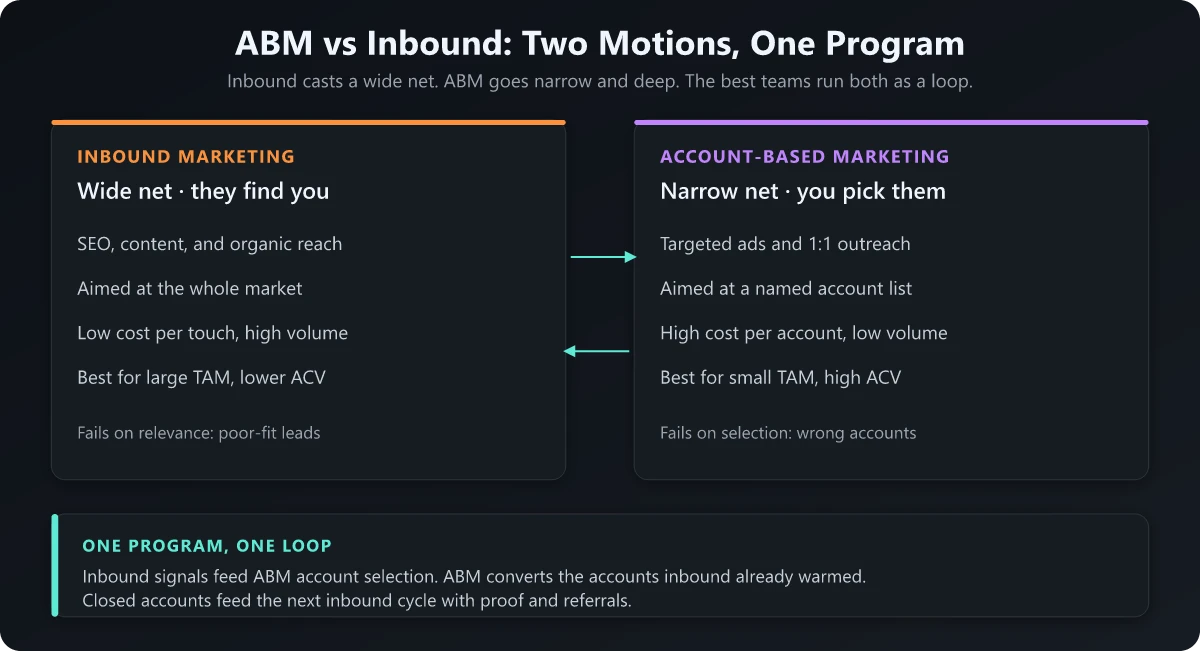
Inbound without ABM produces a busy funnel that never concentrates. You generate real signal and real traffic, but you treat every lead the same, so the handful of accounts that could be transformational get the same generic nurture as the tire-kickers. The whales swim right through the net.
ABM without inbound produces cold, expensive outreach into a vacuum. You target the right accounts, but nobody in them recognizes your name, so your personalized campaign has to do awareness, education, and conversion all at once. That is a heavy lift for a cold ad.
The healthy pattern is a loop:
- Inbound casts the net. Content, SEO, and organic reach create awareness across the whole market and pull in engagement you could never have predicted.
- Inbound signals feed account selection. The accounts consuming your content, hitting your pricing page, and requesting demos tell you which logos are actually warming up. That behavioral data is the best ABM target list you will ever get.
- ABM concentrates on the warmed accounts. You pull the highest-fit, highest-engagement accounts into a focused ABM motion with personalized content and multi-threaded outreach.
- ABM converts what inbound started. Because those accounts already know you, the personalization lands as relevance instead of noise, and the buying committee moves faster.
- Closed accounts feed the next inbound cycle. Their stories, proof, and referrals become the content that fills the top of the funnel again.
If you want the upstream engine behind that first step, I wrote a full breakdown of B2B demand generation and how it feeds both motions. And the mechanics of turning wide reach into captured pipeline are the same ones I unpack in demand generation vs lead generation.
Which One Should You Lead With?
The honest answer depends on your market size and your average contract value. Here is the decision guide I use.
| Company stage / ACV | Lead with | Why |
|---|---|---|
| Early startup, large TAM, lower ACV | Inbound | You cannot name your buyers yet, and you need signal and awareness first |
| Early startup, tiny TAM, very high ACV | ABM | Only a few accounts can ever buy you, so hand-select them from day one |
| Growth stage, mixed ACV | Inbound first, then layer ABM | Let inbound identify the warm accounts, then concentrate on them |
| Enterprise or expansion motion | ABM | Committee-driven, high-value deals reward precision over reach |
| Strong awareness, weak account focus | Add ABM | The market knows you, but you are not concentrating on the best logos |
| Strong account focus, cold accounts | Add inbound | Your targets do not recognize you, so warm them before you sell |
The pattern for most B2B SaaS companies: start with inbound to build awareness and generate signal, then use that signal to select accounts and layer ABM on top. Leading with ABM makes sense only when your market is small and knowable and your deals are large enough to justify per-account spend from the start. The catch is that a small and knowable market has to come from an account count you built yourself, not from a published total multiplied by a share assumption, because an inflated TAM will push you toward inbound when only forty accounts can realistically buy you: running the same market both ways and reading the gap between the two numbers is what tells you which row of this table you actually sit in.
Get your targeting foundation right first
Neither motion works if you have not defined who you are actually trying to reach. Inbound needs a clear point of view aimed at a specific buyer, and ABM needs a defensible account list. Both trace back to the same upstream work.
Before you pick a motion, get your ICP and buyer persona definitions tight. The ICP tells ABM which accounts belong on the list. The buyer persona tells inbound whose problems to write about. Skip this and you will run both motions at the wrong people, efficiently.
Connect the motions across the lifecycle
The other thing that makes the combination work is treating a buyer’s journey as continuous, not as two disconnected campaigns. An account that discovers you through inbound should experience a smooth escalation into ABM, not a jarring restart.
This is where lifecycle marketing earns its keep. It gives you the stages and triggers to move an account from anonymous inbound engagement, to identified and warming, to a named ABM target, without the buyer feeling handed off between two machines that do not talk.
Making the Combined Program Real
Theory is easy. Here is what actually makes the two motions reinforce each other in practice.
Share one account view. Your inbound engagement data and your ABM target list have to live in the same system, or account selection becomes guesswork and the loop breaks. The single most common failure I see is inbound and ABM running on separate dashboards that never reconcile.
Sequence the message. An account should not get a cold, aggressive ABM ad the same week it first found your blog. Warm accounts get personalization; cold ones get awareness. Matching message intensity to account readiness is the whole game.
Agree on shared definitions. Marketing and sales need one definition of a target account, one definition of engagement, and one owner for the handoff. For concrete inspiration on what the ABM half looks like when it is done well, the ABM campaign examples breakdown shows how personalization actually plays out per account.
Measure each motion on its own terms. Do not judge ABM on raw lead volume or inbound on account penetration. Give each a scoreboard that matches what it is built to do, then look at how they hand off to each other.
Conclusion: Stop Choosing, Start Combining
The whole abm vs inbound marketing debate dissolves once you stop treating it as a fork in the road. Inbound is the wide net that finds accounts you could never have named. ABM is the narrow motion that goes deep on the accounts worth naming. One creates signal across the market, the other concentrates spend where that signal points.
So do not pick a side. Lead with the motion your market size and deal value call for, use inbound engagement to select your ABM accounts, and use ABM personalization to convert the accounts inbound already warmed. A buying committee of more than a dozen people is not something you close with a single form fill, and it is not something you reach with cold spray either.
The teams that win the abm vs inbound marketing question are the ones who stopped asking it and started running both as a single loop, wide net into narrow focus, discovery into conversion, over and over.
Frequently Asked Questions
What is the difference between ABM and inbound marketing?
Inbound marketing casts a wide net and waits for buyers to find you through content, SEO, and organic reach. ABM reverses the direction: you pick a defined list of high-value accounts and go to them with targeted, personalized outreach. Inbound is they-find-you and wide; ABM is you-pick-them and narrow. Strong teams run both.
Is ABM better than inbound marketing?
Neither is better in the abstract. ABM wins when you sell high-ACV deals to a small, knowable set of accounts. Inbound wins when your total addressable market is large, your price point is lower, and self-serve discovery is realistic. The mistake is treating them as rivals instead of two motions that feed each other.
Can you use ABM and inbound marketing together?
Yes, and the best programs do. Inbound signals (content engagement, high-intent page visits, demo requests) tell you which accounts to select for ABM. ABM personalization then converts the accounts your inbound content already warmed. Inbound feeds account selection; ABM closes what inbound started.
Should a startup start with ABM or inbound marketing?
Most early startups should lead with inbound to build category awareness and generate signal, unless they sell very high-ACV deals to a tiny, named market. If you only have a few hundred accounts that can ever buy you, ABM makes sense from day one. Otherwise, build inbound first and layer ABM on top once you know which accounts engage.
How do you measure ABM vs inbound marketing?
Measure inbound on reach and volume: organic traffic, form fills, MQLs, and cost per lead. Measure ABM on account-level engagement: target account penetration, opportunities created from the named list, win rate versus non-target accounts, and deal velocity. Judging ABM on raw lead volume, or inbound on account penetration, is the classic reporting error.