How Often Should You Do an SEO Audit? (2026 Cadence Guide)
How often should you do an SEO audit? A practical cadence: monthly checks, quarterly deep dives, annual technical audits, plus the triggers that demand one now.

The worst Monday I ever had started with a coffee, a Search Console tab, and the growing sense that my last SEO audit was far too old. Overnight, a page that had held the top three for two years slipped to the middle of page two, and its traffic had roughly halved. Nothing had changed on our side.
No deploy, no content edit, no lost links. Something had shifted in the search results while I slept, and no monitoring was in place to catch the drop while it was still small.
That morning taught me the lesson this entire post is built on. Search does not sit still, so your checks on it cannot be a once-a-year event. Google is not a fixed target you optimize against one time and then forget.
According to Google’s own How Search Works documentation, in 2023 alone the company ran more than 700,000 experiments that produced over 4,000 improvements to Search. The ground moves under you constantly, whether or not you are watching it.
So when someone asks me how often should you do an SEO audit, my honest answer is that the question is hiding three different questions. There is no single audit cadence, because there are three separate audits running on three separate clocks, plus a category of urgent audits that ignore the calendar entirely.
This guide lays out that cadence: what belongs on a monthly clock, what belongs on a quarterly clock, what belongs on an annual clock, and which events should make you drop everything and audit the same day.
Why an SEO Audit Is Never One and Done
The most expensive belief in SEO is that an audit is a project with an end date. You hire someone, they hand you a 40-page PDF, you fix half of it, and you file the rest under someday. Six months later the site has quietly drifted, and nobody notices until rankings fall off a cliff.
That model fails because the thing you are auditing is not your site in isolation. You are auditing the relationship between your site and a search engine that reshapes itself thousands of times a year.
Every core update and ranking system tweak can move pages you never touched. An audit captures a single snapshot of a moving picture.
This is exactly why an SEO audit is important as a recurring discipline rather than a one-off purchase. The goal is not some finished, audited state. It is to keep the gap between what your site is and what search now rewards small enough that you can close it before it costs you rankings.
An audit you run once decays the moment you finish it. A cadence keeps it alive.
How Often Should You Do an SEO Audit? Three Audits, Three Clocks
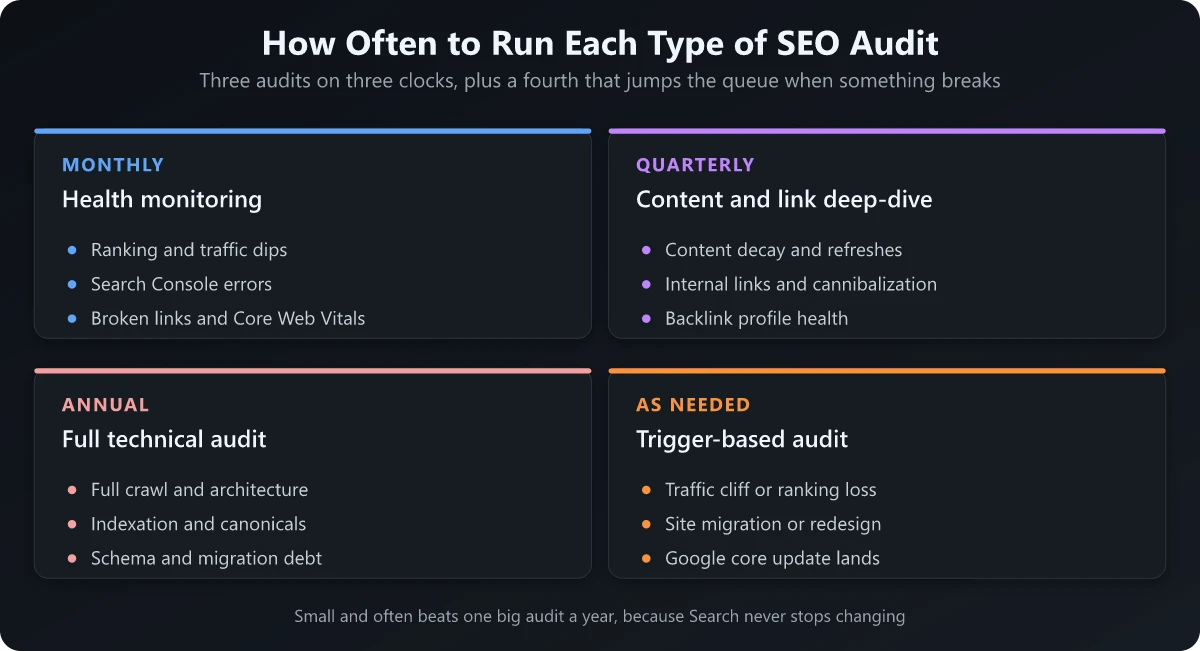
Here is the reframe that makes the whole question answerable. Stop thinking about the audit as one thing. There are three, and they answer three different needs.
The monthly audit is a health check. It is fast, mostly automated, and its job is early detection. You are looking for anything that broke or dropped in the last 30 days so you can catch problems while they are cheap to fix.
The quarterly audit is a deep dive. It is slower and more analytical. Its job is to find the slow decay that a monthly glance misses: content losing ground, internal links going stale, pages competing with each other, backlinks quietly disappearing.
The annual audit is the full technical teardown. Once a year you crawl the whole site and interrogate the architecture to confirm everything is indexable, structured, and clean under the hood. This is the heaviest lift and the one people most often skip.
Then there is a fourth category outside the calendar entirely. Trigger-based audits fire on events, not dates. A traffic cliff, a migration, a Google core update, or a CMS change can demand an SEO audit right now, regardless of the monthly or quarterly rhythm.
If you want a single master list of everything the deeper checks cover, keep a full SEO audit checklist on hand and pull the relevant slice into each clock. The checklist is the menu. The cadence decides which items you order and how often.
The Monthly Monitoring Audit
Think of this as vital signs. You are not diagnosing anything deep.
You are checking that nothing is bleeding. On a healthy site with monitoring already wired up, this takes 30 to 60 minutes a month, most of it reading dashboards rather than digging.
Rankings and traffic drops
Start with movement. Which money keywords lost position this month, which pages lost organic traffic, and, increasingly, whether AI answer engines still mention you, since your AI search visibility can slip even while your blue-link rankings hold?
A single page dropping a spot is noise. A cluster of related pages sliding together is a signal that something structural or algorithmic is at play.
The point of doing this monthly is speed. If you check your SEO ranking on a regular rhythm, a five-position slide is a small, catchable problem. Discover the same slide a year later and it has usually compounded into a traffic collapse that takes months to reverse.
Search Console errors and coverage
Open Google Search Console and read the coverage and indexing reports. New not-indexed pages, a spike in crawl errors, a jump in soft 404s, or a mobile usability warning are all the kind of thing that appears quietly and grows loudly. Monthly is the right frequency because these reports reflect what Google is actually doing with your site right now.
Broken links and Core Web Vitals
Run a quick crawl for broken internal links and confirm that new 404s have not crept in from deleted or renamed pages. Glance at your Core Web Vitals in the Page Experience report to make sure a recent template or script change has not tanked your loading, interactivity, or layout stability scores.
None of these monthly items require deep analysis. They require consistency. The value is entirely in catching the small break before it becomes the reason for a bad Monday.
The Quarterly Deep-Dive Audit
Every 90 days, go beyond vital signs and actually investigate. This is where you find the slow leaks that never trip a monthly alarm. Budget half a day to a full day for it, because the value is in the thinking, not the crawling.
Content decay
Content decay is the silent killer. Pages that used to rank slowly slide as competitors publish fresher, more complete answers and as the query itself evolves. Nothing broke, so nothing alerts you.
A quarterly pass through your top pages, comparing their current position and traffic to last quarter, surfaces the posts that need a refresh before they fall out of striking distance. Catch a decaying page early and a light update restores it. Catch it late and you are rebuilding from scratch.
Internal linking
Internal links are the part of technical SEO you actually control fully, and they rot without maintenance. Over a quarter you publish new posts, retire old ones, and change URLs. Check that your important pages still have strong internal link support and that new content is properly woven into the relevant clusters rather than stranded as an orphan.
Keyword cannibalization
When two or three of your own pages target the same intent, they split signals and confuse Google about which to rank. Cannibalization usually creeps in over time as you publish adjacent content. A quarterly review of which URLs rank for your priority queries catches pages fighting each other so you can consolidate, redirect, or re-differentiate them. Those collisions are easier to see against a table that names one target query per URL, and on a site that is already published you fill that column by building the keyword map from a Search Console export instead of a blank research template.
Backlink health
Scan your backlink profile for changes since last quarter. Are you losing links from pages that used to point at you? Did a burst of spammy links appear that you want to understand?
You are not chasing every link, you are watching the trend line and the health of the profile that supports your most valuable pages. A steady loss of quality referring domains only shows up when you compare quarter over quarter.
The Annual Full Technical SEO Audit
Once a year, do the thing nobody enjoys and everybody needs. The annual full technical SEO audit is a complete teardown of the machinery underneath your content. It is heavy, it takes a few days, and it catches the structural problems that the lighter clocks are not designed to see.
Crawl the entire site
Run a full crawl with a proper crawler and look at the whole picture: redirect chains, orphan pages, thin or duplicate content, canonical conflicts, and pages that waste crawl budget. A year of publishing and editing always leaves debris, and the annual crawl is where you sweep it up before it starts suppressing your good pages.
Architecture and indexation
Step back and interrogate the structure. Is your information architecture still logical after a year of growth, or has it sprawled?
Is the number of indexed pages roughly what you expect, or is Google indexing thin tag archives and parameter URLs it should ignore? This is the level where a genuinely deep review pays off, and it is worth following a rigorous process to conduct a technical SEO site audit rather than skimming the surface.
Schema, canonicals, and the plumbing
Verify your structured data still validates, that canonical tags point where you intend, that your XML sitemap is clean and current, and that robots directives are not accidentally blocking anything important. Standards and rich-result requirements shift year over year, so the schema that was perfect last year may be throwing warnings now.
The annual audit is the one most teams talk themselves out of, because the site seems fine. That surface calm is precisely why the teardown finds the buried problems a monthly glance never will.
Trigger-Based Audits That Jump the Queue
The three clocks handle normal life. Some events are not normal, and they demand an audit the moment they happen no matter what the calendar says. These are the ones that save you when waiting for the next scheduled check would be far too late.
A traffic cliff. A sudden, sharp drop in organic traffic or rankings is a fire alarm. Do not wait for the monthly review. Audit immediately to isolate whether it is a technical break, a manual action, a lost set of backlinks, or an algorithmic shift. If the drop shows only in Search Console impressions while clicks hold, check the date against Google’s Data anomalies page before you audit, since the step I measured on this site on 28 April 2026 lines up with the end of a Search Console logging error.
A migration, redesign, or replatform. Any time you change domains, restructure URLs, move CMS, or ship a major redesign, run a focused audit before and after launch. Migrations are the single most common way sites accidentally delete their own SEO, usually through botched redirects or newly blocked resources.
A Google core update. When Google confirms a broad core update, audit your winners and losers once it finishes rolling out. Core updates are exactly the kind of large-scale change that the constant experimentation feeding Search eventually ships, and they can rearrange your rankings in ways no on-site change caused. Confirmed spam updates belong on the trigger list too, once you have ruled out ordinary noise; I walk through that test for the September 2026 spam update.
A CMS or template change. A new theme, a plugin update, or an edited page template can silently alter meta tags, heading structure, canonical logic, or page speed across thousands of URLs at once. Audit the affected templates right after the change, not next quarter.
A sustained ranking loss on money pages. If your highest-value pages drift down over a few weeks without an obvious cause, that pattern earns a targeted audit even if the aggregate traffic still looks healthy. Your revenue pages deserve their own trigger.
The rule for triggers is simple. If something big changed on your site or in the search landscape, the next scheduled audit is too far away, so move it up.
Your SEO Audit Cadence at a Glance
When a team asks me to translate all of this into a single reference they can pin to the wall, this is the table I hand them. It maps each audit type to its frequency and to what it actually checks.
| Audit type | Cadence | What it checks | Rough time to run |
|---|---|---|---|
| Monitoring health check | Monthly | Rankings, traffic drops, Search Console errors, broken links, Core Web Vitals | 30 to 60 minutes |
| Deep-dive audit | Quarterly | Content decay, internal linking, keyword cannibalization, backlink health | Half a day to a day |
| Full technical audit | Annually | Full crawl, site architecture, indexation, schema, canonicals, sitemap | A few days |
| Trigger-based audit | On the event | Whatever the event touched: migrations, core updates, traffic cliffs, CMS changes | Scoped to the trigger |
Notice that the cadence gets slower as the audit gets deeper, and that the trigger row has no fixed schedule at all. Fast and shallow every month, slow and deep every quarter, exhaustive once a year, and immediate whenever the ground shifts.
The frequencies here are sensible defaults, not laws of physics. A large ecommerce site publishing daily might pull the quarterly deep dive forward to monthly and the annual technical audit to twice a year. The faster clock is driven by URL volume rather than publishing volume, since every filter and sort option spawns fresh parameter URLs and near-duplicate category variants between audits, which is why the store-specific audit I run from category to cart pairs a quarterly full pass with a lighter monthly crawl check. A small brochure site that rarely changes can stretch the quarterly review to twice a year.
The relative order stays the same; the intervals flex with how fast your site and your market move. If your audit keeps surfacing new problems, tighten the cadence. If clean quarters stack up, loosen it.
How Often Should You Do an SEO Audit, Answered
So, how often should you do an SEO audit? The answer is not a single number, and any consultant who gives you one is flattening a question that deserves nuance. You run a light SEO audit every month, a deeper one every quarter, a full technical one every year, and an unscheduled one every single time the search landscape or your own site shifts under you.
That layered cadence exists for one reason: the target never stops moving. A search engine that ships thousands of improvements a year is not something you can audit once and consider handled. The teams that hold their rankings are the ones who turned auditing into a rhythm.
Here is the concrete next step. Do not try to stand up all four clocks at once. Pick the monthly monitoring layer and set it up this week, because early detection is where the compounding value lives and it is the cheapest layer to run.
Block a recurring 45 minutes on your calendar, wire up Search Console and a rank check, and commit to it. Once that heartbeat is steady, layer the quarterly deep dive on top, then schedule the annual teardown. Build the cadence from the fastest clock outward, and you will never sit through another bad Monday wondering why your SEO audit arrived a full year too late.
Frequently Asked Questions
How often should you do an SEO audit?
Run a light monitoring audit monthly to catch ranking drops and errors early, a deeper analytical audit quarterly for content decay and internal linking, and a full technical audit once a year. On top of that fixed cadence, run an unscheduled audit any time a major event hits, such as a traffic cliff, a migration, or a Google core update.
Is a one-time SEO audit enough?
No. A one-time audit is a snapshot of a moving picture, and it starts decaying the moment you finish it because search engines and competitors keep changing. Treat auditing as a recurring rhythm rather than a single project with an end date.
How long does an SEO audit take?
It depends on the type. A monthly monitoring check takes 30 to 60 minutes, a quarterly deep dive takes half a day to a full day, and a full annual technical audit can take a few days. Trigger-based audits are scoped to whatever the event touched.
When should you run an SEO audit outside your normal schedule?
Run an unscheduled audit whenever something big changes. The main triggers are a sudden traffic or ranking drop, a site migration or redesign, a confirmed Google core update, a CMS or template change, and a sustained ranking loss on your highest-value pages.
What is the difference between a monthly and an annual SEO audit?
A monthly audit is a fast health check focused on early detection, looking at rankings, traffic, Search Console errors, and broken links. An annual audit is a full technical teardown that crawls the entire site and interrogates architecture, indexation, schema, and canonicals. The monthly one catches what broke recently, the annual one catches deep structural problems that build up over time.