How Product Reviews Impact AI Search Visibility (2026)
How product reviews shape your AI search visibility - why LLMs and AI assistants pull from ratings and reviews, and how to earn citations in AI answers.

Last month I asked ChatGPT which project management tool to buy for a ten-person team. It gave me three names, a one-line verdict on each, and a reason to strike a fourth off the list. Not a single sentence of that answer came from a vendor’s homepage - it came from what other people had written about those tools in their product reviews.
That is the shift nobody at your company is fully pricing in yet. When a buyer asks an answer engine about your category, the model is not reciting your carefully worded positioning page. It is summarizing the consensus that lives in your product reviews, on the sites you do not control.
And buyers are asking. Almost 1 in 4 shoppers - and 41% of those aged 18 to 34 - say they have used a generative AI tool to search for a product instead of a search engine, according to the Bazaarvoice Shopper Experience Index 2025. When those buyers ask, the model leans on whichever products carry the deepest, best-rated review histories.
Reviews are no longer just social proof sitting on your funnel. They are training data for the machines deciding whether you make the shortlist.
That mechanic is what this post is about: why AI engines lean on reviews over brand-owned pages, which review signals move your AI search visibility, and a concrete playbook for earning AI citations from the reviews you already have.
Why AI Engines Trust Product Reviews More Than Your Marketing Pages
Start with how these systems actually answer a question. When you ask ChatGPT, Perplexity, Gemini, or Google’s AI Overviews about the best CRM for a small agency, the model does not have a fixed opinion sitting in memory.
It retrieves relevant text from across the web, weighs it, and writes a summary. That retrieval step is where your reviews get their power.
The retrieval layer reads consensus, not copy
Language models are consensus machines. They are tuned to report what many independent sources agree on, because agreement is a decent proxy for truth. Your homepage is a single source with an obvious bias, so it carries very little weight when a hundred reviewers are saying something more specific and more credible.
The mistake I see most often is teams pouring effort into the words on their own site and assuming the model will parrot them back. It will not.
A brand claiming it has the most intuitive dashboard in the category is noise. Forty reviewers independently calling that same dashboard cluttered is signal, and the model treats it that way.
Reviews live where the models already crawl
There is also a plumbing reason reviews win. G2, Trustpilot, Capterra, Amazon, TripAdvisor, and Reddit are enormous, structured, frequently updated corpora that the big models have ingested heavily and continue to cite. When a model needs a supporting source for a product claim, those domains are right there with the exact answer, formatted the way it needs.
Your product marketing pages are thinner, less linked, and more promotional, so they sit lower in the retrieval order. I wrote a full breakdown of how to improve brand visibility in AI search engines that covers this source-selection logic, and reviews are one of the highest-leverage inputs into that system.
The Product Review Signals That Move AI Search Visibility
Not every review helps equally. Through testing my own category prompts across the major engines and watching what gets cited, four signals do most of the work. Treat these as the dials you can actually turn.
Volume: enough reviews to form a pattern
A model needs a critical mass of reviews before it will confidently describe your product. Three reviews are an anecdote. Three hundred are a pattern the model can safely summarize.
Below some threshold, the engine either stays vague about you or leans entirely on whichever competitor has the deeper review corpus. Volume also protects you from outliers: one angry review dominates a small sample, but in a large one it becomes a footnote the model correctly discounts.
Recency: reviews from this quarter, not that launch
AI answers skew toward what is current. A wall of five-star reviews from three years ago tells the model about a product that may no longer exist. A steady drip of recent reviews signals that the product is alive, maintained, and currently loved or currently struggling.
Recency is also how you overwrite an old narrative. If your product had a rough patch and those reviews still dominate, the fix is not to delete them but to bury them under a fresh layer of current ones that describe the product as it is now.
Rating quality: the number and the distribution
Average rating matters, but so does the shape of the distribution. A 4.6 built from a wide, believable spread reads as more trustworthy to both humans and models than a suspicious wall of perfect fives. The models have seen enough manipulated review sets to be wary of them, and so have the platforms.
The text alongside the stars matters just as much. Reviews that name specific use cases, features, and outcomes give the model concrete language to reuse. A review that says it cut onboarding time from two weeks to three days is far more citable than one that says great product, love it.
Breadth: the same story across multiple platforms
A model gains confidence when the same positive pattern shows up on G2 and Trustpilot and Reddit and Amazon rather than on one platform alone. Breadth reads as independent corroboration, which is exactly the consensus signal these systems are built to reward. It also insures you against platform bias, since different engines favor different sources and a spread across three or four means you show up no matter which corpus a model is weighting today.
Structure: schema the machines can parse
Finally, structured data makes your reviews legible. Review and AggregateRating schema on your own site, plus the native structured formats that G2 and Trustpilot already emit, hand the model a clean rating, review count, and body text instead of asking it to guess. This is the same discipline that helps you win featured snippets, and if you want the fundamentals, my guide to AEO vs SEO explains why answer engines reward structure so heavily.
Here is how those signals map to what the model does with them.
| Review signal | What the model reads | Effect on AI search visibility | What to aim for |
|---|---|---|---|
| Volume | Sample size it can summarize | More reviews make you easier to describe and cite | A visible lead, or parity, versus your top rival |
| Recency | How current the sentiment is | Fresh reviews overwrite stale narratives | A steady inflow every month, not a launch spike |
| Rating quality | Average plus distribution | Believable, specific reviews get reused | A wide 4.3 to 4.7 spread with detailed text |
| Breadth | Cross-platform agreement | Corroboration across sources builds confidence | Presence on 3 to 4 platforms buyers trust |
| Structure | Schema and native formats | Clean data is easier to parse and quote | Review and AggregateRating markup, valid |
How Your Product Reviews Shape What AI Says About You
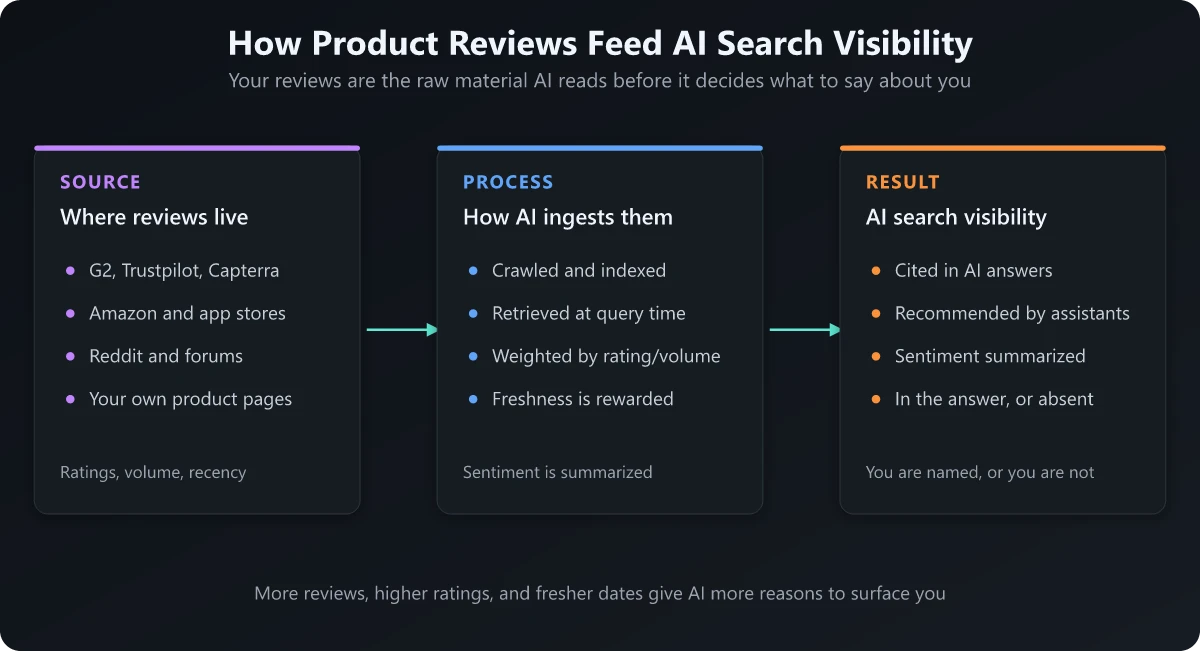
It helps to see the flow end to end, because the leverage points are not where most marketers assume they are.
A buyer types a question into an answer engine. The engine retrieves candidate sources, and review platforms rank high because they are dense, structured, and topical.
The model reads the ratings and the review text, extracts the recurring themes, and writes a summary that reflects the consensus. Then it may cite one or two of those sources so the buyer can verify.
Every stage of that chain is fed by reviews you can influence. You cannot rewrite the model, but you can change what it retrieves and what pattern it finds when it gets there. That is the entire game.
It is the same trust signal search already rewards
If this feels familiar, it should. Reviews have quietly shaped organic rankings for years, especially in local and product search. I dug into the ranking mechanics in do Google reviews help SEO, and the short version is that fresh, plentiful, well-rated reviews have been a trust signal for a long time.
AI search did not invent the pattern. It intensified it, because an answer engine has to pick a winner in a single response instead of listing ten blue links and letting the user decide.
In classic search a thin review profile still lets you rank on page two and pick up scraps of traffic. In an AI answer there is no page two: either the model has enough evidence to name you, or it names someone else and the buyer never learns you existed.
Reviews are voice of the customer the model can read
There is a strategic bonus here. The same review corpus that feeds the models is the richest voice of the customer dataset you own. The exact phrases buyers use to praise or criticize you are the phrases the model will reuse, so mining your reviews improves your messaging and your AI visibility at the same time.
A Playbook to Earn AI Citations From Product Reviews
Enough theory. Here is the operational sequence I would run to make your product reviews work for your AI search visibility.
None of it requires a new platform. It requires treating reviews as an owned growth channel rather than a passive byproduct.
Seed reviews on the platforms models actually read
First, decide where your reviews need to live. For B2B software that usually means G2 and Capterra. For consumer and ecommerce it means Amazon, Trustpilot, and Google.
For hospitality and local it means Google and the category-specific sites. Pick the three or four that both your buyers and the models trust, and concentrate there rather than spreading thin across ten.
Then build a repeatable ask. The best time to request a review is right after a customer hits a win: a successful onboarding, a renewal, a support save, a milestone in the product.
Automate the ask into those moments so review generation is a system, not a quarterly scramble. A short, well-timed prompt with a direct link beats a generic blast to your whole list.
Keep the reviews fresh
A one-time review drive ages out fast. Set a floor for new reviews per month per platform and treat missing it like missing a pipeline number. A living stream of recent reviews is what tells the model your product is current, and it is the single easiest signal to lose through neglect.
Respond to reviews, especially the critical ones
Public responses are text the models read too. A thoughtful reply to a critical review adds context, shows the product is actively supported, and often flips the reader’s impression. It also seeds the counter-narrative directly beside the complaint, so when a model summarizes the thread it has your side of the story in the same breath.
Never fake reviews or pay for them. Beyond the obvious integrity problem, platforms and models are both getting better at detecting manufactured patterns, and a flagged or filtered review set can crater the trust you were trying to build.
Add Review and AggregateRating schema to your own site
On your product and category pages, mark up genuine reviews with valid Review and AggregateRating schema. This does two jobs: it can earn star-rating rich results in classic search, and it gives AI crawlers a clean, structured summary of your rating and volume. Keep it honest and compliant with each platform’s guidelines, since fabricated or self-serving markup gets penalized.
Monitor what AI actually says about you
You cannot improve what you do not measure. Build a small set of the buying-intent prompts your customers would type, things like best tool for a given use case or whether your product is any good, and run them across ChatGPT, Perplexity, Gemini, and Google AI Overviews on a regular cadence, the same way you would schedule a recurring SEO audit.
Log three things: whether you appear, what the model says, and which sources it cites. When the answer is wrong or thin, trace it back to the review evidence and go fix the source. That loop, from prompt to answer to source to action, is what turns AI visibility from a mystery into a channel you can manage.
Where a Product Review Strategy Goes Wrong
A few traps, because I have watched teams stumble into most of them.
The first is treating reviews as a reputation-management afterthought owned by support, rather than a demand and visibility channel owned by marketing. If nobody is accountable for review volume and freshness the way they are for pipeline, the signal decays and your AI presence decays with it.
The second is chasing a perfect average instead of a believable one. A flawless five-star profile with thin, generic text is less persuasive to a model than a 4.5 full of specific, detailed accounts of real use. Depth and specificity beat a shiny number every time.
The third is going silent on the platforms and hoping the models find your homepage instead. They will not prioritize it. Abandon the review channel and you hand the AI narrative about your product to whichever competitor showed up and did the work.
Conclusion: Treat Product Reviews as an AI Search Visibility Channel
The uncomfortable truth is that answer engines now describe your product using words you did not write, pulled from product reviews on sites you do not own. Fighting that is pointless. The winning move is to feed it deliberately, because reviews have quietly become one of the strongest levers you have over your AI search visibility.
So make it a channel with an owner and a number. Pick the three or four platforms your buyers and the models trust, build a system that generates fresh, specific, well-rated reviews every month, respond to the hard ones, mark up your own pages with valid schema, and monitor what the engines say back. Do that and the consensus the models summarize starts to look a lot like the story you want told.
Here is the one action to take this week: open ChatGPT and Perplexity, ask each the exact question your best-fit buyer would ask about your category, and read the answer as a review of your review strategy. Wherever the model is vague, wrong, or citing a competitor, you have just found the first place your product reviews need to get to work.
Frequently Asked Questions
Do product reviews affect AI search visibility?
Yes. Answer engines like ChatGPT, Perplexity, and Google AI Overviews summarize third-party reviews when they describe a product, so the volume, recency, and rating quality of your reviews directly shape what those tools say about you and whether they recommend you.
Which review sites do AI search engines pull from?
They lean on large, structured, frequently updated platforms the models have crawled heavily, including G2, Capterra, Trustpilot, Amazon, and Reddit, plus Google reviews for local and product searches. A presence spread across three or four of these gives you the cross-platform corroboration models trust.
How many reviews do you need to appear in AI answers?
There is no fixed number, but a model needs enough reviews to see a pattern rather than an anecdote, so a few hundred credible reviews is far safer than a handful. If a competitor has many times your review count, they are simply easier for the model to describe and cite.
Can you change what ChatGPT says about your product?
You cannot edit the model, but you can change the evidence it reads. Growing fresh, specific, well-rated reviews across the platforms it trusts, responding to critical reviews, and adding review schema all shift the consensus the model summarizes.
Does review schema help with AI search?
Review and AggregateRating schema gives AI crawlers a clean, structured summary of your rating and review count instead of making them guess, and it can also earn star-rating rich results in classic search. Keep the markup honest and tied to genuine reviews, since fabricated markup gets penalized.