Sales Enablement Checklist: 40+ Items PMMs Actually Ship
The sales enablement checklist used by top PMM teams. 40+ deliverables across onboarding, competitive, launch, and deal support - with a clear owner for each.
Ask ten sales reps what they need and you will hear the same four answers: a pitch deck that does not embarrass them, a battlecard that is less than a month old, a competitive win story they can name in one sentence, and faster answers to the objections that keep costing them deals. A sales enablement checklist exists to make sure those four things and the forty other items that matter never fall through the cracks.
The Highspot State of Sales Enablement 2025 report found that companies leveraging a unified enablement platform are 42% more likely to improve win rates, and that businesses with well-integrated enablement tech stacks are 42% more likely to increase sales productivity. The underlying truth is simpler: sellers win more deals when the content they need is current, findable, and matches the stage of the conversation they are in. This checklist covers what to build, who owns it, and when to refresh.
What Goes on a Sales Enablement Checklist
A complete sales enablement checklist has six categories. If any of the six is missing, you will see it show up as a complaint from the sales team within a quarter.
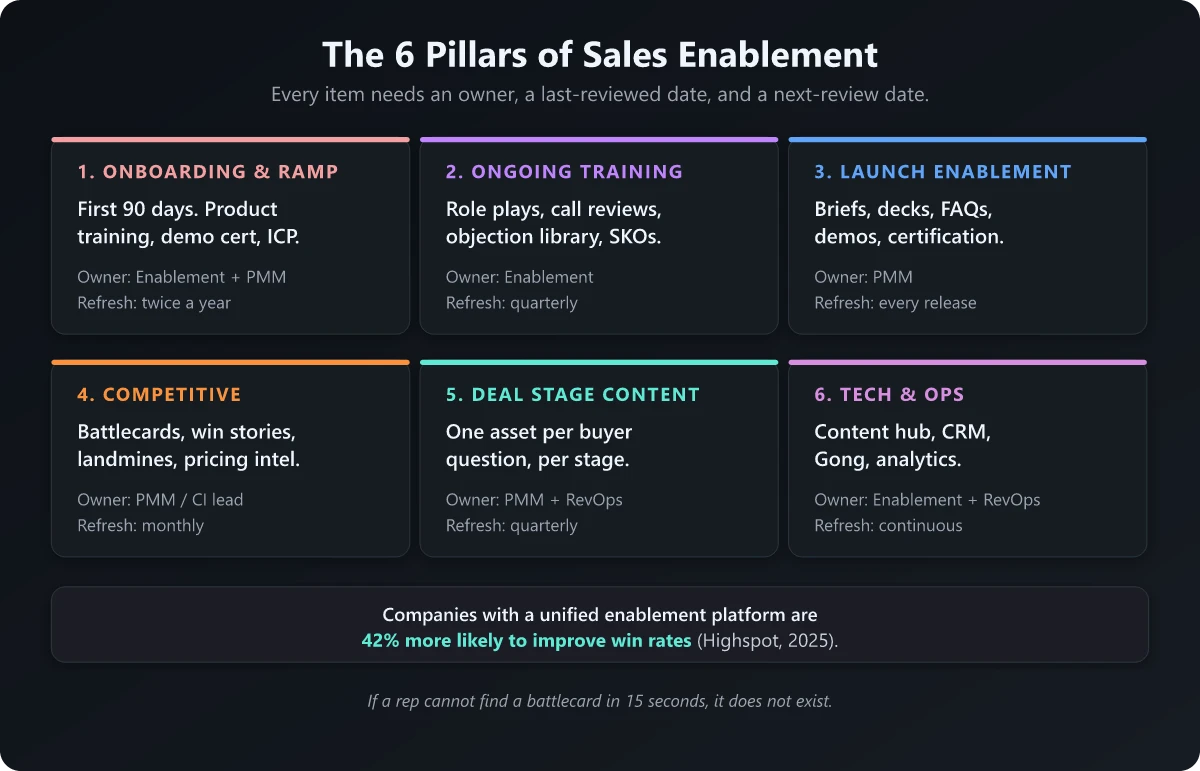
- Onboarding and ramp - everything a new hire needs in the first 90 days
- Ongoing training - the content that keeps tenured reps sharp
- Launch enablement - the package that ships with every product launch
- Competitive enablement - battlecards, objection handling, win stories
- Deal stage content - the asset mapped to each pipeline stage
- Tech and operations - the tools, fields, and systems reps use daily
The Sales Enablement Checklist
Work through each section below. Every item needs an owner, a last-reviewed date, and a next-review date.
1. Onboarding and Ramp (First 90 Days)
The goal of onboarding is to get a new AE to their first closed-won deal faster. Most companies measure this as time-to-first-close or time-to-quota.
- Welcome packet with company mission, org chart, key contacts
- Product training modules covering top 3 product lines or tiers
- ICP and buyer persona briefs (ICP vs buyer persona covers the difference)
- Positioning document with one-liner, elevator pitch, and tagline
- Demo environment access with pre-seeded data for practice
- Demo certification process (new reps must pass before running a live demo)
- Discovery call framework with top 10 qualifying questions
- First 30-60-90 day plan template with clear milestones
- Shadow calls schedule (5 calls minimum across discovery, demo, and close)
- CRM training on required fields and stage definitions
- Buddy or mentor pairing with a tenured rep
- Week 12 checkpoint with manager, PMM, and enablement lead
2. Ongoing Training and Coaching
Enablement does not stop at day 91. Ongoing content is what keeps the middle of the tenure curve performing. The annual sales kickoff is the highest-stakes item in that cadence and the one teams most often build as a list of speakers, so plan it as a timed run of show with one named owner per block.
- Monthly product update training (new features, roadmap context)
- Quarterly sales kickoff or refresher (positioning, competitive, strategic priorities)
- Role-play library with recorded examples of strong discovery, demo, negotiation
- Call recording review cadence (weekly 1:1 or peer review)
- Objection handling library organized by objection category
- Email template library for each sequence and deal stage
- Negotiation playbook for pricing, discounting, and contract terms
- Renewal and expansion playbook (often owned jointly with CS)
3. Launch Enablement
Every product launch should ship with a standard enablement package. Tier the package by launch size: a minor update gets three items, a major launch gets the full kit.
- Launch brief with positioning, target segment, and expected impact
- Pitch deck update with the new feature or product integrated
- One-page product sheet (sales-facing, not marketing-facing)
- Demo script update showing the new feature in context
- FAQ document capturing the top 20 questions reps will get
- Internal announcement email with clear “what reps need to do” section
- Training session (live or recorded) with Q&A from sales
- Launch certification for Tier 1 launches (reps must complete before selling)
- Customer-facing email template to existing accounts
- Competitive implications (how does this shift our battlecard?)
For the full launch framework, see our product launch checklist.
4. Competitive Enablement
Competitive content is the fastest to go stale. Set a monthly refresh cadence for your top 3-5 competitors and a quarterly cadence for the long tail.
- Battlecards for top 3-5 named competitors (competitive battlecard template)
- Win stories by competitor (at least 3 per top competitor)
- Loss analysis by competitor (why we lose, how to flip it)
- Competitive objection handling (top 5 objections per competitor)
- Landmine questions reps can ask to expose a competitor’s weakness
- Competitive pricing intel (updated monthly)
- Feature comparison matrix (honest, with gaps called out)
- Slack or Teams channel for real-time competitive intel sharing
- Quarterly competitive review session with sales leadership
5. Deal Stage Content
Every sales stage has a dominant question in the buyer’s head. Enablement content should answer that question. Map every asset to a stage.
| Stage | Buyer question | Required asset |
|---|---|---|
| Discovery | Do they understand my problem? | Discovery framework, problem diagnostic, industry POV |
| Demo | Does the product do what they claim? | Demo script, tailored demo environment, proof-point slides |
| Technical eval | Will this work in our stack? | Security one-pager, integration list, sample SOC 2 summary |
| Business case | Can I justify this to my boss? | ROI calculator, case studies by segment, reference program |
| Procurement | Are the commercials clean? | MSA, order form template, approved discounting matrix |
| Post-sale handoff | Will I be supported? | Onboarding plan, CS introduction deck, success milestones |
6. Tech and Operations
The tooling layer is the least glamorous part of enablement and the most common reason content goes unused. If a rep cannot find a battlecard in 15 seconds, it does not exist.
- Content hub (Highspot, Seismic, Guru, Notion) with search and tagging
- CRM fields for competitor, use case, decision criteria, close reason
- Sales engagement platform (Outreach, Salesloft) with templates loaded
- Conversation intelligence (Gong, Chorus) with coaching moments tagged
- Proposal generation tool or templated deck system
- E-signature workflow integrated with CRM
- Enablement analytics (content usage, rep engagement, tenure-adjusted metrics)
Who Owns What
Enablement falls apart when ownership is ambiguous. Here is a workable RACI for the most commonly disputed items:
| Item | Owner | Contributor | Approver |
|---|---|---|---|
| Positioning and messaging | PMM | Marketing, Sales leadership | CMO |
| Battlecards | PMM | CI analyst, Sales | Head of PMM |
| Demo script | PMM | Solutions engineering | Sales leadership |
| Pitch deck | PMM | Design, Marketing | CRO |
| Onboarding curriculum | Enablement | PMM, Sales managers | VP Sales |
| Role play content | Enablement | Top performers | VP Sales |
| Competitive intel feed | PMM/CI | Sales, CS | Head of PMM |
| CRM field hygiene | RevOps | Sales managers | CRO |
| Content platform admin | Enablement | RevOps, PMM | VP Sales |
For the deeper PMM ownership view, see what does a product marketing manager do.
Review Cadence: The Part Most Teams Skip
A checklist without a review cadence is a graveyard of stale assets. Set a default cadence at creation:
- Battlecards: Monthly
- Pitch deck: Quarterly
- Onboarding content: Twice a year
- Product one-pagers: Every product release cycle
- Case studies: Quarterly (rotate which ones are featured)
- Objection handling library: Quarterly
- Demo scripts: With each major release
- ICP and persona docs: Annually (or after any meaningful repositioning)
Build the cadence into a shared calendar. Assign the owner. Set the review date on the asset itself. When a rep opens a battlecard and sees “last reviewed 11 months ago,” the content has already lost their trust.
Metrics That Prove Enablement Is Working
Enablement teams that cannot measure their impact get cut in the first budget review. Track at least these sales enablement KPIs:
- Ramp time: days from start to first closed-won deal, quota, or $X in pipeline
- Win rate by tenure bucket: 0-6 months, 6-12 months, 12+ months
- Competitive win rate: overall and by named competitor
- Content usage: top 10 most-used assets, bottom 10 (candidates for retirement)
- Rep confidence scores: self-reported quarterly, bucketed by topic
- Launch adoption: what percentage of reps completed launch certification
The Highspot report additionally found that with AI-powered coaching, teams are 36% more likely to report higher win rates - which means the measurement frontier has shifted from “did reps read the content” to “did the coaching actually change behavior.”
How to Roll Out a New Enablement Checklist
If you are building this from scratch, do not ship all 40 items on day one. Sales will reject the firehose.
- Audit what exists across Drive, Notion, Slack, random decks. Gather it into one place.
- Interview 5 reps and 2 managers about what they wish they had and what they stopped using.
- Ship the top 10 items first: onboarding, pitch deck, top battlecard, demo script, FAQ, objection handling, ICP brief, discovery framework, ROI calculator, and content hub.
- Assign an owner to every item with a review date attached.
- Review with sales leadership monthly for the first quarter. Adjust based on usage data, not assumptions.
- Expand to the full checklist over the next two quarters.
The same staged approach is what saves you during a name change, when every asset on this list carries a dead logo at once. The rebranding rollout plan sequences which of them reps need rebuilt first.
The Bottom Line
A sales enablement checklist is not about producing content. It is about making sure the right content exists, is current, is findable, and is mapped to the moment a rep needs it. The PMM teams that do this well become the partner sales asks for by name. The ones that do not become the team sales quietly works around.
Start with the six categories above. Assign owners. Set review dates. Measure usage. And be willing to retire content that stops earning its place, because the fastest way to lose sales trust is to pile stale assets on top of good ones.
For context on how enablement fits into broader PMM strategy, see the sales enablement strategy framework that ties every item here to a deal stage and a metric, plus SaaS product marketing strategy and product marketing OKRs to align what you build against the outcomes you are accountable for.
Frequently Asked Questions
What is a sales enablement checklist?
A sales enablement checklist is the list of content, training, and systems that equip a sales team to sell effectively. It spans onboarding (first-90-days content), ongoing training, launch collateral, competitive battlecards, deal-stage assets, and technology enablement. A good checklist assigns a clear owner and review cadence to every item.
Who owns sales enablement in a typical company?
It depends on size. In smaller companies, product marketing usually owns enablement. In mid-market and enterprise companies, dedicated enablement teams often report into revenue ops or a Chief Revenue Officer, with PMM owning the content and messaging layer and enablement owning delivery and measurement.
How often should sales enablement content be refreshed?
Battlecards monthly. Pitch decks quarterly. Onboarding curriculum twice a year. Launch collateral as the product changes. Set a review date on every asset at creation - anything without an owner and a next-review date ages into the stale content that reps stop trusting.
What is the difference between sales enablement and sales training?
Training is the delivery mechanism (live sessions, e-learning, certifications). Enablement is the broader function that includes content, tools, coaching, and process design. Training is a component of enablement, not a synonym for it.