Product Launch Checklist: 50+ Items for a Launch That Lands
A product launch checklist used by PMMs for Tier 1, 2, and 3 launches. 50+ pre-launch, launch-day, and post-launch items with clear owners and timing.
A product launch is the one time a company gets to re-introduce itself to the market with intention. Most companies squander it. A product launch checklist exists because the average launch has 50+ moving parts across six teams, and the difference between a launch that lands and one that disappears is rarely brilliance. It is whether the team worked through the list or tried to wing it.
This checklist covers Tier 1, Tier 2, and Tier 3 launches across three phases: pre-launch, launch day, and post-launch. Each item has a suggested owner and a rough timing. Scale it up or down based on the launch tier and the size of your team.
Need the strategic plan first? Use the free Product Launch Plan Template to build a one-page launch plan in 5 minutes - positioning, goals, owners, channels, milestones, and risks. The checklist below is the tactical follow-on.
Start With Launch Tiering
Before anything else, decide what tier the launch is. Treating every release as a Tier 1 launch produces two failures at once: it burns out the team and it trains the market to ignore you. A PMM team that ships 40 “major launches” a year has no major launches at all.
- Tier 1: Category-defining launches or flagship products. Full marketing coverage, analyst relations, press outreach, executive keynote, sales kickoff treatment. Expect 8-12 weeks of PMM lead time.
- Tier 2: Notable features or product lines. Campaign-level coverage, webinar, customer story, sales enablement refresh. 4-6 weeks of lead time.
- Tier 3: Incremental improvements. In-product announcement, release notes, changelog post, maybe a short blog. 1-2 weeks of coordination.
For each launch, write the tier decision down. When scope creeps, the document is the tie-breaker.
One caveat on the Tier 1 line: analyst coverage is not something you switch on for a launch. Analysts form their view of you over quarters of consistent briefings, so an analyst relations cadence has to already exist before a launch can lean on it.
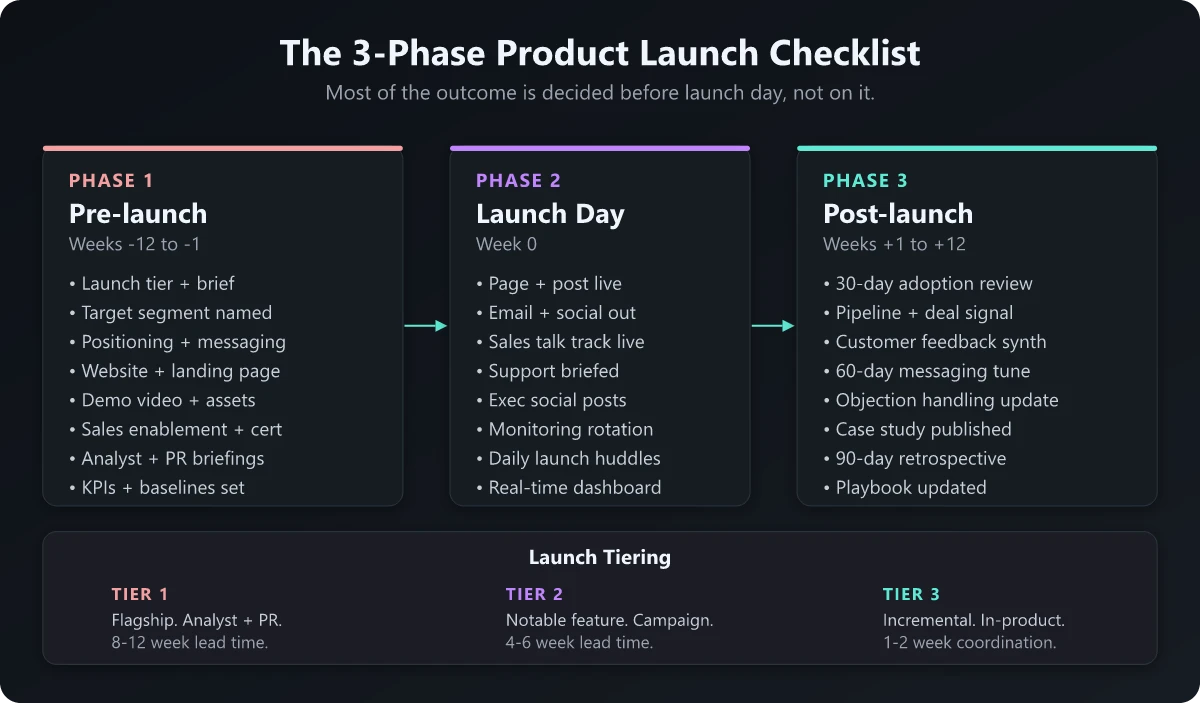
Phase 1: Pre-Launch (Weeks -12 to -1)
The pre-launch phase is where the bulk of the launch outcome is decided. A launch that is misaligned on target audience or messaging at week -10 will not be rescued by a bigger announcement at week 0.
Positioning and Messaging (Weeks -12 to -8)
- Launch brief capturing the what, the why, the who, and the expected impact
- Target segment named specifically (not “SMBs” but “10-50 person marketing teams at B2B SaaS companies”)
- Problem statement that a buyer would nod at, not a description of the feature
- Positioning statement for the launch (who, what, against whom, why us)
- Value proposition with the top 3 outcomes the buyer cares about
- Messaging pillars with the 3-5 points we want to be known for
- Competitive frame (what are we positioning against, implicitly or explicitly?)
- Customer validation from 5+ target-segment interviews
For how to build positioning, see product positioning and marketing strategy for new product.
Cross-Functional Alignment (Weeks -10 to -6)
- Kickoff meeting with product, engineering, marketing, sales, CS, and support
- Launch RACI documented and agreed
- Timeline and milestones with clear dates and owners
- Risk register listing known risks with mitigations (the 9 biggest risks of launching a new product is a good starting list)
- Go/no-go criteria defined upfront (not invented at the final review)
- Communication cadence (weekly standup, weekly email update)
The cadence is the easy half. The harder half is the order in which each audience hears it, which is what a launch communication plan with day offsets and named owners pins down before the date starts moving.
Content and Assets (Weeks -8 to -3)
- Website landing page or homepage update
- Demo video (2-3 minutes, showing the use case, not the UI)
- Product screenshots and GIFs for marketing and docs
- Announcement blog post written, designed, and SEO-optimized
- Customer-facing email to existing users or waitlist
- Social media assets (LinkedIn, X, YouTube thumbnails)
- Paid ad creative if running launch ads
- Press release drafted (Tier 1 only)
- Webinar or launch event planned (Tier 1 and Tier 2)
- Customer case study or reference customer secured (Tier 1)
- FAQ document (internal and external versions)
- Product documentation finalized and reviewed
Sales Enablement (Weeks -6 to -1)
- Pitch deck update with the launch integrated
- One-page product sheet for sales outreach
- Demo script update showing the new functionality
- Battlecard update reflecting competitive shifts
- Sales training session (live or recorded) with Q&A
- Launch certification for Tier 1 launches
- Pricing and packaging decisions finalized and communicated
- Discount approval matrix updated if needed
- Named account target list for sales-led outreach
For the full enablement playbook, see the sales enablement checklist.
Analyst and PR (Weeks -10 to -2, Tier 1 only)
- Analyst briefings scheduled (Gartner, Forrester, IDC if relevant)
- Analyst briefing deck prepared
- Embargoed press briefings booked
- Customer quotes collected for press release
- Executive spokesperson prepped with talking points
- Media Q&A prep with anticipated questions and answers
Measurement Plan (Weeks -4 to -1)
- Launch KPIs agreed (pipeline, adoption, traffic, press coverage, win rate)
- Baseline metrics captured for each KPI
- Analytics tracking set up (UTMs, events, dashboards)
- Reporting cadence defined (daily for week 1, weekly for the month)
- Attribution model clarified (how do we credit launch pipeline?)
Phase 2: Launch Day and Launch Week
Launch day is mostly execution against the plan you built. The items below are the ones teams forget.
Launch Day Itself
- Landing page live and verified across browsers and devices
- Announcement email sent to target list with correct segmentation
- Blog post published with working internal links
- Social posts scheduled and live on all relevant channels
- Press release on the wire (if applicable)
- Product in-app announcement visible to the right user cohort
- Sales team armed with the day-one talk track and asset links
- Customer support briefed with FAQ and escalation path
- Internal announcement sent to the full company
- Executive social posts published from the accounts that matter
- Monitoring rotation set up (who watches support, social, analytics?)
Launch Week
- Daily launch huddle for the first 5 business days
- Real-time dashboard tracking traffic, demos, sign-ups, activations
- Customer feedback log for qualitative signal from sales and CS
- Bug and hotfix triage if issues surface
- Press and analyst follow-up (thank-yous, quotes, corrections)
- Customer webinar or office hours for existing users
- Sales pipeline review at day 5 to flag early deal activity
Phase 3: Post-Launch (Weeks +1 to +12)
The post-launch phase is where the launch stops being a one-time event and becomes a repeatable engine. Most launches fail here by moving on too quickly.
30-Day Review
- Adoption metrics reviewed against forecast (active users, feature usage)
- Pipeline and deal activity reviewed (new deals, expansion, competitive wins)
- Press and media coverage cataloged with sentiment
- Sales feedback session (what is landing, what is not?)
- Customer feedback synthesis from support tickets, NPS, and interviews
- Content performance (blog traffic, video views, email open rates)
- Paid performance if running launch ads (CAC, conversion, ROAS)
60-Day Iteration
- Release notes rewritten for adoption rather than changelog completeness (how to write SaaS release notes)
- Messaging refinement based on customer language and objections heard
- Website updates based on conversion data
- Sales objection handling update for the top 3 objections
- Customer case study secured and drafted (turn a reference into a story)
- Competitive intel update reflecting how competitors responded
90-Day Retrospective
- Full launch retrospective with all cross-functional teams
- Scorecard of actual vs. forecast on every KPI
- What worked, what did not, what to carry forward
- Updated playbook for the next launch (what we do differently)
- Award and celebrate the team (do not skip this, it matters)
The Product Launch Checklist: Owners and RACI
A launch fails when an item has two owners or none. Use this RACI as a starting point.
| Deliverable | Owner | Contributor | Approver |
|---|---|---|---|
| Launch brief | PMM | PM, Marketing | CMO |
| Positioning and messaging | PMM | PM, Sales leadership | CMO |
| Website and landing page | Marketing | PMM, Design, Web | VP Marketing |
| Sales enablement content | PMM | Enablement, Sales | CRO |
| Analyst and PR | PR / Comms | PMM, CEO | CMO or CEO |
| Demo video and collateral | PMM | Design, Product | Head of PMM |
| Pricing and packaging | Product + PMM | Finance, Sales | CEO |
| In-product announcement | Product | PMM, Design | VP Product |
| Measurement and reporting | PMM | RevOps, Marketing Ops | CMO |
| Post-launch retro | PMM | All teams | CMO |
The Most Common Product Launch Failure Modes
Across launches I have worked on or watched, the same four failure modes repeat:
- Scope creep on messaging. The launch starts as a positioning for “data teams at mid-market companies” and by week -2 the homepage says “for everyone who loves data.” Protect the brief.
- Sales not actually trained. A deck in a Google Drive folder is not training. Reps need certification and reps need to run the pitch out loud with feedback.
- No post-launch ownership. The launch team disbands at week +1 and nobody owns 30/60/90-day reviews. The learnings never make it into the next launch.
- Treating every launch as Tier 1. A constant stream of “major” launches produces audience fatigue. Save Tier 1 for the moments that earn it.
The Bottom Line
A product launch checklist is only useful if it survives contact with a real launch. Keep it lean, assign owners to every item, and set the launch tier early enough to defend it when scope creeps. The checklist is not a guarantee, but it closes the gap between what the team intended and what actually shipped.
Build the launch plan before the checklist. The free Product Launch Plan Template gives you a one-page strategic plan - positioning, goals, owners, channels, milestones, risks - in under 5 minutes. PNG download, no signup. Use it before you start working through the tactical checklist above.
For adjacent frameworks, see go-to-market strategy template, go-to-market strategy for startups, and product marketing OKRs to tie the launch back to the quarter’s outcomes.
Frequently Asked Questions
What is a product launch checklist?
A product launch checklist is the complete list of deliverables and decisions a product marketing team works through before, during, and after a launch. It typically spans three phases: pre-launch (positioning, messaging, assets, enablement), launch day (announcements, activations, monitoring), and post-launch (adoption tracking, win/loss, retrospective).
What is launch tiering and why does it matter?
Launch tiering categorizes launches by business impact. Tier 1 is a major launch with analyst engagement and full marketing coverage. Tier 2 is a notable feature with campaign support. Tier 3 is a quiet update announced in-product or via release notes. Tiering prevents teams from treating every release as a Super Bowl ad and burning out.
How far in advance should a product launch start?
For a Tier 1 launch, the PMM should be involved 8-12 weeks before go-live. Tier 2 launches need 4-6 weeks. Tier 3 launches can ship with 1-2 weeks of coordination. The bottleneck is rarely content - it is the time needed for sales enablement certification and analyst briefings, both of which cannot be compressed without cost.
What is the most common reason product launches fail?
A misalignment between what the product does and who it is meant to help. Teams often launch features built for power users to an audience of new prospects, or repackage an incremental update as a category shift. The fix is upfront: clear target segment, clear problem statement, and a launch tier honest enough to match the actual impact.