Is Product Marketing a Good Career? Honest Answer for 2026
Is product marketing a good career? An honest look at the work, salary, growth path, pros and cons, and what it takes to become a PMM - from a senior PMM.

The Product Marketing Alliance’s 2024 State of Product Marketing report found that 80% of PMMs work in teams of just 1-5 people, supporting product, sales, and customer-facing functions many times their own size. That is the highest leverage ratio in tech that does not involve managing 50 people.
The question of whether product marketing is a good career has a clean answer. For people wired for it, it is one of the best seats in tech - and for people who are not, it is a frustrating role with too many stakeholders and not enough authority.
What follows is the honest version, written from inside the role: what PMMs actually do, what they earn, what the growth path looks like, the pros and cons that recruiters skip, and how to break in if you are not already there.
What Does a Product Marketing Manager Do?
Product marketing covers the four corners of the go-to-market motion:
- Positioning and messaging - why the product exists, who it is for, why it wins
- Competitive intelligence and win-loss - what the market is doing, why deals close and don’t
- Sales enablement - the materials, training, and tools that help sales sell
- Product launches - bringing new products and features to market with momentum
Underneath those, PMMs run customer research, pricing input, analyst relations, and a steady stream of cross-functional alignment work. The role is breadth-first, depth-second.
A more detailed breakdown is in what does a product marketing manager do. The short version: if you like the strategic side of marketing, the customer side of product, and the operational side of sales, the role is unusually well-aligned with your wiring.
Is Product Marketing a Good Career? The Honest Pros
1. High Strategic Leverage Per Person
Most PMM teams are tiny relative to the surface area they cover. The output of those small teams reaches every prospect, every customer, and every salesperson. The leverage per hour is unusually high.
A single positioning rewrite can shift the entire revenue motion. A single launch can compress months of sales cycle, and a single battlecard can move win rates by points. Few roles have that ratio of effort to revenue impact.
2. Cross-Functional Influence Without Cross-Functional Politics
PMMs do not own teams - they influence product, sales, CS, and executive teams through clarity and evidence rather than headcount. People who like influence more than management thrive. People who want a team of 20 reporting to them do not.
3. Skills That Transfer
Positioning, messaging, customer research, competitive analysis, launch operations - all of these transfer cleanly across industries. PMMs move between B2B SaaS, consumer tech, healthcare, and fintech without resetting their core skills. That portability is a career asset.
4. Compensation Tracks With Senior Marketing and Product
PMM compensation, especially at mid-senior levels, sits in the same band as product management and senior marketing leadership. At top SaaS companies, Senior and Group PMM total comp can exceed adjacent PM total comp.
5. Clear Path to Senior Leadership
The PMM path leads to VP of Marketing, CMO, and increasingly to CEO seats - especially in product-led SaaS where positioning fluency is a core executive skill. The cross-functional surface area makes PMMs unusually well-prepared for general management. For the level-by-level ladder with salary ranges, see the full product marketing career path.
The Honest Cons
1. Broad Mandate, No Authority
PMMs are responsible for outcomes they do not control. The launch flops because product missed the timeline, sales misses quota because reps will not use the new pitch, and CS churn is up because onboarding broke.
The PMM job is to make all of these work without owning any of them. It is the source of the role’s leverage and its hardest day.
2. “Marketing” Without Demand Generation
Most PMMs are not directly accountable for pipeline numbers, which is a feature in companies where the role is well-defined and a bug in companies where it is not. If the executive team measures marketing by pipeline alone, the PMM job becomes invisible. Choose your company carefully.
3. Ambiguity as a Daily Condition
There is no playbook for the role at most companies. Each PMM ends up defining the job they want to do, then negotiating it into reality. People who need clear briefs struggle, while people who like designing the job thrive.
4. The Role Varies Wildly Company to Company
A PMM at HubSpot, a PMM at a 30-person seed-stage startup, and a PMM at Salesforce are three different jobs. The title gives almost no signal about what the role looks like. The interview process is where you find out.
5. AI Is Restructuring the Production Layer
First-pass copy, basic competitive teardowns, draft sales decks, summarised calls - all of these are now done faster by AI. The PMMs who only execute on production work are at higher risk; the PMMs who decide what to launch, how to position, and what to say no to are more valuable than ever. The shift up the value stack is real.
How Much Does a Product Marketing Manager Make?
Salary varies heavily by market, company stage, and equity. Rough bands as of 2026, with caveats:
United States
| Level | Base | Total Comp (incl. bonus + equity) |
|---|---|---|
| APMM / Associate PMM | $95-$120k | $105-$140k |
| PMM | $130-$160k | $150-$190k |
| Senior PMM | $160-$190k | $190-$240k |
| Group PMM | $180-$220k | $220-$300k+ |
| Director PMM | $200-$240k | $260-$380k+ |
| VP PMM | $250k+ | $400k-$700k+ |
Top tech companies (FAANG-adjacent, public SaaS) push the upper bound materially. Startup PMMs often trade base for equity that ranges from worthless to life-changing.
India
| Level | Total Comp (₹ lakh per year) |
|---|---|
| APMM | ₹10-18L |
| PMM | ₹18-35L |
| Senior PMM | ₹35-60L |
| Group / Lead PMM | ₹55-90L |
| Director / Head of PMM | ₹70L-1.5Cr |
FAANG and high-growth product startups in India push significantly above these ranges, especially for global roles. Mid-stage Indian SaaS companies tend to sit in the middle of these bands.
The numbers above are directional. They reflect what I have seen across hiring conversations, public salary databases (Glassdoor, Levels.fyi, LinkedIn Salary Insights), and direct peer comparisons - not a single survey. Numbers change quickly with market cycles.
The PMM Career Path
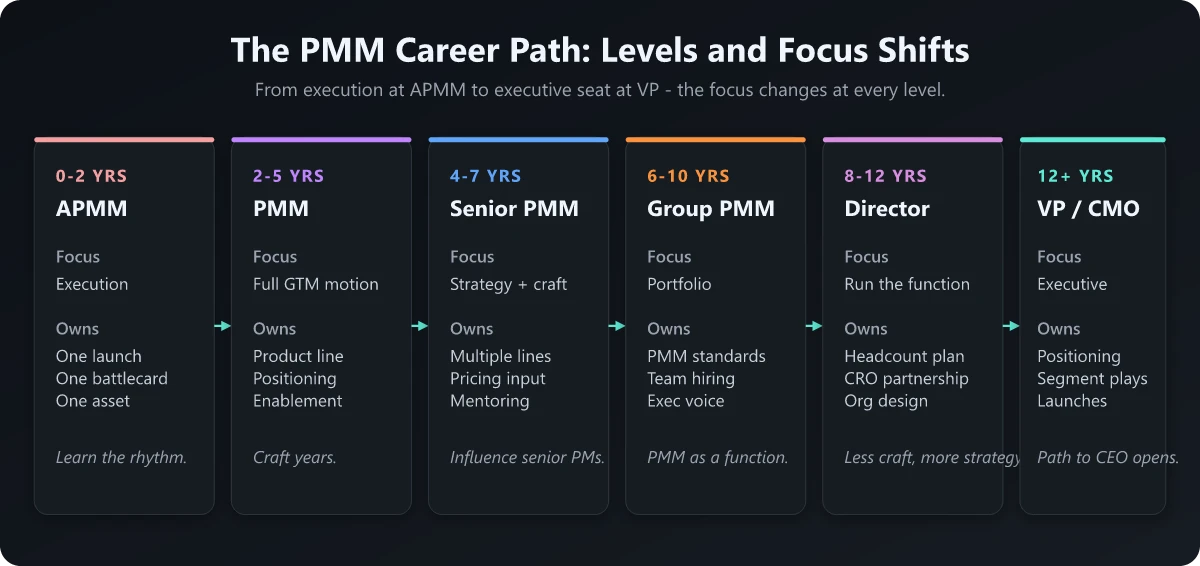
The typical PMM ladder, with the focus shift at each level:
Associate PMM (0-2 years in PMM)
Execution. Owning specific deliverables - a launch, a battlecard, a sales asset, a customer story. Learning the rhythm of the GTM motion.
PMM (2-5 years)
Owning the full PMM motion for a product line. Positioning, messaging, launches, enablement, customer research. This is where most of the craft work happens.
Senior PMM (4-7 years)
Owning multiple product lines or strategic categories. Beginning to influence executive decisions on pricing, packaging, and segment strategy. Mentoring junior PMMs.
Group PMM / Lead PMM (6-10 years)
Owning a portfolio and setting PMM operating standards. Hiring and developing the team. Acting as the senior PMM voice in product and revenue strategy meetings.
Director PMM (8-12 years)
Running the function. Owning headcount planning, hiring, performance, partnership with VP Product and CRO. Less hands-on craft, more org-design and strategy.
VP PMM / CMO (12+ years)
Executive seat. Owning the company’s positioning, segment strategy, launch portfolio, and often the broader marketing function. Increasingly common for VP PMMs to become CMOs and even CEOs.
The progression is not linear. Many PMMs zigzag through related roles - product, growth, strategy - and come back with a sharper edge. Companies value that variety more than they used to.
Who Thrives in Product Marketing
The traits that correlate with PMMs who grow:
- Writers. PMM is a writing-heavy role. People who can write tight, persuasive, customer-centric copy outperform.
- Synthesizers. PMMs absorb input from product, sales, customers, competitors, executives, and synthesize it into a position the company can act on.
- Diplomats with conviction. Influence without authority requires both. Without diplomacy, PMMs alienate stakeholders. Without conviction, they get steamrolled.
- Curious about the customer. PMMs who actually want to talk to customers regularly produce better work than PMMs who don’t.
- Comfortable with broad ambiguity. The job is not pre-defined. You write the brief.
The traits that correlate with PMMs who stall:
- Needs clear briefs and authority to execute
- Resists data fluency - product analytics, sales data, revenue data
- Treats positioning as a one-time exercise
- Cannot make hard prioritisation calls
How to Become a Product Marketing Manager
There is no certification that gets you the job. There is a portfolio that does. For the full step-by-step version - the routes in, the skills that get you hired, and whether a certification is worth it - see how to become a product marketing manager.
From Adjacent Marketing Roles
Content marketing, demand gen, brand marketing, customer marketing. The most common entry point. The bridge: take on PMM-adjacent work in your current role - a positioning teardown, a competitive analysis, a sales enablement asset - and use it as portfolio.
From Product
Product managers and product associates already know the customer and product context. The bridge: write the launch plan, run the win-loss debriefs, build the battlecards for your team’s next launch. PMs who move to PMM often skip APMM and enter as PMM.
From Sales or Sales Engineering
Sellers who have field intuition and product fluency can move to PMM. The bridge: pitch the sales enablement gap and own building it. Field-to-PMM transitions are well-regarded because the PMM understands the receiver of their work intimately.
From Consulting or Strategy
Strong analytical and writing skills, less in-house GTM context. The bridge: contribute to a specific product launch or rebrand as a project, then use that as portfolio.
The Portfolio That Works
Regardless of path, the portfolio that wins interviews:
- A positioning teardown of a real product (yours or a public one) - 1 page
- A competitive battlecard for that product - 1 page
- A launch plan with timeline, audience, channels, success metrics - 2 pages
- A short customer interview write-up - what you learned, what you would change
- A clear point of view on the category - what makes the product different and why now
If you have those five artifacts, you can interview for PMM roles regardless of background. Without them, you are competing on resume keywords.
For a deeper look at the deliverables that define PMM, see the sales enablement checklist, competitive battlecard template, and product launch checklist.
What to Look for in a PMM Job
Not all PMM roles are created equal. The signals of a good PMM job:
- Reports to a senior leader - CMO, VP Marketing, or VP Product. PMMs buried under demand gen often have limited strategic surface.
- Clear product or segment ownership - “PMM for X” with a defined scope, not “PMM for everything.”
- Access to customers - the company expects and supports regular customer conversations.
- Cross-functional respect for the role - product, sales, and CS see PMM as a partner, not a service desk.
- A defined launch process - launches are coordinated, not improvised.
The red flags:
- “We need a PMM to do our content and demand gen and launches and competitive and events”
- No customer access (“our customers are too busy”)
- The PMM role has churned 3 times in 24 months
- Sales does not know what PMM does
Is Product Marketing a Good Career? My Take
For the right person, product marketing is the best high-leverage role in modern tech that does not require managing 50 people. The work is strategic, the influence is real, the skills compound, the compensation is competitive, and the career ladder leads to senior executive seats.
For the wrong person - someone who needs clear briefs, narrow scope, and unambiguous authority - it is a frustrating role with too many stakeholders.
If you are choosing between PMM and an adjacent role today, the question I would ask is: do you want to own a function, or do you want to influence many functions through clarity and evidence? PMM is the second answer. If that is the answer that energises you, the career is one of the best in tech.
Conclusion
Product marketing is a good career for people who want strategic surface area without operational ownership, who like writing and synthesising and influencing, and who are comfortable in a role they partly design themselves. The compensation tracks with adjacent senior roles, the growth path goes all the way to CMO and beyond, and the skills transfer across industries.
The role is changing - AI is reshaping the production layer, and PMMs who only execute will be squeezed - but the strategic core of the job is becoming more valuable, not less. If you are wired for the work, this is one of the better careers you can build in 2026 and beyond.
Frequently Asked Questions
Is product marketing a good career?
For people who like sitting at the intersection of product, sales, and customers - yes. It is one of the highest-leverage roles in tech: the work shapes positioning, launches, pricing, and revenue. The compensation is competitive with adjacent product and marketing roles, the growth path leads to VP and CMO seats, and the skills transfer across industries. The catch is the role is broad - PMMs who try to do everything do nothing well.
How much does a product marketing manager make?
In the US, mid-level PMMs at established SaaS companies typically earn $130k-$180k base with additional bonus and equity, pushing total comp into $160k-$220k. Senior PMMs and Group PMMs at large tech firms exceed $250k total comp. Indian SaaS market mid-senior PMM ranges typically run ₹25-50L total comp, with FAANG and high-growth startups going higher. Numbers vary heavily by company, market, and equity component.
How do you become a product marketing manager?
Most PMMs enter from one of three paths - adjacent marketing roles (content, demand gen), product or technical roles (PM, sales engineering), or business roles (consulting, strategy). The fastest entry is to build a portfolio: a positioning teardown of a real product, a launch case study, a competitive battlecard, sales enablement docs. Apply with proof, not just resume keywords.
What skills do product marketing managers need?
Five core skills: positioning and messaging, competitive intelligence, sales enablement, launch operations, and customer research. Underneath those: writing clearly, data fluency, the ability to influence without authority, and judgment about what to say no to. The PMMs who plateau are usually the ones strong on tactics but weak on judgment.
Is product marketing being replaced by AI?
No, but the job is changing. AI is taking over the production layer - drafting first-pass copy, summarising calls, generating variants. The PMM job is shifting up the value stack: strategic judgment, customer synthesis, decision-making about what to launch and how to position it. PMMs who only execute are at risk. PMMs who decide are more valuable than ever.