21 Product Marketing Interview Questions and Answers (2026)
The product marketing interview questions a working PMM asks, grouped by round, with what a strong answer shows versus the generic answer that sinks candidates.
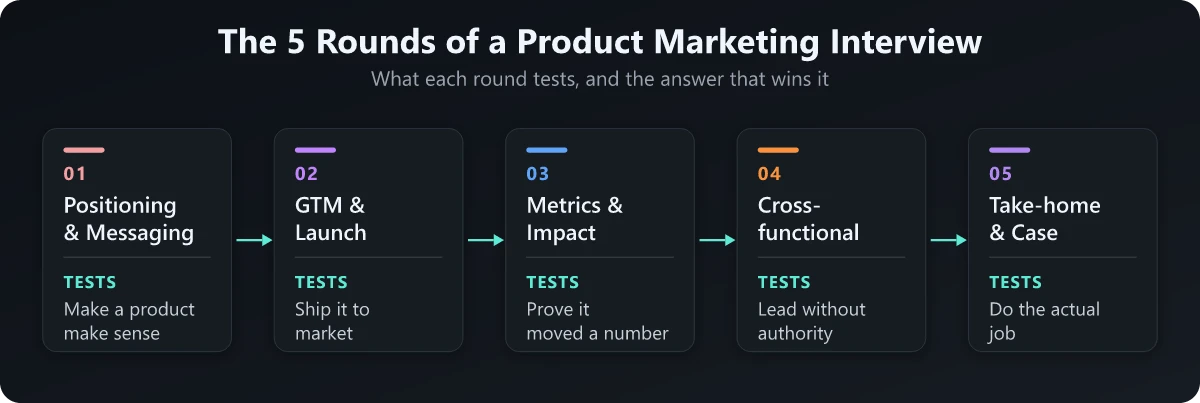
Product marketing interview questions fall into five rounds:
- Positioning and messaging - can you make a product make sense to a buyer
- GTM and launch - can you ship it to market on a real timeline
- Metrics and impact - can you prove the work moved a number
- Cross-functional and stakeholder - can you lead teams you do not manage
- The take-home or case - can you actually do the job
Every question below is a prompt to test one of those five abilities. Learn the pattern and you can answer questions you have never seen.
Most candidates prepare for product marketing interview questions by memorizing frameworks. Then they walk in, recite the framework cleanly, and still do not get the offer. I have sat on both sides of the table, and the pattern is consistent: interviewers are not grading whether you know the AIDA funnel or the four Ps. They are grading whether you have actually done the job and can defend a point of view about it. A strong answer sounds like an operator; a generic answer sounds like someone who read the operator’s blog. This guide is the real questions I ask and get asked, grouped by round, and for each one, what a strong answer demonstrates versus the generic answer that quietly sinks candidates.
What Questions Are Asked in a Product Marketing Interview?
A product marketing interview tests five distinct abilities, and the questions in each round are variations on the same underlying probe. If you understand what each round is really measuring, you can improvise an answer to almost any prompt in it. The role itself sits between product, sales, and marketing, so the interview samples all three - see what the product marketing role actually owns day to day for the full scope the questions draw from.
| Round | What they are really testing | The tell of a weak answer |
|---|---|---|
| Positioning and messaging | Can you make a product make sense to a buyer | Reciting features with no point of view |
| GTM and launch | Can you ship it to market on a real timeline | A textbook framework with no tradeoffs |
| Metrics and impact | Can you prove the work moved a number | Listing activity like downloads and impressions |
| Cross-functional | Can you lead teams you do not manage | Blaming sales or product for what went wrong |
| Take-home or case | Can you actually do the job | A polished deck with no original insight |
The rest of this post walks each round with the exact questions and the strong-versus-generic split.
Round 1: Positioning and Messaging Questions
This is where most interviews start, because positioning is the load-bearing skill. It is also where generic answers are easiest to spot. My deeper take lives in what market positioning is and how to get it right.
1. How would you position our product against our main competitor?
- Strong answer: leads with the buyer and the alternative they would otherwise pick, names one sharp point of difference, and admits where the competitor is genuinely better.
- What sinks it: a feature-by-feature comparison with no point of view, or claiming you win on everything (nobody believes it).
2. Walk me through how you would build a messaging framework for a product you have never sold.
- Strong answer: starts from customer research and the problem, then ladders features up to outcomes, and picks one primary message instead of five.
- What sinks it: jumping straight to taglines and adjectives with no research step underneath.
3. A feature launches that engineering is proud of but customers never asked for. How do you message it?
- Strong answer: reframes the feature around a job the customer already cares about, or is honest that it is a low-priority note, not a headline.
- What sinks it: inventing demand that is not there, or refusing to market it at all.
4. What is the difference between positioning and messaging?
- Strong answer: positioning is the strategic choice of who the product is for and why it wins; messaging is how you say that so a buyer feels it. Positioning is internal, messaging is external.
- What sinks it: using the two words interchangeably, which signals you have never had to write either under pressure.
5. Show me positioning you wrote that you would now change.
- Strong answer: a specific example, what you got wrong, what evidence changed your mind, and what you would do differently.
- What sinks it: claiming you would not change anything. Every honest PMM has repositioned something that missed.
Round 2: GTM and Launch Questions
Here they are testing whether you have shipped, not just planned. The product marketing framework I hand new PMMs covers the structure; the interview probes the judgment inside it.
6. Walk me through a launch you owned end to end.
- Strong answer: names the goal, the audience, the tiering decision, what you cut when time ran short, and the result against the goal.
- What sinks it: a chronological activity list (we did a blog, then an email, then a webinar) with no decisions or outcome.
7. How do you decide launch tier - what earns a big launch versus a changelog note?
- Strong answer: a clear rule tied to customer impact and revenue potential, not internal excitement. A tiering system that keeps the team from launching everything at full volume. My product launch checklist shows the tiering in practice.
- What sinks it: treating every release as a major launch, which reveals you cannot prioritize.
8. Sales says the launch flopped, but adoption data looks fine. Who is right?
- Strong answer: both are measuring different things; you reconcile the pipeline story with the product-usage story before declaring a verdict.
- What sinks it: siding with one function reflexively instead of asking what each is actually seeing.
9. You have three weeks to launch and the product is not ready. What do you cut?
- Strong answer: protects the one message and the highest-leverage channel, cuts scope and nice-to-have assets, and sets a realistic goal for a soft launch.
- What sinks it: insisting on doing everything, or cutting the parts that actually reach buyers.
10. How would you segment the audience for a new product with no existing customers?
- Strong answer: uses the problem and the buying trigger to hypothesize segments, then names how you would validate them fast with research or a design-partner motion.
- What sinks it: demographic segmentation with no connection to the problem the product solves. See how I structure the full plan in the go-to-market strategy template.
Round 3: Metrics and Impact Questions
This round separates PMMs who report activity from those who prove impact. It is also the one candidates prepare for least. The full version is in my guide to the product marketing metrics that prove impact.
11. How do you measure whether a launch succeeded?
- Strong answer: sets the target before the launch, ties it to pipeline, adoption, or revenue, and measures against the pre-agreed number.
- What sinks it: measuring success after the fact with whatever number happened to go up.
12. What is a metric you stopped tracking, and why?
- Strong answer: a specific vanity metric you dropped because it could double while the business stayed flat.
- What sinks it: never having pruned a metric, which suggests you track everything and prioritize nothing.
13. How would you prove product marketing’s impact to a skeptical CFO?
- Strong answer: translates your work into numbers the CFO already values - influenced pipeline, win rate, adoption - and shows the before-and-after.
- What sinks it: leaning on brand and awareness with no line to revenue.
14. A campaign influenced pipeline but did not close revenue. How do you report it?
- Strong answer: reports influence honestly, is clear about attribution limits, and does not overclaim credit.
- What sinks it: taking full credit for revenue you touched but did not close, which erodes trust the moment it is checked.
Round 4: Cross-Functional and Stakeholder Questions
Product marketing is a job of leading without authority, so this round tests judgment and diplomacy. The strong answers all share one trait: they own the outcome without blaming the other function.
15. Product and sales want opposite things from your launch. How do you decide?
- Strong answer: goes back to the customer and the goal as the tiebreaker, then builds a decision both sides can live with.
- What sinks it: picking the louder stakeholder, or escalating before trying to resolve it.
16. How do you get a sales team to actually use the enablement you build?
- Strong answer: builds with sales, not for them, ties the content to deals reps are losing, and measures adoption. Grounded in a real sales enablement checklist, not a content dump.
- What sinks it: producing a battlecard, dropping it in a folder, and blaming reps when it goes unused.
17. Tell me about a time you changed a product decision without owning the roadmap.
- Strong answer: a specific case where customer or market evidence you brought shifted a build decision, and how you influenced it.
- What sinks it: claiming you always get your way, or admitting you have never influenced product at all.
18. A senior stakeholder overrides your positioning with a personal opinion. What do you do?
- Strong answer: separates the opinion from the evidence, proposes a cheap test, and disagrees-and-commits if it goes the other way.
- What sinks it: either caving instantly or digging in with no data, both of which read as poor judgment.
Round 5: The Take-Home and Case Questions
The final round is usually a take-home assignment or a live case: the closest proxy for the actual job. This is where the offer is won or lost. Candidates who have already built a positioning teardown or a launch plan on their own time walk into that case half-rehearsed, which is why building those artifacts before you hold the title is the standard route in for switchers coming from sales, content, or product.
19. Here is our product. Build a go-to-market plan.
- Strong answer: one page of strategy before any tactics - audience, the single problem, positioning, the message, two or three channels, and how you would measure it. One non-obvious insight about their market.
- What sinks it: a 30-slide deck of generic tactics that could apply to any product.
20. Present your positioning for our product to a mock exec panel.
- Strong answer: a clear point of view delivered in two minutes, held calmly under pushback, with tradeoffs acknowledged.
- What sinks it: hedging every claim, or collapsing the moment a panelist disagrees.
21. Teardown: what would you change about our current messaging?
- Strong answer: specific, respectful critique with a rewrite, showing you researched them and can improve the work.
- What sinks it: vague praise, or a harsh teardown with no constructive alternative.
How to Answer Product Marketing Interview Questions
The questions vary, but the technique that wins is constant. A few rules I coach candidates on:
- Answer with a story, not a framework. Frameworks show you read; stories show you did. Lead with a real example and let the structure be implicit.
- Name the tradeoff. Every strong answer includes what you chose not to do. The generic answer pretends there were no constraints.
- Bring one point of view you will defend. Interviewers push back to see if you fold. Have an opinion and hold it, then disagree-and-commit gracefully if the evidence goes the other way. The same open, non-defensive posture that makes good win-loss interview questions work is what makes you sound senior here.
- Quantify when you can. A number you moved beats an adjective every time.
- Match the round. If you cannot tell which of the five abilities a question is testing, ask a clarifying question. That itself is a strong signal.
If you are earlier in the journey and weighing the role at all, the honest map is in the product marketing career path guide.
The Takeaway on Product Marketing Interview Questions
Product marketing interview questions look like dozens of unrelated prompts, but they collapse into five rounds: positioning, launch, metrics, cross-functional judgment, and a take-home case. Each round tests one ability, and each has a strong answer that sounds like an operator and a generic answer that sounds like a candidate who studied for the test.
Prepare for the pattern, not the questions. Have one launch you can narrate end to end, one piece of positioning you would now change, one number you moved, and one point of view you will defend under pressure. Do that, and the product marketing interview questions stop being a memory exercise and start being a conversation you are qualified to have.
Frequently Asked Questions
What questions are asked in a product marketing interview?
Product marketing interviews cluster into five rounds: positioning and messaging, go-to-market and launch, metrics and impact, cross-functional and stakeholder judgment, and a take-home or live case. Each round tests a different ability, from making a product make sense to a buyer, to proving your work moved a number, to leading teams you do not manage.
How do I prepare for a product marketing manager interview?
Prepare one real launch you can narrate end to end, one piece of positioning you would now change, and one number your work moved. Most product marketing manager interview questions are just prompts to see whether you have genuinely owned those things. Rehearse the story, not a framework, and bring a point of view you can defend under pushback.
What is a product marketing take-home or case interview?
It is a prompt to build a go-to-market or positioning plan for the company's own product, usually delivered as a short deck or presented live to a mock panel. It is the closest thing to the actual job. Strong candidates lead with a sharp point of view and one non-obvious insight; weak candidates hand back a polished but generic framework.
How do you answer 'how would you launch this product' in a PMM interview?
Start with the audience and the one problem the launch has to solve, not the tactics. Name who it is for, the single message, the two or three channels that reach them, and how you would know it worked. Then state what you would cut if the timeline slipped. Interviewers are testing tradeoffs and judgment, not whether you can list launch activities.
What makes a strong answer in a product marketing interview?
Specificity and a defensible point of view. Strong answers name the buyer, the alternative, the tradeoff you made, and the outcome. Generic answers recite frameworks, list features, or claim you win on everything. The candidates who advance sound like they have done the job, not read about it.