How to Become a Product Marketing Manager (2026)
How to become a product marketing manager: the real routes in, the skills that get you hired, whether you need a certification, and the portfolio that wins offers.

Most advice on how to become a product marketing manager starts with the wrong instruction: get a marketing degree, then earn a certification, then apply for an entry-level PMM role. I have hired and worked alongside product marketers, and almost none of them took that path. The route that actually works is lateral - you move in from an adjacent job you already hold, carrying domain knowledge and a portfolio of PMM-shaped work, not a fresh credential.
That is the claim this guide defends. There is no gatekeeping exam for product marketing, which is exactly why the entry problem confuses people. The job is judged on demonstrated thinking, so the fastest way in is to start doing the thinking before anyone gives you the title.
How do you become a product marketing manager? You pick a realistic route in from an adjacent role, build the two or three skills that actually get PMMs hired, do PMM work where you already are, package it into a small portfolio, and apply with proof. A certification is optional. A portfolio is not.
Demand for the role is holding up, which makes this a good time to move. Per the Product Marketing Alliance State of Product Marketing 2025 report, 41% of companies now lead with product, up from 31% the year before, and 30.7% of teams increased their product marketing investment this year. More product-led companies means more PMM seats to move into.
How Do You Become a Product Marketing Manager? The Short Version
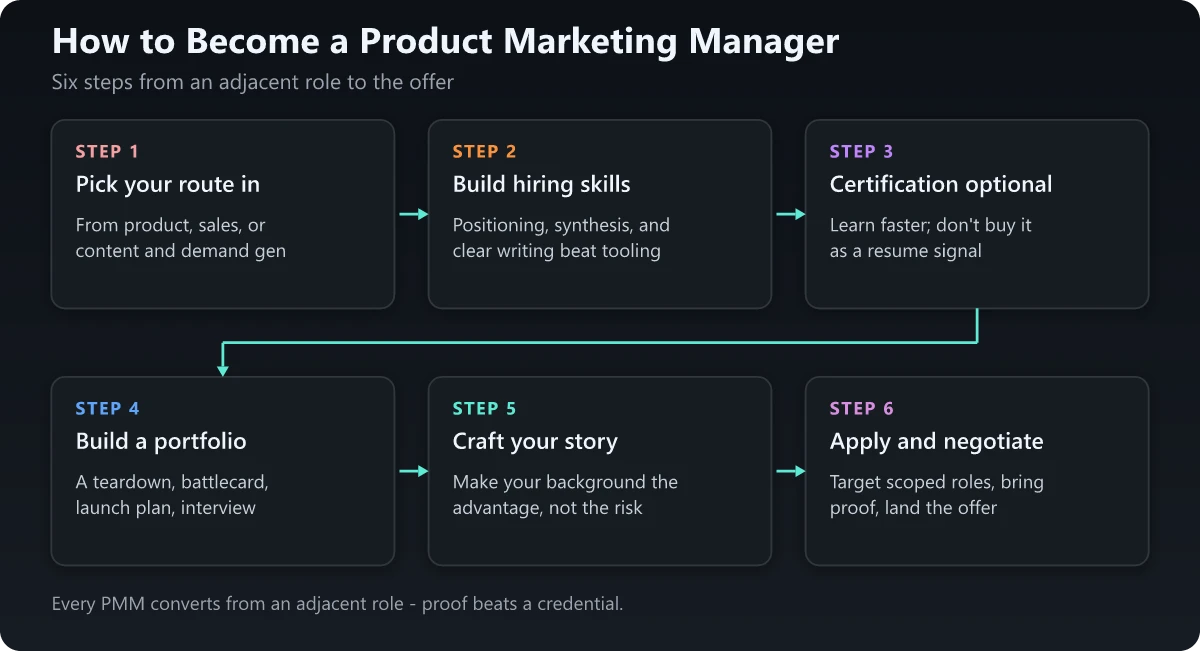
You become a product marketing manager by proving you can do the work before you own the title. That means six moves, in order. The rest of this guide is one section per step.
- Pick your route in - the adjacent role you convert from
- Build the skills that get you hired - and drop the ones people over-index on
- Decide on a certification or course - honestly, and mostly optional
- Build a portfolio - four artifacts that prove PMM thinking
- Craft your story - connect your current work to the PMM job
- Apply, interview, and negotiate the move
This is a different post from three others on this site, so read them alongside this one. The product marketing career path covers the levels and salary once you are in. Whether product marketing is a good career is the should-I decision. And what a product marketing manager does is the role itself. This guide is only about breaking in.
Step 1: Pick Your Route Into Product Marketing
Nobody starts a career as a product marketing manager. Every PMM converts from somewhere else, and your current role decides your fastest bridge. Product School notes that product marketers arrive “from all sorts of backgrounds,” naming sales, content marketing, customer success, and even video production as common starting points.
Here are the five realistic routes and the one move that opens each door.
| Route in | What you already have | The bridge move |
|---|---|---|
| Product management | Customer and product context, roadmap fluency | Write the launch plan and positioning for your team’s next release. PMs often skip the associate level. |
| Sales or sales engineering | Field intuition, objection knowledge, product depth | Volunteer to build the battlecard and objection-handling doc sales actually lacks. |
| Content or demand gen | Writing, audience understanding, campaign chops | Own a positioning teardown and a launch narrative, not just the assets that execute someone else’s. |
| Agency or consulting | Analytical rigor, deck craft, client range | Turn one client engagement into a full go-to-market case study you can show. |
| New grad or unrelated field | Fresh domain knowledge, low salary anchor | Go deep on one product or industry you genuinely know, and build sample deliverables for it. |
I came in through the content and demand gen side, moving from general and digital marketing into a PMM role inside the same company. The internal move is the most underrated path on this list: you already have the product context and the relationships, so you only have to prove the PMM skill set, not learn the business from scratch. If a PMM team exists where you work, shadowing their launches and offering to own one workstream is often faster than any external application.
Step 2: Build the Skills That Actually Get You Hired
This is where most aspiring PMMs waste time. They over-index on tool proficiency and polished decks, and under-invest in the two or three skills a hiring manager is actually screening for.
Here is the honest split between what gets you hired and what people over-value.
| What actually gets you hired | What people over-index on |
|---|---|
| Positioning judgment - who the product is for and why it wins | Knowing every marketing tool by name |
| Customer synthesis - turning ten messy conversations into one clear insight | Perfect slide design and brand polish |
| Clear, persuasive writing - the core PMM deliverable | Memorizing frameworks you cannot apply |
| Sales fluency - understanding how deals actually close | A long list of certifications on your resume |
| Prioritization - saying no to the loudest stakeholder | Being fluent in the latest analytics dashboard |
The pattern: the hiring skills are judgment and communication, and the over-indexed ones are tooling and polish. Tools are learnable in a week on the job. Judgment is what interviews test, because it is what the role is. If you want the deeper skill map, my product marketing framework is the version I hand new PMMs.
One skill deserves its own line: writing. Product marketing is a writing-heavy job, and the fastest way to look like a PMM before you are one is to write like a PMM. Positioning docs, launch narratives, and battlecards are all writing. If your writing is sharp, half the interview is already won.
Step 3: Decide Whether You Need a Product Marketing Certification
The honest answer on a product marketing certification: you do not need one to get hired, and no certification guarantees the job. Recruiters weigh a portfolio of real work far more than a credential line. That said, a course is not useless - it just does a different job than most people think.
A product marketing course is worth paying for when:
- You are switching from an unrelated field and need the fundamentals structured for you
- You have a specific gap - launches, positioning, or research - and want to close it fast
- You will actually apply what you learn to a real artifact you can then show
It is a poor investment when you are buying it as a signal, hoping the certificate itself does the convincing. It will not. Where the recognized options sit:
- Product Marketing Alliance and Product School - the two most recognized PMM-specific programs, good for structured fundamentals and the vocabulary of the discipline
- Coursera and LinkedIn Learning - cheap, broad marketing coverage; fine for filling foundational gaps
- Free primary reading - what is product marketing and the deliverable guides linked below will teach you more per hour than most paid intros, at no cost
My own route in included no PMM certification. I learned the craft by doing the work - running launches, writing positioning, sitting in on sales calls - which is also exactly what a portfolio captures. Treat any course as a faster way to learn the reps, never as a substitute for having done them.
Step 4: Build a Portfolio of Real PMM Work
This is the step that separates candidates who get interviews from candidates who get filtered by a resume screen. There is no certification that gets you the job. There is a portfolio that does.
Build these four artifacts. Each is one to two pages, and each maps to a core PMM responsibility.
- A positioning teardown of a real product - yours or a public one. Who it is for, why it wins, where its messaging is weak.
- A competitive battlecard for that product. Use the competitive battlecard template as your structure.
- A launch plan with audience, tiers, channels, and success metrics. The product launch checklist is the scaffold.
- A customer interview write-up - what you heard, and the one insight that would change the go-to-market.
If you want to show sales enablement depth, add a one-pager built from the sales enablement checklist. With these artifacts, you can interview for PMM roles regardless of background. Without them, you are competing on resume keywords against people who brought proof.
The point of the portfolio is not the documents themselves. It is that building them forces you to think like a PMM, which is the only thing the interview is really testing.
Step 5: Craft the Story That Lands the Offer
A portfolio gets you in the room. A story gets you the offer. Every successful career switcher I have seen can answer one question cleanly: why does your current experience make you a better PMM, not a riskier hire?
Build a two-minute narrative that connects three things:
- Where you are now and the PMM-adjacent work you already do
- The artifacts you built and what you learned making them
- Why this specific company needs the exact angle you bring
The switchers who struggle are the ones who apologize for their background. The ones who land offers reframe it as an advantage: the seller who knows how deals close, the support lead who knows every customer objection, the content marketer who can actually write. Your non-PMM experience is the differentiator, not the liability. Name it as one.
Step 6: Apply, Interview, and Negotiate the Move
Now you apply - but selectively. Not every role titled “product marketing manager” is the same job, and the wrong one can stall a career before it starts.
Target roles with these signals:
- Reports to a senior marketing or product leader, not buried under demand gen
- Defined scope - “PMM for X,” not “PMM for everything”
- Real customer access built into the expectation
- A launch process that already exists, so you are improving a motion, not inventing one alone
Avoid the red flags: a role that bundles content, demand gen, events, and competitive into one seat; no customer access; or a PMM chair that has churned three times in two years. On the internal move, the “interview” is often just consistently doing the work in view of the person who would hire you - which is why it is the fastest path in. For the external loop, the questions are less random than they look - they collapse into five rounds, from positioning to the take-home case, so preparing the pattern beats memorizing answers.
How Long Does It Take to Become a Product Marketing Manager?
From an adjacent role, a focused move usually takes six to eighteen months - long enough to build the portfolio, run a real launch or teardown, and interview. From an unrelated field it takes longer, because you also have to build domain and go-to-market context that a PM or seller already has. Internal moves compress the timeline the most, because the relationships and product knowledge are already in place.
Speed comes from doing the next job before you have the title. The associate who writes the launch plan, the seller who builds the battlecard, the content marketer who owns a positioning teardown - each is already doing PMM work, which is the only evidence that matters.
The Takeaway
How to become a product marketing manager comes down to one shift: stop treating it as a credential to earn and start treating it as work to demonstrate. Pick your route in, build the skills that get you hired instead of the ones that look impressive, treat any certification as optional skill-building, and put a portfolio of real artifacts in front of the right hiring manager.
You do not need permission or a perfect background to become a product marketing manager. You need proof. Build the four artifacts, craft the story that makes your current experience an asset, and apply to roles scoped for success. And since AI is reshaping the tactical layer, the judgment-heavy PMM skills you build getting in are exactly the ones that stay valuable once you are there.
Frequently Asked Questions
How do you become a product marketing manager?
Most people become a product marketing manager by moving laterally from an adjacent role - product, sales, content, demand gen, or consulting - rather than by earning a specific degree. The fastest route is to do PMM-shaped work where you already are (a positioning teardown, a launch plan, a battlecard), package it into a portfolio, and apply with proof instead of resume keywords.
Do you need a certification to become a product marketing manager?
No. No product marketing certification is required to get hired, and none guarantees a job. A certification or course can be worth it as structured skill-building if you are new to the discipline, but hiring managers weigh a portfolio of real work far more than a credential. Spend on a course to learn faster, not to signal.
Can you become a product marketing manager with no experience?
You rarely need PMM experience, but you do need adjacent experience and proof you can do the work. Candidates break in from marketing, sales, product, customer success, or support by using their domain knowledge and building sample deliverables - a positioning doc, a competitive teardown, a launch plan - that show PMM thinking before anyone gives them the title.
What is the best product marketing course?
There is no single best product marketing course - the right one depends on your gap. Product Marketing Alliance and Product School run recognized programs, and general marketing platforms like Coursera and LinkedIn Learning cover the fundamentals cheaply. Pick the one that closes your weakest skill (positioning, launches, or research), then apply it to a real artifact you can show.
How long does it take to become a product marketing manager?
From an adjacent role, a focused lateral move often takes six to eighteen months: enough time to build a portfolio, run a real launch or teardown, and interview. Coming from an unrelated field takes longer because you also need to build domain and go-to-market context. Internal moves are usually the fastest path in.