Odoo Pricing in India: Rupee Prices, Free Plan, Year Two
Odoo pricing in India on 24 November 2026: Standard costs Rs 580 and Custom Rs 1,080 a user a month for 12 months, against full prices of Rs 725 and Rs 1,350.
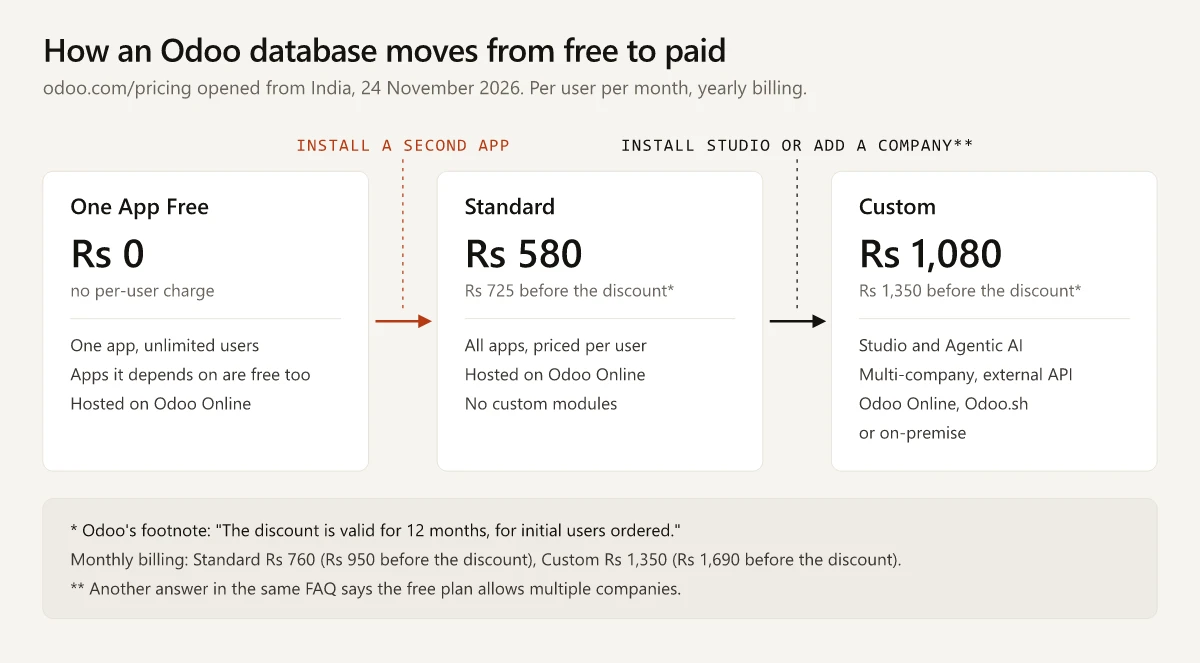
Odoo’s One App Free plan costs nothing for one app and any number of users, and it stops being your plan when you install a second app that the first one does not depend on. Odoo’s own FAQ describes that install as the upgrade to Standard, where every person with access to the backend is priced per user per month. So Odoo pricing starts with a head count: how many of your free users turn into paid ones on the day you add app number two.
My advice is to budget on the larger of the two numbers Odoo prints for each paid plan. On 24 November 2026 Odoo’s pricing page, served in rupees to my Indian connection, showed Standard at ₹580 a user a month with ₹725 beside it on a red stroke, and its footnote limits the lower figure to 12 months and to the users in your first order.
| Plan | Yearly billing, first 12 months | Yearly billing, full price | Monthly billing, first 12 months | Monthly billing, full price |
|---|---|---|---|---|
| One App Free | ₹0 | ₹0 | ₹0 | ₹0 |
| Standard | ₹580 | ₹725 | ₹760 | ₹950 |
| Custom | ₹1,080 | ₹1,350 | ₹1,350 | ₹1,690 |
All figures are per user per month. Source: Odoo’s pricing page, fetched from an Indian connection without signing in on 24 November 2026. “Full price” is my label for the figure Odoo shows before its first-year discount. Odoo writes the currency as “Rs”, before the large figure and after the smaller one; I write ₹ and use Indian digit grouping. Odoo can change any of these figures, so read the page on the day you buy.
Odoo Pricing in India: The Four Prices on Each Paid Card
Each paid card on the pricing page carries two figures on the Yearly view and two more on the Monthly view. I read the page source to see how they are set:
- The large figure, in the card’s colour, is 580 for Standard and 1,080 for Custom on the Yearly view. The Monthly view swaps in 760 and 1,350.
- Beside it sits a smaller figure with a red asterisk: “725 Rs” and “1,350 Rs” on Yearly, “950 Rs” and “1,690 Rs” on Monthly. The page’s style sheet places a red diagonal highlight image behind that figure.
- The asterisk leads to this footnote: ”(*) The discount is valid for 12 months, for initial users ordered.”
- The page opens on Yearly. A switch at the top changes every card to Monthly.
Odoo’s pricing configurator spells out how the two figures relate. Opened for one user on the Yearly view, its summary read:
| Line in the configurator | Standard plan | Custom plan |
|---|---|---|
| ”1 Users, All Apps” | 725.00 Rs | 1,350.00 Rs |
| ”First Year Initial Discount on regular users” | -145.00 Rs | -270.00 Rs |
| ”Total / month” | 580.00 Rs | 1,080.00 Rs |
| ”(*) Billed annually” | 6,960.00 Rs | 12,960.00 Rs |
So ₹725 is the full price and ₹580 is that price after a first-year discount of ₹145. The same form carries the monthly values in its fields: 950 less 190 for Standard, and 1,690 less 340 for Custom.
The configurator’s form also carries a detail worth raising in a negotiation:
- Multi-year fields that the page does not display. The form holds values for two-year to five-year terms: 710 for Standard and 1,350 for Custom, each with a discount equal to the one-year discount divided by the number of years (145 becomes 72.5 on two years, 48.33 on three). I saw only Yearly and Monthly switches on the page, so treat these as a question for an Odoo advisor, never as an offer.
The four figures are easy to mix up. A guide from the agency CodeCrafters, dated 9 November 2026, gives ₹725 as Standard’s monthly-billing price. On 24 November, Odoo’s Monthly view showed 760 with 950 beside it, and 725 belonged to the Yearly view. I cannot tell whether Odoo’s figures moved between those dates, so check the switch position before you copy a number into a budget.
A higher figure on a red stroke beside a lower one is a price anchor. In my guide to B2B SaaS pricing psychology I point out that the champion sees the anchor on the page while finance sees only the quote, so the quote is where both Odoo figures need to appear.
Is Odoo Free? What One App Free Covers
Yes, for one app: the One App Free card reads “One app, unlimited users” at Rs 0 on Odoo Online, and the pricing FAQ says “we guarantee that its usage is free for unlimited users, forever, whatever the dependencies of the app”. The rules that decide when free ends are spread across three answers in the pricing page’s FAQ.
| What you do | What Odoo’s FAQ says happens |
|---|---|
| Pick one app that needs other apps | ”If you choose an app that depends on other apps (e.g., eCommerce depends on Website and Invoicing), you get these required apps for free too.” |
| Install another app you need | ”To upgrade from the One App Free plan to the Standard plan, just install the additional applications you need.” |
| Install Studio or add companies | ”If you install Studio or add companies to your database, you will automatically switch to the Custom plan.” |
| Choose Studio as your one app, or run several companies | ”Yes, the free plan allows multiple companies. You can also choose Odoo Studio as the app for a free plan.” |
The last two rows disagree. One answer says adding companies switches you to Custom; another says the free plan allows multiple companies. Odoo’s page does not reconcile them, so if a second company is the reason you are looking at Odoo, ask an advisor which answer applies before you create it.
A Second App on the Free Plan: The Bill for 12 Users
The free plan has no user limit, so a team can grow large on it. Take 12 people using a free CRM who install Inventory. By the FAQ’s upgrade rule they are now on Standard, and Standard is priced per user:
- First 12 months, yearly billing: 12 x ₹580 = ₹6,960 a month, or ₹83,520 for the year.
- At the full price: 12 x ₹725 = ₹8,700 a month, or ₹1,04,400 a year.
Those totals are my arithmetic on Odoo’s published prices. The page does not say when billing starts after the install, and its paid cards carry a FREE TRIAL button, so ask how the switch is billed before you install the second app. This mix of a free tier and a per-user paid tier is the freemium and per-seat pairing in my breakdown of SaaS pricing models.
Is Odoo Free if You Self-Host?
Odoo has two editions, and its editions page calls them “Odoo Community (open-source) and Odoo Enterprise (licensed)”. Odoo’s licences page puts the Community Edition under LGPL version 3. On the editions page, the Enterprise column’s View Pricing button leads to the pricing page, and the Community column offers a download instead.
The editions table marks what Community goes without:
- Unlimited functional support, version upgrades and hosting.
- The mobile apps for Android and iOS.
- Accounting (Invoicing is in Community; the Accounting app is Enterprise only), Payroll, Documents and Sign.
- Subscriptions, Rental, Helpdesk, Planning, Appointments, Marketing Automation, Social Marketing and Studio.
A self-hosted Community install is open-source software without Odoo’s support, upgrades or hosting, and your own server and upgrade work become the cost.
Odoo Standard vs Custom: What Moves You Up
Custom is the plan “for companies that want to manage multiple companies on a single database and that need to customize Odoo through Odoo Studio, agentic AI, custom developments or through the API”, in the words of the pricing FAQ.
| Need | Standard | Custom |
|---|---|---|
| Apps | All apps | All apps |
| Hosting | Odoo Online | Odoo Online, Odoo.sh or on-premise |
| Custom modules | No: Odoo Online hosts “databases without custom modules” | On Odoo.sh, which lets you “develop or use custom modules” |
| Odoo Studio and Agentic AI | Not listed | Listed |
| Multi-company | Not listed | Listed |
| External API | Not listed | Listed |
| Full price, yearly billing | ₹725 a user a month | ₹1,350 a user a month |
The external API row has a narrow meaning. Odoo’s FAQ defines it as outside software “that initiates calls to the Odoo API (JSON-RPC or XML-RPC)”. Calls that start inside Odoo, such as payment providers, delivery carriers, VoIP providers and bank synchronisation, are “part of the standard plan”.
A plan switch in the middle of a term is priced by the contract. Section 5.1 of the Odoo Enterprise Subscription Agreement (Version 13, dated 2026-09-24) says that when a customer “uses features that require another Subscription Plan”, the customer pays “an extra fee equivalent to the applicable list price” for the required plan “for the remainder of the Term”. I read the agreement’s list price as the figure I call the full price here. Decide on Studio, a second company and outside integrations before you sign for Standard.
Odoo Cost per User: Year One Against the Full Price
Odoo prices per user, so the bill moves with head count. These rows use yearly billing and the 24 November 2026 figures, before tax.
| Team | Plan | 12 months at the first-year price | 12 months at the full price | Difference |
|---|---|---|---|---|
| 5 users | Standard | ₹34,800 | ₹43,500 | ₹8,700 |
| 10 users | Standard | ₹69,600 | ₹87,000 | ₹17,400 |
| 25 users | Standard | ₹1,74,000 | ₹2,17,500 | ₹43,500 |
| 5 users | Custom | ₹64,800 | ₹81,000 | ₹16,200 |
| 10 users | Custom | ₹1,29,600 | ₹1,62,000 | ₹32,400 |
| 25 users | Custom | ₹3,24,000 | ₹4,05,000 | ₹81,000 |
My arithmetic: users x monthly price x 12. The full-price column is what a year would cost at Odoo’s full prices of ₹725 and ₹1,350. Whether year two reaches that figure is the open question below.
Odoo’s pages do not print a second-year price. The word “renew” appears nowhere on the pricing page, the configurator or the Success Packs page. Two statements bear on it:
- The footnote says the discount “is valid for 12 months, for initial users ordered”.
- Section 5.2 of the agreement says that on renewal, if the charges of the previous term “are lower than the most current applicable list price, these charges will increase by up to 7% per year of the previous Term”.
Neither page works an example for a customer whose first year was discounted. I would put the full-price column in the year-two budget and ask Odoo to state the renewal rate in the quote.
Other clauses in the same agreement also change what a year costs:
| Clause | What it says | What to do about it |
|---|---|---|
| 1, Term | The agreement “is automatically renewed for an equal Term” unless either party gives written notice at least 30 days before the end | Put the notice date in a calendar when you sign |
| 5.1, extra users | More users during the term are charged “the applicable list price” for “the remainder of the Term” | Order the head count you are sure of; later seats are not “initial users” |
| 5.1, old versions | A database older than the three most recent major versions pays “an extra fee equal to 25% of the annualized price”, once per year | Keep the database within the three most recent major versions (Odoo releases one a year) |
A worked case for the middle row: a 10-user Standard team that adds two users with six months left would pay 2 x ₹725 x 6 = ₹8,700 for those seats, by my arithmetic, if the list price is still ₹725 that day.
Monthly or Yearly Billing
| Plan | 12 months on yearly billing (first year / full price) | 12 months on monthly billing (first year / full price) | Yearly bill equals |
|---|---|---|---|
| Standard, per user | ₹6,960 / ₹8,700 | ₹9,120 / ₹11,400 | 9.2 monthly payments |
| Custom, per user | ₹12,960 / ₹16,200 | ₹16,200 / ₹20,280 | 9.6 monthly payments |
My arithmetic from the grid at the top. If you expect to keep Odoo for ten months or longer, yearly billing costs less per user on both plans. Monthly billing has one hosting limit as well: the Custom card lists On-premise on the Yearly view only, and the configurator carries the message “The monthly plan is only available to cloud hosting options (Standard or Odoo.sh)”.
Users Odoo Counts as Paying, and the ₹195 Light User
Odoo’s pricing FAQ defines a paying user as “someone who has access to the Odoo backend to create, view, or edit documents or an employee (record in hr application) who has no linked user”.
| Counts as a paying user | Free |
|---|---|
| An employee who reports expenses or a timesheet | Customers and suppliers who see their invoices on the portal |
| A third-party accountant working on your finances in Odoo | Website visitors placing eCommerce orders and tracking deliveries |
| An employee record with no user account |
The third row matters if you run HR in Odoo. If you load 200 employee records into the Employees app for payslips, those records count even though nobody logs in.
For that case the page carries a banner under the cards: “Light User at 195 Rs”. The banner prints no unit; the configurator’s form stores 195 as both its monthly and its yearly Light User value, with no first-year discount field. The FAQ lists what a light user can do:
- As a user: time off, expenses, appraisals, attendances, referrals, planning, field services, the inventory barcode operator role and read-only access to Knowledge.
- As an employee: get payslips, use the Point of Sale and use the Manufacturing shop floor.
You cannot buy it from the page. Odoo’s answer is to “schedule a meeting with an Odoo Advisor”, who “will review your requirements and provide a customized quote”.
Costs Outside the Subscription: Odoo.sh, Success Packs and Credits
The pricing page says “All our plans include unlimited support, hosting and maintenance”, with support “by email, from Monday to Friday, 24/5, in English, French, Spanish or Dutch”. It then lists what the plans leave out: Odoo.sh hosting for custom developments, implementation services, In-App-Purchase credits (SMS, contacts auto-complete, lead generation, AI scanning of vendor bills and expenses) and maintenance of custom code.
Odoo.sh Pricing in India
Odoo.sh’s own pricing page showed only dollar and euro switches when I fetched it, and says “The hosting price does not include the enterprise licence”. The rupee amounts sit in the Custom plan’s configurator on odoo.com, under the Odoo.sh hosting option:
| Odoo.sh item | Monthly view | Yearly view | Range |
|---|---|---|---|
| Worker | 6,200.00 Rs a month | 4,960.00 Rs a month | 1 to 16 |
| Storage, per GB | 20.00 Rs a month | 16.00 Rs a month | 1 to 512 GB |
| Staging environment | 1,550.00 Rs a month | 1,240.00 Rs a month | 0 to 20 |
The configurator’s hints suggest “1 additional worker per 25 back-end users” and “1 GB per user” to start. On those hints, a 10-user Custom team with one worker, 10 GB and one staging environment would pay 4,960 + 160 + 1,240 = ₹6,360 a month for hosting on the Yearly view. Add 10 x ₹1,080 for the licences and the first-year total is ₹17,160 a month; at the full price it is ₹19,860. That is my arithmetic from the configurator’s figures, before tax.
Hosting on Odoo Online is included in every plan. Odoo’s acceptable use policy says accounts above 100 GB of storage “may be reviewed”, and that customers may be asked to move to Odoo.sh or reduce their usage.
Success Pack Prices in Rupees
Implementation is a separate purchase. The FAQ says small companies with fewer than 50 employees “usually work directly with Odoo, using Success Packs”, while larger ones usually work with a partner. Odoo’s Success Packs page listed these prices on 24 November 2026:
| Pack | Consultant hours | Returning customers | New customers | Per hour, returning price |
|---|---|---|---|---|
| Starter | 4 | ₹18,580 | ₹15,793 | ₹4,645 |
| Basic | 25 | ₹95,570 | ₹81,234.50 | ₹3,823 |
| Standard | 50 | ₹1,86,153 | ₹1,58,230.05 | ₹3,723 |
| Custom | 100 | ₹3,32,416 | ₹2,82,553.60 | ₹3,324 |
| Pro | 200 | ₹6,64,831 | ₹5,65,106.35 | ₹3,324 |
The per-hour column is my arithmetic, rounded to the rupee. What the page says about the packs:
- The new-customer column is 15% off, and the footnote limits it: “A 15% discount applies automatically to new customers, for their first pack only.”
- Starter is recommended for simple apps and 1 to 5 users. It covers email and phone support, training, coaching and configuration, with no project management or data import help.
- Development work, onsite consulting and performance issues start at the 50-hour Standard pack, and travel time is billed.
- The configurator adds a deadline: “these hours expire after one year”.
The Odoo pages I read list no partner rates, and the rupee ranges on partner blogs are those partners’ own numbers. If a partner quotes you, set its hourly rate against the per-hour column above.
Does Odoo Pricing Include GST?
None of the three Odoo pages I read says. The pricing page, the configurator and the Success Packs page print no GST, VAT or tax wording beside their rupee figures. The contract does: section 5.3 of the Enterprise Subscription Agreement says “All fees and charges are exclusive of all applicable federal, provincial, state, local or other governmental taxes, fees or charges”, and makes the customer responsible for them.
The agreement names no rate and does not mention GST or India. Treat every figure in this post as a pre-tax figure, and get the tax line from a quote. The configurator has a “Send / Print the quote” button next to Buy Now; I did not submit it, sign in, start a trial or reach a checkout.
Odoo’s Pricing Configurator: What It Adds to the Page
The configurator is Odoo’s own calculator, and each paid card’s BUY NOW button opens it for that plan (the Standard version is here). It asks for:
- The number of regular users.
- On the Custom plan only, the hosting type (see the Odoo.sh table above).
- The implementation route: self service, a Success Pack (which the form recommends below 50 users) or a local partner (recommended above 50).
- Under the partner route, whether to include “the maintenance on extra lines of code”.
Ask for the quote in that form, with the “First Year Initial Discount” line shown, as in the table above.
Which Odoo Plan Fits Your Team
| You are | Plan | Why, from Odoo’s pages |
|---|---|---|
| A small business that needs one app, such as CRM or Invoicing | One App Free | ₹0 for one app and unlimited users, with the apps it depends on |
| A single company that needs several apps as they are | Standard | All apps on Odoo Online; budget ₹725 a user a month on yearly billing |
| A group with more than one company in one database | Custom, after asking about the FAQ’s two answers | Multi-company is listed on the Custom card |
| A team that needs Studio, custom modules or outside software calling Odoo’s API | Custom | Studio, external API, Odoo.sh or on-premise; budget ₹1,350 a user a month |
| An employer with shop-floor, payslip-only or point-of-sale staff | Ask for Light User pricing | ”Light User at 195 Rs”, quoted through an advisor |
| A team with developers and no need for Odoo support | Community, self-hosted | Open source under LGPL version 3, without the Enterprise-only apps |
For a single-vendor suite, compare Zoho One’s two licensing plans; for one app, compare Odoo’s free plan with Zoho Books’ rupee plans, Zoho CRM’s editions in rupees or Salesforce’s dollar-only price list for India. If you would rather pay for accounting software once, TallyPrime sells a lifetime licence with a yearly TSS renewal from year two, as the Tally Prime price post sets out.
Odoo Pricing in India: Budget on the Full Price
Odoo has one free plan and two paid ones, and each paid plan shows a first-year price and a full price on both billing views. Use One App Free for as long as one app is enough, and count your backend users and employee records before you install a second. When you do buy, plan the first year at ₹580 or ₹1,080 a user a month and every year after it at ₹725 or ₹1,350, until Odoo tells you otherwise in writing.
Start with the configurator and keep the quote that shows the discount line.
Frequently Asked Questions
How much does Odoo cost in India?
On 24 November 2026 Odoo's pricing page, opened from India, showed Standard at ₹580 per user per month on yearly billing with ₹725 beside it, and Custom at ₹1,080 with ₹1,350 beside it. On monthly billing the pairs were ₹760 and ₹950 for Standard, and ₹1,350 and ₹1,690 for Custom. The page's footnote says the discount is valid for 12 months, for initial users ordered.
Is Odoo free forever?
One app is. Odoo's One App Free plan costs ₹0 for one app and unlimited users on Odoo Online, and Odoo's FAQ guarantees that usage is free for unlimited users, forever, including the apps that one app depends on. Installing an additional app moves the database to the paid Standard plan.
What is the difference between Odoo Standard and Custom?
Standard gives all apps on Odoo Online without custom modules. Custom adds Odoo Studio, Agentic AI, multi-company, the external API and a choice of Odoo Online, Odoo.sh or on-premise hosting, and Odoo's FAQ says installing Studio or adding companies switches a database to Custom automatically. Another answer on the same page says the free plan allows multiple companies, so confirm with Odoo before adding one.
Does Odoo pricing include GST?
Odoo's pricing page, Success Packs page and configurator showed no GST or tax line beside their prices when I read them on 24 November 2026. The Odoo Enterprise Subscription Agreement says all fees and charges are exclusive of applicable taxes, so ask Odoo for a quote that shows the tax line.
How much does Odoo implementation cost in India?
Odoo's own Success Packs were listed in rupees on 24 November 2026: ₹18,580 for 4 hours, ₹95,570 for 25 hours, ₹1,86,153 for 50 hours, ₹3,32,416 for 100 hours and ₹6,64,831 for 200 hours, with 15% off a new customer's first pack. Partner quotes are separate and Odoo does not publish them.