7 B2B SaaS Pricing Models With Examples (2026)
The 7 B2B SaaS pricing models with real examples, plus the value-metric question a PMM uses to pick the right one and the traps that quietly cap expansion.

| Model | You bill by | Best fit |
|---|---|---|
| Flat-rate | One price, everything included | Simple products, early stage |
| Tiered | Feature bundle per plan | Multiple segments, self-serve |
| Per-seat | Number of users | Collaboration tools |
| Usage-based | Units consumed | Infrastructure, APIs, AI |
| Freemium | Free-to-paid conversion | Bottom-up, viral adoption |
| Per-active-user | Users who actually log in | High-seat, low-activation risk |
| Hybrid | Base plan plus usage | Most maturing SaaS companies |
Most guides to B2B SaaS pricing models hand you this list and stop. The list is the easy part. The decision that actually moves revenue is which one fits your product, and that decision comes down to a single question almost no listicle asks: what grows as the customer gets more value? Answer that, and the model picks itself. Get it wrong, and you either cap your own expansion revenue or scare procurement out of the deal. This is the PMM view of the seven models, each grounded in a named public example, plus the value-metric test that chooses between them and the two traps that catch teams most often.
What Are the B2B SaaS Pricing Models?
The B2B SaaS pricing models are the structures a company uses to charge for software: flat-rate, tiered, per-seat, usage-based, freemium, per-active-user, and hybrid. Each one bills against a different thing, and that “thing” is the whole game.
Here is how they compare on the two questions that matter most - what you bill against, and where each one quietly breaks.
| Model | Bills against | Watch out for |
|---|---|---|
| Flat-rate | Nothing - one fixed price | Leaves expansion revenue on the table |
| Tiered | The plan a customer picks | Tier sprawl and analysis paralysis |
| Per-seat | Headcount using the product | Caps growth once seats saturate |
| Usage-based | Consumption (calls, compute, tokens) | Unpredictable bills spook procurement |
| Freemium | Conversion of free users to paid | Giving the differentiator away for free |
| Per-active-user | Only users who log in | Needs strong activation to earn revenue |
| Hybrid | A base fee plus a usage or seat lever | Complexity buyers struggle to forecast |
Usage-based pricing is no longer the exotic option. In a January 2025 survey of 100 SaaS companies, Metronome found 85% had already adopted usage-based pricing. The pure subscription is giving way to hybrids that pair a predictable base with consumption upside.
The Value-Metric Question That Picks Your Model
Before the models, the test. A value metric is the unit you charge by, and the right one is whatever grows as the customer gets more value out of the product. This is the single decision that determines whether a pricing model expands with your accounts or fights them.
Run your product through this:
- Value grows with people collaborating - price per seat (Slack, Zoom, Figma)
- Value grows with volume processed - price by usage (AWS, Twilio, Stripe)
- Value grows with a specific object - price by that object (HubSpot per contact, Salesforce per record limit)
- Value is roughly constant per account - flat-rate or tiers (Basecamp)
- Value is unclear and adoption is bottom-up - freemium to learn, then layer a metric on
If seats go up but the value the customer gets does not, per-seat pricing will cap your expansion revenue at headcount. If usage goes up unpredictably, usage pricing will hand procurement a bill they cannot forecast. The value metric is where a pricing model is won or lost, which is why it sits upstream of every other pricing decision a product marketer makes.
Picking the metric also decides whether expansion is possible at all. A land and expand motion needs an entry package that deliberately leaves something out, and a usage signal you instrumented before the first contract, not after. Once the model is chosen, the Van Westendorp price sensitivity meter is the cheapest way to put a defensible number on the level.
The 7 B2B SaaS Pricing Models, With Examples
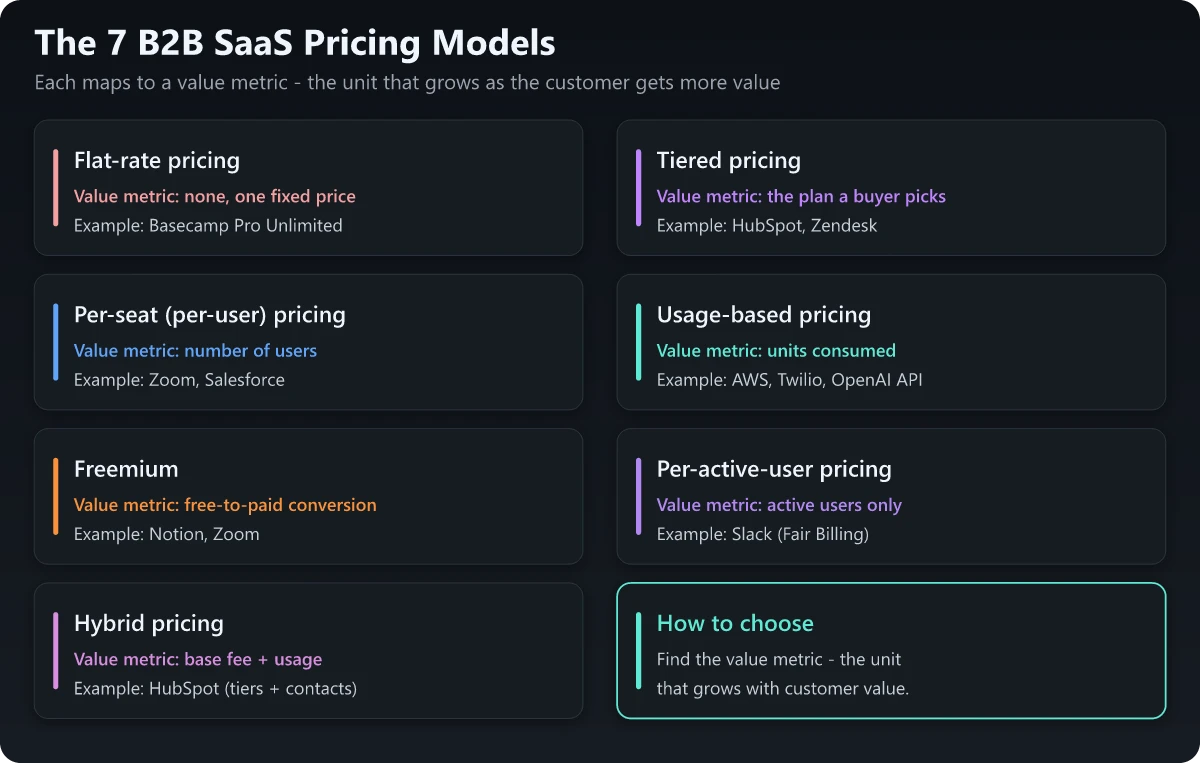
1. Flat-Rate Pricing
One price, every feature, no add-ons. The simplest model to buy and to explain.
- Value metric: none - price is constant per account
- Example: Basecamp’s Pro Unlimited plan is $299 a month for unlimited users, flat, regardless of team size
- Use it when: the product is simple, the segment is homogeneous, or you are early and want zero pricing friction
- The cost: it leaves money on the table the moment your customers start deriving very different amounts of value from the same product
Flat-rate is underrated for a first commercial release and almost always wrong once you have real segments.
2. Tiered Pricing
Three or four plans at rising price points, each built for a segment. The most common model in B2B SaaS, and the default for a reason.
- Value metric: the plan itself, which bundles features, limits, and support
- Example: HubSpot, Zendesk, and most self-serve SaaS run Starter / Professional / Enterprise ladders. That convergence is measurable: across 41 live SaaS pricing ladders, 35 use the word Enterprise somewhere
- Use it when: distinct segments derive value from distinct feature sets
- The rule: three tiers is the sweet spot. Two gives you nothing to anchor against; four or more creates paralysis. The middle tier should be the one you want most buyers to choose
The three-tier version carries enough design rules of its own, from feature allocation to price-gap ratios to target revenue mix, to be worth building Good, Better and Best deliberately rather than by feel.
3. Per-Seat (Per-User) Pricing
Charge by the number of users. Add a teammate, add a seat. Clean to forecast, easy to sell, and the model buyers understand fastest.
- Value metric: number of users
- Example: Zoom and Salesforce bill per user; it maps neatly to tools where each added person gets real value
- Use it when: value scales with the number of people in the product and seat expansion is a natural growth path
- The trap: covered below - per-seat pricing can quietly cap your expansion once a team is fully seated
4. Usage-Based (Consumption) Pricing
Customers pay for what they consume. The bill tracks value almost perfectly, which is why it dominates infrastructure and AI.
- Value metric: units consumed - API calls, compute hours, tokens, gigabytes
- Example: AWS bills for compute and storage, Twilio per message, the OpenAI API per token
- Use it when: consumption is a genuine proxy for value and customers accept a variable bill
- The trap: unpredictable spend is a procurement red flag - address it with caps, commitments, or budget alerts
5. Freemium
A permanently free tier that seeds adoption, with paid plans above it. A distribution strategy as much as a pricing model, and the engine behind most bottom-up growth. It is worth reading how the best-run companies structure it in these product-led growth examples.
- Value metric: conversion of free users into paying ones
- Example: Notion and Zoom both run free tiers that seed teams before an admin consolidates onto a paid plan
- Use it when: the product has viral or bottom-up adoption and a free user creates real pipeline
- The trap: if your differentiator sits in the free tier, you can never charge for it - free should solve a smaller problem, not the core one
6. Per-Active-User Pricing
A refinement of per-seat: only bill for users who actually log in. It removes the biggest buyer objection to seat-based pricing, which is paying for licenses nobody uses.
- Value metric: active users, not provisioned seats
- Example: Slack’s Fair Billing Policy charges only for active members and credits accounts for anyone inactive for 28 days
- Use it when: you sell into large teams where seat activation is a real risk, and you want to signal confidence
- The payoff: it lowers perceived buyer risk, which lifts win rates on large, uncertain rollouts
7. Hybrid Pricing
A base plan plus a usage or seat lever on top. Predictable revenue for you, aligned cost for the customer, upside as they grow. This is where most maturing SaaS companies actually land.
- Value metric: a base fee plus a consumption or seat component
- Example: HubSpot pairs tiered plans with per-contact scaling; many infrastructure vendors pair a platform fee with usage
- Use it when: one metric alone cannot capture value across your customer base - which is most of the time
- The cost: complexity. A buyer who cannot forecast next quarter’s bill will hesitate, so pair the model with a calculator or budget cap
Enterprise SaaS Pricing Models
Enterprise pricing is where the public price list stops. Above the top self-serve tier, enterprise SaaS pricing models are almost always custom and quote-based, and they combine several of the models above:
- Negotiated tiers built per account rather than published
- Committed usage - the customer commits to a minimum spend in exchange for a lower unit rate
- Platform fee plus usage - a floor for predictable revenue, a meter for upside
- Annual contracts with seat and usage bands rather than pay-as-you-go
The reason is buyer behavior. Enterprise procurement wants a fixed, budgetable number, while the vendor wants to capture the value of a large deployment. A pure metered model unsettles the buyer; a pure flat fee leaves the vendor short. The negotiated hybrid is the compromise, and it is why “contact sales” replaces a price on the enterprise tier. How you frame that transition ties directly into your go-to-market strategy for SaaS and the segment you are actually built to serve.
The Two Traps That Catch PMM Teams
Two failure modes show up more than any others when a model is chosen without running the value-metric test.
Trap 1 - Per-seat pricing caps your expansion. Per-seat is easy to sell because buyers get it instantly. The problem shows up later: once a team is fully seated, your revenue from that account flatlines even as they extract more and more value. If usage per seat is climbing but your revenue is not, you picked a value metric that does not track value. The fix is usually a hybrid - keep the per-seat base, add a usage or outcome lever that grows with the account.
Trap 2 - Usage pricing spooks procurement. Usage-based pricing aligns cost to value beautifully, right up until a buyer realizes they cannot predict the invoice. In enterprise deals especially, an unforecastable bill is a deal-killer that has nothing to do with the total amount. The fix is not to abandon usage pricing - it is to wrap it in guardrails: spend caps, committed-use discounts, budget alerts, and a clear calculator in the sales enablement materials so the champion can defend the number internally.
Both traps come from the same root cause: choosing a model by copying a competitor instead of by measuring your own value metric.
A SaaS Pricing Model Template You Can Reuse
Turn the framework into a repeatable check. This is the short SaaS pricing model template I run any product through before committing to a model:
- Name the value metric. What single unit grows as the customer gets more value? Seats, calls, contacts, gigabytes, outcomes. If you cannot name one, default to tiers.
- Match the model. Map the metric to the model it implies from the seven above. A collaboration metric implies per-seat; a consumption metric implies usage; no metric implies flat-rate or tiers.
- Stress-test expansion. Ask: when this customer doubles their value from us, does our revenue move? If not, add a hybrid lever.
- Stress-test procurement. Ask: can the buyer forecast next quarter’s bill? If not, add caps or commitments.
- Pick three tiers. Even a usage model needs packaging - a good/better/best structure with the middle tier as the target.
- Publish or gate deliberately. Self-serve and SMB segments convert better with transparent pricing; enterprise motions often need discovery. Decide by segment mix, not by fear.
Run every candidate model through those six checks and the right B2B SaaS pricing model usually falls out on its own.
Conclusion
The seven B2B SaaS pricing models are not a menu you pick from by taste. Flat-rate, tiered, per-seat, usage-based, freemium, per-active-user, and hybrid each bill against a different value metric, and the model that fits is the one whose metric grows exactly when your customer’s value does.
Start there, not with the competitor’s price list. Name your value metric, match it to a model, then stress-test it against the two traps - per-seat capping expansion and usage pricing spooking procurement. A model chosen that way expands with your accounts instead of fighting them, which is the entire point of getting B2B SaaS pricing models right. From there, the wider pricing strategy playbook covers packaging, testing, and the operating cadence that keeps price aligned with value over time.
Frequently Asked Questions
What are the main B2B SaaS pricing models?
The seven models most B2B SaaS companies use are flat-rate, tiered, per-seat (per-user), usage-based, freemium, per-active-user, and hybrid. Tiered and hybrid dominate in practice because pure single-model pricing rarely fits how a real product delivers value across segments.
What is the most common SaaS pricing model?
Tiered pricing is the most common in B2B SaaS - three plans at rising price points, each aimed at a segment. Most mature companies then layer a usage or per-seat component on top, which makes the true dominant pattern a hybrid rather than any single pure model.
What is an example of usage-based SaaS pricing?
AWS bills for compute hours, storage, and data transferred; Twilio charges per message or call; the OpenAI API charges per token. In each case the bill scales with what the customer actually consumes, so cost tracks value almost exactly.
How do you choose a B2B SaaS pricing model?
Ask one question: what grows as the customer gets more value from the product? If it is seats, price per seat; if it is API calls or compute, price by usage; if it is nothing measurable, use flat-rate or tiers. That metric, called the value metric, is what picks the model.
What pricing model do enterprise SaaS companies use?
Enterprise SaaS almost always runs on custom, negotiated tiers - a quote-based hybrid of platform fee, seat count, and usage commitments, often with an annual minimum. Published self-serve pricing usually stops below the enterprise tier, where a sales-assisted motion takes over.